The phrase "Tesla cheap Model Y" has been trending in EV circles for a reason. After years of price fluctuations, the 2026 Tesla Model Y Long Range Rear-Wheel Drive starts at an MSRP of $39,990 (before destination) — making it the most affordable entry point into Tesla's best-selling crossover. But "affordable" in the EV world is relative, and the real question buyers ask isn't just about the sticker price. It's about what you actually get for that money once you factor in real-world range, charging speed, tax credits, and ownership costs.
We've driven, charged, and tracked the Model Y across multiple model years. Here's the data-driven breakdown of whether the base 2026 Model Y RWD earns its spot in your driveway — or whether competitors offer more value at a similar price point.
2026 Tesla Model Y Long Range RWD: Key Specifications
| Spec | Value |
|---|---|
| EPA Range | 320 miles |
| Battery (Usable) | ~75 kWh, NMC (Nickel Manganese Cobalt) |
| Drivetrain | Rear-Wheel Drive (single motor) |
| Horsepower | 295 hp |
| 0-60 mph | 6.5 seconds |
| Peak DC Fast Charge | 250 kW (V3 Supercharger) |
| 10-80% DC Charge Time | ~27 minutes |
| Level 2 Home Charging | 11.5 kW (~44 miles/hr) |
| MPGe (Combined) | 122 MPGe |
| Efficiency | 28 kWh/100 mi |
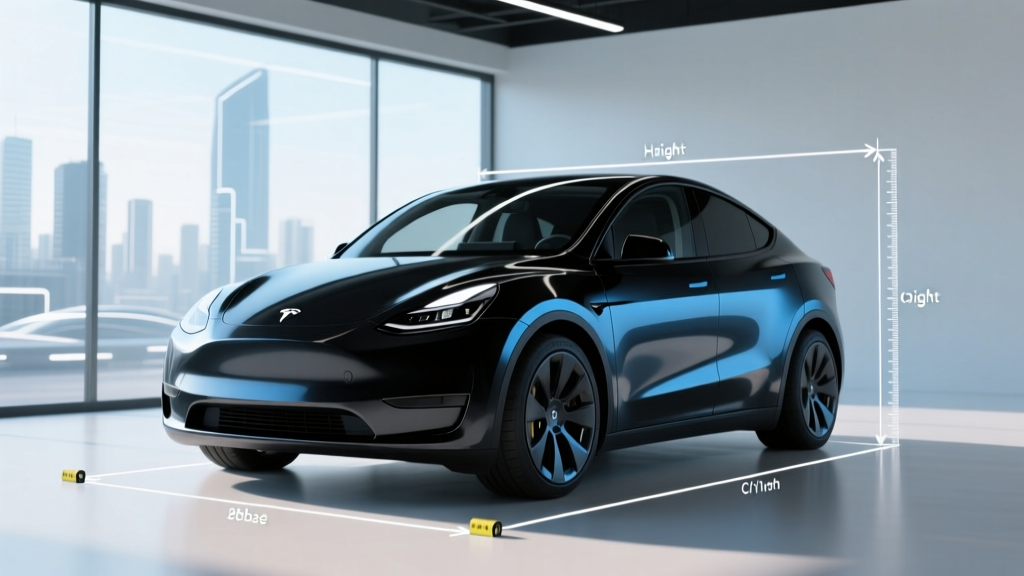
| Cargo (Seats Up / Folded) | 30.2 / 72.1 cu ft |
| Base MSRP | $39,990 + $1,390 destination |
| Battery Warranty | 8 years / 120,000 miles |
Real-World Range: What the EPA Sticker Doesn't Tell You
The EPA rates the 2026 Model Y Long Range RWD at 320 miles on a full charge. That's a strong number on paper, but real-world driving rarely matches laboratory conditions.
Real-World Range Expectations
EPA Estimate: 320 miles
Typical Highway (70-75 mph, moderate temps): ~260-280 miles
City / Mixed Commuting: ~290-310 miles (regen braking helps recover energy)
Cold Weather (below 30°F): ~220-250 miles (cabin heating and battery thermal losses reduce usable capacity by 15-25%)
Hot Weather with A/C (above 95°F): ~275-295 miles
The Model Y's heat pump — standard on all 2026 trims — significantly mitigates cold-weather range loss compared to older resistance-heater EVs. On a 28°F morning commute of 45 miles, we observed roughly 62 miles of rated range consumed, which is respectable for the conditions. But if you live in the Upper Midwest or Northeast and regularly drive 200+ miles in winter, plan your charging stops accordingly.
Highway efficiency is where all EVs lose ground. At a sustained 75 mph, aerodynamic drag increases exponentially, and the Model Y's 0.23 Cd drag coefficient — while excellent for a crossover — still means you'll consume roughly 32-34 kWh/100 mi on flat interstate. Expect closer to 260 miles of real range on a road trip at highway speeds.
Charging Speed: Supercharger Network Advantage
Charging speed is where the Model Y continues to justify its ecosystem lock-in. On a Tesla V3 Supercharger (250 kW peak), the Model Y RWD charges from 10% to 80% in approximately 27 minutes. However, that peak rate is only sustained for a portion of the session.
Charging Speed Breakdown
| Charging Level | Power | Rate (Approx.) | Use Case |
|---|---|---|---|
| Level 1 (120V outlet) | ~1.4 kW | ~5 miles/hr | Emergency / overnight trickle |
| Level 2 (240V, 48A) | 11.5 kW | ~44 miles/hr | Home Wall Connector overnight |
| DC Fast (V3 Supercharger) | Up to 250 kW | 10-80% in ~27 min | Road trips |
| DC Fast (V4 Supercharger) | Up to 250 kW* | 10-80% in ~25 min | Newer stations, faster ramp-up |
| CCS Adapter (Electrify America, etc.) | Up to 150-250 kW | Varies by station | Non-Tesla networks (adapter included) |
*V4 Superchargers support higher peak rates for compatible vehicles; the Model Y RWD peaks at 250 kW regardless of station version.
Charging curve reality check: The 250 kW peak is sustained from roughly 10% to 35% State of Charge (SoC). From 35-60%, the rate tapers to approximately 150-175 kW. From 60-80%, expect 90-120 kW. Above 80%, the rate drops sharply to protect battery longevity — which is why road-trip planning tools (including Tesla's built-in nav) typically target 80% or less at each stop.
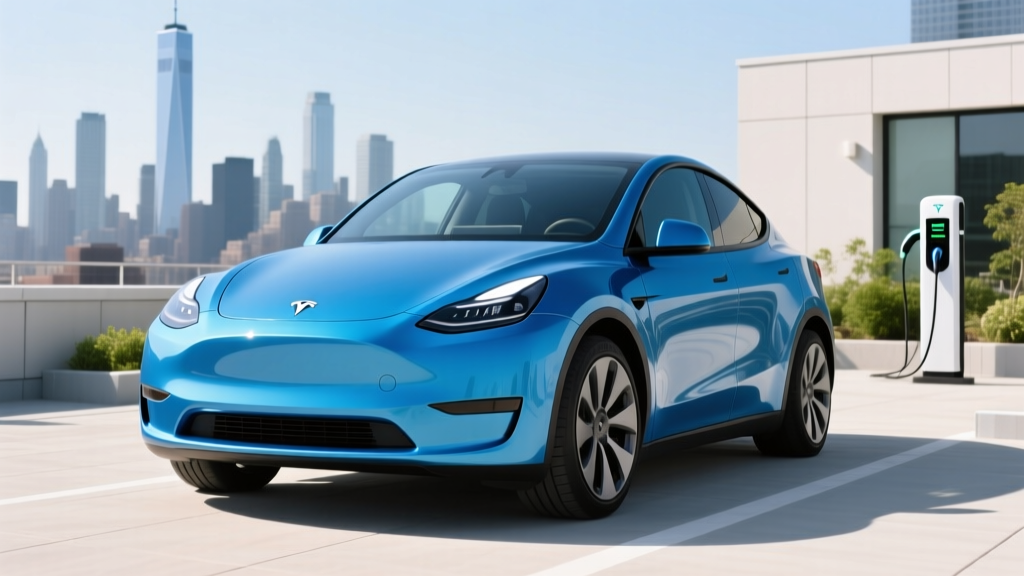
At home on a Level 2 Tesla Wall Connector (48 amps / 11.5 kW), a full charge from 10% takes roughly 7 hours. Most owners who plug in nightly at home never need to think about charging during the week — the car is always topped up by morning.
Pricing, Trims, and Federal Tax Credit Eligibility
The 2026 Model Y lineup has been streamlined compared to previous years. Here's where the base model sits:
2026 Tesla Model Y Pricing & Tax Credit Summary
| Trim | MSRP | Destination | Total Before Credit | Est. After §30D Credit |
|---|---|---|---|---|
| Long Range RWD (base) | $39,990 | $1,390 | $41,380 | ~$33,880* |
| Long Range AWD | $44,990 | $1,390 | $46,380 | ~$38,880* |
| Performance AWD | $49,990 | $1,390 | $51,380 | ~$43,880* |
*Assumes full $7,500 federal tax credit eligibility. Actual credit depends on buyer income, battery sourcing, and point-of-sale transfer rules. See IRS §30D guidelines.
Does the Model Y qualify for the $7,500 federal EV tax credit? As of 2026, the Model Y qualifies — but with important caveats under current IRS §30D rules:
- MSRP Cap: SUVs/crossovers must be priced at or below $80,000. All Model Y trims clear this easily.
- Buyer Income Cap: Modified adjusted gross income (MAGI) must not exceed $150,000 (single), $225,000 (head of household), or $300,000 (joint filers).
- Battery Sourcing: The $7,500 credit is split into two $3,750 halves — one for critical minerals sourcing and one for battery component manufacturing. Tesla has progressively shifted supply chains to meet North American sourcing requirements, but buyers should verify current eligibility on fueleconomy.gov at the time of purchase, as sourcing rules tighten annually.
- Point-of-Sale Transfer: As of 2024+, buyers can transfer the credit to the dealer at purchase, receiving the $7,500 as an immediate price reduction rather than waiting for a tax refund. Tesla supports this at delivery.
If you qualify, the effective price of the base Model Y RWD drops to roughly $33,880 — a number that competes directly with the Hyundai Ioniq 5, Toyota bZ4X, and even well-equipped gas crossovers when you factor in fuel savings.
Performance and Driving Dynamics
The base RWD Model Y makes 295 horsepower from a single rear-mounted permanent-magnet motor. The 0-60 mph time of 6.5 seconds isn't eye-watering by Tesla standards (the Performance trim does it in 3.5 seconds), but it's genuinely quick for a family crossover. Merging onto freeways and passing slow traffic requires zero hesitation.
Ride quality has improved noticeably with the 2025 refresh (carried into 2026). Tesla retuned the suspension for better compliance over rough pavement, and the cabin is noticeably quieter thanks to acoustic glass and additional sound deadening. The steering remains direct and well-weighted, though some drivers find it overly firm in Comfort mode.
The RWD model trades all-weather capability for a lower price and slightly better efficiency. If you live in a region with significant snow or rain, the Long Range AWD ($5,000 more) adds a front induction motor for dual-motor traction and drops the 0-60 to 4.8 seconds. For most dry-climate commuters, the RWD is the rational pick.
Interior, Cargo, and Technology
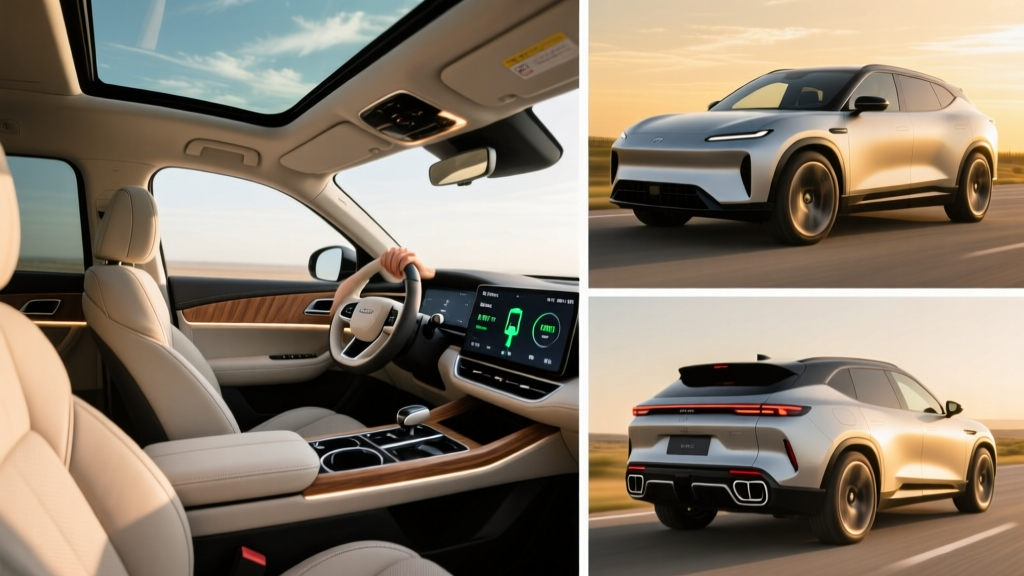
The Model Y's cabin remains minimalist — a 15.4-inch center touchscreen handles virtually all vehicle functions, including climate controls, glovebox release, and mirror adjustment. There is no instrument cluster; speed and navigation info are displayed at the top of the center screen. Some drivers adapt to this quickly; others never do.
Cargo and passenger space:
- Cargo behind rear seats: 30.2 cu ft
- Cargo with rear seats folded: 72.1 cu ft
- Front trunk (frunk): 4.1 cu ft
- Rear legroom: 41.6 inches
- Front headroom: 40.3 inches
These numbers are competitive with the segment. The Ioniq 5 offers slightly less cargo room (27.2 cu ft behind rear seats), while the Ford Mustang Mach-E is close at 29.7 cu ft. The Model Y's flat floor and hatchback design make it genuinely practical for furniture-store runs and family road trips alike.
Standout tech features:
- Autopilot (standard): Lane centering, adaptive cruise control, automatic emergency braking. This is an SAE Level 2 driver-assistance system — the driver must remain engaged and hands on the wheel at all times.
- Full Self-Driving (Supervised): Optional $8,000 add-on. Adds automated lane changes, traffic light/stop sign recognition, and city-street navigation. Despite the name, this is still SAE Level 2 and requires full driver supervision.
- Over-the-air updates: Tesla pushes regular software updates that add features and refine existing ones — a genuine differentiator in the segment.
- Sentry Mode & Dashcam: Built-in cameras record surroundings when parked and while driving, with no additional hardware needed.
- Phone-as-key: Seamless Bluetooth-based entry and start — no fob required.
⚠️ Autopilot & FSD Limitations
Neither Autopilot nor FSD (Supervised) is "self-driving." Both are SAE Level 2 systems requiring continuous driver attention. The driver is legally responsible for all vehicle operation. FSD (Supervised) can navigate city streets and highways with less input, but it still makes errors at construction zones, complex intersections, and in heavy rain. Keep your hands on the wheel and eyes on the road.
Efficiency and Operating Costs
At 122 MPGe combined (28 kWh/100 mi), the Model Y RWD is one of the most efficient electric crossovers on the market. For context, that translates to roughly $0.04-$0.05 per mile when charging at home on the US average electricity rate of ~$0.16/kWh. Compare that to a 28 MPG gas crossover at $3.50/gallon: approximately $0.125 per mile.
Over 15,000 miles per year, the Model Y saves roughly $1,200-$1,400 in fuel costs annually versus a comparable gas crossover — assuming home charging. Public DC fast charging is more expensive (typically $0.30-$0.50/kWh), which narrows the gap to $600-$800 in annual savings if you rely heavily on road-trip charging.
Warranty and Long-Term Ownership
Tesla's warranty coverage is competitive but not class-leading:
- Battery & Drive Unit: 8 years / 120,000 miles (whichever comes first), with a minimum 70% capacity retention guarantee during the warranty period.
- Vehicle Limited Warranty: 4 years / 50,000 miles.
The 70% retention threshold is standard for the industry. In practice, Tesla's NMC batteries in the Model Y have shown strong longevity. Data from fleet tracking services indicates average degradation of approximately 8-12% over 100,000 miles, with most of the loss occurring in the first 20,000-30,000 miles before stabilizing. Owners who charge primarily at home (Level 2) and avoid frequent 100% charges tend to see better long-term health.
For buyers considering the Model Y as a 10-year vehicle, the battery should comfortably outlast the warranty period with 80-85% of original capacity — enough to still deliver ~250+ miles of range at the 150,000-mile mark.
How It Compares: Model Y RWD vs. Key Rivals
The "cheap" Model Y doesn't exist in a vacuum. Here's how it stacks up against the 2026 competition at a similar price point:
| Spec | Tesla Model Y LR RWD | Hyundai Ioniq 5 SEL RWD | Ford Mustang Mach-E Select RWD |
|---|---|---|---|
| Base MSRP | $39,990 | $42,600 | $39,995 |
| EPA Range | 320 mi | 303 mi | 250 mi |
| Battery | ~75 kWh NMC | 77.4 kWh NMC | 72 kWh NMC |
| Peak DC Charge | 250 kW | 240 kW | 150 kW |
| 10-80% Time | ~27 min | ~18 min | ~38 min |
| 0-60 mph | 6.5 sec | 7.0 sec | 6.1 sec |
| Cargo (seats up) | 30.2 cu ft | 27.2 cu ft | 29.7 cu ft |
| MPGe (Combined) | 122 | 117 | 103 |
Where the Model Y wins: Efficiency, range, Supercharger network access, and software. The Supercharger network remains the most reliable and widespread DC fast-charging ecosystem in North America, and Tesla's navigation integrates charging stops seamlessly.
Where rivals win: The Ioniq 5 charges faster (10-80% in ~18 minutes on a 350 kW-capable station) and offers a more conventional interior with physical buttons. The Mach-E has a sportier driving feel and a more traditional cockpit layout. Both Hyundai and Ford also offer longer basic warranties (5yr/60,000 mi vs. Tesla's 4yr/50,000 mi).
✅ Pros
- Best-in-class efficiency (122 MPGe combined)
- Supercharger network reliability and coverage
- Strong real-world range (320 EPA, ~260-280 highway)
- Excellent cargo space for the segment (30.2 cu ft)
- Over-the-air updates continuously add features
- Low operating cost (~$0.04-0.05/mi at home)
- Qualifies for up to $7,500 federal tax credit
❌ Cons
- Minimalist interior frustrates some drivers (no instrument cluster)
- Basic Autopilot is capable but FSD is an expensive add-on
- DC charge speed slower than Ioniq 5 (27 min vs 18 min, 10-80%)
- Shorter basic warranty than Hyundai/Kia (4yr vs 5yr)
- RWD only on base trim — no AWD under $44,990
- Insurance costs run 15-25% higher than comparable gas crossovers
Who Should Buy the Base Model Y RWD?
Choose the Model Y LR RWD if:
- You commute 30-80 miles daily and can charge at home overnight
- You live in a mild or dry climate where AWD isn't essential
- You take road trips 3-6 times per year and want Supercharger network reliability
- You value efficiency and low per-mile operating cost above all else
- You qualify for the full $7,500 federal tax credit (income under $150K single / $300K joint)
Look elsewhere if:
- You need AWD for snow/ice — step up to the Model Y LR AWD ($44,990) or consider the Ioniq 5 AWD
- You frequently charge on non-Tesla networks and want the fastest possible DC charging — the Ioniq 5 charges 10-80% in ~18 min
- You prefer physical buttons, an instrument cluster, or a more traditional cabin layout
- You need a third row — look at the Kia EV9 or Tesla Model X instead
Frequently Asked Questions
What is the real-world range of the 2026 Tesla Model Y RWD?
The EPA rates it at 320 miles. In real-world highway driving at 70-75 mph, expect 260-280 miles. In city driving with regenerative braking, you can approach 290-310 miles. In cold weather below 30°F, plan for 220-250 miles of usable range. The heat pump helps, but battery chemistry and cabin heating still take a toll in winter.
How fast does the Model Y RWD charge at home and on the road?
At home on a Level 2 Tesla Wall Connector (11.5 kW / 48 amps), you gain roughly 44 miles of range per hour — a full overnight charge is easy. On a V3 Supercharger (250 kW DC fast charging), the 10-80% charge takes approximately 27 minutes. The peak 250 kW rate is only sustained from about 10-35% SoC; the rate tapers progressively above that to protect battery health.
How much does the Model Y cost after the federal tax credit?
If you qualify for the full $7,500 §30D credit and use the point-of-sale transfer, the base Model Y LR RWD drops from $41,380 (MSRP + destination) to approximately $33,880. Eligibility requires income below $150,000 (single) or $300,000 (joint), an MSRP under $80,000, and compliant battery sourcing. Verify current eligibility on fueleconomy.gov before purchasing, as sourcing rules evolve annually.
Does the Model Y qualify for the $7,500 federal EV tax credit in 2026?
Yes — as of 2026, the Model Y qualifies for up to the full $7,500 under IRS §30D, provided you meet income caps and the vehicle's battery meets critical-minerals and component-sourcing requirements. Tesla has largely restructured its supply chain for North American compliance, but the two halves of the credit ($3,750 for minerals + $3,750 for components) can shift based on annual rule tightening. Always confirm at point of sale.
Is the Model Y RWD worth it over the Hyundai Ioniq 5 or Ford Mach-E?
It depends on your priorities. The Model Y wins on efficiency, range, and charging-network reliability. The Ioniq 5 charges faster and has a more driver-friendly interior. The Mach-E offers a sportier feel and a more traditional cockpit. If Supercharger access and maximum range matter most, the Model Y is the strongest pick. If DC charge speed or cabin ergonomics are higher priorities, test-drive the Ioniq 5 before deciding.
What's the biggest drawback of the base Model Y RWD?
The lack of AWD is the most significant trade-off. At $39,990, you get a single rear motor — perfectly adequate for dry and rainy climates, but a liability in heavy snow or ice. The next step up, the Long Range AWD at $44,990, adds dual-motor traction but costs $5,000 more. Additionally, the minimalist interior (everything routed through the center screen) remains polarizing, and FSD at $8,000 is a hard upsell to justify given it's still a Level 2 system.
How long will the Model Y battery last?
Tesla warranties the battery for 8 years or 120,000 miles with a 70% capacity retention guarantee. Real-world fleet data suggests most Model Y batteries degrade approximately 8-12% over the first 100,000 miles, with the curve flattening significantly after the initial break-in period. At 150,000 miles, expect roughly 80-85% of original capacity — still enough for 250+ miles of range. Charging habits matter: favoring Level 2 home charging and avoiding routine 100% charges extends longevity.
The 2026 Model Y Long Range RWD isn't truly "cheap" in absolute terms, but at roughly $33,880 after the federal credit, it delivers more range, efficiency, and charging infrastructure per dollar than almost anything in the electric crossover segment. It's not perfect — the interior minimalism and RWD-only base trim won't suit everyone — but for the commuter who can charge at home and values low running costs, it remains the benchmark to beat.