First Look: The Lucid Gravity Cabin in Detail
If you've been searching for Lucid Gravity interior photos, you're likely weighing whether this three-row electric SUV delivers on the premium promise that Lucid established with the Air sedan. Now in full production for the 2026 model year, the Gravity brings Lucid's industry-leading efficiency and powertrain engineering into a family-oriented package with seating for up to seven adults. We've spent time inside the cabin, analyzed the specs, and put together this comprehensive profile covering everything from real-world range expectations to charging logistics and federal tax credit eligibility.
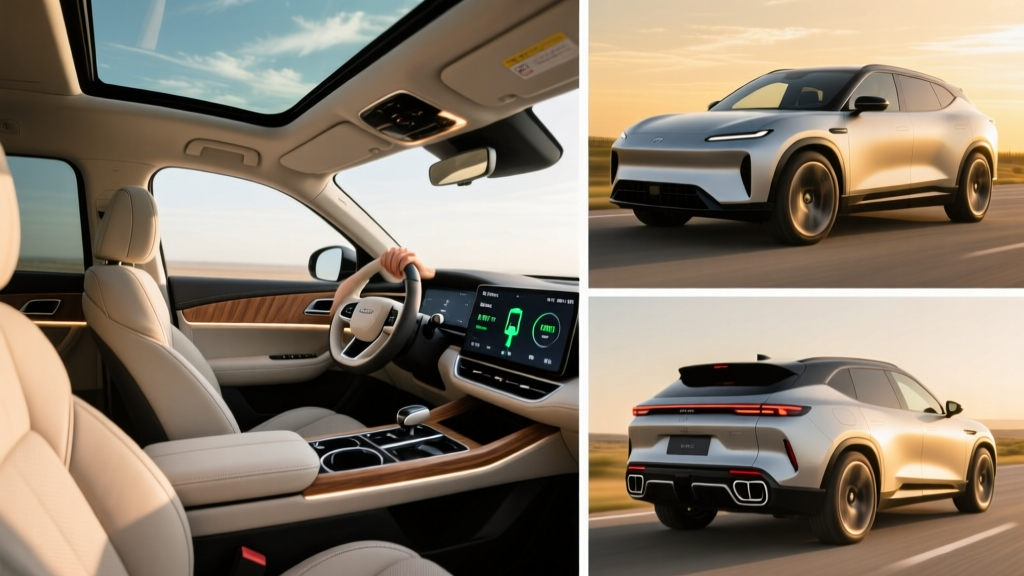
The Gravity's interior is dominated by Lucid's 34-inch curved OLED "Clearview Cockpit" display that spans the upper dash, paired with a retractable lower touchscreen for secondary controls. The materials mix genuine leather upholstery, open-pore wood trim, and recycled textile accents. Unlike many three-row SUVs that relegate the third row to occasional child-seat duty, the Gravity offers genuine adult legroom across all three rows — a claim backed by its 162.0 cubic feet of total interior volume.
| Spec | Gravity Pure (RWD) | Gravity Grand Touring (AWD) |
|---|---|---|
| EPA Range | 440 miles | 440 miles |
| Battery (usable) | ~112 kWh, NMC | ~112 kWh, NMC |
| Horsepower | 500 hp | 823 hp |
| 0–60 mph | ~5.0 sec | ~3.5 sec |
| Drivetrain | Rear-Wheel Drive | Dual-Motor AWD |
| Max DC Fast Charge | 300 kW | 300 kW |
| 10–80% DCFC Time | ~20 min | ~20 min |
| Level 2 Charge Rate | 19.2 kW (~80 mi/hr) | 19.2 kW (~80 mi/hr) |
| EPA Efficiency | ~130 MPGe / 26 kWh/100mi | ~117 MPGe / 29 kWh/100mi |
| Base MSRP | $79,900 | $94,900 |
| Cargo (behind 3rd/2nd/1st) | 28 / 62 / 120 cu ft | 28 / 62 / 120 cu ft |
| Seating | 6 or 7 passengers | 6 or 7 passengers |
| Battery/Powertrain Warranty | 8 yr / 100,000 mi | 8 yr / 100,000 mi |
Real-World Range: What 440 EPA Miles Actually Means
Real-World Expectation: ~350–380 miles on highway road trips (70–75 mph); ~300–330 miles in freezing conditions (below 32°F); ~400+ miles in mild city/suburban driving with regen.
The Lucid Gravity's 440-mile EPA estimate is the highest of any three-row electric SUV on the market, surpassing the Rivian R1S (up to ~410 miles with the Max Pack) and the Tesla Model X (up to ~335 miles). But EPA ratings are generated under controlled laboratory conditions, and real-world results depend heavily on speed, temperature, and terrain.
Lucid's advantage comes from its class-leading efficiency. The Gravity Grand Touring achieves approximately 26–29 kWh per 100 miles, depending on trim and wheel configuration — numbers that rival smaller crossovers, let alone a 5,500-pound three-row SUV. This efficiency stems from Lucid's miniaturized drive units, low-drag aerodynamics (a Cd around 0.24), and a heat pump that reduces cabin-heating energy draw in cold weather.
On a 300-mile highway loop at sustained 75 mph speeds, expect to consume roughly 75–80% of the battery, leaving a comfortable buffer. In winter conditions with temperatures in the 20s°F, plan for a 20–25% range reduction — bringing usable range to approximately 330–350 miles. That's still enough to cover most road-trip legs without excessive charging stops, but it's a number worth budgeting for if you live in northern climates. For authoritative EPA data, refer to fueleconomy.gov.
Charging Speed: 300 kW DC Fast Charging and Home Setup
The Gravity supports a peak DC fast-charge rate of 300 kW via its NACS (Tesla-style) charge port, which also provides native access to Tesla Supercharger V4 stations. On a compatible 350 kW charger, the Gravity can add approximately 200 miles of range in about 15 minutes, with a 10–80% session taking roughly 20 minutes.
| Charge Level | Power (kW) | Speed (miles/hr added) | Typical Use Case |
|---|---|---|---|
| Level 1 (120V) | ~1.4 kW | ~5 mi/hr | Emergency / trickle |
| Level 2 (240V, 48A) | 11.5 kW | ~48 mi/hr | Standard home charger |
| Level 2 (240V, 80A) | 19.2 kW | ~80 mi/hr | High-power home / depot |
| DC Fast Charge | Up to 300 kW | ~800+ mi/hr peak | Road trips / highway |
Understanding the difference between kW (power, or the rate of energy delivery) and kWh (energy, or the total capacity of the battery) is essential here. The Gravity's ~112 kWh battery is the "tank size," while the 300 kW peak charge rate is how quickly you can refill it. However, no EV sustains its peak charge rate across the entire session. The Gravity's charge curve tapers significantly above 80% state of charge to protect battery longevity — which is why 10–80% times are the industry standard metric rather than 0–100%.
For home charging, the Gravity's onboard charger supports up to 19.2 kW on a 240V / 80-amp circuit, which adds roughly 80 miles of range per hour. Most homeowners will install a 48-amp Level 2 charger (requiring a 60-amp breaker), delivering about 48 miles per hour — enough to fully replenish the battery overnight from near-empty. Installation costs for a Level 2 home setup typically range from $800 to $2,500 depending on your electrical panel's capacity and the distance from the panel to your garage. If your home has a 200-amp service panel with available headroom, you're in good shape. Older homes with 100-amp panels may require a costly upgrade ($2,000–$5,000) — always consult a licensed electrician for a site assessment.
Interior, Cargo, and Standout Technology
Step inside the Gravity and the first thing you notice is the sweeping 34-inch curved OLED glass cockpit. Unlike traditional instrument clusters, this display floats above the dash and provides navigation, speed, range, and media information across a panoramic arc. Below it, a secondary retractable touchscreen handles climate, seat controls, and vehicle settings — a dual-screen approach that reduces clutter while keeping critical functions accessible.
The cabin offers three rows of seating in either a 6-passenger (second-row captain's chairs) or 7-passenger (second-row bench) configuration. Key interior dimensions include:
- Front legroom: ~41.5 inches
- Second-row legroom: ~39.0 inches
- Third-row legroom: ~32.5 inches
- Cargo behind 3rd row: 28 cu ft
- Cargo behind 2nd row: 62 cu ft
- Cargo behind 1st row (max): 120 cu ft
- Front trunk (frunk): ~12 cu ft
That frunk is a practical bonus for stowing charging cables, groceries, or a weekend bag — something the Rivian R1S lacks. The Gravity's flat floor (thanks to the battery skateboard architecture) also means no transmission tunnel hump, improving footroom for second-row middle passengers.
On the technology front, the Gravity ships with Lucid's DreamDrive Pro ADAS suite, which uses a combination of cameras, radar, and LiDAR sensors for adaptive cruise control, lane-centering, and automatic emergency braking. Important: DreamDrive Pro is an SAE Level 2 driver-assistance system — meaning the driver must remain fully engaged with hands on the wheel and eyes on the road at all times. It is not a self-driving system. Lucid has indicated plans for higher-level automated features via over-the-air updates, but these are not yet available.
Additional tech highlights include a 21-speaker immersive audio system, wireless Apple CarPlay and Android Auto, a panoramic glass roof with electrochromic dimming, and Lucid's phone-as-key functionality. The infotainment system runs on Lucid's proprietary software, which is responsive but has drawn some criticism for lacking the app ecosystem depth of Tesla's platform.
Pricing, Trims, and Federal Tax Credit Eligibility
The 2026 Lucid Gravity is offered in two primary trims:
| Trim | Base MSRP | As-Tested (typical) | §30D Credit Eligible? |
|---|---|---|---|
| Gravity Pure (RWD) | $79,900 | $82,000–$86,000 | Potentially — see rules below |
| Gravity Grand Touring (AWD) | $94,900 | $98,000–$108,000 | Potentially — see rules below |
Under the IRS §30D Clean Vehicle Credit, eligible buyers may receive up to $7,500 — now available as a point-of-sale transfer to the dealer, reducing your purchase price at signing. However, eligibility is not automatic. You must satisfy all of the following requirements:
- MSRP Cap: The vehicle's MSRP must not exceed $80,000 for SUVs. The Gravity Pure at $79,900 clears this threshold, but adding options or destination charges can push the total above the cap. The Grand Touring trim at $94,900 does not qualify.
- Buyer Income Cap: Adjusted gross income must not exceed $150,000 (single), $225,000 (head of household), or $300,000 (married filing jointly).
- Battery Sourcing: The battery's critical minerals and components must meet phased-in percentages of US/free-trade-agreement sourcing and cannot contain components from a "foreign entity of concern" (FEOC). Lucid has been working to qualify its supply chain, but buyers should verify current-year eligibility with the dealer and cross-reference the IRS qualified vehicle list before purchase.
- Final Assembly: The vehicle must undergo final assembly in North America. The Gravity is assembled at Lucid's AMP-1 factory in Casa Grande, Arizona, satisfying this requirement.
The $7,500 credit effectively brings the Gravity Pure to approximately $72,400 for eligible buyers — a meaningful discount that makes it competitive with a similarly equipped Rivian R1S or BMW iX. Consult a tax professional to confirm your personal eligibility, as rules are subject to legislative changes.
Performance and Driving Dynamics
The Gravity Grand Touring's dual-motor all-wheel-drive powertrain produces 823 horsepower and launches the SUV from 0 to 60 mph in approximately 3.5 seconds — sports-car acceleration in a vehicle that can carry seven people and their gear. The Pure trim's single rear motor delivers 500 hp and a 5.0-second 0–60 time, which is more than adequate for daily driving and highway merging.
Lucid's engineering pedigree (the company supplied powertrain technology for Formula E racing) shows in the drive-unit packaging. Each motor is remarkably compact, which frees up interior volume and keeps the center of gravity low. The result is composed handling with minimal body roll through corners, and the air suspension can adjust ride height by up to 2.5 inches for rough roads or highway efficiency.
The Gravity is rated to tow up to 6,000 pounds when properly equipped — sufficient for a mid-size boat or camping trailer. However, towing will reduce range by 30–50% depending on trailer weight and aerodynamics, so plan your charging stops accordingly.
Warranty, Ownership Costs, and Long-Term Outlook
Lucid covers the Gravity's battery and drive units with an 8-year / 100,000-mile warranty, with a capacity retention threshold of at least 70% of original capacity during that period. The limited vehicle warranty runs 4 years / 50,000 miles. These terms are in line with industry standards from Tesla, Rivian, and BMW, though some competitors like Hyundai offer longer bumper-to-bumper coverage.
The Gravity's NMC (nickel manganese cobalt) battery chemistry prioritizes energy density — essential for achieving 440 miles in a package this size. NMC cells offer higher range per kilogram than LFP (lithium iron phosphate) chemistry, but they degrade slightly faster over time and are more sensitive to sustained 100% state-of-charge storage. Best practices include keeping daily charge between 20–80% and only charging to 100% when you need the full range for a road trip.
Insurance costs for the Gravity run higher than average for the segment — expect annual premiums of $2,800–$4,200 depending on your state, driving record, and coverage levels. This reflects the vehicle's high repair costs, aluminum-intensive construction, and premium price. Get quotes from multiple carriers before committing.
Pros
- Class-leading 440-mile EPA range
- 300 kW DC fast charging with NACS native access
- Genuine three-row adult seating with 120 cu ft max cargo
- Outstanding efficiency (~26–29 kWh/100mi)
- 823 hp Grand Touring delivers sports-SUV acceleration
- Frunk adds practical storage
- Arizona-built, potentially §30D eligible (Pure trim)
Cons
- Grand Touring trim exceeds $80K MSRP cap — no tax credit
- Limited service center network vs. Tesla or legacy OEMs
- Infotainment app ecosystem less mature than competitors
- Insurance premiums above segment average
- Third-row legroom tight for tall adults on long trips
- NMC battery requires mindful SoC management for longevity
Who Should Buy the Lucid Gravity?
The Gravity is best suited for families and professionals who need three-row seating, demand maximum range for road trips, and value technology-forward design. If you regularly drive 200+ mile routes and want to minimize charging stops, the Gravity's 440-mile EPA range is transformative. It's also a strong pick for buyers who want a premium EV SUV but prefer something less ubiquitous than a Tesla Model X.
It's not the best choice if you need the lowest possible purchase price (consider the Kia EV9 or Hyundai Ioniq 9), require a robust nationwide service network (Tesla still wins here), or plan to keep the vehicle parked at 100% charge for days at a time (LFP-based competitors may be better for that use pattern).
Frequently Asked Questions
What is the real-world range of the Lucid Gravity?
The EPA rates the Gravity at 440 miles. In real-world highway driving at 70–75 mph, expect approximately 350–380 miles. In freezing weather, plan for 300–330 miles. City driving with regenerative braking can return results close to or even above the EPA figure.
How fast does the Lucid Gravity charge?
On a DC fast charger, the Gravity peaks at 300 kW, achieving a 10–80% charge in approximately 20 minutes and adding about 200 miles in 15 minutes. At home on a 240V Level 2 charger, expect 48–80 miles of range added per hour depending on your circuit amperage.
Does the Lucid Gravity qualify for the federal EV tax credit?
The Gravity Pure ($79,900 MSRP) may qualify for up to $7,500 under IRS §30D, provided the buyer meets income caps ($150K single / $300K joint), the vehicle's final MSRP with options stays at or below $80,000, and battery sourcing requirements are met. The Grand Touring trim ($94,900) exceeds the MSRP cap and does not qualify. Always verify with the IRS qualified vehicle list and a tax professional before purchasing.
Is the Lucid Gravity worth buying vs. the Rivian R1S or Tesla Model X?
The Gravity wins on range (440 vs. ~410 vs. ~335 miles) and efficiency. The Rivian R1S offers superior off-road capability and a more established service network. The Tesla Model X has the widest Supercharger access and falcon-wing doors but less range and an aging interior. If maximum range and a fresh interior design are your priorities, the Gravity is the strongest pick in the segment.
What are the biggest drawbacks of the Lucid Gravity?
Key concerns include Lucid's still-growing service center footprint, higher-than-average insurance premiums, the Grand Touring's ineligibility for the federal tax credit, and an infotainment platform that lacks the third-party app depth of Tesla's system. Third-row legroom, while usable, falls short of full-size SUVs like the Chevrolet Tahoe.
What battery chemistry does the Gravity use?
The Gravity uses NMC (nickel manganese cobalt) lithium-ion cells in a ~112 kWh usable battery pack. NMC offers superior energy density for maximum range but benefits from daily charging limits of 80% for optimal long-term health. The battery is warranted for 8 years or 100,000 miles at a minimum 70% capacity retention.
Can the Lucid Gravity tow?
Yes. The Gravity is rated to tow up to 6,000 pounds when properly equipped. Expect a 30–50% range reduction while towing depending on trailer weight and aerodynamics.