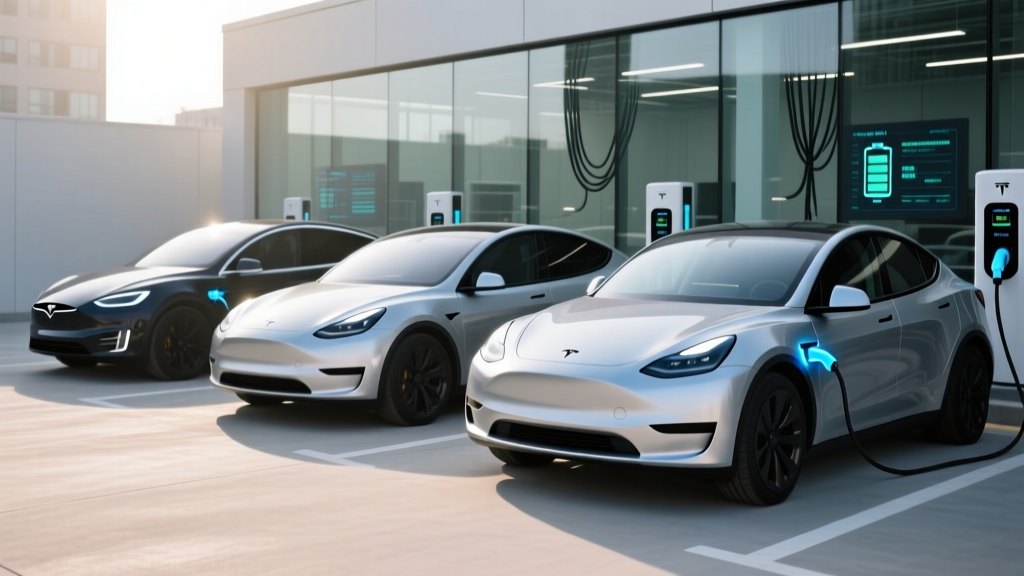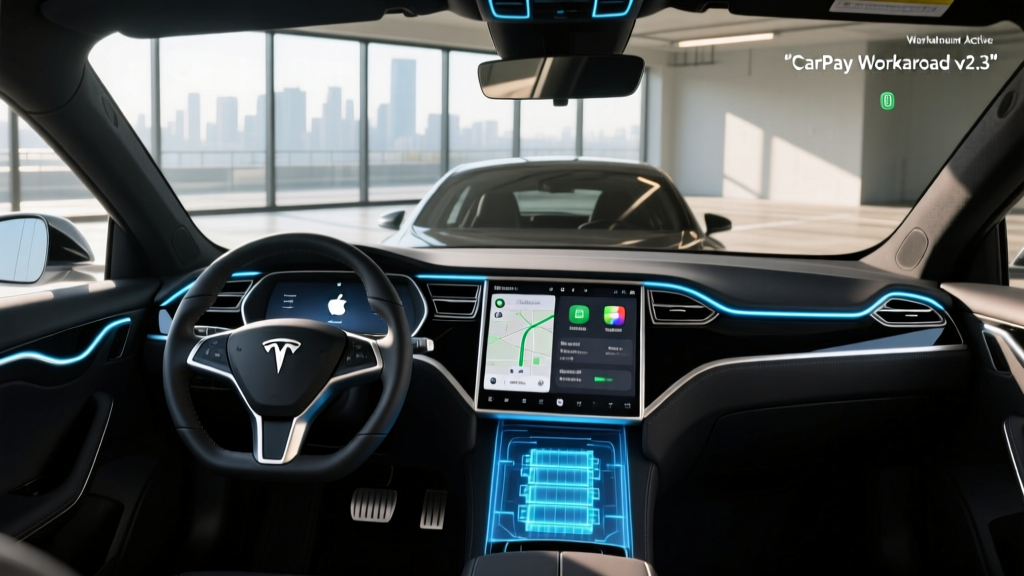
If you've searched for Tesla CarPlay compatibility, you already know the short answer: Tesla does not support Apple CarPlay or Android Auto in any production vehicle as of the 2026 model year. Unlike nearly every other automaker, Tesla has built its infotainment ecosystem entirely in-house, relying on its proprietary 15.4-inch touchscreen interface, native navigation, and integrated app suite.
But the question behind the question is whether Tesla's native software is good enough to make CarPlay unnecessary — and whether the rest of the vehicle (range, charging, price, and ownership economics) justifies the infotainment trade-off. This review covers the full Tesla lineup available in 2026 with a focus on what iPhone users actually experience, along with the hard numbers every buyer needs: real-world range, charging curves, battery chemistry, and post-credit pricing.
Why Tesla Doesn't Offer Apple CarPlay
Tesla's infotainment philosophy is fundamentally different from legacy automakers. Rather than outsourcing the display layer to Apple or Google, Tesla runs a custom Linux-based operating system that integrates deeply with vehicle controls — from suspension damping and regen settings to Sentry Mode cameras and trip planning with Supercharger routing. CEO Elon Musk has stated publicly that CarPlay would introduce a redundant interface layer that conflicts with Tesla's native navigation and over-the-air update pipeline.
The practical result: everything you'd normally do through CarPlay — navigation, music, podcasts, phone calls, messages — is handled through Tesla's native apps. Spotify, Apple Music (via Bluetooth), YouTube, Netflix, and Arcade games are all built in. Navigation uses Tesla's own maps with real-time traffic and automatic Supercharger routing on road trips.
Tesla's Bluetooth audio streaming supports Apple Music, podcasts, and phone calls with contact sync. Siri is accessible via a long-press on the steering wheel scroll button on 2025+ models. However, you cannot mirror Apple Maps, iMessage, or any CarPlay-style widget layout to the touchscreen. Third-party hardware adapters that claim to add CarPlay to Teslas exist but require aftermarket installation and are not endorsed by Tesla.
2026 Tesla Model Lineup: Range, Battery & Charging Specs
Below is the complete spec breakdown for Tesla's current 2026 U.S. lineup. All range figures are EPA-estimated; real-world expectations follow in the next section.
| Spec | Model 3 (Long Range AWD) | Model Y (Long Range AWD) | Model S (Dual Motor) | Cybertruck (AWD) |
|---|---|---|---|---|
| EPA Range | 363 mi | 330 mi | 402 mi | 340 mi |
| Battery (usable) | ~75 kWh, NMC | ~75 kWh, NMC | ~100 kWh, NMC | ~123 kWh, NMC |
| Peak DC Fast Charge | 250 kW | 250 kW | 250 kW | 350 kW |
| 10–80% DC Time | ~25 min | ~27 min | ~30 min | ~20 min |
| Level 2 Home Rate | 11.5 kW / ~44 mi/hr | 11.5 kW / ~42 mi/hr | 11.5 kW / ~38 mi/hr | 11.5 kW / ~32 mi/hr |
| Efficiency (MPGe) | 134 MPGe combined | 122 MPGe combined | 120 MPGe combined | 79 MPGe combined |
| 0–60 mph | 4.2 sec | 4.8 sec | 3.1 sec | 3.9 sec |
| Horsepower | 346 hp | 384 hp | 670 hp | 600 hp |
| Drivetrain | Dual-Motor AWD | Dual-Motor AWD | Dual-Motor AWD | Dual-Motor AWD |
| Base MSRP | $47,740 | $48,990 | $79,990 | $79,990 |
Source: fueleconomy.gov and Tesla.com 2026 model-year data. MSRP excludes destination fee.
Real-World Range: What the EPA Sticker Doesn't Tell You
Model 3 Long Range: EPA 363 mi — expect ~290–310 mi on sustained highway driving at 70+ mph; ~230–260 mi in sub-30°F winter conditions with cabin heat.
Model Y Long Range: EPA 330 mi — expect ~265–285 mi highway; ~210–240 mi in cold weather.
Model S Dual Motor: EPA 402 mi — expect ~330–360 mi highway; ~270–300 mi in cold weather.
Cybertruck AWD: EPA 340 mi — expect ~260–290 mi highway (aerodynamic penalty is significant above 65 mph); ~200–230 mi cold weather.
Highway driving, cold temperatures, and elevation gain all reduce range. Tesla's heat pump (standard on all 2026 models) recovers significant efficiency in winter compared to resistive heating.
Tesla's efficiency advantage is real — the Model 3 Long Range at 25 kWh/100mi is among the most efficient EVs sold in the U.S. That efficiency translates directly into more usable miles per kWh of battery, which matters for road-trip charging costs and battery longevity. The Cybertruck's lower efficiency (roughly 42 kWh/100mi) is a direct consequence of its 6,600-lb curb weight and brick-like aerodynamics.
Charging Speed and the Supercharger Network Advantage
Tesla's DC fast charging peaks at 250 kW on V3 Superchargers (Model 3/Y/S) and 350 kW on V4 posts (Cybertruck). However, peak kW is not sustained kW. The charging curve on a Model 3 Long Range typically holds above 200 kW from roughly 10% to 35% SoC, then tapers progressively — dropping to ~100 kW by 60% and ~50 kW by 80%. This is why the 10–80% time is the meaningful metric, not the peak number.
| Level | Power (kW) | Miles Added per Hour | Use Case |
|---|---|---|---|
| Level 1 (120V) | ~1.4 kW | 3–5 mi/hr | Overnight trickle, emergencies |
| Level 2 (240V, 48A) | 11.5 kW | 32–44 mi/hr | Daily home charging |
| DC Fast (V3 Supercharger) | Up to 250 kW | ~1,000 mi/hr (peak) | Road trips, 10–80% in ~25 min |
| DC Fast (V4 Supercharger) | Up to 350 kW | ~1,200 mi/hr (peak) | Cybertruck, future models |
One significant 2026 development: with Tesla opening the Supercharger network to NACS-equipped vehicles from Ford, GM, Rivian, and others, the Supercharger reliability advantage is now shared across the industry. Tesla owners no longer have exclusive access, but the network remains the most reliable DC fast-charging option in the U.S. with >99% uptime according to Tesla's published data.
For home charging, Tesla's Wall Connector ($420) delivers up to 11.5 kW on a 60-amp circuit (48A continuous). A full overnight charge from 20% to 80% takes roughly 5–6 hours on a Model 3 — more than sufficient for daily driving needs. Professional installation of a 240V/60A circuit typically runs $500–$2,000 depending on panel proximity and local permitting.
Pricing, Trims & Federal Tax Credit Eligibility
The federal EV tax credit under IRS §30D remains a significant factor in Tesla purchase decisions, but eligibility is not automatic. Here's how the 2026 Tesla lineup maps to current credit rules:
| Model / Trim | MSRP | Under $55K SUV / $80K Sedan Cap? | Est. §30D Credit | Effective Price |
|---|---|---|---|---|
| Model 3 RWD | $38,990 | Yes (sedan cap $80K) | Up to $7,500* | ~$31,490 |
| Model 3 Long Range AWD | $47,740 | Yes | Up to $7,500* | ~$40,240 |
| Model Y Long Range | $48,990 | Yes (SUV cap $80K) | Up to $7,500* | ~$41,490 |
| Model S Dual Motor | $79,990 | Yes (sedan cap $80K) | Up to $7,500* | ~$72,490 |
| Cybertruck AWD | $79,990 | Yes (truck cap $80K) | Up to $7,500* | ~$72,490 |
*Credit amount depends on battery component and critical mineral sourcing requirements per IRS §30D rules. Buyer income caps apply: $150K single / $225K HOH / $300K joint MAGI. Point-of-sale transfer available at participating dealers. Verify current eligibility at purchase — sourcing rules tighten annually.
The key variable for 2026 is the critical-mineral and battery-component sourcing requirement. Tesla has worked to qualify its LFP and NMC supply chains, but the partial-credit ($3,750) vs. full-credit ($7,500) split depends on the specific build week and battery cell source. Always confirm the exact credit amount with Tesla at delivery and consult a tax professional for your individual situation.
Interior, Tech & the CarPlay Question Revisited
Inside, the Tesla cabin is minimalist by design — no instrument cluster, no physical buttons for climate or media. Everything routes through the central 15.4-inch touchscreen (17-inch on Model S/X). For iPhone users, the experience works like this:
- Navigation: Tesla's native maps are competent for daily use and excellent for road trips, with automatic Supercharger routing, real-time stall availability, and preconditioning prompts that warm the battery before you arrive at a charger. Apple Maps users will need to pre-plan routes on their phone and then enter destinations manually.
- Music: Native Spotify integration is seamless. Apple Music is supported via Bluetooth streaming — functional but without the album art, queue management, or Siri Voice Control integration that CarPlay would provide.
- Phone: Bluetooth calling and contact sync work reliably. Messages can be dictated and sent via voice command, but there's no visual message preview on-screen the way CarPlay renders them.
- Voice Assistant: Tesla's voice commands handle navigation, media, and climate. A long-press on the steering wheel activates Siri on 2025+ models for iPhone-specific queries, though it's not a full CarPlay replacement.
The 2026 software suite also includes a built-in dashcam (Sentry Mode), a web browser, Netflix/YouTube for parked viewing, and over-the-air updates that have historically added meaningful features — including improved route planning and battery preconditioning algorithms — without dealer visits.
Tesla's Autopilot (standard) and Full Self-Driving Supervised ($8,000 option) are SAE Level 2 driver-assistance systems. The driver must remain fully engaged, hands on or near the wheel, and eyes on the road at all times. These are not autonomous driving systems. FSD Supervised handles city streets, stop signs, and highway lane changes but requires active supervision and can make errors. NHTSA continues to monitor Tesla's driver-monitoring compliance data.
Warranty, Ownership Costs & Cargo Capacity
Tesla's warranty structure is straightforward:
- Basic Vehicle: 4 years / 50,000 miles
- Battery & Drive Unit: 8 years / 100,000 miles (Model 3 RWD) or 8 years / 120,000 miles (Long Range, Model Y, Model S, Cybertruck), with a minimum 70% capacity retention guarantee
Cargo capacity varies significantly across the lineup:
- Model 3: 23 cu ft trunk + 3 cu ft frunk — adequate for two suitcases and groceries
- Model Y: 34 cu ft behind second row / 76 cu ft folded + 4 cu ft frunk — competitive with compact SUVs
- Model S: 28 cu ft rear + 5 cu ft frunk — liftback design aids loading
- Cybertruck: 6.5-ft bed with 67 cu ft lockable vault + ~7 cu ft frunk — designed for utility
Insurance costs remain a consideration. Tesla vehicles carry higher-than-average premiums due to repair complexity and parts costs. Average annual insurance for a Model 3 runs $2,200–$3,000 depending on state, age, and driving record — roughly 20–40% above a comparably priced Toyota Camry. Tesla Insurance is available in select states and can be competitive for clean-record drivers.
Pros, Cons & Who Should Buy a Tesla
Pros
- Best-in-class efficiency (Model 3: 134 MPGe)
- Supercharger network: most reliable DC charging in the U.S.
- Over-the-air updates continuously improve the vehicle
- Strong real-world range (290+ mi highway for Model 3 LR)
- Low maintenance costs — no oil, spark plugs, or transmission fluid
- Federal tax credit eligibility on most trims
Cons
- No Apple CarPlay or Android Auto — a dealbreaker for some
- All controls on touchscreen — no physical buttons for climate or volume
- Insurance premiums 20–40% above average
- FSD ($8,000) remains Level 2, not autonomous
- Build quality inconsistency (panel gaps, trim alignment)
- Model S and Cybertruck push the $80K MSRP cap boundary for tax credits
- Choose the Model 3 Long Range if: You're a commuter who wants maximum efficiency, 300+ real-world miles, and the lowest cost per mile in the Tesla lineup. Best for singles and couples without large cargo needs.
- Choose the Model Y Long Range if: You need family-friendly cargo space (34 cu ft), AWD for inclement weather, and a vehicle that qualifies for the full tax credit. The default pick for most households.
- Choose the Model S if: You want 400+ EPA miles, luxury performance, and don't mind the premium price. Best for high-mileage road trippers who value range above all.
- Choose the Cybertruck if: You need a truck bed, 11,000-lb towing capacity, and can accept the efficiency penalty. A niche vehicle that excels at utility but costs more per mile to drive.
- Look elsewhere (Hyundai Ioniq 5, BMW i4, Ford Mustang Mach-E) if: Apple CarPlay is a non-negotiable requirement, you prefer physical controls, or you want a more traditional dealership service experience.
Frequently Asked Questions
Can I add Apple CarPlay to a Tesla aftermarket?
Third-party hardware solutions exist (typically $300–$600 plus installation) that intercept the Tesla display signal to inject a CarPlay interface. However, these are not supported by Tesla, may interfere with over-the-air updates, and could affect warranty coverage on the infotainment system. Most owners who try them report mixed results with latency and touch responsiveness.
Does Tesla support Apple Music natively?
Not as a built-in app. You can stream Apple Music from your iPhone via Bluetooth, but you won't get the integrated browsing, playlist management, or album artwork display that the native Spotify app provides. For the best native music experience in a Tesla, Spotify is the superior option.
What's the real-world range of a Model Y in winter?
In sustained temperatures below 30°F, expect the Model Y Long Range to deliver roughly 210–240 miles — a 25–35% reduction from the 330-mile EPA estimate. Tesla's heat pump helps significantly compared to resistive heating systems. Preconditioning the battery while plugged in (using grid power instead of battery) can recover 10–15 miles of range on cold mornings.
Does the Tesla Model 3 qualify for the full $7,500 federal tax credit?
As of 2026, the Model 3 RWD and Long Range AWD qualify for up to $7,500 under §30D, subject to buyer income limits ($150K single / $300K joint MAGI) and battery sourcing requirements. The credit can be transferred at point of sale for an immediate price reduction. However, the exact amount ($3,750 vs. $7,500) depends on whether the battery meets both the critical-mineral and battery-component thresholds. Always verify at the time of purchase via the IRS clean vehicle credit page.
How does Tesla's Supercharger network compare to Electrify America or EVgo?
Tesla's Supercharger network remains the reliability leader with >99% uptime and consistent charge speeds. Electrify America and EVgo have improved significantly but still experience higher rates of offline or malfunctioning stalls. With NACS adoption spreading to Ford, GM, and Rivian vehicles in 2025–2026, Supercharger congestion at popular corridors has increased — plan road-trip stops with backup options.
Is Tesla's Autopilot self-driving?
No. Both Autopilot and Full Self-Driving (Supervised) are SAE Level 2 driver-assistance systems. They can manage steering, acceleration, and braking on highways and some city streets, but the driver must remain fully attentive and ready to take over immediately. Tesla's cabin camera monitors eye direction but is not a substitute for active driving engagement.