The Apple CarPlay Question Every Tesla Buyer Asks
If you've searched "Tesla CarPlay" hoping for a straightforward answer, here it is up front: Tesla does not natively support Apple CarPlay in any 2026 model — not the Model 3, Model Y, Model S, Model X, or the Cybertruck. Tesla's vertically integrated infotainment system is designed to keep you inside its own software ecosystem, which means no CarPlay, no Android Auto, and no third-party phone-mirroring protocol.
That reality frustrates a significant slice of buyers. A 2025 survey by Cox Automotive found that over 40% of smartphone-owning drivers consider CarPlay or Android Auto a "must-have" feature. Tesla's refusal to integrate either is one of the most common objections raised by shoppers cross-shopping a Model Y against a Hyundai Ioniq 5, Ford Mustang Mach-E, or BMW i4 — all of which support wireless CarPlay.
So what are your options if you want Tesla's driving dynamics and Supercharger network but also want your iPhone's interface on the dash? Below, we map out every workaround, weigh their trade-offs, and then deliver a full spec-and-value profile of the two vehicles most affected by this question: the 2026 Tesla Model 3 and Model Y.
Why Tesla Refuses CarPlay — and What You Lose
Tesla's position is philosophical as much as technical. The company views its 15.4-inch center touchscreen (in the refreshed Model 3 and Model Y) as a core product differentiator, tightly coupled with navigation, vehicle settings, climate controls, Sentry Mode, and over-the-air updates. Handing real estate on that screen to Apple would dilute Tesla's control over the user experience and, critically, its ability to collect usage data that feeds its Autopilot and Full Self-Driving (Supervised) neural networks.
What you miss by not having CarPlay:
- Apple Maps with your saved favorites, home/work pins, and iCloud-synced history
- Spotify, Apple Music, and Podcasts with native Siri voice control
- Messages and phone calls rendered through the familiar CarPlay interface
- Waze for crowd-sourced traffic and speed-trap alerts
- Calendar integration with automatic navigation to your next event
Tesla counters with its own built-in apps: Spotify, Apple Music (via Bluetooth, not CarPlay), a built-in web browser, theater mode (YouTube/Netflix/Twitch while parked), and an increasingly capable voice-command system. But the integration is not seamless, and you still can't mirror your phone's native interface.
Tesla CarPlay Workarounds: What Actually Works in 2026
Several third-party solutions attempt to bridge the gap. Here's what's available, ranked by practicality:
1. CarPlay AI Box (HDMI/USB Dongle)
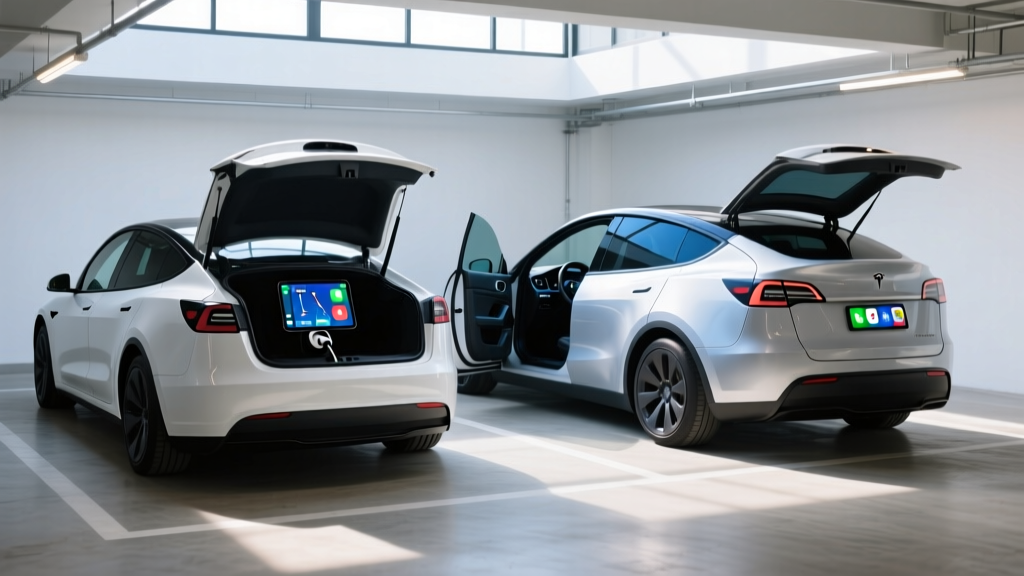
Devices like the Carlinkit T2C Plus or Ottocast P3 connect via the Tesla's USB-C port and a hidden HDMI adapter, then project a CarPlay-like interface into Tesla's built-in web browser. You pair your iPhone via Bluetooth to the dongle, and the dongle streams a CarPlay UI to the browser tab.
- Pros: No permanent modification; uses genuine CarPlay on the backend
- Cons: Noticeable latency (~200-400ms); no steering-wheel button integration; browser-based rendering looks less polished than native CarPlay; ~$150-$250 hardware cost; Tesla software updates can break compatibility
2. Bluetooth Audio + Tesla App Integration
The lowest-friction approach: pair your iPhone via Bluetooth for audio, use Tesla's built-in navigation, and rely on Siri via your phone (mounted on a MagSafe vent clip) for messages and calls. Tesla's 2026 voice commands handle basic navigation and media requests natively.
- Pros: Free; reliable; no third-party hardware
- Cons: Not true CarPlay; phone screen still needed for some tasks
3. Aftermarket Head-Unit Swap
A few shops offer full head-unit replacements with CarPlay-compatible screens. We strongly advise against this: it voids Tesla's infotainment warranty, disables Sentry Mode and OTA updates, and can interfere with vehicle telemetry.
2026 Tesla Model 3: Full Spec Profile
The refreshed "Highland" Model 3 continues into 2026 with minor software and battery-pack updates. It remains Tesla's most affordable sedan and the model most cross-shopped by CarPlay-seeking buyers considering the BMW i4 or Hyundai Ioniq 6.
| Spec | Model 3 RWD | Model 3 Long Range AWD | Model 3 Performance |
|---|---|---|---|
| EPA Range | 363 mi | 346 mi | 315 mi |
| Battery (usable) | ~60 kWh (LFP) | ~75 kWh (NMC) | ~75 kWh (NMC) |
| MPGe (combined) | 132 MPGe | 134 MPGe | 121 MPGe |
| kWh/100 mi | 25 | 25 | 28 |
| 0-60 mph | 5.8 sec | 4.2 sec | 2.9 sec |
| Horsepower | 271 hp | 346 hp | 510 hp |
| Drivetrain | RWD | Dual-Motor AWD | Dual-Motor AWD |
| Max DC Fast Charge | 170 kW | 250 kW | 250 kW |
| 10-80% DCFC Time | ~28 min | ~25 min | ~25 min |
| Level 2 Home Charge | 11.5 kW (~44 mi/hr) | 11.5 kW (~44 mi/hr) | 11.5 kW (~44 mi/hr) |
| Cargo (trunk + frunk) | 23 cu ft | 23 cu ft | 23 cu ft |
| Rear Legroom | 35.2 in | 35.2 in | 35.2 in |
| Battery Warranty | 8 yr / 100,000 mi | 8 yr / 120,000 mi | 8 yr / 120,000 mi |
| Base MSRP | $38,990 | $45,990 | $52,990 |
Source: fueleconomy.gov and Tesla's 2026 order page.
2026 Tesla Model Y: Full Spec Profile
The "Juniper" refresh brought a redesigned interior, ventilated seats, a rear touchscreen, and a slightly larger battery to the Model Y for 2025, and those changes carry into 2026. The Model Y is the best-selling EV in the U.S. and the vehicle most likely to be compared against CarPlay-equipped rivals like the Hyundai Ioniq 5, Kia EV6, and Ford Mustang Mach-E.
| Spec | Model Y RWD | Model Y Long Range AWD | Model Y Performance |
|---|---|---|---|
| EPA Range | 320 mi | 330 mi | 303 mi |
| Battery (usable) | ~62 kWh (LFP) | ~78 kWh (NMC) | ~78 kWh (NMC) |
| MPGe (combined) | 123 MPGe | 122 MPGe | 111 MPGe |
| kWh/100 mi | 27 | 28 | 30 |
| 0-60 mph | 6.5 sec | 4.8 sec | 3.5 sec |
| Horsepower | 315 hp | 384 hp | 510 hp |
| Drivetrain | RWD | Dual-Motor AWD | Dual-Motor AWD |
| Max DC Fast Charge | 170 kW | 250 kW | 250 kW |
| 10-80% DCFC Time | ~30 min | ~27 min | ~27 min |
| Level 2 Home Charge | 11.5 kW (~44 mi/hr) | 11.5 kW (~44 mi/hr) | 11.5 kW (~44 mi/hr) |
| Cargo (rear seats up) | 30 cu ft | 30 cu ft | 30 cu ft |
| Cargo (rear seats down) | 72 cu ft | 72 cu ft | 72 cu ft |
| Rear Legroom | 38.4 in | 38.4 in | 38.4 in |
| Battery Warranty | 8 yr / 100,000 mi | 8 yr / 120,000 mi | 8 yr / 120,000 mi |
| Base MSRP | $44,990 | $48,990 | $53,990 |
Source: fueleconomy.gov and Tesla's 2026 order page.
Pricing, Tax Credits, and Total Cost
| Trim | MSRP | Est. §30D Credit | Effective Price |
|---|---|---|---|
| Model 3 RWD | $38,990 | $0–$7,500* | $31,490–$38,990 |
| Model 3 Long Range | $45,990 | $0–$7,500* | $38,490–$45,990 |
| Model Y RWD | $44,990 | $0–$7,500* | $37,490–$44,990 |
| Model Y Long Range | $48,990 | $0–$7,500* | $41,490–$48,990 |
*Federal §30D tax credit caveats: The up-to-$7,500 credit under IRS §30D is subject to multiple requirements that change frequently:
- MSRP caps: Sedans (Model 3) must be ≤$55,000; SUVs/pickups (Model Y) must be ≤$80,000
- Buyer income caps: AGI ≤$150,000 (single), ≤$225,000 (head of household), ≤$300,000 (joint)
- Battery sourcing: Critical minerals and battery components must meet escalating domestic-content thresholds. Tesla has shifted some sourcing to U.S. and FTA-partner suppliers, but the exact credit amount ($3,750 vs. $7,500) varies by build month. Always verify on Tesla's order page and consult a tax professional.
- Point-of-sale transfer: As of 2024+, you can transfer the credit to the dealer for an upfront price reduction rather than claiming it on your tax return
Charging Speed: DC Fast, Level 2, and the Supercharger Advantage
| Charging Level | Power | Miles Added per Hour | Notes |
|---|---|---|---|
| Level 1 (120V) | ~1.4 kW | ~4–5 mi/hr | Emergency/trickle only |
| Level 2 (240V, 48A) | 11.5 kW | ~44 mi/hr | Full charge in 7–9 hours |
| DC Fast (Tesla V3 Supercharger) | Up to 250 kW | ~1,000 mi/hr (peak) | 10-80% in ~25 min (LR/AWD) |
| DC Fast (V4 Supercharger) | Up to 350 kW | Higher peak; limited by vehicle | Model 3/Y capped at 250 kW onboard |
Tesla's Supercharger network remains its strongest competitive moat — over 6,500 V3/V4 stalls in North America with near-flawless plug-and-charge reliability. The Model 3 and Model Y use the NACS (North American Charging Standard) connector natively. With Ford, GM, Rivian, and others adopting NACS in 2025-2026, Tesla's connector is now the de facto industry standard.
Charging-curve reality check: The 250 kW peak on Long Range and Performance trims is sustained only between roughly 10-30% State of Charge. Above 50%, the curve tapers to ~100 kW, and above 80% it drops further to ~40 kW. That 10-80% time of ~25 minutes assumes you've preconditioned the battery via the navigation system. Arriving at a Supercharger without preconditioning can add 5-10 minutes to your session, especially in cold weather.
Competitor Comparison: CarPlay-Equipped Alternatives
If CarPlay is a hard requirement, the Hyundai Ioniq 5, Kia EV6, Ford Mustang Mach-E, and BMW i4 all offer wireless CarPlay with competitive range and pricing. The Ioniq 5 and EV6 charge faster (peak 235-250 kW with a more favorable curve), while the Mach-E offers a more traditional crossover feel. The BMW i4 is the luxury alternative with CarPlay and up to 307 miles EPA.
What those competitors cannot match: Tesla's Supercharger network (though NACS adoption is closing the gap), Tesla's OTA update cadence, and the resale-value advantage Tesla still holds.
Pros and Cons: Tesla Without CarPlay
- Class-leading Supercharger network with NACS standard
- Excellent real-world efficiency (25-28 kWh/100 mi)
- Strong OTA updates continuously add features
- Spacious Model Y cargo area (72 cu ft seats-down)
- Industry-leading Autopilot/FSD (Supervised) capability — SAE Level 2
- Competitive pricing after potential §30D credit
- LFP battery option (RWD) offers longer cycle life and no cobalt
- No Apple CarPlay or Android Auto — a dealbreaker for many
- Touchscreen-only controls (no physical buttons for climate/media)
- Model 3 rear-seat space is tight for tall adults (35.2 in legroom)
- Turn-signal stalk removed in Highland/Juniper refresh (steering-wheel buttons)
- Insurance premiums often 15-25% higher than segment average
- LFP cold-weather range loss more pronounced than NMC
Who Should Buy a Tesla Despite the CarPlay Gap?
- You road-trip frequently and value Supercharger reliability above all
- You're comfortable with a touchscreen-centric interface
- You want OTA feature updates and Tesla's driver-assist tech
- You can adapt to Bluetooth audio + native Tesla apps for daily use
- You prioritize efficiency and range-per-dollar over infotainment familiarity
- Apple Maps, Siri integration, and Waze are non-negotiable for your commute
- You prefer physical buttons and a traditional infotainment layout
- You want faster DC charging peaks (Ioniq 5/EV6 800V architecture)
- Back-seat space is a priority (Ioniq 5 offers 39.4 in rear legroom)
Frequently Asked Questions
Does any 2026 Tesla model support Apple CarPlay?
No. As of 2026, no Tesla vehicle — Model 3, Model Y, Model S, Model X, or Cybertruck — supports Apple CarPlay or Android Auto natively. Tesla relies exclusively on its proprietary infotainment system.
What is the real-world range of the 2026 Tesla Model 3 Long Range?
The EPA rates it at 346 miles. In real-world mixed driving, expect ~300-320 miles. Sustained highway driving at 75 mph drops that to ~280-300 miles, and sub-freezing winter conditions can reduce it further to ~230-250 miles. Preconditioning the battery before departure helps recover some cold-weather loss.
How fast does the Tesla Model Y charge at home and on DC fast chargers?
On a Level 2 home charger (240V, 48A), the Model Y charges at 11.5 kW, adding roughly 44 miles of range per hour — a full charge takes 7-9 hours. On a V3 Supercharger, the Long Range and Performance trims peak at 250 kW and achieve a 10-80% charge in approximately 27 minutes with battery preconditioning. The RWD trim peaks at 170 kW, taking ~30 minutes for the same 10-80% session.
How much does a 2026 Tesla Model 3 cost after the federal tax credit?
The Model 3 RWD starts at $38,990 MSRP. If you qualify for the full $7,500 §30D credit (subject to income caps, battery-sourcing requirements, and MSRP limits — see IRS guidelines), the effective price can drop to ~$31,490. The Long Range AWD at $45,990 can fall to ~$38,490. Always verify current eligibility, as sourcing rules change by build date.
Is a Tesla worth buying over a CarPlay-equipped competitor?
It depends on your priorities. If Supercharger access, class-leading efficiency, and continuous OTA improvements matter most, Tesla still leads. If CarPlay integration, physical controls, faster peak charging, or rear-seat space are higher on your list, the Hyundai Ioniq 5, Kia EV6, or Ford Mustang Mach-E may serve you better. Test-drive both ecosystems before deciding.
Does the Tesla Model 3 or Model Y qualify for the federal EV tax credit?
Both models are eligible for up to $7,500 under §30D, but qualification depends on the buyer's adjusted gross income (≤$150K single / ≤$300K joint), the vehicle's MSRP (Model 3 ≤$55K sedan cap; Model Y ≤$80K SUV cap), and battery-component/critical-minerals sourcing thresholds that tighten annually. The credit can be transferred to the dealer as a point-of-sale discount. Check the latest details on irs.gov and confirm with your tax professional before ordering.
Can I use a third-party CarPlay adapter with my Tesla?
Yes, with caveats. Devices like the Carlinkit T2C or Ottocast P3 project a CarPlay-like interface through Tesla's built-in web browser via a USB-C dongle. They cost $150-$250 and work, but introduce latency, lack steering-wheel integration, and may break after Tesla software updates. They're a workaround, not a native experience.