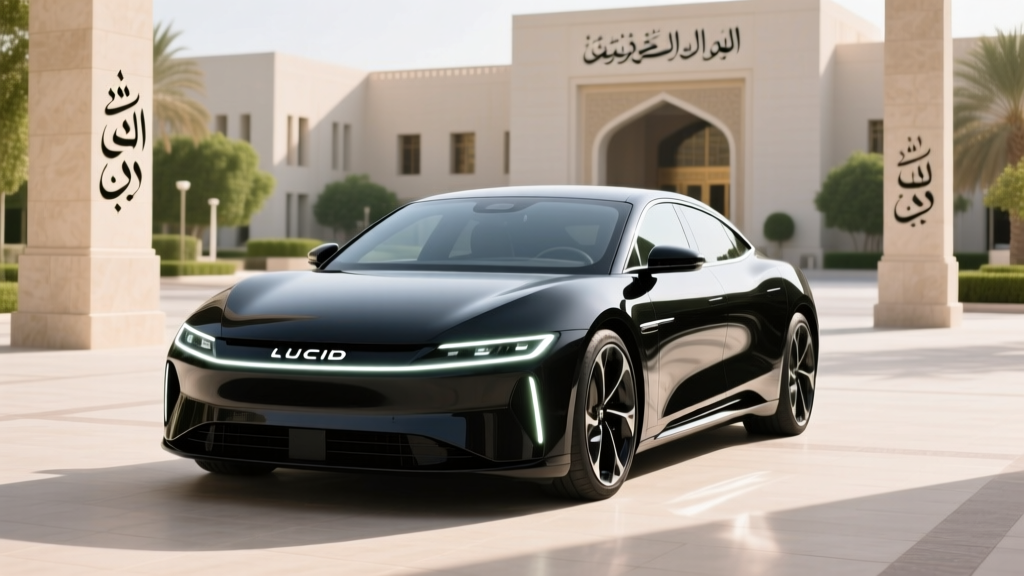
If you have been following the electric-vehicle industry's geopolitical shifts, you have likely encountered the phrase Lucid EV Saudi embassies in headlines. Saudi Arabia's Public Investment Fund (PIF) holds a roughly 60% stake in Lucid Motors, and Lucid's AMP-2 manufacturing plant in King Abdullah Economic City (KAEC) has become a focal point of the Kingdom's Vision 2030 diversification strategy. But beyond the sovereign-wealth narrative, Lucid's flagship sedan — the Air — remains one of the most range-efficient, technologically ambitious EVs on the US market. This review covers the 2026 Lucid Air lineup with the exact numbers buyers need: EPA range, charging curves, pricing, federal tax-credit eligibility, and real-world ownership considerations.
Why the Saudi Connection Matters for Lucid Buyers
Before we get into specs, it is worth understanding why the Lucid-Saudi relationship affects you as a US buyer. The PIF's investment provides Lucid with capital stability that many EV startups lack — Lordstown, Fisker, and others have folded or restructured without similar backing. The KAEC factory also positions Lucid to serve Middle Eastern and eventually European markets, diversifying revenue beyond North America.
For US consumers, the practical implication is twofold: Lucid has the financial runway to continue honoring warranties and developing new models (like the upcoming Gravity SUV), but production volumes remain modest compared to Tesla or legacy automakers. Service-center density is still a pain point in many metro areas, and parts availability can lag. These are ownership realities that no spec sheet captures.
2026 Lucid Air: EPA Range, Battery, and Efficiency
The 2026 Lucid Air lineup spans four trims, all built on Lucid's proprietary 900-volt electrical architecture. The Air Pure and Air Touring use a single-motor rear-wheel-drive setup, while the Grand Touring and Sapphire employ dual-motor all-wheel-drive configurations. Battery chemistry across the lineup is NMC (nickel manganese cobalt), chosen for its high energy density — critical for achieving the Air's class-leading range figures.
The EPA numbers below represent ideal mixed-cycle testing. In real-world highway driving at 75 mph, expect roughly 85-90% of the EPA figure. In cold weather (below 32°F), range can drop an additional 15-25% depending on cabin-heating demand and whether you precondition the battery. The Air's available heat pump helps mitigate cold-weather losses compared to resistive-heater-equipped competitors.
| Trim | Battery (kWh usable) | EPA Range (mi) | Drivetrain | HP | 0-60 mph (s) | MPGe (combined) | kWh/100 mi |
|---|---|---|---|---|---|---|---|
| Air Pure | 88 | 419 | RWD | 430 | 5.0 | 136 | 25 |
| Air Touring | 92 | 425 | RWD | 620 | 3.4 | 131 | 26 |
| Air Grand Touring | 112 | 516 | AWD (dual-motor) | 1,050 | 3.0 | 131 | 26 |
| Air Sapphire | 118 | 427 | AWD (tri-motor) | 1,234 | 1.89 | 110 | 31 |
The efficiency figures deserve emphasis. The Air Grand Touring achieves 516 miles of EPA range with a 112 kWh pack — roughly 4.6 miles per kWh — which is among the best in the luxury EV segment. For comparison, the Mercedes EQS 450+ delivers about 3.2 mi/kWh. Lucid's miniaturized drive units and low-drag aero (Cd of 0.20) are the engineering reasons behind this efficiency gap.
Charging Speed: 900V Architecture in Practice
Lucid's 900-volt platform enables some of the fastest DC fast-charging rates available in a production sedan. Here is what the numbers look like across charging levels:
| Charging Level | Power / Rate | Miles of Range Added per Hour | Notes |
|---|---|---|---|
| Level 1 (120V household) | ~1.4 kW | ~5-6 mi/hr | Emergency/trickle only |
| Level 2 (240V home, 48A) | 11.5 kW | ~47 mi/hr | Full charge overnight (~9-10 hrs) |
| DC Fast Charge (peak) | ~300 kW (Grand Touring/Sapphire) | ~200 mi in 15 min (10-80%) | Requires 350 kW CCS station; taper above 80% |
| DC Fast Charge (Pure/Touring) | ~250 kW peak | ~10-80% in ~20 min | Slightly lower peak; sustained curve still strong |
A critical ownership note: the Air ships with a CCS1 connector in North America. Lucid has confirmed NACS (Tesla Supercharger) adapter compatibility, allowing access to Tesla's network — which remains the most reliable DC fast-charging infrastructure in the US. If you road-trip frequently, that adapter is essential.
The 900V architecture means the Air sustains higher charging power deeper into the state-of-charge curve than 400V competitors. Where many EVs begin tapering sharply at 50% SoC, the Air maintains strong charge rates through roughly 60-65% before a more gradual taper. This translates to real time savings on long highway trips.
Pricing, Tax Credits, and Total Cost of Ownership
The 2026 Lucid Air positions firmly in the luxury sedan segment. Here is the current MSRP breakdown by trim, along with federal tax-credit considerations:
| Trim | Base MSRP | Federal §30D Credit Eligible? | Effective Price (est.) |
|---|---|---|---|
| Air Pure | $69,900 | No — MSRP exceeds $55,000 sedan cap | $69,900 |
| Air Touring | $87,400 | No — MSRP exceeds $55,000 sedan cap | $87,400 |
| Air Grand Touring | $125,600 | No — MSRP exceeds $55,000 sedan cap | $125,600 |
| Air Sapphire | $249,000 | No — MSRP exceeds $55,000 sedan cap | $249,000 |
This is a key point many buyers miss. Under IRS §30D rules, sedans are capped at an MSRP of $55,000 to qualify for the up-to-$7,500 federal tax credit. Every Lucid Air trim exceeds this threshold. (The SUV cap is $80,000, which is why some luxury SUVs still qualify.) Additionally, buyer income limits apply ($150,000 single / $300,000 joint AGI), and battery-critical-mineral and component sourcing requirements further restrict eligibility even for vehicles under the MSRP cap.
For the most current rules, always check the IRS clean vehicle credits page before making a purchase decision. Tax professionals can also help determine whether a point-of-sale transfer or lease-loophole strategy applies to your situation.
Interior, Cargo, Technology, and Driver Assistance
The Air's cabin emphasizes minimalist luxury with a massive glass canopy roof and a curved 34-inch glass cockpit display. Lucid's infotainment system runs on a custom OS with wireless Apple CarPlay and Android Auto, native navigation with route-based battery preconditioning, and over-the-air updates.
Passenger and cargo dimensions:
- Front legroom: 45.3 inches
- Rear legroom: 37.6 inches
- Trunk volume: 32.1 cu ft (rear cargo)
- Frunk (front trunk): 10.0 cu ft
- Total cargo: 42.1 cu ft
That combined cargo figure is exceptional for a sedan and approaches some mid-size SUVs. The frunk is genuinely usable for charging cables or a carry-on bag.
DreamDrive Pro (ADAS): Lucid's driver-assistance suite includes adaptive cruise control, lane-centering, automatic emergency braking, blind-spot monitoring, and a surround-view camera system. DreamDrive Pro is a SAE Level 2 system — meaning the driver must remain fully engaged, hands on or near the wheel, and eyes on the road at all times. It is not a self-driving system. Competitors like GM's Super Cruise and Ford's BlueCruise offer hands-free operation on pre-mapped highways, which is an area where Lucid's feature set currently lags in perceived convenience, even though the underlying sensor suite (lidar, radar, cameras) is robust.
Lucid's DreamDrive Pro is an SAE Level 2 driver-assistance system. It does NOT provide autonomous or self-driving capability. The driver is legally and operationally responsible for the vehicle at all times. Never treat any Level 2 system as a substitute for active driving attention.
Warranty Coverage and Long-Term Battery Outlook
Lucid provides the following warranty coverage for the 2026 Air:
- Basic vehicle warranty: 4 years / 50,000 miles
- Battery and drive unit: 8 years / 100,000 miles (capacity retention threshold: 70%)
- Corrosion warranty: 12 years / unlimited miles
The 8-year/100,000-mile battery warranty is standard for the premium EV segment (matching Tesla, BMW, and Mercedes). The 70% capacity-retention threshold means Lucid will repair or replace the battery if it degrades below 70% of original capacity within the warranty period. Based on NMC chemistry degradation data from similar high-voltage platforms, owners who avoid habitual 100% charges and frequent DC fast-charging in extreme heat should expect 85-90% capacity retention at 100,000 miles.
For context on NMC battery longevity, the Department of Energy's EV technology resources provide useful background on lithium-ion degradation patterns.
Pros, Cons, and Verdict
- Class-leading EPA range (up to 516 mi on Grand Touring)
- Outstanding efficiency (4.6 mi/kWh) reduces charging costs
- 900V architecture enables fast DC charging with strong sustained curve
- Generous interior space and cargo volume for a sedan
- Sapphire trim offers hypercar-level performance (1.89s 0-60)
- PIF backing provides financial stability
- NACS adapter enables Tesla Supercharger access
- No trim qualifies for the $7,500 federal EV tax credit
- Service center network is limited outside major metros
- DreamDrive Pro lacks hands-free highway driving (no Level 2+ hands-off)
- Brand awareness and resale-value data remain limited
- High starting price with no budget-friendly trim
- Parts and repair turnaround can be slow
Who the Lucid Air suits best: The Air is ideal for affluent commuters and road-trippers who prioritize maximum range and efficiency, want a luxury sedan (not an SUV), and have reliable home Level 2 charging. The Grand Touring trim is the sweet spot for long-distance drivers. The Sapphire exists for performance enthusiasts who want to humble supercars at stoplights. If you need hands-free highway driving or live far from a Lucid service center, a Tesla Model S or Mercedes EQS may be more practical.
Lucid Air vs. Key Competitors
| Attribute | Lucid Air Grand Touring | Tesla Model S Long Range | Mercedes EQS 450+ | BMW i7 xDrive60 |
|---|---|---|---|---|
| EPA Range | 516 mi | 402 mi | 390 mi | 318 mi |
| Battery (kWh) | 112 | ~100 | 108.4 | 101.7 |
| Peak DC Charge | ~300 kW | ~250 kW | ~200 kW | ~195 kW |
| 0-60 mph | 3.0s | 3.1s | 5.5s | 4.5s |
| Base MSRP | $125,600 | $74,990 | $104,400 | $119,300 |
| §30D Credit | No | No (sedan cap) | No (sedan cap) | No (sedan cap) |
The Air Grand Touring wins on range, efficiency, and peak charge rate. The Model S wins on price, Supercharger network access (native NACS), and Autopilot functionality. The EQS and i7 win on traditional luxury dealership service networks and brand cachet.
Frequently Asked Questions
What is the real-world range of the 2026 Lucid Air?
The EPA rates the Air Grand Touring at 516 miles. In real-world highway driving at 70-75 mph in moderate temperatures, expect approximately 430-460 miles. In cold weather (below freezing), that drops to roughly 360-400 miles depending on cabin heat usage and whether you precondition. The Air Pure delivers roughly 350-380 real-world highway miles in mild conditions.
How fast does the Lucid Air charge at home and on the road?
On a Level 2 home charger (240V, 48 amps), the Air charges at up to 11.5 kW, adding about 47 miles of range per hour — a full overnight charge from near-empty takes 9-10 hours. On a 350 kW DC fast charger, the Grand Touring peaks at roughly 300 kW and can add 200 miles in about 15 minutes (10-80% SoC). Charging slows considerably above 80% to protect battery health.
Does the Lucid Air qualify for the $7,500 federal EV tax credit?
No. Under current IRS §30D rules, sedans must have an MSRP below $55,000 to qualify. Every Air trim exceeds this cap. Additionally, buyer income limits and battery-sourcing requirements apply. Always verify current rules at irs.gov before purchasing.
Is the Lucid Air worth buying vs. a Tesla Model S or Mercedes EQS?
If maximum range and efficiency are your top priorities and you have home charging, the Air Grand Touring is arguably the best luxury electric sedan available. If you value hands-free driving features, a dense service network, or a lower entry price, the Model S is more practical. If traditional dealership service and brand prestige matter most, the EQS or i7 may be better fits.
What are the biggest ownership risks with Lucid?
The primary concerns are limited service-center availability (especially outside California, New York, and a few other markets), relatively slow parts supply chains, and uncertain long-term resale value compared to established luxury brands. Lucid's PIF backing reduces bankruptcy risk, but the company's production volumes and market share remain small.
Does the Lucid Air use NACS or CCS for charging?
The Air ships with a CCS1 inlet for North America. Lucid provides a NACS adapter that enables charging at Tesla Superchargers. For public non-Tesla DC fast chargers (Electrify America, EVgo, etc.), the native CCS1 connector works directly.
How does the Saudi ownership affect parts and service in the US?
The Saudi PIF's investment provides Lucid with capital to expand, but US service infrastructure still lags behind Tesla and legacy luxury brands. The KAEC factory primarily serves Middle Eastern demand. US-market vehicles are built at Lucid's AMP-1 plant in Casa Grande, Arizona. Parts sourcing and service logistics are US-managed, though delays have been reported by owners in less-served regions.