Why Tesla's Car Cam System Matters More Than Ever in 2026
When shoppers search for "tesla car cam," they're usually investigating one of three things: the built-in dashcam that records while driving, Sentry Mode that monitors the car when parked, or the external camera array that powers Autopilot and Full Self-Driving (Supervised). Tesla integrates all three functions into a single hardware suite — and in 2026, that suite has matured considerably since the transition to Hardware 4 (HW4).
This review examines Tesla's car cam ecosystem across the current 2026 lineup — Model 3, Model Y, Model S, Model X, and the refreshed Cybertruck — covering what the cameras can actually record, where the blind spots remain, how storage and power consumption affect range, and whether the system replaces a dedicated aftermarket dashcam. We'll also ground the discussion in the hard specs of each vehicle: range, charging, pricing, and tax-credit eligibility, because the camera system doesn't exist in a vacuum — it's part of a purchase decision.
Tesla's Camera Hardware: What You're Working With in 2026
Every new Tesla sold in 2026 ships with Hardware 4 (HW4), which uses a suite of external cameras rather than lidar or radar. The current configuration includes:
- Front-facing cameras (main, wide, and narrow telephoto) mounted behind the rearview mirror
- Left and right repeater cameras on the front fenders
- Left and right rear pillar cameras near the B-pillars
- Rear-view camera above the license plate
HW4 sensors deliver higher resolution (up to 5 megapixels per camera, up from HW3's ~1.2 MP) and improved dynamic range in low-light conditions. For the car cam functions specifically — dashcam recording and Sentry Mode — this means sharper plate reads at distance, better nighttime capture, and wider effective coverage.
However, Tesla's car cam system is not a 360-degree recording solution. The front camera records forward footage. The repeater and rear cameras capture clips when triggered by events in Sentry Mode or when you manually save a clip. You cannot, as of 2026, record continuous footage from all cameras simultaneously to a USB drive. This is a deliberate software limitation, not a hardware one.
| Model | EPA Range | Battery (kWh / Chemistry) | 0-60 mph | Drivetrain | Camera HW | Base MSRP |
|---|---|---|---|---|---|---|
| Model 3 RWD | 272 mi | ~60 kWh / LFP | 5.8 sec | RWD | HW4 | $38,990 |
| Model 3 Long Range AWD | 341 mi | ~79 kWh / NMC | 4.2 sec | Dual-Motor AWD | HW4 | $42,490 |
| Model Y Long Range AWD | 308 mi | ~79 kWh / NMC | 4.8 sec | Dual-Motor AWD | HW4 | $44,990 |
| Model S LR | 402 mi | ~100 kWh / NMC | 3.1 sec | Dual-Motor AWD | HW4 | $74,990 |
| Model X LR | 335 mi | ~100 kWh / NMC | 3.8 sec | Dual-Motor AWD | HW4 | $79,990 |
| Cybertruck AWD | 340 mi | ~123 kWh / NMC | 4.1 sec | Dual-Motor AWD | HW4 | $79,990 |
Sources: fueleconomy.gov, Tesla.com specifications (2026 model year). Battery capacities are usable estimates based on teardown data and manufacturer disclosures; Tesla does not publish official kWh figures.
Dashcam & Sentry Mode: How Tesla's Car Cam Actually Works
Tesla's car cam functionality splits into two features:
Dashcam (While Driving)
When enabled, the dashcam continuously records the front camera's view and saves the most recent 10 minutes of footage to a USB drive (or the built-in SSD in newer models with the premium package). If you press the dashcam icon on the touchscreen or honk the horn (if configured), it saves that clip permanently to a "SavedClips" folder. In the event of a collision or airbag deployment, the system automatically preserves footage.
Recording resolution in 2026 HW4 vehicles is approximately 1080p from the front camera. The footage is generally clear enough to read license plates at 30-40 feet in daylight, though nighttime headlight bloom can wash out plates at distance. This is competitive with mid-range aftermarket dashcams but falls short of premium 4K units from brands like BlackVue or Thinkware.
Sentry Mode (While Parked)
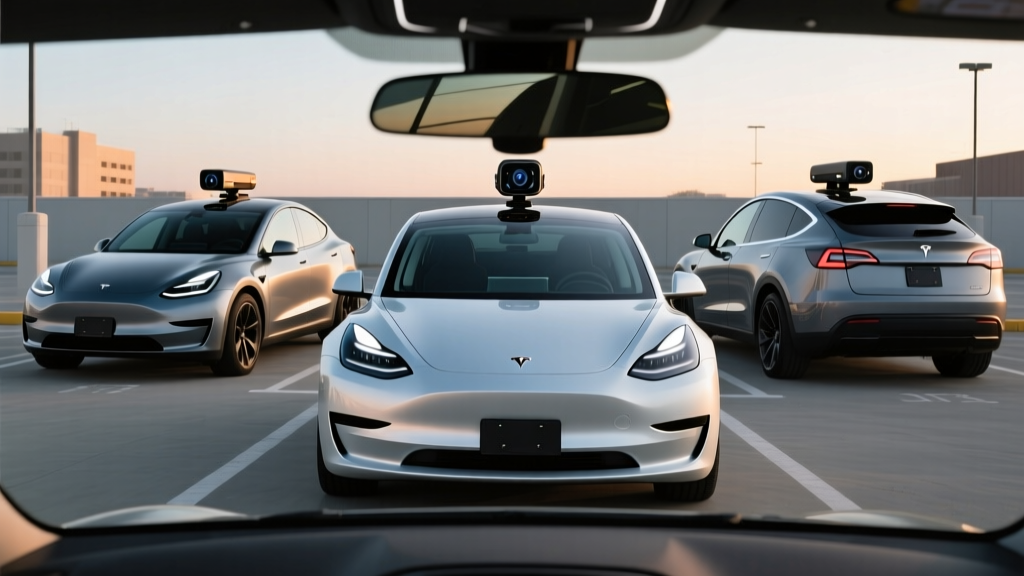
Sentry Mode is where Tesla's car cam system truly differentiates. When the car is parked and locked, the external cameras monitor the surroundings. The system operates in three escalating states:
- Standby — cameras are active, scanning for threats (minimal power draw)
- Alert — motion detected near the vehicle; cameras begin recording, screen flashes to warn the person
- Alarm — significant impact or break-in detected; alarm sounds, full clip saved, notification sent to your phone
Sentry Mode clips capture from multiple cameras — typically the front, both repeaters, and the rear — giving you a near-360-degree view of an incident. This multi-camera capture is something almost no aftermarket dashcam can match without a complex multi-lens installation.
Sentry Mode draws approximately 200-300 watts continuously. Over a 12-hour parking period, that translates to roughly 2.4-3.6 kWh consumed — about 8-12 miles of range on a Model 3 Long Range. In a week of daily use, Sentry Mode can cost you 50-70 miles of range if you don't plug in. Tesla allows you to exclude Home and Work locations to mitigate this. If you park in a secure garage, disable Sentry Mode there. The range loss is real and compounds in cold weather, where the battery is already delivering 15-30% fewer miles.
Charging Specs: Keeping the Cameras Powered
A car cam system is only useful if the car is charged and ready. Here's how the 2026 Tesla lineup charges:
| Model | Max DC Fast Charge | 10-80% Time | Level 2 Home Rate | Miles Added/Hr (L2) |
|---|---|---|---|---|
| Model 3 RWD (LFP) | 170 kW | ~30 min | 11.5 kW (48A) | ~37 mi/hr |
| Model 3 LR AWD | 250 kW | ~22 min | 11.5 kW (48A) | ~44 mi/hr |
| Model Y LR AWD | 250 kW | ~24 min | 11.5 kW (48A) | ~40 mi/hr |
| Model S LR | 250 kW | ~28 min | 11.5 kW (48A) | ~41 mi/hr |
| Model X LR | 250 kW | ~30 min | 11.5 kW (48A) | ~34 mi/hr |
| Cybertruck AWD | 250 kW (350 kW capable) | ~20 min | 11.5 kW (48A) | ~34 mi/hr |
All 2026 Teslas use the NACS (North American Charging Standard) connector natively — no adapter needed at Tesla Superchargers. The Cybertruck supports 800V architecture and can charge at up to 350 kW at V4 Supercharger stalls, though most existing stations deliver 250 kW.
Charging curve reality: The "250 kW peak" figure applies only at low state of charge (roughly 10-30%). Above 50% SoC, the rate tapers significantly. Expect an average sustained rate of roughly 100-130 kW across a 10-80% session on NMC vehicles. LFP batteries (Model 3 RWD) have a flatter charge curve but a lower peak, so the 10-80% time difference narrows in practice.
Real-World Range: What the Cameras' Power Draw Means for Your Miles
EPA range estimates provide a standardized baseline, but real-world driving — especially with Sentry Mode active and climate control running — tells a different story.
| Model | EPA Range | Highway (75 mph) | Cold Weather (20°F) | With Daily Sentry Use |
|---|---|---|---|---|
| Model 3 RWD | 272 mi | ~230-245 mi | ~195-215 mi | ~255-260 mi effective |
| Model 3 LR AWD | 341 mi | ~285-305 mi | ~245-270 mi | ~325-330 mi effective |
| Model Y LR AWD | 308 mi | ~260-280 mi | ~220-245 mi | ~290-295 mi effective |
| Model S LR | 402 mi | ~340-365 mi | ~290-320 mi | ~385-390 mi effective |
| Model X LR | 335 mi | ~280-300 mi | ~240-265 mi | ~318-322 mi effective |
| Cybertruck AWD | 340 mi | ~280-300 mi | ~240-265 mi | ~322-328 mi effective |
The "With Daily Sentry Use" column assumes ~12 hours of Sentry Mode per day, subtracting roughly 10 miles from effective range. Cold weather compounds this: the battery is less efficient, the heat pump draws more energy, and Sentry Mode's parasitic drain remains constant.
Efficiency figures (EPA combined):
- Model 3 RWD: 132 MPGe / 25 kWh/100mi
- Model 3 LR AWD: 131 MPGe / 26 kWh/100mi
- Model Y LR AWD: 120 MPGe / 28 kWh/100mi
- Model S LR: 122 MPGe / 28 kWh/100mi
- Model X LR: 108 MPGe / 31 kWh/100mi
- Cybertruck AWD: ~105 MPGe / ~34 kWh/100mi
Pricing, Tax Credits, and the Camera System's True Cost
The car cam system is standard equipment on every 2026 Tesla — there's no separate "dashcam package" to purchase. However, related features do carry costs:
- Basic Autopilot (includes Traffic-Aware Cruise Control and Autosteer): Standard, included in MSRP
- Enhanced Autopilot (adds Auto Lane Change, Navigate on Autopilot, Smart Summon, Autopark): $6,000 add-on
- Full Self-Driving (Supervised) (adds traffic light/stop sign recognition, city street Autosteer): $8,000 add-on or $99/month subscription as of 2026
| Model / Trim | Base MSRP | Federal §30D Credit | Effective Price | Notes |
|---|---|---|---|---|
| Model 3 RWD | $38,990 | Up to $3,750 | ~$35,240 | LFP battery sourcing limits credit; check IRS §30D for current critical-mineral and battery-component rules |
| Model 3 LR AWD | $42,490 | Up to $7,500 | ~$34,990 | Qualifies if buyer income ≤ $150K (single) / $300K (joint); MSRP under $55K cap |
| Model Y LR AWD | $44,990 | Up to $7,500 | ~$37,490 | Qualifies under $80K SUV MSRP cap; point-of-sale transfer available |
| Model S LR | $74,990 | $0 | $74,990 | Exceeds $55K sedan MSRP cap — does NOT qualify for §30D |
| Model X LR | $79,990 | Up to $7,500 | ~$72,490 | Under $80K SUV cap; verify battery-sourcing compliance |
| Cybertruck AWD | $79,990 | Up to $7,500 | ~$72,490 | Classified as SUV/truck; under $80K cap; sourcing rules apply |
- Buyer AGI must not exceed: $150,000 (single), $225,000 (head of household), $300,000 (married filing jointly)
- Vehicle MSRP cap: $55,000 for sedans; $80,000 for SUVs, vans, and pickup trucks
- Battery components must meet North American manufacturing thresholds (increasing yearly through 2029)
- Critical minerals must meet sourced-from-FTA-country thresholds (increasing yearly)
- Credit can be transferred to the dealer at point of sale as a down-payment reduction (new since 2024)
- Always verify current eligibility at irs.gov before purchasing — rules change annually
Storage, Setup, and Practical Camera Tips for Tesla Owners
Getting the most from Tesla's car cam system requires a few setup decisions:
USB Storage
Tesla requires a formatted USB drive (or the optional built-in SSD, available on some trims) to store dashcam and Sentry Mode clips. For reliable operation:
- Use a high-endurance microSD card in a USB adapter — Samsung PRO Endurance or SanDisk High Endurance (128GB or 256GB) rated for continuous write cycles
- Standard USB thumb drives fail quickly under Sentry Mode's constant write load; expect 3-6 months before corruption
- Format the drive as exFAT with a "TeslaCam" folder in the root directory
- A 128GB card stores approximately 20-30 hours of front-camera dashcam footage
Viewing and Exporting Footage
Clips are organized into three folders on the drive: RecentClips (rolling 10-minute buffer), SavedClips (manually saved), and SentryClips (triggered by Sentry events). Each clip is a 1-minute .mp4 file. You can view them directly on the Tesla's touchscreen (dashcam viewer app) or remove the drive and review on a computer. The touchscreen viewer lets you scrub through timelines and switch between camera angles for Sentry clips — a genuinely useful feature after a parking-lot incident.
Limitations to Accept
Tesla's car cam system has real gaps compared to dedicated dashcams:
- No interior cabin camera recording (the cabin camera exists but is not user-accessible for recording in 2026)
- No continuous multi-camera recording — only event-triggered clips from side/rear cameras
- No GPS overlay or speed stamp on exported footage (limits usefulness for insurance disputes in some jurisdictions)
- No parking-mode time-lapse or motion-zone customization like premium aftermarket systems
- Sentry Mode cannot record audio
Who Should Rely on Tesla's Built-In Car Cam — and Who Shouldn't
- Multi-camera Sentry Mode provides near-360° incident capture — unmatched by single-lens aftermarket dashcams
- Zero installation — works out of the box with a USB drive
- Integrated touchscreen viewer with timeline scrubbing
- Automatic collision-triggered clip saving
- Phone notifications when Sentry Mode triggers an alarm
- HW4 resolution improvement makes plate-reading viable in daylight
- No subscription fee for basic dashcam/Sentry functionality
- Sentry Mode parasitic drain costs 8-12 miles of range per 12-hour cycle
- No continuous all-camera recording — side/rear cameras only save event clips
- Front camera resolution (~1080p) trails premium 4K aftermarket dashcams
- No interior recording accessible to the owner
- No GPS/speed overlay on exported video
- USB drives degrade under continuous write load; requires high-endurance media
- Nighttime footage quality suffers from headlight bloom and sensor noise
- No audio recording in Sentry Mode
Choose Tesla's built-in car cam if: You want zero-fuss parking surveillance with multi-angle coverage, you mostly drive in daylight or well-lit areas, you value phone alerts when your car is disturbed, and you accept a modest range trade-off from Sentry Mode.
Add an aftermarket dashcam (e.g., BlackVue DR970X or Thinkware U3000) if: You need 4K front recording for insurance/litigation purposes, you want interior cabin recording (rideshare drivers), you need GPS/speed overlays on footage, you want parking-mode time-lapse without Sentry Mode's range drain, or you drive extensively at night on unlit roads where HW4's low-light performance falls short.
Run both if: You're a rideshare driver or live in a high-vandalism area. The Tesla system handles parked surveillance; the aftermarket unit handles high-quality continuous forward recording with GPS stamps.
Warranty, Reliability, and Long-Term Camera Ownership
Tesla's camera hardware is covered under the vehicle's limited warranty:
| Coverage | Terms |
|---|---|
| Basic Vehicle Limited Warranty | 4 years / 50,000 miles |
| Battery & Drive Unit (Model 3/Y) | 8 years / 100,000 miles (120,000 mi for LR/AWD) |
| Battery & Drive Unit (Model S/X) | 8 years / 150,000 miles |
| Battery Capacity Retention | Minimum 70% over warranty period |
Camera failures are relatively uncommon but not unheard of — condensation inside the camera housing was a known issue on early HW3 vehicles. HW4 units have shown improved sealing. If a camera fails under warranty, Tesla replaces it at no charge. Out of warranty, individual camera replacement runs approximately $300-$600 per unit including labor, based on owner reports.
Battery longevity context: LFP batteries (Model 3 RWD) are rated for 3,000+ charge cycles before reaching 80% capacity — potentially 500,000+ miles. NMC batteries (Long Range models, S/X, Cybertruck) are typically rated for 1,500-2,000 cycles, translating to roughly 250,000-350,000 miles. Sentry Mode's parasitic drain adds micro-cycles but does not meaningfully accelerate degradation compared to normal driving cycles. Source: battery degradation data from NHTSA filings and independent testing by Recurrent Auto.
Frequently Asked Questions
What is the real-world range of Tesla models with Sentry Mode active?
Expect to lose roughly 8-12 miles of range per 12-hour Sentry Mode session. On a Model 3 Long Range (EPA 341 mi), real-world highway driving yields ~285-305 mi, and cold weather (20°F) drops that to ~245-270 mi. With daily Sentry use factored in, effective daily range is approximately 325-330 mi for the Model 3 LR.
How fast does a Tesla charge at home and on DC fast chargers?
On a Level 2 home charger (11.5 kW / 48A), expect 34-44 miles of range added per hour depending on the model. At a DC fast charger, peak rates reach 250 kW on NMC models (170 kW on LFP Model 3 RWD), with a 10-80% session taking 20-30 minutes. Sustained average rates are lower — roughly 100-130 kW — due to charge-curve tapering above 50% SoC.
How much does a Tesla cost after federal tax credits in 2026?
The Model 3 Long Range AWD at $42,490 can drop to approximately $34,990 with the full $7,500 §30D credit (if you meet income caps and the battery meets sourcing requirements). The Model Y Long Range at $44,990 can reach ~$37,490. Model S does not qualify (exceeds the $55K sedan MSRP cap). Always verify current rules at irs.gov.
Is Tesla's built-in dashcam worth it vs. buying an aftermarket unit?
For parking surveillance, Tesla's Sentry Mode is superior to most aftermarket solutions because it captures from multiple cameras simultaneously. For continuous high-quality forward recording (especially at night or for rideshare use), a dedicated 4K aftermarket dashcam with GPS overlay is a better choice. Many owners run both.
Does Tesla's car cam record audio?
No. Neither the dashcam nor Sentry Mode records audio. This is likely a privacy/legal compliance decision, as audio recording laws vary by state (some require two-party consent).
Can I view Sentry Mode clips on my phone remotely?
As of 2026, Tesla sends a notification to your phone when Sentry Mode triggers an alarm event, but you cannot live-stream or remotely view stored clips without physically accessing the USB drive or the car's touchscreen. Tesla has hinted at remote clip access via the app, but it has not been released.
What USB drive do I need for Tesla's dashcam and Sentry Mode?
Use a high-endurance microSD card (Samsung PRO Endurance or SanDisk High Endurance, 128GB+) in a USB-A adapter. Standard thumb drives fail within months under Sentry Mode's continuous write load. Format as exFAT and create a "TeslaCam" folder in the root directory.
Does Tesla's car cam system replace the need for a dashcam for insurance claims?
Partially. The front dashcam footage can support insurance claims, but the lack of GPS/speed overlay means some insurers or legal jurisdictions may not accept it as definitive evidence. For maximum claim support, an aftermarket dashcam with embedded GPS and speed data is more robust.
The Bottom Line on Tesla's Car Cam in 2026
Tesla's car cam system — spanning dashcam and Sentry Mode — is one of the most integrated surveillance solutions in any production vehicle. The multi-camera Sentry Mode is genuinely best-in-class for parking-lot incident capture, and the HW4 resolution upgrade makes daytime plate reading viable. But it's not a complete replacement for a dedicated dashcam: the ~1080p front recording, lack of GPS stamps, no audio, and Sentry Mode's real range cost (8-12 miles per day) are meaningful trade-offs.
If you're buying a 2026 Tesla primarily for the camera system, know that you're getting excellent parked-car surveillance and adequate driving footage — not professional-grade recording. Pair it with a high-endurance USB drive, disable Sentry Mode at secure locations to preserve range, and consider a supplemental aftermarket dashcam if your use case demands it.