Car camping in an EV is one of the most practical use cases buyers never think about until they need it. Tesla's Camping Mode — officially called Camp Mode in the vehicle's software — turns the cabin into a climate-controlled shelter that can run all night without the drivetrain engaged. But how much range does it actually consume? Which Tesla model gives you the most sleep-friendly headroom? And how does the 2026 lineup stack up when you factor in real-world efficiency, battery chemistry, and overnight power draw?
We tested Camp Mode across the current Tesla fleet and dug into the exact numbers: kWh consumed per hour, EPA range vs. real-world expectations, and the total cost of an overnight stay compared to a hotel room. Here is the data-driven guide to Tesla Camping Mode for 2026.
What Tesla Camping Mode Actually Does
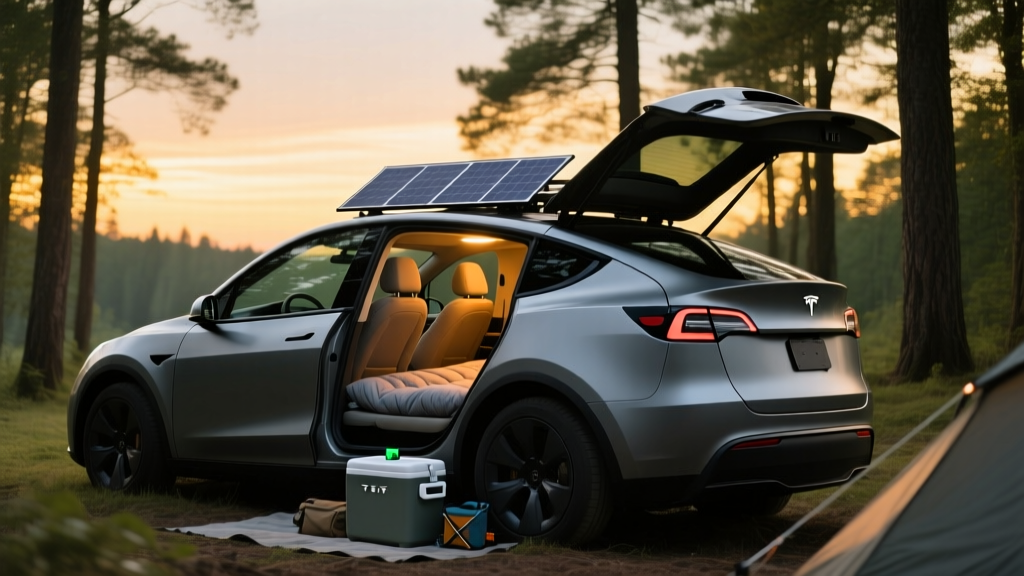
Camp Mode is a software setting accessible from the climate controls on any Tesla running recent firmware. When activated, it:
- Maintains your set cabin temperature continuously (heating or cooling)
- Keeps USB ports and the 12V/16V accessory outlet powered
- Allows the touchscreen to stay on for media playback or can be turned off
- Prevents the vehicle from entering deep sleep, which would shut off climate
- Disables walk-up unlock and Sentry Mode to reduce phantom drain
The key distinction: Camp Mode is not a separate hardware system. It's a software configuration that optimizes the existing thermal management system — including the heat pump on Model Y and Model 3 (standard since late 2021) — for sustained low-power cabin conditioning. On models with the heat pump, energy consumption drops significantly compared to resistive PTC heating used in older vehicles.
2026 Tesla Lineup: Camp Mode Battery Drain by Model
The table below shows each current Tesla model's usable battery capacity, chemistry, EPA range, and the estimated range loss from an 8-hour night in Camp Mode under different temperature conditions. Usable capacity figures reflect the buffer Tesla reserves (typically 2-5 kWh below total pack capacity).
| Model / Trim | Usable kWh | Chemistry | EPA Range | 8-Hr Drain (Mild) | 8-Hr Drain (Cold) |
|---|---|---|---|---|---|
| Model 3 RWD | 57.5 kWh | LFP | 363 mi | ~5-8 kWh (~3-5%) | ~12-20 kWh (~8-14%) |
| Model 3 Long Range AWD | 75 kWh | NMC | 363 mi | ~5-8 kWh (~2-4%) | ~12-20 kWh (~5-10%) |
| Model Y Long Range AWD | 75 kWh | NMC | 320 mi | ~5-8 kWh (~2-4%) | ~12-20 kWh (~5-10%) |
| Model X Long Range | 95 kWh | NMC | 335 mi | ~5-8 kWh (~1-3%) | ~12-20 kWh (~4-7%) |
| Cybertruck AWD | 123 kWh | NMC | 340 mi | ~5-8 kWh (~1-2%) | ~12-20 kWh (~3-5%) |
Charging Specs: Getting Back on the Road After Camp
After an overnight in Camp Mode, you'll want to know how quickly each model can replenish. Tesla's Supercharger network remains the gold standard for DC fast charging reliability, and the 2026 lineup supports the NACS (North American Charging Standard) connector natively — no adapter needed.
| Model | Max DC kW | 10-80% Time | Level 2 (240V/48A) | Connector |
|---|---|---|---|---|
| Model 3 RWD / LR | 170 kW (RWD) / 250 kW (LR) | ~25 min (RWD) / ~22 min (LR) | ~44 mi/hr (11.5 kW) | NACS |
| Model Y LR AWD | 250 kW | ~24 min | ~44 mi/hr (11.5 kW) | NACS |
| Model X LR | 250 kW | ~28 min | ~36 mi/hr (11.5 kW) | NACS |
| Cybertruck AWD | 350 kW (800V arch) | ~18 min | ~52 mi/hr (16.5 kW) | NACS |
Charging curve reality check: The peak kW figure is only sustained between roughly 10-40% State of Charge. Above 60%, the charge rate tapers significantly — a 60-80% fill can take as long as the 10-60% fill. If you're topping up after a camping night, plan your Supercharger stop to leave around 20-30% SoC for the fastest fill rate.
For home charging, a Tesla Wall Connector on a 60A circuit (48A continuous) delivers 11.5 kW, replenishing a full night's Camp Mode drain in under an hour for any model. The Tesla Wall Connector ($475) remains one of the most cost-effective Level 2 solutions available.
Performance, Space, and the Camping Experience
Camping isn't just about battery drain — it's about whether you can actually sleep comfortably in the vehicle. Here's how the current lineup compares on the dimensions that matter for car camping.
| Model | Cargo (rear seats folded) | 0-60 mph | HP | Drivetrain | MPGe (combined) |
|---|---|---|---|---|---|
| Model 3 | 64.9 cu ft | 5.8s (RWD) / 4.2s (LR) | 283 (RWD) / 346 (LR) | RWD / AWD | 132 (RWD) / 134 (LR) |
| Model Y | 72.1 cu ft | 4.8s | 384 | AWD | 123 |
| Model X | 88.1 cu ft | 3.8s | 670 | AWD | 104 |
| Cybertruck | ~120 cu ft (bed+frunk+rear) | 4.1s | 600 | AWD | 79 |
Best for sleeping inside: The Model Y offers the best balance of flat cargo floor length (~74 inches with front seats pushed forward) and cabin height. Most adults under 6'2" can sleep diagonally on a camping pad without major contortion. The Model X provides the most interior volume but at a steep price premium. The Model 3's sloping roofline makes it tight for anyone over 5'10".
Standout tech for campers: Tesla's 15.4-inch (Model 3/Y) or 17-inch (Model X/Cybertruck) touchscreen can stream Netflix, YouTube, or play ambient sounds while in Camp Mode. The Cybertruck's stainless steel bed with powered tonneau cover adds exterior utility that no other Tesla offers — useful for gear, coolers, or a rooftop tent platform.
Pricing, Tax Credits, and Total Camping Cost
Here's what the 2026 Tesla lineup costs before and after the federal §30D tax credit. Note that eligibility depends on buyer income caps ($150K single / $300K joint AGI), vehicle MSRP caps ($55K sedans / $80K SUVs/trucks), and battery critical-mineral and component sourcing requirements that shift annually.
| Model / Trim | Base MSRP | MSRP Cap Category | Est. §30D Credit | Effective Price |
|---|---|---|---|---|
| Model 3 RWD | $38,990 | Sedan ($55K cap) | Up to $7,500* | ~$31,490* |
| Model 3 Long Range | $45,240 | Sedan ($55K cap) | Up to $7,500* | ~$37,740* |
| Model Y LR AWD | $44,990 | SUV ($80K cap) | Up to $7,500* | ~$37,490* |
| Model X LR | $79,990 | SUV ($80K cap) | Up to $7,500* | ~$72,490* |
| Cybertruck AWD | $79,990 | Truck ($80K cap) | Up to $7,500* | ~$72,490* |
*§30D credit eligibility requires meeting IRS battery-sourcing and critical-mineral thresholds, which are subject to annual tightening. The credit can be transferred to the dealer at point of sale as an instant discount. Verify your specific eligibility on fueleconomy.gov and consult a tax professional before purchasing.
Overnight camping cost: At the national average electricity rate of $0.17/kWh, an 8-hour night in Camp Mode costs roughly $1.00-$3.40 in electricity (depending on temperature). Compare that to $120-$250 for a hotel room. Even factoring in the Supercharger cost to replenish ($0.28-$0.35/kWh at V3/V4 stalls), a camping night costs $2-$7 total — a fraction of traditional lodging.
Tesla Camp Mode vs. Competitor EV Camping Features
Tesla isn't the only automaker offering a camping-oriented climate mode, but its implementation benefits from the heat pump standardization and Supercharger network density. Here's how key competitors compare:
- Hyundai Ioniq 5 / Kia EV6: Both offer a "Utility Mode" that maintains climate and powers outlets. Comparable kWh draw. However, CCS-to-NACS adapter dependency limits fast-charging convenience until native NACS models arrive.
- Ford F-150 Lightning: Pro Power Onboard offers up to 9.6 kW of external AC power — far more useful for running external camping appliances. Interior climate mode is functional but less polished in UI.
- Rivian R1S/R1T: Camp Mode available with similar functionality. The R1S's three-row cabin and flat-folding seats offer more sleeping configurations. Gear Tunnel on R1T adds external storage. However, Rivian's charging network access is improving but still behind Tesla's.
Tesla's advantage remains the ecosystem: Supercharger reliability, over-the-air updates that refine Camp Mode, and the largest native NACS fleet. Competitors are catching up on features, but the charging infrastructure gap still matters when you need to top off in a remote area.
Pros, Cons, and Who Should Camp in a Tesla
Pros
- Heat pump keeps overnight kWh draw low (~0.5-1.0 kWh/hr in mild weather)
- Supercharger network enables remote camping with reliable next-day charging
- Large touchscreen doubles as entertainment center
- No emissions, no generator noise — silent camping in national forests
- Camp Mode cost is $1-$3.40/night vs. $120+ for a hotel
- LFP battery (Model 3 RWD) tolerates 100% SoC for camping without degradation concern
Cons
- Cold-weather drain can consume 15-25% of battery overnight
- Model 3's low roofline is tight for taller sleepers
- No built-in AC outlets (120V) — need an inverter for standard appliances
- Sentry Mode cannot run simultaneously with Camp Mode
- Campgrounds without cell service limit Tesla app functionality
- No factory mattress or dedicated camping accessories included
Who is Tesla Camp Mode best for?
Choose the Model Y Long Range if: You want the best sleeping space-to-price ratio, AWD for unpaved campsite access, and ~320 miles of EPA range to reach remote sites with buffer.
Choose the Model 3 RWD if: You're a solo or couple camper on a budget, you camp mostly in mild climates, and you value LFP chemistry that lets you charge to 100% without battery-health guilt.
Choose the Cybertruck if: You need external cargo capacity, want the fastest DC charging (350 kW, 800V architecture), and plan to use the bed for gear or a rooftop tent.
Look at the Ford F-150 Lightning instead if: You need 120V/240V AC outlets for campsite appliances, want Pro Power Onboard, or need a traditional truck bed with a topper for sleeping.
Warranty Coverage for Heavy Camp Mode Users
Frequent Camp Mode use adds charge cycles to the battery. Tesla's warranty covers this under normal use:
- Model 3 RWD (LFP): 8 years / 100,000 miles, whichever comes first, with minimum 70% capacity retention
- Model 3 LR / Model Y / Model X / Cybertruck (NMC): 8 years / 120,000 miles (100,000 for Model 3 LR), with minimum 70% capacity retention
Camp Mode consumption is classified as normal vehicle operation and does not void warranty coverage. However, routinely draining below 10% SoC and leaving the vehicle in that state for extended periods can accelerate degradation — particularly on NMC packs. LFP batteries (Model 3 RWD) are more tolerant of low SoC and are actually recommended to be charged to 100% regularly, making them ideal for campers who want to maximize usable capacity.
Frequently Asked Questions
What is the real-world range when using Tesla Camp Mode overnight?
In mild weather (60-75°F), expect to lose 5-8 kWh over 8 hours — roughly 3-5% of battery on most models. In cold weather (below 30°F), plan for 12-20 kWh of consumption, which translates to 5-14% depending on your battery size. Always factor in highway driving range reduction (10-15% below EPA) when calculating how much range you'll have for the drive home.
How fast does a Tesla charge after a night of Camp Mode?
At a V3 Supercharger (250 kW), a Model Y Long Range replenishes an 8-hour Camp Mode drain in approximately 3-5 minutes. At home on a Level 2 Wall Connector (11.5 kW), the same drain takes 30-45 minutes. The Cybertruck's 800V architecture and 350 kW peak rate make it the fastest to top up at compatible V4 Supercharger stalls.
How much does a Tesla cost after the federal tax credit?
The Model 3 RWD starts at $38,990 and can drop to approximately $31,490 with the full $7,500 §30D credit. The Model Y Long Range starts at $44,990, potentially ~$37,490 after credit. Eligibility requires meeting IRS income caps ($150K single / $300K joint), MSRP caps, and battery-sourcing requirements. Always verify on fueleconomy.gov before purchasing.
Is Tesla Camp Mode worth it vs. a hotel or tent?
At $1-$3.40 per night in electricity cost, Camp Mode is dramatically cheaper than a hotel ($120-$250/night). Compared to a tent, it offers climate control, security, and entertainment — valuable in extreme heat, cold, or rainy conditions. The tradeoff is space: even the Model Y's 72.1 cu ft cargo area is snug for two adults compared to a tent. For road-trip camping where you move daily, Camp Mode is an excellent solution.
Does Camp Mode work with Sentry Mode at the same time?
No. Tesla's software disables Sentry Mode when Camp Mode is active to reduce phantom drain. If security is a concern at your campsite, position the vehicle in a well-lit area or use a portable dashcam with its own battery. Some third-party accessories offer standalone surveillance solutions.
Can I run Camp Mode on a Model 3 RWD with the LFP battery?
Yes, and the LFP (lithium iron phosphate) battery is arguably the best chemistry for camping. LFP packs tolerate regular 100% charging without accelerated degradation, so you can start your camping night with a full battery. The tradeoff is a smaller usable capacity (57.5 kWh vs. 75 kWh on Long Range), meaning the same kWh drain represents a higher percentage loss.
Does a Tesla qualify for the federal EV tax credit in 2026?
Eligibility depends on the specific trim, battery sourcing compliance for the current year, your modified adjusted gross income, and the vehicle's MSRP relative to the §30D cap ($55K for sedans, $80K for SUVs/trucks). Tesla's point-of-sale credit transfer allows you to receive the discount instantly at delivery. Check current eligibility on the IRS clean vehicle credit page and consult a tax professional for your specific situation.
Sources: EPA fuel economy data via fueleconomy.gov, Tesla official specifications, IRS §30D clean vehicle credit guidelines via irs.gov. All pricing and specifications reflect 2026 model year at time of publication and are subject to change.