What Is Tesla Camping Mode and Why Do EV Owners Use It?
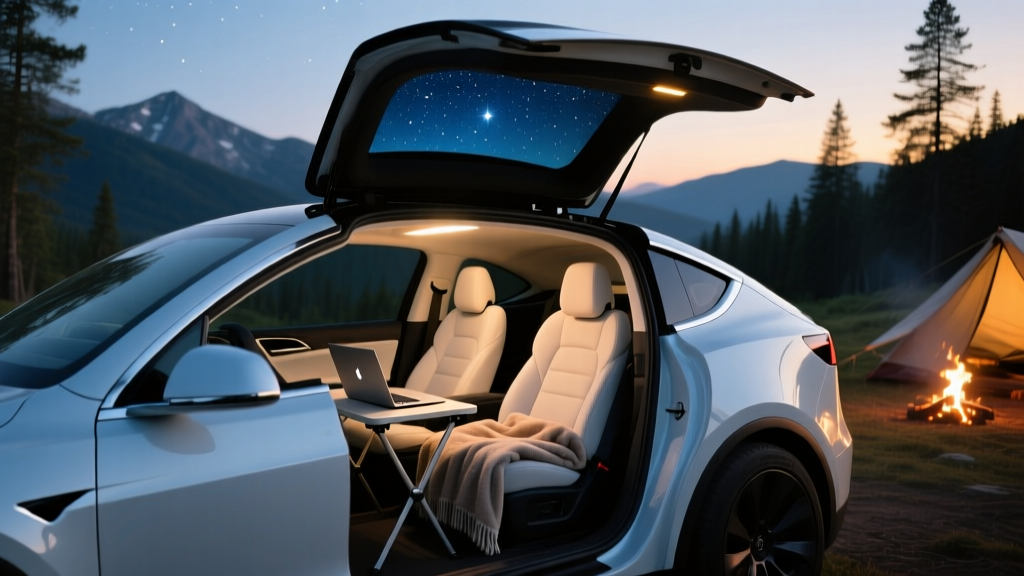
Tesla's Camping Mode is a dedicated climate-control setting that keeps the cabin at a comfortable temperature, maintains airflow, and powers USB outlets and the touchscreen entertainment system while the vehicle is parked. Unlike simply leaving climate control on, Camping Mode is engineered for extended stationary use — think overnight car camping, tailgating, or a rest stop nap — without the car automatically shutting systems down.
When you activate Camping Mode (via the climate menu on the touchscreen), the vehicle disables auto-shutoff timers, keeps the HVAC system running at your set temperature, and ensures the 12V auxiliary battery stays charged from the high-voltage traction pack. You can stream Netflix or YouTube on the center display, play music through the premium audio system, and keep devices charged all night.
This feature has turned Tesla models into surprisingly capable camping platforms, eliminating the need for portable power stations or generators. But how much range does it actually consume, and which Tesla model is best suited for sleeping in? Let's break down the feature alongside the full specs of the most popular Tesla for camping: the 2026 Tesla Model Y Long Range AWD.
How Much Range Does Camping Mode Actually Use?
The big question for any EV camper: will you wake up to a dead battery? In real-world testing and owner reports, Camping Mode typically draws between 1–2% of battery capacity per hour in mild weather (60–75°F). In colder conditions (below 40°F), the heat pump works harder and consumption can climb to 3–4% per hour.
- Mild weather (65°F): ~8–16% battery used, roughly 25–50 miles of range lost
- Cold weather (30°F): ~24–32% battery used, roughly 75–100 miles of range lost
- Hot weather with A/C (95°F): ~12–20% battery used, roughly 38–65 miles of range lost
Bottom line: in moderate temperatures, an 8-hour night costs you about 30–40 miles of range — manageable if you plan your charging stops accordingly.
The Tesla Model Y Long Range AWD's 75 kWh (usable) LFP or NMC battery pack (chemistry varies by production batch and region) gives you a substantial buffer. With an EPA-estimated 320 miles of range, you can comfortably camp overnight and still have 250+ miles remaining in mild conditions.
2026 Tesla Model Y Long Range AWD: Full Specifications
| Specification | Value |
|---|---|
| EPA Estimated Range | 320 miles |
| Real-World Highway Range | ~270–290 mi (70–80 mph); ~220–250 mi in cold weather |
| Battery Capacity (Usable) | ~75 kWh |
| Battery Chemistry | NMC (Long Range AWD); LFP available on RWD Standard Range |
| MPGe (Combined) | 122 MPGe |
| Efficiency | 28 kWh/100 mi |
| Max DC Fast Charge Rate | 250 kW (peak) |
| 10–80% DC Fast Charge Time | ~25 minutes |
| Level 2 Home Charging Rate | 11.5 kW (~44 mi/hr) |
| 0–60 mph | 4.8 seconds |
| Horsepower | 384 hp (dual motor) |
| Drivetrain | Dual Motor AWD |
| Cargo Volume (rear seats up) | 30.2 cu ft |
| Cargo Volume (rear seats folded) | 72.0 cu ft |
| Rear Legroom | 38.4 inches |
| Battery Warranty | 8 years / 120,000 miles (70% minimum retention) |
| Basic Vehicle Warranty | 4 years / 50,000 miles |
Source: fueleconomy.gov, Tesla official specifications.
Charging Speed: DC Fast Charging and Home Setup
| Charging Level | Power (kW) | Miles Added per Hour | Notes |
|---|---|---|---|
| Level 1 (120V household) | ~1.4 kW | ~4–5 mi/hr | Emergency/trickle only |
| Level 2 (240V, 48A Wall Connector) | 11.5 kW | ~44 mi/hr | Full charge in ~7 hours |
| DC Fast Charge (V3 Supercharger) | 250 kW peak | ~180 mi in 15 min | Peak rate to ~50%; tapers above 80% |
| DC Fast Charge (V4 Supercharger) | Up to 325 kW* | ~200 mi in 15 min | *Model Y acceptance rate limited to ~250 kW |
A critical detail for road-trip campers: the Model Y's charge curve peaks at 250 kW only between roughly 10–50% state of charge (SoC). Above 60%, the rate tapers significantly. A 10–80% session takes approximately 25 minutes at a V3 Supercharger, but the last 20% (80–100%) can add another 20+ minutes. For camping trips, plan to charge to 80% at your last Supercharger stop before reaching your campsite — you rarely need a full 100% and the time savings are substantial.
At home, Tesla's Wall Connector on a 60-amp circuit delivers 11.5 kW, replenishing roughly 44 miles of range per hour. A full overnight charge from 20% to 100% takes about 7 hours — ideal for pre-trip preparation.
Camping Mode Features Breakdown: What Stays On and What Doesn't
When Camping Mode is active, the following systems remain operational:
- HVAC system: Maintains your set cabin temperature continuously (heat pump on Model Y)
- USB-A and USB-C ports: Power delivery stays active for phones, laptops, and accessories
- Touchscreen entertainment: Netflix, YouTube, Spotify, and arcade games remain available
- Interior lighting: Manually controllable; won't auto-shut off
- Premium audio system: Full access to streaming and Bluetooth audio
- 12V battery maintenance: The DC-DC converter keeps the 12V battery topped up from the traction pack
Systems that are disabled or modified in Camping Mode:
- Walk-away auto-lock: Disabled to prevent accidental lockouts
- Auto climate shutoff: Normally, climate turns off after 30 minutes when parked — Camping Mode overrides this
- Sentry Mode: Cannot run simultaneously with Camping Mode (as of 2026 software). Choose one or the other. If security is a concern at your campsite, this is a trade-off to plan for.
- Automatic frunk/trunk open: Key fob proximity triggers are suppressed
Pro tip: You can activate Camping Mode remotely via the Tesla app before you arrive at your campsite, pre-cooling or pre-heating the cabin so it's comfortable the moment you park.
Pricing, Trims, and Federal Tax Credit Eligibility
| Trim | MSRP | Est. After §30D Credit | Federal Credit Eligible |
|---|---|---|---|
| Model Y Long Range AWD | $44,990 | ~$37,490 | Yes (up to $7,500)* |
| Model Y Performance AWD | $48,990 | ~$41,490 | Yes (up to $7,500)* |
| Model Y Standard Range RWD | $39,990 | ~$32,490 | Yes (up to $7,500)* |
*Federal EV tax credit (IRS §30D) eligibility depends on multiple requirements that can change annually. As of 2026, key rules include:
- MSRP cap: SUVs must be priced at or below $80,000 (all Model Y trims qualify)
- Buyer income cap: Modified AGI must not exceed $150,000 (single), $225,000 (head of household), or $300,000 (joint filers)
- Battery sourcing: Critical minerals and battery components must meet phased-in domestic/FHA-sourcing thresholds — Tesla has largely met these requirements for US-built Model Y, but verify at purchase
- Point-of-sale transfer: Eligible buyers can apply the credit as an immediate price reduction at the dealer rather than waiting for tax filing
Always confirm current eligibility with your tax professional and the IRS clean vehicle credit page before purchasing, as battery-sourcing compliance can shift with supply-chain changes.
Tesla Model Y Pros and Cons for Camping and Daily Driving
Pros
- Camping Mode is best-in-class: no other mainstream EV offers this level of integrated overnight climate + entertainment
- Flat-folding rear seats create a near-level sleeping platform (~72 cu ft cargo)
- Heat pump is standard — significantly reduces HVAC energy draw in cold weather vs resistive heating
- Supercharger network remains the most reliable and widespread DC fast-charging ecosystem in the US
- Over-the-air updates continuously add features (recent updates improved Camping Mode battery management)
- 250 kW peak DC charging is competitive for the segment
- Strong resale value relative to non-Tesla EVs
Cons
- Sentry Mode and Camping Mode cannot run simultaneously — security trade-off at campsites
- No V2L (vehicle-to-load) power output — you cannot power external AC devices directly from the car (unlike Hyundai Ioniq 5 or Ford F-150 Lightning)
- Rear-seat headroom is tighter than competitors (38.4" legroom is adequate but not class-leading)
- Phantom drain: even without Camping Mode, parked Model Y can lose 1–3% per day from background processes
- Insurance premiums remain above segment average
- Minimal physical controls — everything runs through the touchscreen, which some find distracting
Is the Model Y the Best EV for Camping? Competitor Context
The Model Y is arguably the most popular EV for camping thanks to Tesla's integrated Camping Mode and the Supercharger network's reach into rural areas. But it's not the only option:
- Hyundai Ioniq 5: Offers V2L (powers external devices like a coffee maker or lights) but lacks a dedicated camping climate mode. EPA range: 305 mi. Starting at ~$42,000.
- Ford F-150 Lightning: Best for serious campers who need truck utility and Pro Power Onboard (up to 9.6 kW V2L). Range: 320 mi (Extended Range). Much larger footprint at campsites.
- Rivian R1S: Purpose-built adventure SUV with integrated camp kitchen accessories. Starting at ~$79,900 — premium pricing. Range: up to 352 mi.
For most car-campers who want a simple sleep-in-the-back setup with climate control and entertainment, the Model Y Long Range hits the sweet spot of range, interior space, price, and charging infrastructure.
Who Should Buy the Tesla Model Y for Camping and Daily Use?
The Model Y Long Range AWD is ideal for:
- Weekend campers who want a no-generator, no-extra-gear sleep setup
- Daily commuters with 30–80 mile round trips who can charge at home overnight
- Small families (2 adults + 2 children) who need cargo flexibility
- Road-trippers who value Supercharger network coverage over rural destinations
It's less suited for:
- Those who need to power external camping equipment (choose a V2L-equipped EV instead)
- Large families needing three rows (consider the Model X or Rivian R1S)
- Buyers in apartments without home charging access (public charging for camping trips adds complexity)
Frequently Asked Questions
Can you run Camping Mode all night without draining the battery?
Yes. In mild weather (60–75°F), Camping Mode uses roughly 8–16% of battery over 8 hours. With the Model Y Long Range's 320-mile EPA range, you'll wake up with approximately 270–290 miles of range remaining. In extreme cold (below 20°F), budget for up to 30% overnight consumption.
Does Camping Mode work on all Tesla models?
Camping Mode is available on Model 3, Model Y, Model S, and Model X via software. The feature set is identical across models, though battery capacity and overnight range impact vary. Model 3's smaller cabin heats and cools slightly faster; Model S/X offer more interior sleeping space.
Can I use Camping Mode and Sentry Mode at the same time?
No. As of 2026 Tesla software, Camping Mode and Sentry Mode are mutually exclusive. If campsite security is a concern, consider using Camping Mode for sleep hours and switching to Sentry Mode when you step away from the vehicle during the day.
Does the Tesla Model Y have V2L (vehicle-to-load) capability?
No. The Model Y does not offer V2L or vehicle-to-home (V2H) capability. You cannot plug external AC devices (coolers, lights, laptops via AC adapter) directly into the vehicle. USB ports provide DC power for smaller electronics. If V2L is a priority, consider the Hyundai Ioniq 5, Kia EV6, or Ford F-150 Lightning.
How do I make the Model Y cargo area flat for sleeping?
Fold the 60/40 split rear seats forward. The resulting surface is nearly flat with a slight incline. Many owners use a purpose-fit camping mattress (brands like Tesmat or Exped make Model Y-specific pads) that bridges the gap and creates a comfortable sleeping platform for two adults. The 72 cu ft maximum cargo volume accommodates most inflatable or foam mattresses.
Does the Model Y qualify for the $7,500 federal EV tax credit?
The US-built Model Y currently qualifies for the full $7,500 federal tax credit under IRS §30D, subject to buyer income limits ($300,000 joint / $150,000 single), the $80,000 SUV MSRP cap, and battery-sourcing compliance. The credit can be applied at point of sale as an immediate price reduction. Verify current eligibility at irs.gov before purchase.
What is the real-world range of the Model Y Long Range AWD?
The EPA rates the 2026 Model Y Long Range AWD at 320 miles. In real-world highway driving at 75 mph, expect 270–290 miles. In winter conditions (30°F or below), range drops to approximately 220–250 miles due to battery chemistry limitations and increased HVAC load. The heat pump helps mitigate cold-weather loss compared to older resistive-heater EVs.