The Real Cost of Insuring an EV: Discounts, Premiums, and the Bottom Line
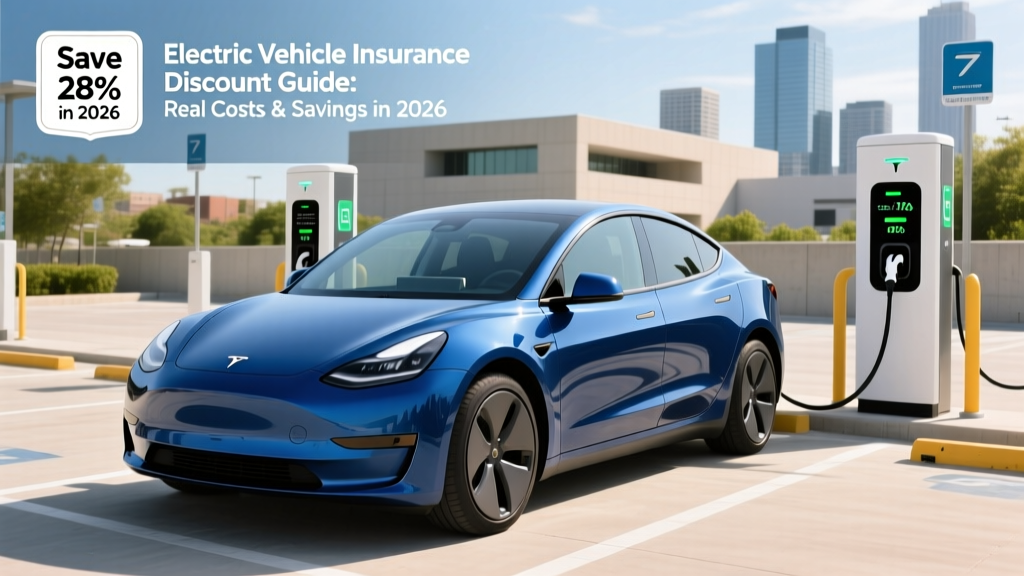
Search for "electric vehicle insurance discount" and you'll find a confusing mix of marketing claims and outdated advice. Some insurers advertise green-vehicle discounts of 5-10%, while others quietly charge EV owners 20-30% more than comparable gas-car drivers. The truth about EV insurance in 2026 is nuanced: while a handful of carriers offer modest discounts, the structural cost of insuring an electric vehicle remains higher than its internal-combustion counterpart — and understanding why is essential before you sign a purchase agreement.
This guide breaks down the full five-year ownership picture. Insurance is just one line item alongside purchase price, federal and state incentives, charging costs, maintenance savings, and depreciation. Only by looking at the total cost of ownership (TCO) can you determine whether an EV genuinely saves you money — or costs you more than you bargained for.
Why EV Insurance Typically Costs More Than Gas Cars
Before chasing an electric vehicle insurance discount, it helps to understand the baseline. According to industry data, the average EV insurance premium in 2025-2026 runs approximately 15-25% higher than a comparably priced gas vehicle. Several factors drive this gap:
- Higher repair costs: EV battery packs, power electronics, and specialized sensors (LiDAR, radar, cameras for ADAS) are expensive to replace after a collision. A minor fender-bender that damages a front-mounted radar unit and cooling loop can total out a section of repair costs that would be trivial on a conventional sedan.
- Specialized labor: Fewer body shops have high-voltage-certified technicians. Insurance adjusters factor in the premium shops charge for certified EV repair work.
- Higher vehicle MSRP: Even as prices fall, the average transaction price for a new EV remains above the average gas car. Higher replacement value means higher premiums.
- Parts availability: Supply-chain constraints on specific EV components (battery modules, inverters, structural castings) can extend repair timelines, increasing rental-car payouts insurers must cover.
That said, EVs also have traits that reduce certain risk categories. Electric motors have far fewer moving parts, meaning less likelihood of a mechanical breakdown causing an accident. Regenerative braking reduces brake wear, keeping stopping performance consistent. And EVs tend to attract owners who drive fewer annual miles — a factor some insurers reward.
Which Insurers Actually Offer EV Discounts?
A handful of major carriers offer what they term "green vehicle" or "eco" discounts, typically in the 5-10% range. These are not universal, and eligibility often depends on your state, policy type, and driving record. Examples include:
- Liberty Mutual: Offers a green-vehicle discount in select states for battery-electric and plug-in hybrid vehicles.
- Farmers Insurance: Has offered an alternative-fuel vehicle discount in certain markets.
- GEICO and Progressive: Do not currently advertise a dedicated EV discount, though competitive rates may still beat carriers that do.
- Tesla Insurance: Available in a growing number of states, priced using real-time telematics from the vehicle. Safe Tesla drivers have reported meaningful savings, though rates adjust monthly based on driving behavior.
The most reliable way to find an electric vehicle insurance discount is to bundle quotes from at least four carriers, explicitly asking about EV-specific programs. Telematics-based programs (where you share driving data) tend to benefit low-mileage, careful EV drivers the most.
Federal Tax Credit: The §30D Rules You Need to Know
The single largest financial incentive for EV buyers remains the federal IRS §30D Clean Vehicle Credit, which offers up to $7,500 for qualifying new EVs and up to $4,000 for qualifying used EVs. However, "up to" is the operative phrase. Eligibility depends on a stack of requirements that change periodically and disqualify many popular models.
§30D New EV Credit Eligibility Checklist (2026)
- Buyer income cap: Modified adjusted gross income (MAGI) must not exceed $150,000 (single), $225,000 (head of household), or $300,000 (married filing jointly).
- Vehicle MSRP cap: Vans, SUVs, and pickup trucks must have an MSRP ≤ $80,000. Sedans and other passenger cars must have an MSRP ≤ $55,000.
- Battery component sourcing: A percentage of battery components must be manufactured or assembled in North America (the threshold increases annually — check current IRS guidance).
- Critical minerals sourcing: A percentage of critical minerals in the battery must be sourced from the U.S. or a free-trade-agreement partner (also escalating annually).
- Final assembly: Vehicle must undergo final assembly in North America. Verify at fueleconomy.gov.
- Point-of-sale transfer: As of 2024, buyers can transfer the credit to the dealer at point of sale, reducing the purchase price directly rather than waiting for a tax refund.
- One credit per four-year period: Each taxpayer can claim the new-vehicle credit once every four years (VIN-locked).
Rules are subject to legislative and regulatory changes. Always verify current eligibility at irs.gov and consult a tax professional before relying on the credit in your purchase decision.
The used-EV credit (§25E) offers up to $4,000 or 30% of the sale price (whichever is lower) for vehicles priced at $25,000 or less, purchased from a licensed dealer, with separate income caps ($75,000 single / $112,500 head of household / $150,000 joint). This credit is particularly valuable for buyers looking at 2-3-year-old models that have already absorbed initial depreciation.
State, Local, and Utility Incentives
Important: State and local incentives vary enormously by jurisdiction and change frequently. The examples below illustrate what's available in certain regions — they are not universal. Always check your state's energy office, your utility provider's website, and the Alternative Fuels Data Center for current programs in your ZIP code.
Beyond the federal credit, many EV buyers stack additional incentives:
- State rebates: States like Colorado, California, Massachusetts, and New York offer additional purchase rebates or tax credits ranging from $1,000 to $7,500+ depending on income and vehicle price.
- Utility rebates: Many electric utilities offer $500-$1,500 rebates for purchasing an EV, and an additional $300-$1,000 for installing a Level 2 home charger.
- HOV lane access: Several states grant single-occupant carpool lane access to EVs — a significant time savings in congested metro areas.
- Reduced registration fees: A few states offer reduced annual registration for EVs, though many have introduced higher EV registration fees to offset lost gas-tax revenue.
- Time-of-use (TOU) rates: Utility TOU plans can cut your charging cost by 40-60% if you charge overnight during off-peak hours.
Five-Year Total Cost of Ownership: EV vs. Gas
Let's model a realistic five-year TCO comparing a popular 2026 EV against a comparably equipped gas compact SUV. We'll use a Hyundai Ioniq 5 SE Standard Range (approx. $42,500 MSRP, 220-mile EPA range, 63 kWh LFP battery) versus a Honda CR-V EX AWD (approx. $36,000 MSRP, 30 MPG combined).
| Cost Category | Hyundai Ioniq 5 SE (EV) | Honda CR-V EX AWD (Gas) |
|---|---|---|
| Purchase price (MSRP) | $42,500 | $36,000 |
| Federal tax credit (§30D) | −$7,500 (if eligible) | $0 |
| Effective purchase price | $35,000 | $36,000 |
| Fuel/charging (60k mi) | $4,800 (home L2, $0.14/kWh) | $7,000 ($3.50/gal, 30 MPG) |
| Maintenance (5 years) | $1,800 | $3,500 |
| Insurance (5 years) | $10,500 ($2,100/yr avg) | $8,500 ($1,700/yr avg) |
| Depreciation (est.) | $17,500 (~50%) | $14,400 (~40%) |
| 5-Year Total Cost | $72,100 | $69,400 |
Key takeaways from this model:
- With the full $7,500 federal credit, the EV's effective purchase price actually undercuts the gas car. Without it (due to income, MSRP, or sourcing ineligibility), the EV starts $6,500 higher.
- Fuel savings are real: ~$2,200 saved over five years at these assumptions. But the gap narrows if you rely heavily on DC fast charging at $0.35-$0.50/kWh.
- Maintenance savings are significant: ~$1,700 over five years — no oil changes, no spark plugs, reduced brake wear from regenerative braking.
- Insurance erodes savings: The $2,000 insurance premium difference over five years eats into the fuel and maintenance gains.
- Depreciation is the wild card: EV resale values have been volatile. If the Ioniq 5 retains value better than projected, the EV wins handily. If a price war or battery-tech leap crushes used EV values, the gas car's lower depreciation could swing the comparison.
Charging vs. Gas: The Per-Mile Math
| Scenario | EV ($/mile) | Gas Car ($/mile) |
|---|---|---|
| Home Level 2 at $0.14/kWh, 3.5 mi/kWh | $0.040 | — |
| Home Level 2 at $0.22/kWh (high-rate state) | $0.063 | — |
| DC fast charging at $0.40/kWh | $0.114 | — |
| Gas at $3.50/gal, 30 MPG combined | — | $0.117 |
| Gas at $4.50/gal, 25 MPG (city driving) | — | $0.180 |
The takeaway: home charging is dramatically cheaper than gas — typically 65-70% less per mile. But if you rely entirely on DC fast charging at current public-charging rates, your per-mile cost approaches or even exceeds that of a fuel-efficient gas car. This is why home Level 2 access is the single biggest economic variable in EV ownership.
Maintenance Savings: Where EVs Genuinely Win
| Service Item | EV Cost | Gas Car Cost |
|---|---|---|
| Oil changes (every 5,000-7,500 mi) | $0 | $600-$900 |
| Brake pad replacement | $0-$200 (regen extends life) | $400-$800 |
| Transmission fluid | $0 (single-speed reduction gear) | $150-$300 |
| Coolant flush | $100-$150 | $100-$150 |
| Cabin air filter | $80-$120 | $80-$120 |
| Tire rotation/replacement | $1,200-$1,800 (heavier vehicle, instant torque) | $1,000-$1,500 |
| Spark plugs, ignition | $0 | $200-$400 |
| Total (approx.) | $1,580-$2,270 | $2,530-$4,170 |
EVs eliminate the most frequent and annoying maintenance visits — oil changes, spark plugs, emissions checks. Regenerative braking is a genuine maintenance saver: many EV owners report original brake pads at 80,000+ miles because regen handles the majority of deceleration. The one maintenance cost where EVs can run higher is tires: the combination of instant torque and 500-800 lb. higher curb weight accelerates tread wear. Budget for a tire rotation every 5,000-7,500 miles and expect replacement at 30,000-40,000 miles rather than the 50,000+ you might see on a lighter gas car.
EV Depreciation: The Biggest Unknown in Your TCO
Depreciation is typically the largest single cost of vehicle ownership, and for EVs it has been especially unpredictable. Several factors are reshaping EV resale values in 2025-2026:
- Tesla price cuts cascading through the used market: Aggressive new-vehicle pricing by Tesla in 2023-2024 cratered resale values for many used EVs, and the aftershocks are still working through the market.
- Battery health concerns: Used buyers remain cautious about battery degradation and replacement cost (typically $5,000-$20,000 depending on the pack), even though most modern EV batteries retain 85-95% capacity at 100,000 miles.
- Technology obsolescence: Rapid improvements in charging speed, range, and infotainment make 3-year-old EVs feel dated faster than their gas counterparts.
- Fleet and rental sell-offs: Large fleet disposals (notably Hertz's EV sell-off) flooded the used market, depressing prices.
Current data suggests mainstream EVs are depreciating approximately 45-55% over three years, compared to 35-45% for comparable gas vehicles. However, this gap is narrowing as the market matures and battery confidence grows. Models with strong brand loyalty (Porsche Taycan, Ford F-150 Lightning in certain trims) have held value better than volume models caught in price wars.
Practical advice: If depreciation worries you, consider buying a 2-3-year-old EV that has already absorbed the steepest depreciation curve. You'll pay $20,000-$30,000 for a vehicle that was $45,000+ new, and you may still qualify for the $4,000 used-EV credit under §25E.
Frequently Asked Questions
Do insurance companies offer a specific electric vehicle insurance discount?
Some do, but it's not universal. Discounts labeled "green vehicle" or "eco" typically save 5-10% and are available from select carriers in certain states. Telematics-based programs (sharing your driving data) often produce bigger savings for careful, low-mileage EV drivers than a flat discount. Always compare quotes from multiple insurers rather than assuming a named discount is the best deal.
How much does it really cost to own an EV over 5 years?
Based on our modeling, a mainstream EV like the Hyundai Ioniq 5 costs approximately $70,000-$75,000 over five years and 60,000 miles — including purchase price (net of tax credits), charging, insurance, maintenance, and depreciation. A comparably equipped gas SUV costs roughly $67,000-$72,000. The EV wins if you qualify for the full federal credit, charge primarily at home, and the vehicle holds its value. The gas car wins if you can't access home charging, don't qualify for credits, or if EV depreciation accelerates.
Do I qualify for the $7,500 federal EV tax credit?
Possibly — but it depends on your income, the vehicle's MSRP, where it was assembled, and battery-sourcing requirements. Income must be under $150K (single) or $300K (joint). SUVs/trucks must have an MSRP ≤ $80,000; sedans ≤ $55,000. Battery components and critical minerals must meet escalating domestic-sourcing thresholds. Check the current eligible vehicle list at fueleconomy.gov and verify your personal eligibility with a tax professional.
How much do I save on fuel and maintenance with an EV?
For a driver covering 12,000 miles per year with home Level 2 charging at $0.14/kWh, fuel savings average $400-$600 per year versus a 30-MPG gas car. Maintenance savings add another $300-$400 per year from eliminated oil changes, reduced brake wear, and fewer fluid services. Combined, expect $700-$1,000 in annual operating savings — meaningful, but not enough to offset a large purchase-price gap or higher insurance premiums on their own.
Are EVs more expensive to insure than gas cars?
Yes, typically 15-25% more expensive, driven by higher repair costs, specialized labor, and elevated MSRP values. The gap varies by model (a Nissan Leaf costs less to insure than a Tesla Model S Plaid), by state, and by your driving profile. Some insurers offer modest EV discounts, and telematics programs can help safe drivers reduce premiums. Always get insurance quotes before purchasing an EV to avoid surprises.
How well do EVs hold their resale value?
EV depreciation has been steeper than gas vehicles in recent years — roughly 45-55% over three years versus 35-45% for gas cars. Price wars, battery-health uncertainty, and rapid technology advances are the main drivers. The gap is narrowing as the market matures. Buying a 2-3-year-old EV lets you skip the steepest depreciation and potentially stack the used-EV credit for even better value.
The Bottom Line: When Does an EV Actually Save You Money?
An electric vehicle makes financial sense when most of these conditions are true for you:
- You qualify for the federal §30D credit (or the used-EV §25E credit)
- You have access to affordable home Level 2 charging (garage or driveway with a 240V circuit)
- Your state or utility offers additional rebates that stack with federal incentives
- You drive enough miles annually (10,000+) for fuel and maintenance savings to compound
- You plan to keep the vehicle 5+ years, amortizing the higher upfront cost
- You've compared insurance quotes and the premium gap is manageable
If you rely entirely on public DC fast charging, don't qualify for tax credits, or plan to trade in within three years, the economics tilt less favorably — and a hybrid or plug-in hybrid may deliver better total cost of ownership with fewer compromises. Run the numbers for your specific situation, get real insurance quotes, and let the math — not the marketing — guide your decision.