Search for "Tesla camper van" and you'll find a thriving ecosystem of aftermarket conversions, DIY builds, and concept renders—but no factory-built Tesla campervan rolling out of Gigafactory Texas. That hasn't stopped thousands of owners from turning the Model Y into one of the most capable electric camping platforms available. With its flat-folding rear seats, frunk storage, and access to the Supercharger network, the Model Y has become the de facto Tesla camper van for overlanders and weekend warriors alike.
This guide breaks down what a Tesla camper van conversion actually looks like in 2026: the real-world range you can expect when loaded with gear, charging logistics on remote routes, conversion costs, and whether this setup genuinely competes with dedicated electric RVs and traditional camper vans.
What Exactly Is a Tesla Camper Van?
Let's clear this up immediately: Tesla does not manufacture a camper van. There is no "Tesla Campervan" trim, no factory pop-top, no built-in kitchenette from Fremont or Austin. What exists instead is a robust aftermarket and DIY community that converts the Tesla Model Y (and occasionally the Model X or the larger Cybertruck) into a camper platform.
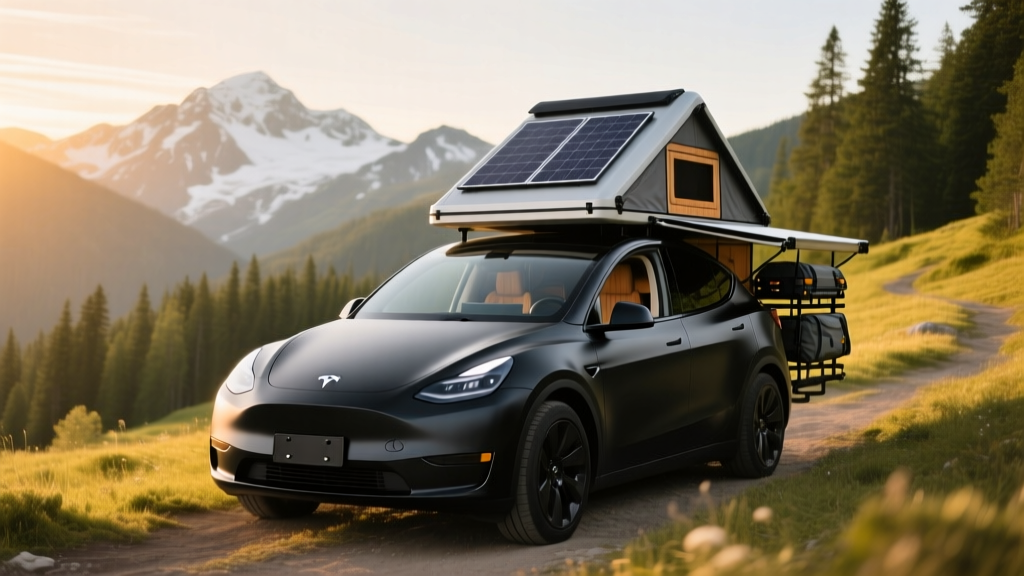
The most popular approach uses the Model Y Long Range AWD as the base vehicle, paired with a conversion kit or custom build that adds:
- A platform bed frame that sits over the folded rear seats
- Window covers and privacy blackout curtains
- Portable power stations (like EcoFlow or Jackery) charged via the 12V system or a dedicated outlet
- Rooftop tents (on models with aftermarket crossbar racks)
- Compact camp kitchens stored in the frunk or rear cargo area
Companies like Tesla Camping, EV Camper Co., and various Etsy/Amazon vendors sell turnkey kits ranging from $500 mattress-and-privacy sets to $5,000+ full platform builds with slide-out kitchens. The result is a vehicle that sleeps two adults comfortably, retains daily-driver usability, and leverages the Supercharger network for road-trip charging.
Base Vehicle Specs: 2026 Tesla Model Y Long Range AWD
Every Tesla camper van conversion starts with the donor vehicle. Here are the exact specifications for the 2026 Model Y Long Range AWD—the most common base for camper builds:
| Specification | 2026 Model Y Long Range AWD |
|---|---|
| EPA Estimated Range | 320 miles |
| Battery Capacity | ~78 kWh usable (NMC chemistry) |
| Drivetrain | Dual-Motor All-Wheel Drive |
| Horsepower | 384 hp combined |
| 0-60 mph | 4.8 seconds |
| Max DC Fast Charge Rate | 250 kW (peak) |
| 10-80% DC Fast Charge | ~22 minutes |
| Level 2 Home Charge Rate | 11.5 kW (~44 miles/hr) |
| EPA Efficiency | 122 MPGe combined / 28 kWh/100mi |
| Cargo Volume (rear seats folded) | 72.1 cu ft |
| Cargo Volume (rear seats up) | 26.6 cu ft |
| Front Trunk (Frunk) | 4.1 cu ft |
| Rear Legroom | 41.6 inches |
| Battery & Drive Unit Warranty | 8 years / 120,000 miles |
| Base MSRP | $48,990 |
Sources: fueleconomy.gov, Tesla Model Y specs
Real-World Range: What Happens When You Load It Up?
EPA Sticker: 320 miles
Loaded highway driving (65-75 mph, full camping gear, 2 passengers): Expect 245–270 miles
Cold weather (below 32°F, cabin heat on): Expect 200–235 miles
Mixed city/highway, mild weather, light load: ~290–305 miles
The Model Y's NMC battery delivers strong energy density, but aerodynamic drag and weight from a camper conversion (typically 150–400 lbs of added platform, mattress, and gear) reduce efficiency noticeably at highway speeds. If you mount a rooftop tent, add another 10-15% range penalty from the disrupted airflow.
For context, most Tesla camper van owners plan road trips around 200-mile legs between Supercharger stops. This is conservative but realistic—you arrive with a 15-20% buffer, charge for 20-25 minutes, and continue. The Supercharger network's density along major US corridors (I-5, I-10, I-80, I-90, I-70) makes this workable for most routes.
The bigger challenge is off-grid camping. If you're boondocking at a dispersed BLM site with no charging infrastructure, you need to arrive with enough charge to leave. A full battery gives you roughly 245 usable real-world miles after accounting for camping energy drain (running climate control overnight in Camp Mode consumes roughly 1-2 kWh per hour, or ~15-30 miles of range over an 8-hour night).
Charging the Tesla Camper Van: Home, Highway, and Off-Grid
| Charging Method | Power (kW) | Speed | Best For |
|---|---|---|---|
| Level 1 (120V standard outlet) | 1.4 kW | ~5 miles/hr | Emergency top-off only |
| Level 2 (240V home, Wall Connector) | 11.5 kW | ~44 miles/hr | Daily overnight charging; full charge in ~7 hours |
| DC Fast Charge (Supercharger V3) | 250 kW peak | 10-80% in ~22 min | Road trips; adds ~175 miles in 15 min |
| DC Fast Charge (Supercharger V4) | Up to 350 kW | 10-80% in ~18 min (supported models) | Newer corridors; Model Y may not peak at 350 kW |
Understanding the charge curve: The Model Y peaks at 250 kW only between roughly 10-30% State of Charge. Above 50%, the rate tapers significantly—dropping to ~80 kW by 70% and ~40 kW by 85%. This is why Tesla quotes 10-80% times rather than 0-100%. Charging from 80-100% can take as long as 10-80%. For road-trip efficiency, charge to 80% and go.
Home charging setup: Most camper van owners install a Tesla Wall Connector ($420 for the unit) on a 60-amp circuit, delivering the full 11.5 kW. A licensed electrician typically charges $500–$2,000 for installation depending on panel proximity and local permit costs. If your home's electrical panel needs an upgrade from 100A to 200A service, budget an additional $1,500–$3,500. Every morning, you wake up to a full battery—critical for multi-day camping trips.
Campground charging: Many KOA and state park campgrounds now offer 240V/50-amp RV pedestals (NEMA 14-50 outlets). With Tesla's Mobile Connector and the appropriate adapter ($35), you can charge at up to 7.6 kW (~29 miles/hr) overnight at your campsite. This is a massive advantage over non-Electric camping setups.
Camping Mode and Standout Tech Features
The Model Y's killer feature for camper van use is Camp Mode. When activated (via the touchscreen or the Tesla app), it maintains climate control, airflow, and USB power to devices while the vehicle is parked. You can set a target temperature and the heat pump (standard on all 2026 Model Y trims) efficiently maintains it overnight.
Key tech features that elevate the Tesla camper van experience:
- Camp Mode climate control: Runs the HVAC system silently, using the heat pump for efficient heating (roughly 1-2 kWh/hr depending on outside temperature)
- 15.4-inch touchscreen: Streams Netflix, YouTube, or Spotify while parked—built-in entertainment without external devices
- Sentry Mode: Records surroundings via cameras when parked; valuable security at remote campsites
- App-based preconditioning: Warm or cool the cabin from your sleeping bag before getting up
- Autopilot (SAE Level 2): Reduces highway fatigue on long drives to remote trailheads. This is a driver-assistance system requiring active supervision—not self-driving.
- Frunk storage: 4.1 cu ft of sealed, front-mounted space perfect for storing camp cooking gear away from sleeping quarters
Tesla's Autopilot and available Full Self-Driving (Supervised) are SAE Level 2 driver-assistance systems. The driver must remain fully engaged, hands on or near the wheel, eyes on the road at all times. These systems handle highway lane-keeping and adaptive cruise well, but they do NOT drive autonomously. Only Level 4 robotaxi services like Waymo operate without a human driver.
Pricing: Tesla Camper Van Total Cost Breakdown
Here's what you'll actually spend to build a Tesla camper van in 2026:
| Item | Cost Range |
|---|---|
| 2026 Tesla Model Y Long Range AWD (base MSRP) | $48,990 |
| Typical as-tested price (with common options/paint) | $50,500–$53,000 |
| Basic camper kit (mattress platform + window covers) | $500–$1,200 |
| Mid-range conversion (platform bed + storage + kitchen slide) | $2,000–$4,000 |
| Premium full conversion (custom cabinetry, electrical, rooftop tent) | $5,000–$12,000 |
| Home Level 2 charger (Wall Connector + electrician install) | $920–$2,500 |
| Total (base vehicle + mid-range conversion + home charger) | $53,400–$59,500 |
Federal Tax Credit Eligibility (§30D)
The 2026 Tesla Model Y qualifies for the up-to-$7,500 federal EV tax credit under IRS §30D, but eligibility depends on multiple factors:
- MSRP cap: SUVs/crossovers must be under $80,000 MSRP — the Model Y qualifies at all trims
- Buyer income cap: Modified AGI ≤ $150,000 (single) or ≤ $300,000 (joint filers)
- Battery sourcing: Critical minerals and battery components must meet phased percentage thresholds from US/free-trade-agreement partners; Tesla's US-assembled LFP and NMC packs have generally met these requirements for the full $7,500, but always verify current-year sourcing compliance
- Point-of-sale transfer: As of 2024+, you can transfer the credit to the dealer at purchase for an immediate price reduction rather than waiting to claim it on your tax return
Always verify current eligibility at IRS.gov §30D guidelines before purchasing. Rules and sourcing requirements update regularly.
After the maximum $7,500 credit, the effective base price drops to approximately $41,490—competitive with a well-equipped Toyota RAV4 Hybrid when you factor in fuel savings.
Tesla Camper Van vs. Key Competitors
How does a converted Model Y compare to other electric and traditional camper van options?
| Factor | Tesla Model Y Camper Conversion | VW ID. Buzz (Camp-Converted) | Ford E-Transit (Class B RV) | Traditional Gas Camper Van (Sprinter/Promaster) |
|---|---|---|---|---|
| Starting Price (with conversion) | ~$53,000–$60,000 | ~$65,000–$72,000 | ~$85,000–$120,000 | ~$90,000–$150,000 |
| Real-World Range (loaded) | 245–270 mi | 180–210 mi | 100–125 mi | 400–550 mi (gas) |
| Sleeping Capacity | 2 adults | 2–4 adults | 2–4 adults | 2–4 adults |
| Charging/Fuel Network | 19,000+ Superchargers | CCS networks (EA, etc.) | CCS networks | Any gas station |
| Daily Driver Usable? | Yes, excellent | Yes, good | No, too large | No, too large |
| Off-Grid Capability | Moderate (Camp Mode) | Moderate | Good (larger battery) | Excellent (generator option) |
| Maintenance Cost | Very low (no oil, fewer fluids) | Low | Low | High (diesel service, emissions) |
The Tesla camper van's biggest advantage is dual-use practicality. It's a genuine daily commuter Monday through Friday and a capable weekend camper with minimal setup. A Sprinter-based Class B RV might offer more interior space and off-grid range, but you're not parking it in a standard garage or commuting in it.
- Access to 19,000+ Superchargers—best charging network in North America
- Daily-driver practicality: park in a garage, commute, then camp on weekends
- Camp Mode with heat pump: quiet, efficient overnight climate control
- Low operating cost: ~$0.04–$0.08/mile (electricity) vs $0.15–$0.22/mile (gas van)
- Minimal maintenance: no oil changes, no transmission service, regenerative braking saves brake pads
- Frunk adds secure, weatherproof storage for camp gear
- Tax credit eligibility brings effective price well below competitors
- Not a factory camper—conversion requires aftermarket purchases and DIY effort
- Interior height: no standing room (5'7" interior height); not a true "van life" experience
- Limited off-grid range: 200-270 miles means careful route planning in remote areas
- No built-in bathroom, shower, or kitchen—requires portable solutions
- Added weight from conversion reduces range by 10-15%
- Rooftop tent mounting requires aftermarket crossbars and may void certain warranty aspects
- Cold-weather camping drains battery faster; range can drop below 200 miles
Who Is the Tesla Camper Van For?
Ideal for:
- Couple campers who want a minimalist, car-camping experience for 2–5 night trips
- Dual-vehicle households where the Model Y serves as both the daily commuter and the weekend adventure vehicle
- Solo overlanders who prioritize reaching remote trailheads over living in the vehicle full-time
- Budget-conscious adventurers who want EV camping without the $100K+ price tag of a dedicated electric RV
- Tech-forward campers who value Sentry Mode security, app-based preconditioning, and built-in entertainment
Not ideal for:
- Families of 3+ who need sleeping space for more than two people
- Full-time van-lifers who need a bathroom, standing room, and large kitchen
- Extreme off-grid boondockers who camp more than 200 miles from any charging
- Those who want a turnkey, factory-warrantied camper with no aftermarket modification
Frequently Asked Questions
Does Tesla make a factory camper van?
No. Tesla does not manufacture any camper van or RV product. The "Tesla camper van" concept refers to aftermarket conversions of the Model Y (most commonly), Model X, or Cybertruck into camping platforms. Several companies sell conversion kits, and many owners build custom setups.
What is the real-world range of a Tesla camper van conversion?
A loaded 2026 Model Y Long Range AWD with a camper conversion (150–400 lbs of added gear) delivers approximately 245–270 miles of real-world highway range in mild weather. In cold conditions (below freezing), expect 200–235 miles. The EPA sticker reads 320 miles, but that assumes no added weight, moderate speeds, and ideal conditions.
How much does a Tesla camper van cost after tax credits?
With the base Model Y Long Range AWD at $48,990, a mid-range conversion at ~$3,000, and a home charger at ~$1,500, your total investment is roughly $53,500. If you qualify for the full $7,500 federal tax credit under §30D (meeting MSRP, income, and battery-sourcing requirements), the effective cost drops to approximately $46,000. State incentives may reduce this further—check your local programs.
Can I charge a Tesla camper van at campgrounds?
Yes, at campgrounds with 240V RV electrical hookups. Using Tesla's Mobile Connector with a NEMA 14-50 adapter, you can charge at up to 7.6 kW (about 29 miles per hour) overnight. This is enough to replenish a full day's driving during an 8–10 hour overnight stay. Always check campground amenities before booking.
How long does the Tesla Model Y battery last?
Tesla warranties the Model Y Long Range battery for 8 years or 120,000 miles (whichever comes first), guaranteeing at least 70% capacity retention. Real-world data from high-mileage Tesla owners suggests NMC batteries retain approximately 85–90% capacity at 100,000 miles with normal use. For a camper van that sees moderate mileage (10,000–15,000 miles/year), the battery should outlast a decade of service.
Is a Tesla camper van worth it versus a traditional RV?
It depends on your use case. If you need a daily-drivable vehicle that can double as a weekend camper for two people, the Tesla camper van conversion is significantly cheaper to buy and operate than a traditional Class B RV ($46K–$60K vs $100K–$150K). If you need standing room, a bathroom, or full-time living space, a dedicated RV is the better choice despite the higher cost and fuel consumption.
Does the Tesla camper van qualify for the federal EV tax credit?
The base vehicle—the 2026 Tesla Model Y—qualifies for the up-to-$7,500 §30D federal tax credit, provided you meet the income cap ($150K single / $300K joint), the vehicle MSRP stays under $80,000 (it does), and the battery meets current-year critical-mineral and component sourcing thresholds. Aftermarket camper conversions do not affect tax credit eligibility. Verify current sourcing compliance at IRS.gov before purchasing.
Always confirm current pricing, specifications, and tax credit eligibility directly with Tesla and the IRS before making a purchase decision. Aftermarket modifications may affect certain warranty claims—consult Tesla's modification policy before installing rooftop racks or electrical modifications.