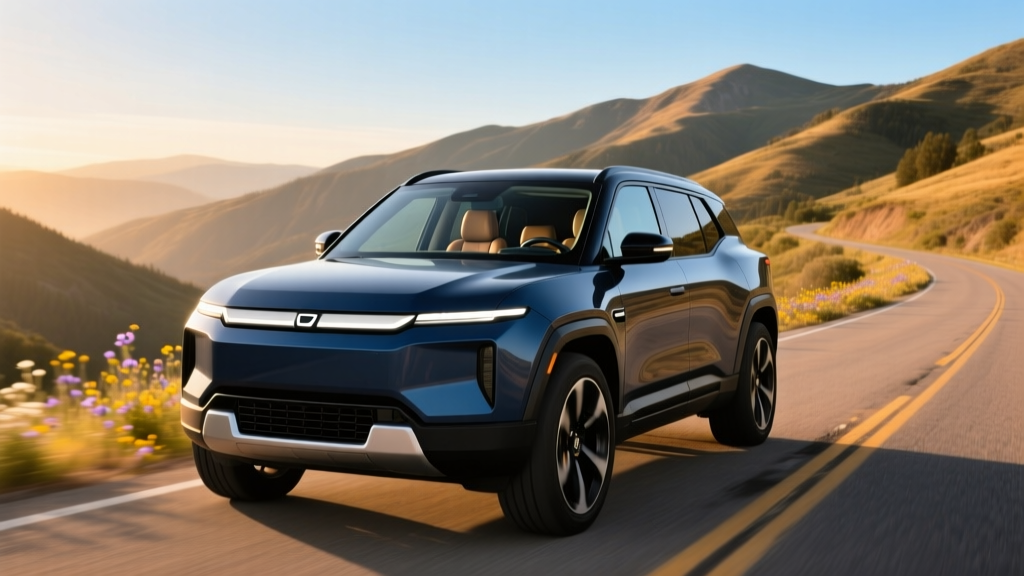
If you've been searching for an electric three-row family hauler that can actually tow, climb trails, and road-trip cross-country, you've likely asked: who makes a Rivian SUV? The answer is Rivian Automotive, Inc., an American EV manufacturer headquartered in Irvine, California, with production based at its plant in Normal, Illinois. Founded in 2009 by RJ Scaringe, Rivian launched its first consumer vehicles — the R1S SUV and R1T pickup — in 2022 and has since become one of the most closely watched EV startups in the U.S.
The 2026 Rivian R1S is the brand's flagship three-row electric SUV. It rides on Rivian's proprietary skateboard platform with available dual-motor, tri-motor, and quad-motor powertrains, offering EPA range from 270 to over 410 miles depending on configuration. Below, we break down every number that matters — range, charging, pricing, tax credits, and real-world ownership — so you can decide if the R1S is the right electric SUV for your driveway.
2026 Rivian R1S Quick Spec Sheet
| Spec | Dual-Motor (Standard) | Tri-Motor | Quad-Motor |
|---|---|---|---|
| EPA Range | 270–410 mi | 320–390 mi | 270–350 mi |
| Usable Battery | 95 kWh (Standard) / 128 kWh (Max) | 128 kWh (Max) | 128 kWh (Max) |
| Battery Chemistry | NMC (Max) / LFP (Standard Pack) | NMC | NMC |
| Horsepower | 533 hp | 850 hp | 1,025 hp |
| 0-60 mph | 4.5 sec | 2.9 sec | 2.5 sec |
| Drivetrain | AWD (dual-motor) | AWD (tri-motor) | AWD (quad-motor) |
| Max DC Fast Charge | 200 kW (Std) / 220 kW (Max) | 220 kW | 220 kW |
| 10-80% DCFC Time | ~27 min (Max Pack) | ~27 min | ~29 min |
| Level 2 Home Charging | 11.5 kW (~30 mi/hr) | 11.5 kW | 11.5 kW |
| Towing Capacity | 7,700 lbs | 7,700 lbs | 7,700 lbs |
| MPGe (Combined) | 69–73 MPGe | 65 MPGe | 62 MPGe |
| Starting MSRP | $79,900 | $105,900 | $119,900 |
Range & Efficiency: EPA Numbers vs. the Real World
Rivian offers the R1S with two battery sizes. The Standard Pack uses a ~95 kWh usable LFP (lithium iron phosphate) battery, which sacrifices range for lower cost and longer cycle life. LFP chemistry tolerates daily charging to 100% without the degradation concerns of NMC cells, making it practical for commuters who can charge at home nightly.
The Max Pack uses a ~128 kWh NMC (nickel manganese cobalt) battery. NMC offers higher energy density — hence the 410-mile EPA peak — but Rivian recommends charging to 80-90% for daily use and reserving 100% for road trips. Over a typical ownership period, expect roughly 8-12% total battery degradation based on industry NMC data, though Rivian's thermal management system helps mitigate this.
Efficiency varies significantly by trim. The Dual-Motor Standard achieves around 73 MPGe combined (roughly 46 kWh/100 mi), while the Quad-Motor drops to about 62 MPGe (54 kWh/100 mi). If you're optimizing for road-trip range and charging cost, the Dual-Motor Max Pack is the sweet spot — you get the most miles per dollar spent at the charger.
Charging Speed: DC Fast Charging & Home Level 2
Charging speed is where the R1S is competent but not class-leading. The Max Pack models peak at 220 kW on a DC fast charger, while the Standard Pack tops out around 200 kW. Rivian uses the NACS (North American Charging Standard) connector on 2025+ models, giving R1S owners native access to the Tesla Supercharger network — a significant real-world advantage for road-trip charging reliability.
| Charging Level | Power | Speed (Max Pack) | Notes |
|---|---|---|---|
| Level 1 (120V) | ~1.4 kW | ~3-4 mi/hr | Emergency/trickle only |
| Level 2 (240V, 48A) | 11.5 kW | ~30 mi/hr | Full charge overnight (~10-12 hrs Max Pack) |
| DC Fast Charge | 220 kW peak | 10-80% in ~27 min | Tapers above 80%; 80-100% adds ~20+ min |
A critical note on the charge curve: the R1S sustains peak charging rates only in the 10-40% state-of-charge window. Above 60%, the rate tapers noticeably, and above 80%, it slows dramatically to protect the battery. On a road trip, plan your stops around 10-80% charges — pushing to 100% at a DC fast charger is rarely worth the wait. For most highway trips, a 25-minute stop adds roughly 200-240 miles of range.
At home, the R1S accepts up to 11.5 kW on Level 2 (48 amps on a 240V/60A circuit). This means a full charge from empty takes roughly 11-12 hours for the Max Pack. Most owners who charge nightly from 30-80% will wake up fully topped off. A quality Level 2 home charger (like the ChargePoint Home Flex or Tesla Wall Connector) costs $500-$700 for the unit, with professional installation running $500-$2,000 depending on your electrical panel.
Performance & Drivetrain: From Family Cruiser to Trail Monster
Every R1S comes with all-wheel drive — there's no rear-wheel-drive option. The powertrain lineup is where Rivian differentiates itself from competitors:
- Dual-Motor (AWD): One motor per axle, 533 hp, 0-60 in 4.5 seconds. This is the volume seller and the range champion.
- Tri-Motor (AWD): One front motor, two rear motors, 850 hp, 0-60 in 2.9 seconds. A serious performance upgrade with only modest range loss.
- Quad-Motor (AWD): One motor per wheel with individual torque vectoring, 1,025 hp, 0-60 in 2.5 seconds. Supercar acceleration in a three-row SUV.
Beyond straight-line speed, the R1S is genuinely capable off-road. It offers up to 14.9 inches of ground clearance (adjustable air suspension), a wading depth of over 3 feet, and dedicated drive modes for rock crawling, sand, and snow. The quad-motor's tank-turn capability (spinning the vehicle in place by driving left and right wheels in opposite directions) is more a party trick than a daily necessity, but it underscores the platform's engineering ambition.
Ride quality on pavement is composed and comfortable, with the air suspension absorbing most road imperfections. Body roll is well-controlled for a 6,800-pound vehicle, though you'll feel the mass during aggressive cornering. The regenerative braking system offers multiple levels, including a strong one-pedal driving mode that most owners set and forget.
Interior, Cargo & Technology
The R1S seats up to seven passengers across three rows. Second-row captain's chairs (six-passenger config) are optional. Cargo space behind the third row is limited — roughly 10.4 cu ft — but fold the third row and you get 46.7 cu ft, and fold both rear rows for 91.6 cu ft. A front trunk (frunk) adds another 11.1 cu ft of secure, weatherproof storage — ideal for charging cables or groceries.
Legroom is generous in the first two rows (41.3" front, 38.2" second row) but the third row is best suited for children on longer trips (32.3" legroom). This is a common compromise in three-row SUVs, and the R1S is no exception.
The infotainment system runs on a 15.6-inch center touchscreen with Rivian's proprietary software. It's responsive, visually clean, and supports over-the-air (OTA) updates that have meaningfully improved the system since launch. Wireless Apple CarPlay and Android Auto are standard. Notably, Rivian does not include a traditional instrument cluster — a 6.8-inch driver display integrated into the steering column handles speed, range, and navigation prompts.
The R1S comes equipped with Rivian's Driver+ suite, which includes adaptive cruise control, lane-centering assist, automatic emergency braking, and blind-spot monitoring. This is an SAE Level 2 driver-assistance system — the driver must remain fully attentive with hands on the wheel. Rivian has been developing a hands-free highway assist feature, but as of 2026, it requires active driver supervision. This is not a "self-driving" vehicle.
Pricing, Trims & Federal Tax Credit Eligibility
| Trim | Base MSRP | Est. After §30D Credit* | Destination |
|---|---|---|---|
| Dual-Motor Standard Pack | $79,900 | $72,400 | $1,800 |
| Dual-Motor Max Pack | $89,900 | $82,400 | $1,800 |
| Tri-Motor Max Pack | $105,900 | $98,400 | $1,800 |
| Quad-Motor Max Pack | $119,900 | $112,400 | $1,800 |
*Tax credit estimates assume buyer eligibility. See rules below.
- MSRP Cap: SUVs must be priced at or below $80,000. Only the Dual-Motor Standard Pack at base MSRP qualifies — adding options can push it over the cap.
- Buyer Income Limits: Modified AGI must not exceed $300,000 (joint), $225,000 (head of household), or $150,000 (single).
- Battery Sourcing: Critical minerals and battery components must meet phased-in domestic/free-trade-partner sourcing thresholds that tighten annually. Verify current-year compliance on fueleconomy.gov before purchasing.
- Point-of-Sale Transfer: Eligible buyers can transfer the credit to the dealer at purchase, reducing the upfront price rather than waiting for a tax refund.
The pricing reality: the R1S is a premium vehicle, and most well-equipped configurations land between $85,000-$110,000 before incentives. Only the base Dual-Motor Standard Pack has a realistic path to the full $7,500 federal credit, and even then, battery sourcing compliance and buyer income caps apply. Higher trims exceed the $80,000 MSRP cap and are ineligible for §30D.
Ownership Costs & Warranty
Rivian covers the R1S with a 5-year/60,000-mile bumper-to-bumper warranty and an 8-year/175,000-mile battery and drive unit warranty. The battery warranty guarantees the pack will retain at least 70% of its original capacity during the coverage period — a competitive threshold in the EV industry. Rivian also includes 5 years of roadside assistance.
Maintenance costs are lower than a comparable gas SUV — no oil changes, no transmission fluid, no spark plugs. Expect to budget for tire rotation/replacement (EVs wear tires faster due to instant torque and weight), cabin air filter replacement, and brake fluid checks. The regenerative braking system significantly extends brake pad life; many EV owners go 80,000+ miles before needing pad replacement.
Insurance tends to be higher than non-electric equivalents. Early R1S owners reported annual premiums 15-30% above similarly priced gas SUVs, though rates have moderated as insurers accumulate more EV claims data. Get quotes before purchasing — this is a real ownership cost that affects total cost of ownership (TCO).
Charging at home (at a national average of $0.16/kWh) costs roughly $20 to fully charge the Max Pack — equivalent to about $0.05-$0.06 per mile. Compare that to a gas SUV getting 20 MPG at $3.50/gallon ($0.175/mile), and the R1S saves about $0.12 per mile on energy when charging at home. Public DC fast charging is more expensive ($0.30-$0.50/kWh), narrowing or eliminating the savings on road trips.
R1S vs. Competitors: Is It Worth Buying?
- Class-leading 410-mi EPA range (Dual-Motor Max)
- Genuine off-road capability with air suspension
- 7,700-lb towing — best in electric SUV class
- Native NACS/Supercharger access (2025+ models)
- OTA updates continuously improve the vehicle
- LFP Standard Pack option for daily 100% charging
- Premium pricing — most configs exceed $80K tax-credit cap
- Third row is tight for adults
- DCFC speed (220 kW) trails Hyundai/Kia 800V platforms
- Service center network still expanding in some regions
- Higher insurance premiums than gas equivalents
- No hands-free highway driving (yet)
The R1S competes most directly with the Tesla Model X (more range options, Supercharger native, falcon-wing doors, but aging interior), the Kia EV9 (significantly cheaper at ~$55K-$75K, 800V fast charging, but shorter range and no off-road pretension), and the BMW iX (luxury-focused, excellent ride, but only two rows). For buyers who need three rows, genuine towing, and off-road capability, the R1S is currently the only electric SUV that checks all three boxes.
If you primarily commute and road-trip on pavement, the Kia EV9 or Tesla Model X may offer better value. If you need a go-anywhere family adventure vehicle and have the budget, the R1S stands alone.
Who Should Buy the 2026 Rivian R1S?
- You need three rows AND off-road/towing capability
- You want 350+ miles of range for road trips without a trailer
- You have home Level 2 charging access
- You value OTA updates and a tech-forward ownership experience
- Your budget is $80,000-$120,000 for an electric SUV
- You need the cheapest possible three-row EV (see Kia EV9)
- You rarely leave pavement and don't tow (Model X or iX may suit better)
- You lack reliable home or workplace charging
- You need adult-friendly third-row space for daily use
Frequently Asked Questions
Who makes the Rivian SUV and where is it built?
Rivian Automotive, Inc. manufactures the R1S SUV at its production facility in Normal, Illinois. The company was founded in 2009 and is headquartered in Irvine, California. Amazon holds a significant investment stake in Rivian, and the company also produces commercial electric delivery vans for Amazon's fleet.
What is the real-world range of the Rivian R1S?
The EPA rates the R1S Dual-Motor Max Pack at 410 miles. In real-world highway driving at 70-75 mph, expect 330-360 miles. In cold weather (below 30°F), plan for 280-320 miles. The Standard Pack (270 mi EPA) delivers roughly 220-240 real-world highway miles in moderate temperatures.
How fast does the R1S charge at home and on the road?
On a DC fast charger, the R1S Max Pack peaks at 220 kW and charges from 10-80% in approximately 27 minutes. At home on a Level 2 charger (11.5 kW), it adds about 30 miles of range per hour, fully charging the Max Pack in roughly 11-12 hours.
Does the Rivian R1S qualify for the $7,500 federal EV tax credit?
Only the Dual-Motor Standard Pack at its base MSRP of $79,900 falls under the $80,000 SUV MSRP cap for §30D eligibility. Adding options may push it over. Buyer income limits ($300K joint / $150K single) and battery sourcing requirements also apply. Higher trims are ineligible due to MSRP. Always verify current eligibility on fueleconomy.gov and consult a tax professional.
Can the Rivian R1S use Tesla Superchargers?
Yes. Model-year 2025 and newer R1S vehicles come equipped with the NACS charge port, providing native access to Tesla's Supercharger network without an adapter. This significantly improves road-trip charging convenience and reliability.
Is the Rivian R1S good for towing?
The R1S is rated to tow up to 7,700 lbs across all trims — the highest in the electric SUV segment. However, towing significantly reduces range. Expect a 40-50% range reduction when towing near maximum capacity at highway speeds. Plan charging stops accordingly.