The "Tesla Camper" Isn't a Product — It's a Hack (And a Good One)
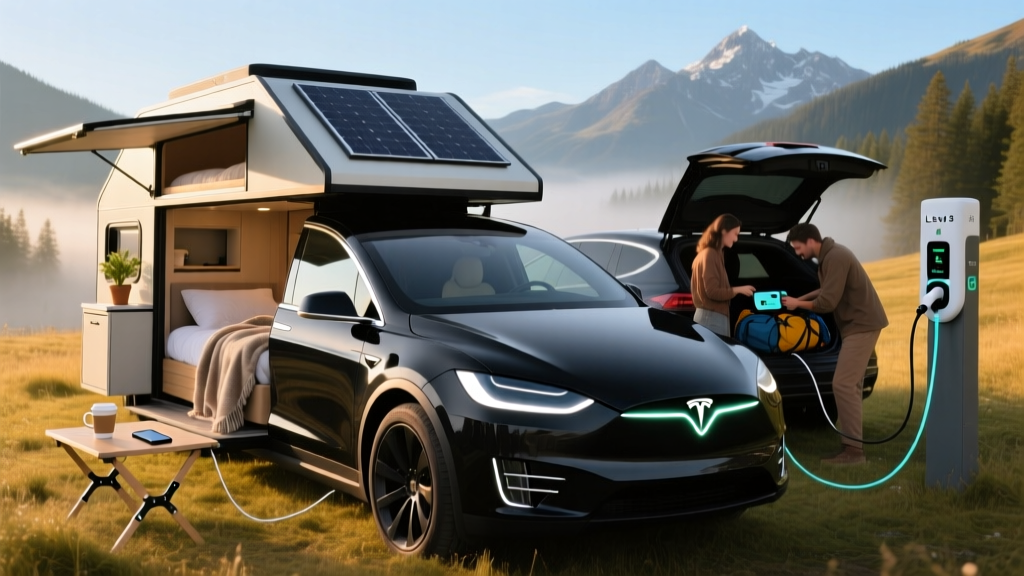
Search volume for Tesla camper continues to climb as overlanding and car-camping culture collides with EV adoption. Here's the essential truth Tesla never markets: there is no factory-built Tesla camper van, no OEM pop-top, no slide-in truck camper from Fremont or Austin. What exists is a community-driven ecosystem of aftermarket conversions, DIY mattress platforms, and Tesla's own software feature — Camp Mode — that makes sleeping in a Tesla viable in ways no internal-combustion vehicle can match without an idling engine and carbon-monoxide risk.
This review evaluates the three Teslas most commonly converted into campers in 2026 — the Cybertruck, Model Y, and the discontinued-but-still-available-used Model X — against the real requirements of car camping: flat sleeping length, climate control overnight, range preservation, charging logistics in remote areas, and cargo capacity for gear. We'll use hard numbers, not Instagram reels.
Which Tesla Makes the Best Camper Platform?
Each Tesla model trades off interior volume against efficiency and price. Here's how the three most-converted platforms stack up for camping duty:
| Spec | Cybertruck AWD | Model Y Long Range AWD | Model X (Used, 2023-2024) |
|---|---|---|---|
| EPA Range | 340 mi | 320 mi | 325-335 mi (varies by year) |
| Battery / Chemistry | ~123 kWh usable / NMC | ~75 kWh usable / NMC | ~95-100 kWh usable / NMC |
| Max DC Fast Charge | 250 kW (V3 Supercharger); 350 kW capable on V4 | 250 kW peak | 250 kW peak |
| 10-80% DC Time | ~28 min | ~27 min | ~30 min |
| Level 2 Home Rate | 11.5 kW (~44 mi/hr) | 11.5 kW (~44 mi/hr) | 11.5 kW (~40 mi/hr) |
| 0-60 mph | 4.1 sec (AWD) | 4.8 sec | 3.8 sec (Plaid) |
| Horsepower | 600 hp (AWD) | 384 hp | 670 hp (Plaid) |
| Cargo (rear seats folded) | ~67 cu ft bed + 54 cu ft frunk + sail pillars | ~72 cu ft (rear folded) | ~88 cu ft (rear folded) |
| Flat Sleeping Length | ~6.0 ft (bed); ~7.5 ft w/ tailgate down + bed extender | ~6.3 ft (front seats forward) | ~6.8 ft (front seats forward) |
| Towing Capacity | 11,000 lb | 3,500 lb | 5,000 lb |
| Base MSRP / Typical Used | $79,990 (AWD) | $44,990 | $45,000-$65,000 used |
| §30D Federal Credit Eligible (new) | Yes — up to $7,500 (MSRP, income, sourcing rules apply) | Yes — up to $7,500 (MSRP, income, sourcing rules apply) | N/A (used credit up to $4,000) |
| Efficiency | ~2.0 kWh/mi (50 MPGe) | ~280 Wh/mi (120 MPGe combined) | ~310 Wh/mi (107 MPGe) |
| Battery/Drive Warranty | 8 yr / 120,000 mi | 8 yr / 120,000 mi | 8 yr / 150,000 mi |
Camp Mode Explained: What It Actually Does (and Doesn't)
Camp Mode is a software setting in Tesla's climate menu that keeps HVAC, USB power, and the touchscreen active while the vehicle is parked — without the car auto-shutting down after 30 minutes as it normally would. It also disables the walk-up unlock chime and Sentry Mode's external cameras to preserve energy. According to Tesla's owner manual, Camp Mode maintains a set cabin temperature continuously.
Expect 10-15% battery drain over an 8-hour night in moderate temperatures (50-70°F) with climate set to 68°F. That translates to roughly 30-50 miles of lost EPA range in a Model Y, or 40-60 miles in a Cybertruck. In sub-freezing conditions (20-30°F), heat-pump load roughly doubles that figure — plan for 20-25% loss. This is the single biggest planning constraint for Tesla campers heading off-grid.
Camp Mode does not provide a 120V/240V AC outlet natively in the Model Y or Model X cabin — you'll need a DC-to-AC inverter wired to the 12V system for anything beyond USB-C laptops and CPAP machines. The Cybertruck is the exception: its Powershare feature offers up to 9.6 kW of bidirectional AC output (120V and 240V outlets in the bed and cabin), which is genuinely transformative for camping — enough to run an induction stove, electric kettle, or even a small space heater without draining the pack catastrophically.
Real-World Charging on the Campground Trail
The Tesla Supercharger network remains the strongest EV road-trip charging infrastructure in North America, with over 6,500 V3/V4 stalls in the U.S. as of early 2026. But camping destinations — national parks, BLM land, dispersed forest-service sites — are often 50-150 miles from the nearest Supercharger. That's where planning matters.
| Charging Level | Power (kW) | Miles Added per Hour | Use Case |
|---|---|---|---|
| Level 1 (120V standard outlet) | 1.0-1.4 kW | 3-5 mi/hr | Emergency trickle at a campsite with shore power; ~12 hours for meaningful gain |
| Level 2 (240V campground pedestal) | 7.2-11.5 kW | 25-44 mi/hr | Overnight at RV parks with 30A/50A service — viable top-up |
| DC Fast (V3 Supercharger) | Up to 250 kW peak | ~1,000 mi/hr at peak (tapers after 50% SoC) | Highway-adjacent stops; 10-80% in ~27-30 min |
Charge-curve reality: Peak kW is sustained only between roughly 10-40% State of Charge. Above 60%, the rate tapers sharply — a Model Y that charges at 250 kW at 20% SoC will pull only ~60 kW by 75%. Plan Supercharger stops for the 10-70% window and move on; topping to 100% wastes time and stresses NMC chemistry long-term.
- Zero idling emissions at the campsite — no CO risk, silent HVAC
- Camp Mode maintains precise cabin temperature all night
- Cybertruck Powershare offers up to 9.6 kW of usable AC power
- Supercharger network makes long-drive-in camping viable
- Flat cargo floors in Model Y/X with seats folded
- Over-the-air updates keep adding camping-relevant features
- No factory camper product — all conversions are aftermarket
- Cold weather cuts overnight range loss roughly in half
- Remote campsites often lack any charging infrastructure
- Model Y sleeping length is tight for anyone over 6'2"
- No native AC outlet in Model Y/X (inverter required)
- Ground clearance on Model Y (6.6 in) limits rough-road access
Aftermarket Camper Conversions: What's Actually Available
Several companies now build dedicated Tesla camping kits. The most established include Space Camp (Model Y pop-top roof tent, ~$12,000 installed), Tesla-specific mattress platforms from brands like Tescamper and Expel that create a flat sleeping surface with gear storage beneath (~$400-$1,200), and Cybertruck bed-cap systems from Basecamp and Space Camper that add a hard-shell canopy with a rooftop tent ($8,000-$18,000).
For Model X owners, the larger cargo volume and available 6- or 7-seat fold-flat configurations make a simple foam-mattress-and-window-screen setup surprisingly livable — many owners report multi-week road trips with less than $300 in gear. The falcon-wing doors, however, complicate rooftop tent mounting and limit awning compatibility.
Pricing, Tax Credits, and the True Cost of a Tesla Camper Build
Converting a Tesla into a camper adds meaningful cost on top of the vehicle itself. Here's a realistic build budget for a 2026 Model Y Long Range conversion:
| Item | Cost |
|---|---|
| Model Y Long Range AWD (base MSRP) | $44,990 |
| Federal §30D tax credit (if eligible — income, sourcing, MSRP rules apply per IRS guidelines) | -$7,500 (potential) |
| Effective vehicle cost (best case) | $37,490 |
| Aftermarket mattress platform + mattress | $800-$1,500 |
| Window screens + privacy shades | $150-$300 |
| 12V DC-to-AC inverter (300W pure sine) | $150-$250 |
| Portable induction cooktop + cookware | $100-$200 |
| Level 2 mobile connector + 240V adapter | $250-$400 |
| Total build (best-case credit scenario) | ~$39,000-$40,000 |
§30D credit caveats for 2026: Eligibility requires adjusted gross income under $150,000 (single) or $300,000 (joint), vehicle MSRP under $80,000 for SUVs/trucks (Model Y qualifies), and compliance with critical-mineral and battery-component sourcing thresholds that phase in more strictly each year. The credit can be transferred to the dealer at point of sale as a price reduction. Always verify current-year rules on irs.gov before committing — sourcing requirements have tightened annually since 2023.
Who Should Actually Build a Tesla Camper?
- You already own or plan to buy a Tesla for daily use and want dual-purpose camping
- You camp mostly in mild-to-warm climates (30°F and above) where overnight HVAC drain stays manageable
- You camp within 100 miles of a Supercharger or at RV parks with 240V shore power
- You value silent, emission-free campsite climate control over off-grid self-sufficiency
- You're a Cybertruck buyer who wants Powershare for genuine off-grid AC power
- You need multi-day off-grid capability far from any charger
- You need sleeping space for more than two adults
- You require standing room, a wet bath, or a full kitchen
- You camp frequently in sub-20°F conditions where battery drain becomes a safety concern
Frequently Asked Questions
What is the real-world range of a Tesla when used as a camper?
EPA-rated range is 320 miles for the Model Y Long Range and 340 miles for the Cybertruck AWD. In real-world highway driving at 70 mph, expect 260-280 miles before needing a charge in the Model Y. Add an overnight Camp Mode session and subtract another 30-50 miles of range. In winter highway conditions, total usable range between charges can drop to 200-220 miles — plan accordingly.
How fast does a Tesla charge on a camping road trip?
At a V3 Supercharger, both the Model Y and Cybertruck peak at 250 kW, adding roughly 200 miles in 15 minutes during the 10-60% SoC window. A full 10-80% session takes 27-30 minutes. At a campground with 240V/50A service (Level 2), expect 25-44 miles of range added per hour — enough to recover an overnight Camp Mode drain in 2-3 hours.
Does the Tesla Model Y qualify for the federal EV tax credit?
Yes, the Model Y qualifies for up to $7,500 under §30D, provided the buyer meets income caps ($150K single / $300K joint MAGI), the vehicle MSRP is under the $80,000 SUV/truck cap, and the battery's critical-mineral and component sourcing meets 2026 thresholds. Point-of-sale transfer is available. Verify current rules at irs.gov before purchase.
Is a Tesla camper worth it vs. a Rivian R1S or Ford F-150 Lightning?
The Rivian R1S offers more interior volume and a purpose-built adventure ethos but starts above $75,000 and has a smaller charging network. The F-150 Lightning offers Pro Power Onboard (up to 9.6 kW) and a full-size truck bed for tents and gear but sacrifices efficiency (~2.0 kWh/mi vs Model Y's 0.28 kWh/mi). The Tesla wins on charging-infrastructure reliability and efficiency; the Lightning and R1S win on interior space and off-pavement capability. The Cybertruck splits the difference with Powershare and 11,000-lb towing but remains polarizing in design and size for tight forest roads.
Can I run a CPAP machine or electric blanket in a Tesla overnight?
Yes. A CPAP drawing 30-60W over 8 hours uses roughly 0.3-0.5 kWh — negligible against a 75-123 kWh pack. Use a USB-C PD adapter or a small pure-sine-wave inverter on the 12V system. An electric blanket at 50-100W over 8 hours draws 0.4-0.8 kWh and can actually reduce HVAC load, saving more battery than it consumes — a common cold-weather camping trick in the Tesla community.
What are the biggest risks of Tesla camping in remote areas?
The primary risk is insufficient charging access if you misjudge range. A Model Y with 15% SoC in a remote area with no Level 1/2 outlet and no cell service for Supercharger routing is a stranded vehicle — there's no jerry-can rescue for an EV. Always arrive at remote campsites with at least 40% SoC buffer, carry a Level 1 mobile connector as backup, and identify the nearest Supercharger before leaving pavement. Secondary risk: 12V battery drain if accessories are mismanaged — Tesla's DC-DC converter keeps the 12V charged from the main pack in Camp Mode, but aftermarket inverters wired incorrectly can cause issues.