The Real Cost of Going Electric in Louisiana
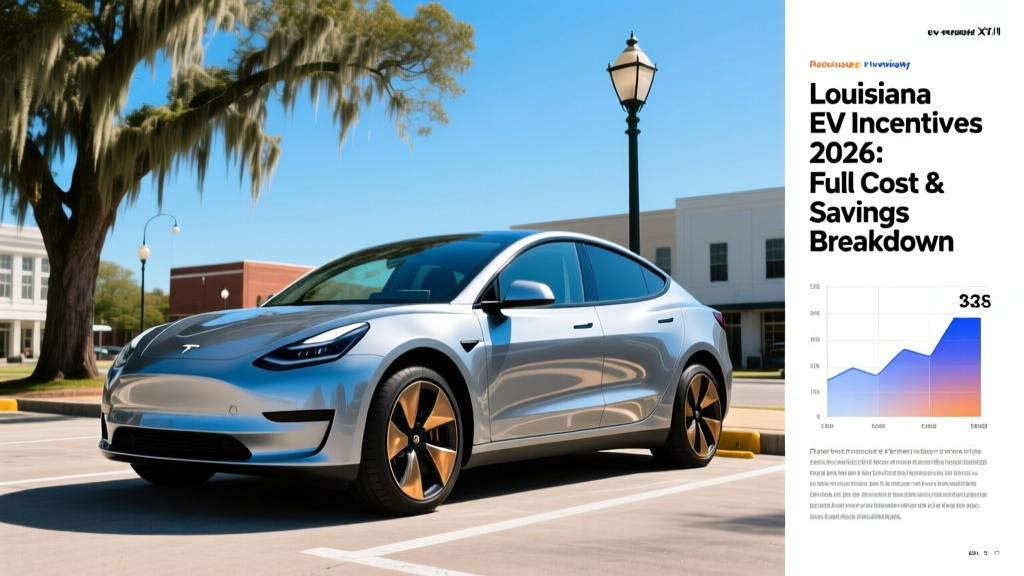
Buying an EV in Louisiana means navigating a shifting incentive landscape. The state once offered a $1,500 tax credit for qualifying battery-electric vehicles, but that program ended and has not been reinstated as of 2026. That makes the federal §30D Clean Vehicle Credit — worth up to $7,500 — the primary financial lever for Louisiana EV buyers, alongside select utility rebates from providers like Entergy and Cleco.
But incentives only tell part of the story. The true question is total cost of ownership: how purchase price, electricity rates, insurance premiums, maintenance needs, and depreciation add up over five years compared to a comparable gasoline vehicle. Below, we break down every cost category with concrete numbers calibrated to Louisiana's driving conditions and energy prices.
Louisiana EV Incentives: What's Available in 2026
Unlike states such as Colorado or Massachusetts that layer substantial state-level credits on top of federal incentives, Louisiana EV buyers in 2026 rely primarily on federal programs and localized utility rebates. Here's what exists today:
Important: State and local incentive programs change frequently. Always verify current availability through official state energy office sources and your local utility provider before making a purchase decision based on rebate assumptions.
- Federal §30D Clean Vehicle Credit: Up to $7,500 for new EVs, up to $4,000 for used EVs — subject to strict MSRP, income, and battery-sourcing requirements (detailed below).
- Entergy Louisiana Residential EV Rate: Entergy offers a time-of-use rate plan that allows overnight charging at significantly reduced per-kWh costs, often around $0.06–$0.08/kWh compared to the standard residential average of ~$0.11/kWh.
- Cleco Power EV Programs: Cleco has periodically offered rebates for Level 2 home charger installation (up to $250 in past programs). Contact Cleco directly for current availability.
- Municipal Utilities: Lafayette Utilities System (LUS) and other municipal providers may offer reduced EV charging rates. Check locally.
- HOV Lane Access: Louisiana does not currently offer HOV lane access for EVs, unlike some neighboring states.
Federal §30D Tax Credit: Eligibility Rules for 2026
The federal Clean Vehicle Credit under IRS §30D is the single largest incentive available to Louisiana EV buyers. But qualifying is not automatic — the rules tightened significantly starting in 2023 and continue to evolve. Here's the eligibility checklist as of 2026:
- Vehicle MSRP caps: Vans, SUVs, and pickups must have an MSRP at or below $80,000. Sedans and all other body styles are capped at $55,000.
- Buyer income limits (modified AGI): $300,000 for joint filers, $225,000 for heads of household, $150,000 for all other filers. If your AGI exceeds the limit in either the purchase year or the prior year, you do not qualify.
- Battery sourcing requirements: The vehicle must meet critical-minerals and battery-component sourcing thresholds that increase annually. In 2026, a growing number of models lose partial or full credit eligibility as these thresholds tighten.
- Final assembly: The vehicle must undergo final assembly in North America (US, Canada, or Mexico).
- Point-of-sale transfer: Since 2024, buyers can transfer the credit to the dealer at purchase, receiving the credit amount as an immediate price reduction rather than waiting to claim it on their tax return. This effectively lowers the out-of-pocket cost at signing.
- Used EV credit (§25E): Up to $4,000 or 30% of the sale price (whichever is less) for qualifying used EVs priced at $25,000 or below, with separate income caps ($150k joint / $112.5k head of household / $75k other).
Because battery-sourcing rules change annually and vary by model and trim, always check the latest qualifying vehicle list at fueleconomy.gov before committing to a purchase. A model that qualified in 2025 may not qualify in 2026.
5-Year Total Cost of Ownership: EV vs. Gas in Louisiana
To model real ownership costs, we're comparing a 2026 Tesla Model 3 Long Range AWD (363 miles EPA, 82 kWh usable battery, ~$47,740 MSRP before incentives) against a comparably equipped 2026 Toyota Camry SE (28 MPG combined, ~$32,000 MSRP). Both represent popular mid-size options for Louisiana drivers.
| Cost Category | 2026 Tesla Model 3 LR AWD | 2026 Toyota Camry SE |
|---|---|---|
| Purchase Price (MSRP) | $47,740 | $32,000 |
| Federal Tax Credit (§30D) | −$7,500 (if eligible) | $0 |
| Effective Purchase Price | $40,240 | $32,000 |
| Louisiana Sales Tax (est. 9.55% avg) | $3,843 (on post-credit price with POS transfer) | $3,056 |
| Fuel/Energy (75,000 mi) | $2,625 (home charging at ~$0.10/kWh avg) | $8,036 (28 MPG at ~$3.00/gal avg) |
| Insurance (5 years) | $11,250 ($2,250/yr avg) | $7,500 ($1,500/yr avg) |
| Maintenance (5 years) | $1,500 | $3,750 |
| Depreciation (est.) | −$18,000 | −$12,000 |
| 5-Year Total Cost | ~$41,458 | ~$42,342 |
Key takeaway: The Model 3's higher sticker price is substantially offset by the federal tax credit, dramatically lower fuel costs, and reduced maintenance. Insurance is the EV's biggest cost penalty. Over five years and 75,000 miles, the EV edges out the gas car by roughly $900 — and the gap widens if you drive more miles annually or secure cheaper insurance.
Important caveats: These figures assume home Level 2 charging at Louisiana's average residential rate (~$0.10/kWh as of early 2026). Public DC fast charging at $0.35–$0.48/kWh would increase energy costs substantially. Depreciation estimates reflect current EV resale trends, which have been volatile. Insurance quotes vary significantly by driver profile, ZIP code, and insurer.
Charging vs. Gas: Louisiana Cost Per Mile
Louisiana has some of the lowest residential electricity rates in the country, which works heavily in the EV owner's favor. Here's how the per-mile math breaks down:
| Energy Source | Rate Assumption | Vehicle Efficiency | Cost Per Mile |
|---|---|---|---|
| Home Charging (LA avg residential) | $0.10/kWh | 26 kWh/100mi (Model 3 LR) | $0.026/mile |
| Home Charging (Entergy TOU overnight) | $0.07/kWh | 26 kWh/100mi | $0.018/mile |
| Public DC Fast Charging | $0.40/kWh | 26 kWh/100mi | $0.104/mile |
| Gasoline (LA avg) | $3.00/gallon | 28 MPG (Camry SE) | $0.107/mile |
At home on standard rates, the Model 3 costs roughly $0.026 per mile to fuel — about one-quarter the cost of the Camry on gasoline. Even at public DC fast charger rates, the EV is essentially cost-parity with gas. The savings multiply if you can take advantage of Entergy's time-of-use plan and charge overnight at $0.07/kWh, dropping to under $0.02 per mile.
Over 75,000 miles of driving, home-charging the Model 3 saves approximately $5,400 in fuel costs compared to the Camry. That's money directly back in your pocket, and it's one of the most reliable financial advantages of EV ownership in a low-electricity-rate state like Louisiana.
Maintenance Savings: Where EVs Quietly Win
EVs eliminate many of the recurring maintenance items that gas-car owners accept as routine. No engine means no oil changes, no spark plugs, no timing belts, no exhaust system repairs, and no transmission fluid swaps. Regenerative braking also dramatically reduces brake pad and rotor wear — many EV owners report original brake pads lasting 80,000–100,000+ miles.
| Maintenance Item | EV (Model 3) | Gas (Camry) |
|---|---|---|
| Oil Changes | $0 | $750 (10 changes at ~$75) |
| Brake Pads/Rotors | $0–$200 (minimal regen wear) | $600–$1,000 |
| Air Filters (engine) | $0 (no engine air filter) | $150 |
| Cabin Air Filter | $150 | $150 |
| Tire Rotation/Replacement | $1,000 (EV tires wear ~15% faster due to weight/torque) | $800 |
| Coolant/Fluids | $150 | $300 |
| Wiper Blades, Misc. | $100 | $100 |
| Total (est.) | ~$1,500 | ~$3,750 |
The net maintenance savings for an EV over five years is roughly $2,000–$2,500. The one area where EVs cost slightly more is tires — the instant torque and heavier curb weight (the Model 3 LR AWD weighs ~4,034 lbs vs. the Camry SE at ~3,310 lbs) accelerate tire wear. Budget for premium all-season or EV-specific tires and rotate every 5,000–6,000 miles.
Insurance Costs: The Honest EV Premium
EV insurance is typically 15–30% more expensive than equivalent gas vehicles. This isn't arbitrary — it reflects real actuarial data. EVs have higher repair costs after collisions (specialized parts, high-voltage safety protocols, and fewer certified body shops), higher total-loss rates due to battery-damage write-offs, and higher initial vehicle values.
For our Louisiana comparison, expect to pay approximately:
- Model 3 LR AWD: $2,000–$2,500/year for a 35-year-old driver with a clean record in the Baton Rouge or New Orleans metro area
- Camry SE: $1,300–$1,700/year under the same profile
That's an insurance premium of roughly $500–$800 per year for the EV, or $2,500–$4,000 over five years. Some insurers now offer EV-specific discounts — GEICO, Progressive, and Tesla Insurance (available in Louisiana) may offer competitive rates. Always get quotes from at least three carriers before purchase. If you have a home security system, bundled home/auto policies, or a low annual mileage profile, those discounts can partially offset the EV insurance premium.
Depreciation and Resale Value: The Wildcard
EV depreciation has been volatile. In 2023–2024, a wave of Tesla price cuts triggered a broader used-EV value decline, with some models losing 40–50% of their value in two years. By 2026, the market has stabilized somewhat, but EVs still depreciate faster on average than top-selling gas vehicles like the Camry or RAV4.
Typical 5-year depreciation expectations:
- Mid-size EV sedan (e.g., Model 3): 40–50% depreciation over 5 years / 75,000 miles
- Mid-size gas sedan (e.g., Camry): 35–40% depreciation over the same period
Several factors influence your actual resale outcome:
- Battery health: A well-maintained battery with 90%+ State of Health (SoH) commands a premium. Most manufacturers warranty the battery at 70% capacity retention for 8 years/100,000 miles.
- Technology obsolescence: Rapid improvements in range and charging speed can make older EVs feel dated faster than gas cars, accelerating depreciation.
- Incentive changes: If federal credits are reduced or restructured, used EV demand could shift.
- Brand/model specific: Some EVs (Hyundai Ioniq 5, Rivian R1T) have held value better than others.
For our TCO model, we estimate the Model 3 loses ~$18,000 in value over five years, while the Camry loses ~$12,000. That $6,000 depreciation gap is the EV's single largest cost disadvantage — but it's partially offset by the fuel and maintenance savings detailed above.
Louisiana-Specific Ownership Considerations
Driving an EV in the Pelican State comes with unique practical factors:
- Heat and battery health: Louisiana's hot summers (routinely 95°F+) can accelerate battery degradation if the vehicle is regularly parked in direct sunlight at high State of Charge. Modern EVs like the Model 3 use active thermal management to mitigate this, but garage parking and avoiding sustained 100% SoC in summer are smart practices.
- Hurricane and flood risk: EV batteries are sealed and rated for water immersion (IP67/IP6K9K), but flood-damaged EVs can be total losses. Comprehensive insurance is strongly recommended.
- Public charging infrastructure: Louisiana's DC fast-charging network is growing along I-10, I-12, and I-49 corridors, but rural areas remain underserved. Home Level 2 charging is strongly recommended as your primary fueling strategy. A 240V/48A home charger adds roughly 35–44 miles of range per hour of charging.
- No state EV registration surcharge: Unlike some states that impose annual EV registration fees ($50–$225) to offset lost gas tax revenue, Louisiana does not currently levy a special EV registration fee. This is a small but real cost advantage.
Frequently Asked Questions
How much does it really cost to own an EV over 5 years in Louisiana?
Based on our analysis of a 2026 Tesla Model 3 Long Range vs. a Toyota Camry SE over 75,000 miles, the EV's 5-year total cost is approximately $41,500 (after the $7,500 federal credit) vs. $42,300 for the gas car. The EV saves significantly on fuel (~$5,400) and maintenance (~$2,250) but costs more on insurance (~$3,750) and depreciation (~$6,000). Your actual results depend on your electricity rate, driving mileage, insurance profile, and the specific EV model chosen.
Do I qualify for the federal §30D tax credit?
You likely qualify if: your modified AGI is under $150,000 (single) or $300,000 (joint), the EV's MSRP is under $55,000 (sedans) or $80,000 (SUVs/trucks/vans), the vehicle meets current battery-sourcing requirements, and it was assembled in North America. Check the current qualifying vehicle list at fueleconomy.gov and consult a tax professional for your specific situation. The credit can now be transferred to the dealer at point of sale for an immediate price reduction.
How much do I save on fuel and maintenance?
At Louisiana's average residential electricity rate of ~$0.10/kWh, expect to pay roughly $0.026/mile to charge an efficient EV like the Model 3 — compared to $0.107/mile for a 28 MPG gas car at $3.00/gallon. Over 75,000 miles, that's approximately $5,400 in fuel savings. Add $2,000–$2,500 in maintenance savings (no oil changes, reduced brake wear) for a combined operational savings of $7,400–$7,900 over five years.
Are EVs more expensive to insure in Louisiana?
Yes, typically 15–30% more. For a mid-size EV sedan vs. a comparable gas sedan, expect an additional $500–$800 per year in insurance premiums, totaling $2,500–$4,000 over five years. Higher repair costs, specialized parts, and elevated total-loss rates after collisions drive this difference. Shop multiple carriers and ask about EV-specific discounts.
How well do EVs hold their value?
EV depreciation has been steeper than gas vehicles, with mid-size EV sedans losing 40–50% of value over five years vs. 35–40% for popular gas models. Battery health, technology pace, and incentive policy changes all influence resale. This gap is narrowing as the used EV market matures, but depreciation remains the EV's biggest financial headwind compared to proven gas models.
Does Louisiana offer any state-level EV incentives in 2026?
Louisiana's previous $1,500 state EV tax credit has ended and has not been reinstated as of 2026. The primary incentives available are the federal §30D credit (up to $7,500), utility time-of-use charging rates from Entergy and Cleco, and occasional utility rebates for Level 2 charger installation. Louisiana does not currently impose an EV registration surcharge, which is a modest cost advantage over states that do.