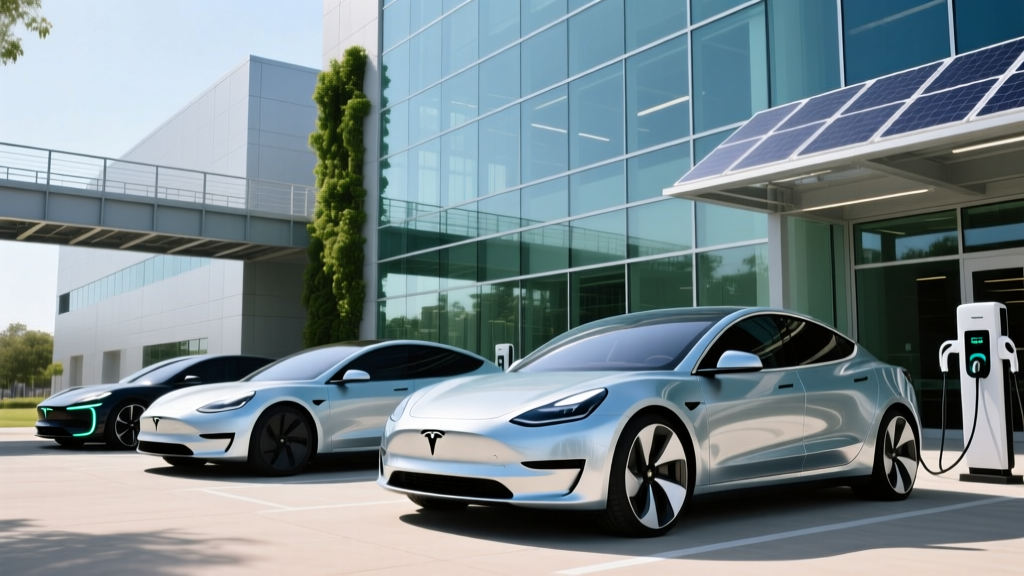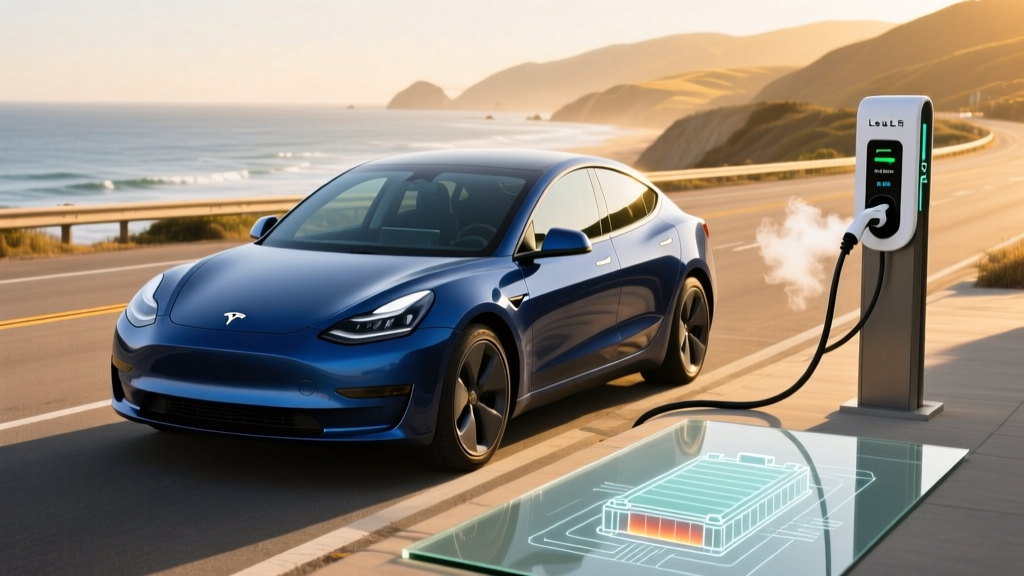
California buys more Teslas than any other state — and for good reason. The state's charging infrastructure, HOV-lane perks, and $7,000 CVRP rebate (for income-eligible buyers) stack on top of federal incentives to make Tesla ownership more accessible here than anywhere else in the U.S. But which Tesla model actually earns its spot in California driveways, and does the math still work in 2026?
We put the 2026 Tesla Model 3 Long Range AWD — the volume leader in Tesla California sales — through a full spec, charging, and ownership analysis. This is the variant most California buyers choose: long range for Bay Area-to-LA road trips, dual-motor AWD for Sierra snow runs, and a price point that can still qualify for federal tax credits.
2026 Tesla Model 3 Long Range AWD: Key Specifications
| Spec | Value |
|---|---|
| EPA Range | 341 miles |
| Battery (usable) | 79 kWh, NMC (nickel manganese cobalt) |
| Peak DC Fast Charge | 250 kW |
| 10–80% DC Charge Time | ~26 minutes |
| Level 2 Home Charge Rate | 11.5 kW (~44 mi/hr) |
| 0–60 mph | 4.2 seconds |
| Horsepower | 346 hp (dual motor) |
| Drivetrain | AWD (dual motor) |
| Efficiency | 131 MPGe combined / 25 kWh/100 mi |
| Cargo Volume | 23 cu ft (rear trunk + frunk) |
| Rear Legroom | 34.9 inches |
| Battery Warranty | 8 years / 120,000 miles (70% retention) |
| Base MSRP | $47,740 |
Real-World Range: What 341 EPA Miles Actually Means in California
EPA Sticker: 341 miles
Real-World Highway (70–80 mph): ~280–300 miles
Cold-Weather (below 40°F, Sierra passes): ~240–260 miles
City/Commuter (mild SoCal climate): ~320–340 miles
The EPA's 341-mile estimate is achievable in stop-and-go traffic at moderate speeds — exactly the kind of driving that defines a Los Angeles or San Diego commute. Regenerative braking recaptures energy constantly, and the Model 3's heat pump (standard since the Highland refresh) minimizes cabin-heating drain in winter.
On a 75-mph cruise along I-5 from Kettleman City to Buttonwillow, expect consumption closer to 28–30 kWh/100 mi, which trims range to roughly 280 miles. If you're heading to Tahoe in January with the cabin at 72°F and a roof box, plan for 240 miles between charges. This isn't a flaw — it's physics. Cold reduces lithium-ion mobility, and aerodynamic drag scales with the square of speed.
For context, the rival Hyundai Ioniq 6 Long Range posts a 361-mile EPA figure on a slightly larger 77.4 kWh battery, but its real-world highway range narrows the gap to within ~15 miles of the Model 3.
Charging Speed: Supercharger Network Is the Real Moat
| Charging Level | Power (kW) | Miles Added per Hour | Typical Use Case |
|---|---|---|---|
| Level 1 (120V outlet) | 1.4 kW | ~5 mi/hr | Emergency / overnight trickle |
| Level 2 (240V, 48A) | 11.5 kW | ~44 mi/hr | Home daily charging |
| DC Fast Charge (V3 Supercharger) | 250 kW peak | ~170 mi in 15 min | Road trips |
The Model 3 Long Range peaks at 250 kW on a V3 Supercharger, but — and this is critical — it only sustains that rate between roughly 10% and 30% State of Charge. Above 50%, the charge curve tapers significantly. By 80%, you're pulling closer to 60 kW. That's why Tesla (and the EPA) quote a 10–80% time of about 26 minutes rather than a "full charge" figure.
Preconditioning matters. If you navigate to a Supercharger using the car's built-in navigation, the battery thermal management system begins warming the pack miles before you arrive. Skip this step (for example, by using a third-party map to find a charger) and your peak charge rate may drop to 150–180 kW in cool weather, adding 5–8 minutes to your stop.
At home on a Wall Connector (48 amps, 240V), you'll add roughly 44 miles of range per hour. A full overnight session from 20% to 90% takes about 7 hours — more than enough for a daily commuter. Most California owners with solar panels report near-zero marginal charging costs.
California's Supercharger network is the densest in the country, with over 1,200 stalls statewide. Even with the network opening to NACS-adapted Fords, Rivians, and GM EVs in 2024–2025, Tesla owners still benefit from native plug-in reliability — no adapter required, automatic billing, and real-time stall availability in the app.
Performance and Drivetrain: 4.2 Seconds, Dual-Motor Precision
The Long Range AWD pairs a permanent-magnet rear motor with an induction front motor for a combined 346 horsepower and a 4.2-second 0–60 mph time. The induction front motor decouples during light-load cruising to reduce parasitic drag — one reason the Long Range achieves better efficiency than the Performance variant despite having AWD.
On California's twisty Highway 1 or Angeles Crest, the dual-motor torque vectoring feels planted without the artificial stiffness of a sport-sedan suspension. The refreshed Highland chassis (introduced for 2024, carried into 2026) added acoustic glass, improved damping, and a quieter cabin at highway speed — addressing the most common complaint from the previous generation.
For buyers prioritizing outright acceleration, the Model 3 Performance ($52,990 MSRP) cuts 0–60 to 2.9 seconds and adds adaptive dampers and track mode, but sacrifices 20 miles of EPA range (319 mi) and costs enough to push past the §30D MSRP cap in some configurations.
Pricing, Tax Credits, and Total Cost for California Buyers
| Trim | MSRP | §30D Federal Credit | CA CVRP Rebate* | Effective Price |
|---|---|---|---|---|
| Model 3 RWD | $38,990 | Up to $7,500 | Up to $7,000 | ~$24,490 |
| Model 3 Long Range AWD | $47,740 | Up to $7,500 | Up to $7,000 | ~$33,240 |
| Model 3 Performance | $52,990 | Up to $7,500 | Up to $7,000 | ~$38,490 |
*CVRP availability is income-dependent (under $250K household for new vehicles) and subject to program funding. Check Energy.ca.gov for current status.
Federal §30D Tax Credit Eligibility
As of 2026, the IRS §30D clean vehicle credit offers up to $7,500 at the point of sale, but eligibility depends on multiple factors:
- MSRP Cap: Sedans must be under $55,000. All Model 3 trims currently qualify.
- Buyer Income Cap: Modified AGI must not exceed $150,000 (single), $225,000 (head of household), or $300,000 (joint).
- Battery Sourcing: A portion of the credit requires critical minerals and battery components sourced from the U.S. or FTA partners. Tesla's shifting supply chain means the exact credit split ($3,750 minerals + $3,750 components) can vary by production batch — always confirm with the dealer and your tax professional before purchase.
- Point-of-Sale Transfer: Since 2024, you can transfer the credit to the dealer for an immediate price reduction at purchase, rather than waiting for a tax refund.
For a California household earning under the income caps, stacking the $7,500 federal credit with the $7,000 CVRP rebate brings a Model 3 Long Range to an effective $33,240 — competitive with a mid-trim Toyota Camry Hybrid when you factor in five years of fuel savings.
Interior, Tech, and Daily Usability
The 2026 Model 3 interior carries over the minimalist cabin introduced with the Highland refresh: a single 15.4-inch center touchscreen handles navigation, media, climate, and vehicle settings. A rear 8-inch screen for passengers controls climate and entertainment. There are no physical stalks — turn signals live on the steering wheel rim, and gear selection is via the touchscreen or overhead console (with an automatic drive/reverse guess based on context).
Standout tech:
- Tesla Vision Autopilot: Standard adaptive cruise and lane-centering. FSD (Supervised) is a $8,000 option or $99/month subscription — it remains an SAE Level 2 system requiring full driver attention.
- Sentry Mode & Dashcam: Records from multiple cameras when parked; useful in tight urban lots.
- Over-the-air updates: Regular feature additions, UI refinements, and efficiency tweaks without dealer visits.
- Phone-as-key: Bluetooth proximity unlocks and starts the car; no fob needed.
Important: Tesla Autopilot and FSD (Supervised) are SAE Level 2 driver-assistance systems. You must keep your hands on the wheel and eyes on the road at all times. Tesla's camera-based driver monitoring enforces this with escalating warnings. This is not autonomous driving — only Level 4 services like Waymo operate without a human driver.
Notable drawbacks:
- Rear legroom (34.9 in) is tighter than the Hyundai Ioniq 6 (37.0 in) or BMW i4 (36.0 in).
- No Apple CarPlay or Android Auto — Tesla's native infotainment only.
- Turn signals on the steering wheel rim take adjustment for drivers used to column stalks.
- Panel gaps and paint quality, while improved, still draw more owner complaints than legacy luxury brands.
Efficiency, Cargo, and Warranty
At 131 MPGe combined (25 kWh/100 mi), the Model 3 Long Range is one of the most efficient AWD electric sedans on the market. For comparison, the Ioniq 6 Long Range AWD achieves 117 MPGe, and the BMW i4 xDrive40 lands at 104 MPGe. Efficiency translates directly to lower charging costs: at California's average residential rate of ~$0.30/kWh, a full charge costs roughly $23.70 — about $0.07 per mile.
Cargo space totals 23 cubic feet (19.8 cu ft rear trunk + 3.1 cu ft frunk). The trunk opening is a traditional sedan shape rather than a hatchback, which limits loading bulky items. If cargo versatility matters, the Model Y hatchback offers 76 cu ft with seats folded.
Tesla's battery warranty covers 8 years or 120,000 miles (whichever comes first) against degradation below 70% capacity. The basic vehicle warranty is 4 years / 50,000 miles. For California commuters doing 15,000 miles per year, the battery warranty extends to roughly 8 years of ownership — aligning with typical lease-and-refresh cycles.
Is It Worth It vs. the Competition?
Pros
- 341-mile EPA range covers most California road trips without charging
- Supercharger network: 250 kW, ~26 min 10–80%, unmatched reliability
- Class-leading efficiency (131 MPGe) keeps charging costs low
- OTA updates add features over time without dealer visits
- Stacked CA + federal incentives can drop effective price below $34K
- Strong resale value relative to most EV competitors
Cons
- Rear seat is tight for taller passengers (34.9 in legroom)
- No CarPlay/Android Auto — Tesla-only infotainment
- Steering-wheel turn signals require adaptation
- Highway range drops to ~280 mi at 75+ mph
- FSD (Supervised) remains Level 2 — not self-driving despite the name
- Increasing Supercharger congestion from non-Tesla EVs at popular stops
Choose the Model 3 Long Range if: You commute 30–80 miles daily in California, want access to the Supercharger network for Sierra or coastal road trips, and value efficiency and software updates over rear-seat space.
Look elsewhere if: You regularly carry rear-seat adults (consider the Ioniq 6 or BMW i4), need CarPlay integration, or want a hatchback cargo area (Model Y or Ioniq 5).
Frequently Asked Questions
What is the real-world range of the 2026 Tesla Model 3 Long Range?
The EPA rates it at 341 miles, but expect roughly 280–300 miles at sustained highway speeds (70–80 mph) and 240–260 miles in cold weather below 40°F. City driving in mild California climates can match or approach the EPA figure.
How fast does the Model 3 Long Range charge?
On a V3 Supercharger, it peaks at 250 kW and charges from 10–80% in about 26 minutes with proper battery preconditioning. At home on a 48-amp Level 2 Wall Connector, it adds ~44 miles of range per hour.
How much does the Model 3 cost after tax credits in California?
The Long Range AWD lists at $47,740. With the full $7,500 federal §30D credit (subject to income, MSRP, and battery-sourcing rules) and California's $7,000 CVRP rebate (income-eligible, subject to funding), the effective price can drop to approximately $33,240.
Does the Tesla Model 3 qualify for the federal EV tax credit?
Yes — all 2026 Model 3 trims are under the $55,000 sedan MSRP cap. Buyer income must not exceed $150K/$225K/$300K (single/HOH/joint). The exact credit amount ($3,750, $7,500, or somewhere in between) depends on battery mineral and component sourcing for the specific production batch. Confirm with IRS guidelines and your tax advisor.
Is the Model 3 worth buying over the Hyundai Ioniq 6 or BMW i4?
The Model 3 wins on Supercharger access, efficiency, and software. The Ioniq 6 offers more rear legroom and slightly higher EPA range. The BMW i4 provides a more traditional luxury interior and CarPlay. If Supercharger reliability and OTA updates matter most, the Model 3 holds the edge — especially for California road-trippers.
How long will the Model 3 battery last?
Tesla warranties the Long Range battery for 8 years or 120,000 miles against degradation below 70% capacity. Real-world data from high-mileage Teslas suggests NMC packs retain 85–90% capacity at 100,000 miles with typical charging habits (daily charging to 80–90%, occasional 100% for trips).
Sources: EPA Fuel Economy, IRS §30D Clean Vehicle Credits, Tesla Model 3 Specifications.