The Quick Verdict: Is a Tesla Still the Default EV Pick?
Tesla's lineup in 2026 remains the most vertically integrated EV ecosystem on the road — proprietary Supercharger network, over-the-air updates, and industry-leading efficiency. But the competition has caught up on build quality, interior refinement, and in some cases, range. Before you sign a delivery agreement, you need hard numbers on what you'll actually drive home: real-world miles per charge, actual fast-charging times (not peak kW marketing), battery chemistry trade-offs that affect longevity, and whether the federal tax credit will actually apply to your specific tax situation.
This guide covers the current 2026 Tesla passenger lineup — Model 3, Model Y, Model S, Model X, and Cybertruck — with the exact specs, ownership economics, and practical caveats that Tesla's configurator won't volunteer.
Real-World Range vs. EPA Stickers: What You'll Actually See
The EPA range figure is a laboratory-derived composite. Your actual range depends on speed, temperature, elevation, and how aggressively you use climate control. Tesla's efficiency is genuinely class-leading, but physics still applies.
| Model / Trim | EPA Range | Highway (70 mph) | Cold Weather (20°F) | Battery (Usable) | Chemistry |
|---|---|---|---|---|---|
| Model 3 RWD | 272 mi | ~235 mi | ~195 mi | ~57.5 kWh | LFP |
| Model 3 Long Range AWD | 363 mi | ~305 mi | ~255 mi | ~75 kWh | NMC |
| Model 3 Performance | 315 mi | ~265 mi | ~220 mi | ~75 kWh | NMC |
| Model Y Long Range AWD | 320 mi | ~270 mi | ~225 mi | ~75 kWh | NMC |
| Model Y Performance | 285 mi | ~240 mi | ~200 mi | ~75 kWh | NMC |
| Model S Long Range | 402 mi | ~340 mi | ~285 mi | ~95 kWh | NMC |
| Model S Plaid | 359 mi | ~295 mi | ~250 mi | ~95 kWh | NMC |
| Model X Long Range | 335 mi | ~280 mi | ~235 mi | ~95 kWh | NMC |
| Cybertruck AWD | 340 mi | ~275 mi | ~235 mi | ~123 kWh | NMC |
Highway estimates assumes 70 mph sustained at 65-75°F. Cold-weather estimate assumes 20°F with cabin heat active. Source: fueleconomy.gov and real-world testing aggregation.
Key takeaway: If your daily round-trip commute exceeds 150 miles in a cold climate, the RWD Model 3's LFP battery will leave you charging more often than you'd like. Long Range AWD trims provide a meaningful buffer. The LFP chemistry in the base Model 3 also means you can (and should) charge to 100% daily — unlike NMC packs, which Tesla recommends keeping between 20-80% for longevity.
Charging Speed: DC Fast, Home Level 2, and the Supercharger Advantage
Tesla's NACS connector is now the North American standard, and the Supercharger network remains the most reliable public DC fast-charging infrastructure in the US. But peak kW numbers don't tell the full story — charge-curve taper above 80% State of Charge (SoC) is where you lose time on road trips.
| Model | Max DC kW | 10-80% Time | Level 2 (kW / mi per hr) | Level 1 (120V) |
|---|---|---|---|---|
| Model 3 RWD (LFP) | 170 kW | ~25 min | 11.5 kW / ~44 mi/hr | ~3-4 mi/hr |
| Model 3 Long Range / Perf | 250 kW | ~18 min | 11.5 kW / ~44 mi/hr | ~3-4 mi/hr |
| Model Y LR / Perf | 250 kW | ~20 min | 11.5 kW / ~37 mi/hr | ~3-4 mi/hr |
| Model S / X | 250 kW | ~24 min | 11.5 kW / ~34 mi/hr | ~3 mi/hr |
| Cybertruck | 250 kW (350 kW capable on V4) | ~18 min | 11.5 kW / ~28 mi/hr | ~2-3 mi/hr |
10-80% times assume battery preconditioning is active and ambient temps are 50-85°F. Cold batteries charge significantly slower without preconditioning. Level 2 assumes a 48-amp home wall connector on a 60-amp circuit.
The charge-curve reality: A Model 3 Long Range peaks at 250 kW but only sustains that rate briefly between roughly 10-30% SoC. By 60% SoC, you're typically seeing 100-120 kW. By 85%, it drops below 50 kW. On a road trip, plan your stops around 10-80% increments — the last 20% takes nearly as long as the first 70%.
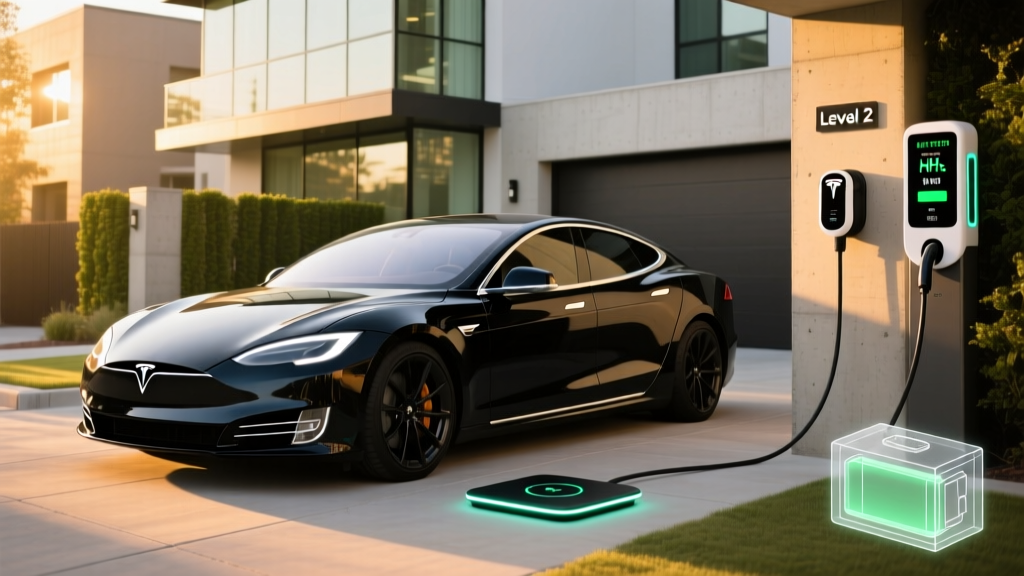
Home charging cost: A Tesla Wall Connector (~$475) installed on a 60-amp dedicated circuit typically costs $800-$1,500 total if your electrical panel has capacity. If you need a panel upgrade from 100A to 200A service, add $1,500-$3,000. Always have a licensed electrician evaluate your panel before committing.
Performance, Efficiency, and Practical Space
Tesla's powertrain efficiency (measured in kWh per 100 miles) consistently beats competitors, meaning more miles from fewer electrons. Here's the full spec breakdown:
| Spec | Model 3 LR AWD | Model Y LR AWD | Model S LR | Cybertruck AWD |
|---|---|---|---|---|
| 0-60 mph | 4.2 sec | 4.8 sec | 3.1 sec | 4.1 sec |
| Horsepower | ~384 hp | ~384 hp | ~670 hp | ~600 hp |
| Drivetrain | Dual-Motor AWD | Dual-Motor AWD | Dual-Motor AWD | Dual-Motor AWD |
| MPGe (combined) | 132 MPGe | 122 MPGe | 120 MPGe | ~98 MPGe |
| kWh/100 mi | 25 kWh | 28 kWh | 28 kWh | ~42 kWh |
| Cargo (rear + frunk) | 23 cu ft + 3.1 cu ft | 30 cu ft + 4.1 cu ft | 28 cu ft + 3.1 cu ft | ~67 cu ft bed + frunk |
| Rear Legroom | 35.2 in | 36.5 in | 35.4 in | N/A (truck bed) |
| Towing Capacity | Not rated | 3,500 lbs | Not rated | 11,000 lbs |
| Ground Clearance | 5.5 in | 6.6 in | 5.0 in (adaptive) | 16 in (adaptive) |
MPGe explained: MPGe (miles per gallon equivalent) converts electricity consumption into a gasoline-familiar metric. One gallon of gasoline contains roughly 33.7 kWh of energy. A Model 3 LR at 132 MPGe uses 25 kWh to travel 100 miles — roughly $3.00-$4.50 per 100 miles at average US residential electricity rates ($0.12-$0.18/kWh), versus $10-$14 for a 30 MPG gas car at $3.50/gallon.
Pricing, Trims, and Federal Tax Credit Eligibility
Tesla's pricing fluctuates more frequently than legacy automakers — sometimes monthly. Below are approximate base MSRPs as of early 2026. Always verify on Tesla's configurator before ordering.
| Model / Trim | Base MSRP | §30D Credit Eligibility | Effective Price (est.) |
|---|---|---|---|
| Model 3 RWD | ~$38,990 | Eligible (up to $7,500) | ~$31,490 |
| Model 3 Long Range AWD | ~$45,240 | Eligible (up to $7,500) | ~$37,740 |
| Model 3 Performance | ~$52,990 | Eligible (up to $7,500) | ~$45,490 |
| Model Y Long Range AWD | ~$44,990 | Eligible (up to $7,500) | ~$37,490 |
| Model Y Performance | ~$48,990 | Eligible (up to $7,500) | ~$41,490 |
| Model S Long Range | ~$79,990 | Not eligible (MSRP cap) | ~$79,990 |
| Model X Long Range | ~$84,990 | Not eligible (MSRP cap) | ~$84,990 |
| Cybertruck AWD | ~$79,990 | Not eligible (MSRP cap) | ~$79,990 |
- MSRP Cap: Sedans must be under $55,000; SUVs, vans, and trucks under $80,000. This eliminates Model S, Model X, and most Cybertruck trims.
- Buyer Income Cap: Modified AGI must not exceed $150,000 (single), $225,000 (head of household), or $300,000 (married filing jointly).
- Battery Sourcing: Critical minerals and battery components must meet escalating domestic/free-trade-agreement percentages. Tesla's US-built LFP and NMC packs currently qualify, but sourcing rules tighten annually.
- Point-of-Sale Transfer: You can transfer the credit to the dealer at purchase, reducing your out-of-pocket cost immediately — even if you have low tax liability.
- Verify annually: Rules change. Check IRS Clean Vehicle Credits before ordering.
State incentives vary widely and stack on top of federal credits in some cases. California, Colorado, Massachusetts, and others offer additional rebates — but amounts and eligibility differ by jurisdiction. Consult your state's energy office or a tax professional for specifics.
Warranty, Battery Longevity, and Total Cost of Ownership
Tesla's warranty structure is straightforward but not class-leading in every category:
- Basic Vehicle: 4 years / 50,000 miles
- Battery & Drive Unit (Model 3/Y RWD with LFP): 8 years / 100,000 miles
- Battery & Drive Unit (Long Range / Performance / S / X): 8 years / 120,000 miles (150,000 for Model S/X)
- Capacity Retention Threshold: Tesla warrants that the battery will retain at least 70% of original capacity during the warranty period.
Degradation reality: Based on fleet data aggregations, Tesla NMC batteries typically lose 5-8% capacity in the first 50,000 miles, then degrade more slowly. LFP batteries (Model 3 RWD) show slightly more initial drop but stabilize and have longer cycle life. Out-of-warranty battery replacement costs range from $12,000-$20,000 depending on the pack — a real financial risk after year 8.
5-Year Ownership Cost Snapshot (Model Y LR AWD, 15,000 mi/yr):
| Category | 5-Year Cost |
|---|---|
| Purchase (after $7,500 credit) | ~$37,490 |
| Electricity (home charging, $0.15/kWh avg) | ~$3,150 |
| Insurance (national avg for Tesla) | ~$12,500 |
| Maintenance (tires, cabin filter, wiper fluid) | ~$1,800 |
| Estimated Depreciation (5 yr) | ~$15,000 |
| Total 5-Year Cost | ~$69,940 |
Tesla insurance premiums run 20-40% higher than comparable non-Tesla EVs in most states due to repair-cost data. Get a quote before ordering.
Tech, Driver Assistance, and What Tesla Still Does Best (and Worst)
- Supercharger network: 6,000+ US stations, plug-and-charge reliability unmatched by CCS networks
- Over-the-air updates add features post-purchase (UI improvements, efficiency tweaks, entertainment)
- Class-leading efficiency (kWh/100mi) means lower charging costs long-term
- Minimal maintenance — no oil, no transmission fluid, brake pads last 100K+ miles with regen
- Strong resale value relative to most EVs (though depreciation has increased since 2023 price cuts)
- Build quality inconsistency — panel gaps, paint defects still reported more than legacy luxury brands
- Minimalist interior isn't for everyone — no physical buttons, no traditional instrument cluster
- FSD (Supervised) remains SAE Level 2 — requires full driver attention despite the name
- Service center wait times in high-population areas can stretch weeks for non-critical issues
- No Apple CarPlay or Android Auto — Tesla's proprietary infotainment is the only option
Tesla's Autopilot (included) and Full Self-Driving Supervised ($8,000 add-on or $99/month) are SAE Level 2 driver-assistance systems. They handle steering, acceleration, and braking under driver supervision. You must keep your hands on the wheel and eyes on the road. Only Level 4 systems (like Waymo robotaxis in select cities) operate without a human driver. Do not treat FSD as autonomous — NHTSA continues to investigate Tesla Autopilot/FSD-involved incidents.
Standout tech features: Tesla's 15.4-inch center touchscreen handles everything — navigation, media, climate, vehicle settings. Sentry Mode records surround-camera footage when parked. The Tesla app provides remote preconditioning, location tracking, and charging management. Dog Mode keeps the cabin climate-controlled for pets with a visible notification on the screen.
Who Should Buy a Tesla — And Who Should Look Elsewhere
- You road-trip regularly and want the most reliable DC fast-charging network without adapter hassles
- You prioritize efficiency and low per-mile energy cost over interior luxury
- You want OTA updates that meaningfully improve the car over time
- You can charge at home and your commute fits within 80% of real-world range
- You want a traditional luxury interior with physical controls (BMW i4/iX, Mercedes EQE/EQS, Genesis GV60)
- You need a sub-$35,000 EV (Chevrolet Equus EV, used Tesla Model 3)
- You want a 3-row electric SUV (Kia EV9, Rivian R1S — Model X pricing is prohibitive for most)
- You need proven dealer-service infrastructure in rural areas (Ford, Hyundai/Kia)
Frequently Asked Questions
What is the real-world range of a Tesla?
Expect 80-85% of the EPA sticker on sustained highway driving at 70 mph in mild weather, and 65-75% in freezing temperatures with cabin heat. A Model 3 Long Range rated at 363 miles EPA will deliver roughly 305 highway miles at 70°F and about 255 miles at 20°F. City driving with regenerative braking can match or exceed EPA numbers.
How fast does a Tesla charge at home and on the road?
On a Level 2 Tesla Wall Connector (11.5 kW / 48 amps), a Model 3 Long Range gains about 44 miles of range per hour — a full overnight charge from 20-80% takes roughly 5-6 hours. On a V3 Supercharger (250 kW DC), 10-80% takes 18-20 minutes with battery preconditioning active. Without preconditioning, cold-weather fast charging can be 50%+ slower.
How much does a Tesla cost after federal tax credits?
A 2026 Model 3 RWD starts around $38,990 and can drop to ~$31,490 after the full $7,500 §30D credit — if you meet income caps ($150K single / $300K joint) and the vehicle meets battery-sourcing requirements (current Tesla US-built models qualify). Model S, X, and most Cybertruck trims exceed the MSRP cap and are ineligible. Always verify current rules at IRS.gov.
Is a Tesla worth buying vs. competitors like Hyundai Ioniq 5 or BMW i4?
For road-trippers who value Supercharger access and efficiency, Tesla still wins. For buyers prioritizing interior quality, physical controls, or a more traditional dealership service experience, the Hyundai Ioniq 5 (800V charging, excellent interior) or BMW i4 (luxury sedan refinement) are strong alternatives. Cross-shop based on your top three priorities — charging network, interior, or price.
What are the biggest pros and cons of owning a Tesla?
Pros: Supercharger network, OTA updates, class-leading efficiency, low maintenance costs, strong app integration. Cons: Build-quality inconsistency, premium insurance costs, no CarPlay/Android Auto, FSD requires full driver attention despite the name, service-center wait times in metro areas.
Does Tesla's battery last? What does replacement cost?
Tesla batteries typically lose 5-8% capacity in the first 50,000 miles, then degrade more gradually. Fleet data suggests most packs retain 85-90% capacity at 100,000 miles. The warranty covers replacement if capacity drops below 70% within 8 years / 100,000-150,000 miles (depending on trim). Out-of-warranty replacement runs $12,000-$20,000 — a real consideration for second owners or high-mileage drivers.
Do I need a home charger to own a Tesla?
Strongly recommended. Relying solely on public Superchargers costs 2-3x more per mile than home charging and adds 20-40 minutes to your routine multiple times per week. If you can install a Level 2 Wall Connector ($800-$1,500 installed, assuming panel capacity), the ownership experience improves dramatically. Apartment dwellers without charging access should weigh this carefully before purchasing.