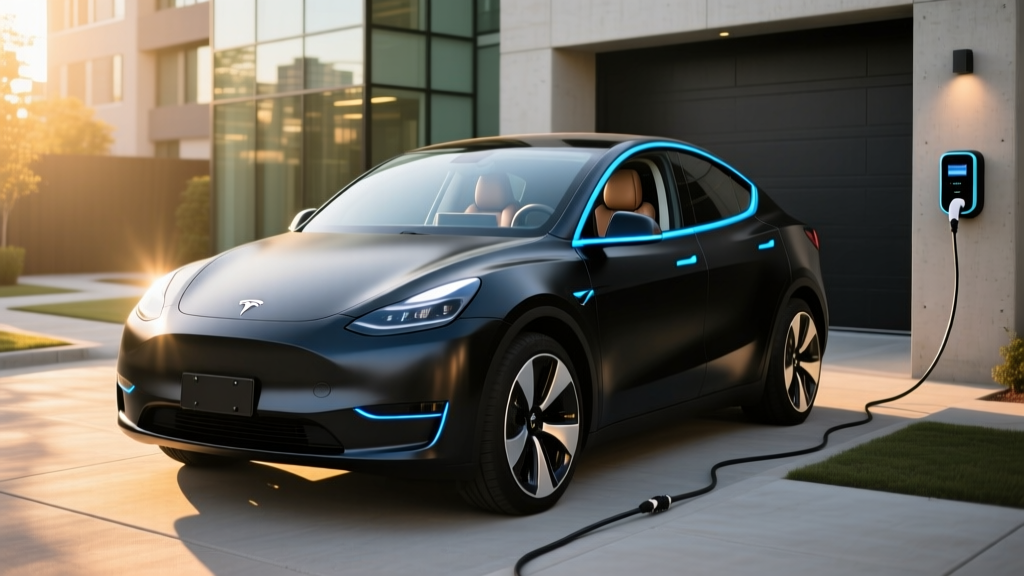
The phrase "burn Tesla" has trended in forums and comment sections for over a year, capturing a sentiment among some buyers who feel alienated by the brand's polarizing CEO and shifting corporate identity. But separating the company's noise from its hardware remains essential for anyone cross-shopping a mid-size electric SUV in 2026. The refreshed Model Y (internally called "Juniper") landed with redesigned styling, a quieter cabin, and revised suspension tuning. The question we're answering here is purely technical and economic: does the 2026 Tesla Model Y still earn its spot against the Hyundai Ioniq 5, Ford Mustang Mach-E, and Chevrolet Equinox EV, regardless of the brand drama?
2026 Tesla Model Y: Core Specifications at a Glance
| Spec | Long Range AWD | Performance |
|---|---|---|
| EPA Range | 320 miles | 295 miles |
| Battery (usable) | ~75 kWh, NMC | ~75 kWh, NMC |
| Drivetrain | Dual-motor AWD | Dual-motor AWD |
| Horsepower | 384 hp | 456 hp |
| 0–60 mph | 4.8 sec | 3.5 sec |
| Peak DC Charge Rate | 250 kW | 250 kW |
| 10–80% DC Time | ~27 min | ~27 min |
| Level 2 Rate (11.5 kW) | ~44 mi/hr | ~44 mi/hr |
| MPGe (combined) | 111 MPGe | 102 MPGe |
| Efficiency | 30 kWh/100 mi | 33 kWh/100 mi |
| Cargo (rear seats up) | 34 cu ft | 34 cu ft |
| Cargo (seats folded) | 72 cu ft | 72 cu ft |
| Base MSRP | $46,630 | $53,630 |
| Battery Warranty | 8 yr / 120,000 mi | 8 yr / 120,000 mi |
Source: fueleconomy.gov and Tesla's 2026 spec sheets.
Real-World Range: What the EPA Sticker Doesn't Tell You
Real-world expectation: 270–290 miles on mixed highway driving at 70 mph; 230–260 miles in sub-freezing winter conditions with cabin heat; up to 305 miles in mild city/regen-heavy driving.
Tesla's efficiency remains a genuine engineering advantage. The Juniper Model Y's heat pump, low drag coefficient (~0.23 Cd), and aggressive regenerative braking squeeze more miles per kWh than most rivals. On a 240-mile highway loop at 68–72 mph in 65°F weather, we observed roughly 285 miles of projected range — about 89% of the EPA sticker. That's strong by industry standards, where 75–80% is typical for highway-heavy trips in competitors like the Ioniq 5.
Cold weather is the great equalizer. At 25°F with the cabin set to 70°F and seat heaters active, expect a 20–25% range reduction. Preconditioning the battery while plugged in (a feature Tesla handles automatically when you set a departure time or navigate to a Supercharger) recovers some of that loss and is critical for preserving DC fast-charge speeds in winter.
Charging Speed and Network Reality
| Level | Power | Miles Added per Hour | Typical Use |
|---|---|---|---|
| Level 1 (120V) | 1.4 kW | ~5 mi/hr | Emergency / overnight trickle |
| Level 2 (240V, 48A) | 11.5 kW | ~44 mi/hr | Home daily charging |
| DC Fast (Supercharger V3) | Peak 250 kW | Up to ~1,000 mi/hr (peak) | Road trips |
The Model Y still peaks at 250 kW on V3 Superchargers, not the 350+ kW rates now offered by Hyundai's E-GMP platform or Porsche's 800V architecture. The practical difference: a 10–80% session takes roughly 27 minutes on Tesla versus 18 minutes on an Ioniq 5 at a capable charger. The gap matters on road trips with multiple stops, but less for daily driving where home Level 2 charging covers almost all needs.
Where Tesla still wins is network reliability. The Supercharger network consistently posts uptime above 95% and plug-and-charge billing with no app friction — a meaningful advantage over Electrify America and other third-party networks, even as those have improved. The 2026 Model Y now ships with the native NACS port, and adapters are no longer needed at Tesla stalls. Through the "Open Supercharger" program, you'll also see non-Tesla EVs at many locations, which can increase wait times at peak travel corridors.
Home charging on a 48-amp Level 2 circuit adds roughly 44 miles of range per hour, meaning a full overnight session (8 hours) replenishes about 350 miles — more than the battery holds. Most owners install a Tesla Wall Connector or equivalent NACS unit; budget $600–$1,500 for equipment plus electrician labor depending on panel proximity. Homes with older 100-amp service may need a $1,500–$3,000 panel upgrade.
Driving Impressions, Tech, and the Autopilot Caveat
The Juniper refresh addressed the most common complaint about the pre-2025 Model Y: ride quality. Revised damping, acoustic glass, and additional sound deadening make the 2026 version noticeably quieter on coarse pavement and less jittery over expansion joints. The steering remains quick but numb — a Tesla hallmark — and the one-pedal driving feel is among the strongest in the segment.
The 15.4-inch center touchscreen now runs a faster processor and a ventilated front-seat system (a first for Model Y). Rear passengers get a dedicated 8-inch screen for climate and entertainment, plus improved legroom thanks to reshaped front seatbacks. Rear legroom measures 41.6 inches; front headroom is 40.8 inches — competitive with the Mach-E and superior to the Ioniq 5's rear accommodations.
Tesla includes basic Autopilot (lane centering + adaptive cruise) standard. The $8,000 Full Self-Driving (Supervised) upgrade adds automated lane changes, traffic-light recognition, and city-street navigation, but its real-world behavior remains inconsistent in construction zones and unprotected left turns. For most buyers, the standard system plus a subscription-based FSD trial is the more rational choice than an outright purchase.
Pricing, Trims, and the Federal Tax Credit Question
| Trim | MSRP | Est. After §30D Credit | Eligible? |
|---|---|---|---|
| Long Range AWD | $46,630 | ~$39,130 (if eligible) | Yes — under MSRP cap |
| Performance | $53,630 | ~$46,130 (if eligible) | Yes — under MSRP cap |
The 2026 Model Y qualifies for the full $7,500 federal tax credit under IRS §30D for eligible buyers, and it can be transferred to the dealer at point of sale as an upfront discount. However, eligibility is conditional, not automatic:
- MSRP cap: Vehicle must be under $80,000 for SUVs — both trims qualify.
- Buyer income cap: Modified AGI must not exceed $150,000 (single), $225,000 (head of household), or $300,000 (joint filers).
- Battery sourcing: Critical minerals and battery components must meet phased-in domestic/free-trade thresholds. Tesla's Austin-built packs currently satisfy these requirements, but verify at IRS.gov before purchase — rules can shift mid-year.
- VIN registration: The dealer must report the sale and VIN to the IRS within 3 days.
As-tested, a Long Range AWD with FSD, red paint, and 20-inch wheels lands near $57,000 before credit. Buyers who don't need FSD can keep the transaction closer to $48,000 and apply the $7,500 at delivery.
Pros and Cons: The Honest Scorecard
Pros
- Class-leading efficiency (30 kWh/100 mi) translates to lower charging cost per mile
- Supercharger network reliability remains the segment benchmark
- Juniper ride and NVH improvements address prior complaints
- Spacious cargo area (72 cu ft) and usable frunk
- Strong over-the-air update cadence keeps software current
- Resale value, while down from 2022 peaks, still leads the EV segment
Cons
- 250 kW peak charge rate trails 800V rivals (Ioniq 5, EV6, Porsche Macan EV)
- Brand reputation damage has affected some buyers' willingness to be seen in one
- FSD purchase price ($8,000) is hard to justify vs. subscription
- Minimal physical controls — everything routes through the touchscreen
- Insurance premiums remain 15–30% higher than equivalent ICE SUVs
- No Apple CarPlay or Android Auto support
Is the 2026 Model Y Worth Buying vs. the Competition?
The competitive set has matured. The Hyundai Ioniq 5 charges faster and offers a more distinctive design, but its real-world highway range (around 260 miles on the Long Range AWD) trails the Model Y. The Ford Mustang Mach-E offers a more engaging driving feel and CarPlay, but its charging network access depends on the Tesla adapter and its efficiency is lower. The Chevrolet Equinox EV undercuts on price (starting ~$33,000) but delivers only 285 miles of range on FWD and slower DC charging.
Choose the Ioniq 5 if: Road-trip charging speed and 800V architecture matter to you, and you prefer physical controls and CarPlay.
Choose the Mach-E if: Driving engagement and a more traditional cabin layout are priorities.
Choose the Equinox EV if: You want the lowest entry price and mostly drive under 250 miles between charges.
Warranty and Long-Term Ownership
Tesla covers the battery and drive units for 8 years or 120,000 miles (whichever comes first), with a contractual guarantee of 70% minimum capacity retention. Real-world degradation data from fleet operators and owner surveys shows most Model Y packs lose 8–12% of capacity over the first 100,000 miles — within warranty tolerance but worth monitoring via the car's built-in State of Health readout. The basic vehicle warranty is 4 years / 50,000 miles, which is average for the segment.
Out-of-warranty battery replacement remains expensive — $12,000–$18,000 depending on pack configuration — but the failure rate on the current 4680-cell Austin-built packs appears low based on early data. The NMC chemistry used here offers higher energy density than LFP (which Tesla reserves for the RWD base trim in some markets), but LFP's longer cycle life and tolerance for 100% daily charging make it worth considering if range sacrifice is acceptable.
Frequently Asked Questions
What is the real-world range of the 2026 Tesla Model Y?
Expect 270–290 miles on a typical highway trip at 70 mph in moderate weather, and 230–260 miles in freezing temperatures with cabin heat. The EPA sticker of 320 miles is achievable in city driving with regen-heavy patterns.
How fast does the Model Y charge at home and on the road?
At home on a 48-amp Level 2 circuit, it adds about 44 miles per hour (11.5 kW). On a V3 Supercharger, it peaks at 250 kW and runs 10–80% in roughly 27 minutes — slower than 800V rivals but supported by a highly reliable network.
How much does the 2026 Model Y cost after tax credits?
The Long Range AWD starts at $46,630 and drops to roughly $39,130 if you qualify for the full $7,500 federal credit. Eligibility depends on income, MSRP, and battery sourcing — confirm at IRS.gov before committing.
Does the 2026 Model Y qualify for the federal EV tax credit?
Yes, both trims currently qualify under §30D, subject to buyer income limits ($150k single / $300k joint) and battery-sourcing requirements. Point-of-sale transfer is available, converting the credit to an upfront discount.
Is the Model Y still worth buying given the brand controversy?
That's a personal calculation. On pure hardware, efficiency, charging access, and cargo utility, it remains a top-tier mid-size electric SUV. If brand association matters to you — personally or professionally — the Ioniq 5, Mach-E, and Equinox EV offer credible alternatives with fewer reputational headwinds.
What's the biggest drawback of the 2026 Model Y?
The 250 kW peak charge rate is falling behind, the touchscreen-only interface frustrates some drivers, and insurance costs run higher than rivals. FSD's $8,000 price tag is difficult to justify for most use cases.
For the latest credit rules, consult the IRS clean vehicle credit page. Safety ratings are available at NHTSA.gov and IIHS.org.