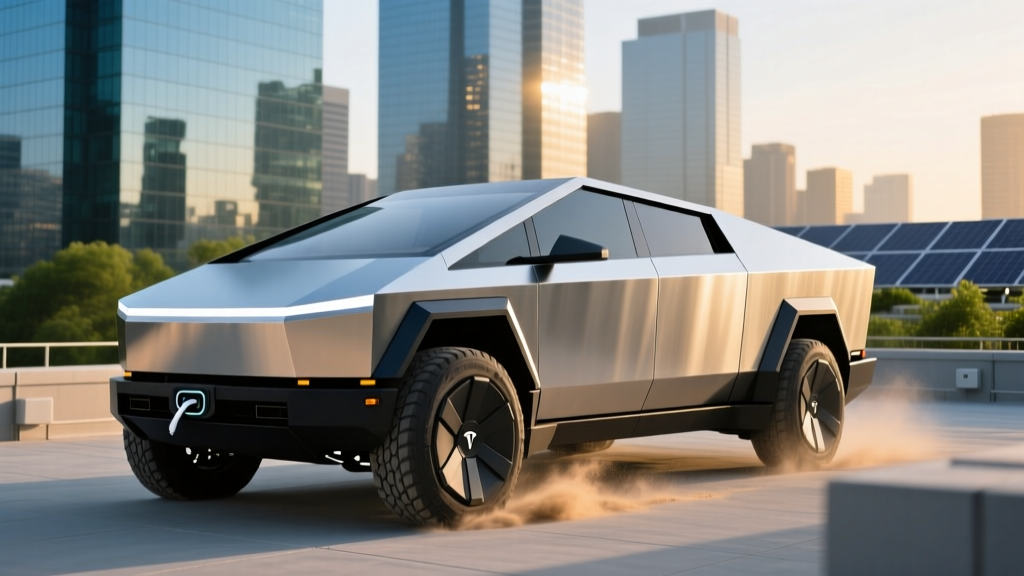
The term Tesla bricks has become shorthand among EV enthusiasts for Teslas that suffer catastrophic electrical failures, rendering them immobile and unfixable without major dealer intervention. While the label originated from scattered reports across Model S, Model 3, and Model Y ownership forums, it gained mainstream traction with the Cybertruck's rocky 2024–2025 launch, where high-profile drive-unit failures, 12V system faults, and software-induced lockouts left early adopters stranded. Now in the 2026 model year, Tesla has pushed multiple over-the-air patches and hardware revisions — but does the Cybertruck still deserve the "brick" reputation? This review examines the 2026 Tesla Cybertruck with hard data on range, charging, pricing, and the real reliability picture.
What "Tesla Bricks" Actually Means
In EV ownership circles, a "bricked" vehicle is one whose core electrical architecture fails to the point where the car cannot be driven, started, or even towed in neutral without specialized service equipment. For Tesla specifically, the term has been applied to:
- 12V lithium auxiliary battery failures — when the small battery that powers door handles, screens, and contactors dies, the car locks you out and cannot engage the drive system.
- Drive-unit (motor/inverter) failures — particularly on early Cybertruck AWD models, where the front drive unit was recalled and replaced under warranty.
- OTA update failures — software flashes that stall mid-install, leaving the vehicle in a non-bootable state requiring mobile service or a flatbed to a service center.
- High-voltage contactor welds — a known issue across Tesla's lineup where the relay connecting the traction battery to the drivetrain can fuse open or closed.
It's worth noting that "bricking" is not unique to Tesla — any modern EV with a fully electronic architecture (no mechanical key override, no manual neutral release) is vulnerable if the low-voltage system fails. But Tesla's scale and its early-adopter customer base mean these incidents get outsized attention.
2026 Cybertruck: Range, Efficiency & Real-World Expectations
The 2026 Cybertruck is offered in three configurations: Long Range AWD, Dual Motor AWD (Performance), and the Cyberbeast tri-motor. Here's what the EPA and real-world testing tell us.
| Trim | EPA Range | Real-World Highway (70 mph) | Cold Weather (20°F) |
|---|---|---|---|
| Long Range AWD | 340 mi | ~270–290 mi | ~230–260 mi |
| Dual Motor AWD | 320 mi | ~255–275 mi | ~215–245 mi |
| Cyberbeast (Tri-Motor) | 300 mi | ~240–260 mi | ~200–230 mi |
The stainless-steel exoskeleton creates more aerodynamic drag than a conventional unibody truck, and the heavy curb weight (~6,600–6,800 lbs) compounds highway efficiency losses. In mild city driving with regen braking, owners report getting closer to EPA figures.
Efficiency on the Long Range AWD sits at approximately 2.0 kWh/mi (50 MPGe combined), per fueleconomy.gov. That's notably less efficient than a Model Y Long Range (~3.6 mi/kWh) due to the truck's mass and drag coefficient.
Battery & Charging: Specs That Matter
The 2026 Cybertruck uses a structural battery pack with an estimated ~123 kWh usable capacity (gross pack ~135 kWh). Tesla uses NMC (nickel manganese cobalt) chemistry in the Cybertruck — chosen for its higher energy density, which is critical for a vehicle this heavy. This differs from the LFP packs used in the base Model 3 RWD.
| Metric | Long Range AWD | Dual Motor AWD | Cyberbeast |
|---|---|---|---|
| Battery (usable) | ~123 kWh (NMC) | ||
| Max DC Fast Charge | 250 kW (V3 Supercharger) / 350 kW (V4 capable) | ||
| 10–80% DC Time | ~28–32 minutes | ||
| Peak Charge Rate Sustained | ~180–200 kW average (10–80%) | ||
| Level 2 Home Charge (11.5 kW) | ~34 mi/hr added | ||
| Level 2 Home Charge (7.7 kW / 32A) | ~22 mi/hr added | ||
| NACS Connector | Yes (native) | ||
Charging curve reality: The Cybertruck peaks near 250 kW only between roughly 10–30% State of Charge (SoC). Above 50%, the rate tapers significantly — you'll see ~100 kW by 70% and ~50 kW by 85%. This is normal for large NMC packs but means the advertised "250 kW" is a peak, not a sustained rate. Plan road-trip stops for 10–80% to avoid the slow tail.
At home on a 48-amp Level 2 charger (11.5 kW), a full charge from 10% takes roughly 12 hours. Most owners charging overnight from 30–80% daily need only 5–6 hours, which is manageable with a standard NEMA 14-50 or hardwired Wall Connector installation.
Performance, Drivetrain & Dimensions
| Spec | Long Range AWD | Dual Motor AWD | Cyberbeast |
|---|---|---|---|
| 0–60 mph | 4.1 sec | 3.9 sec | 2.6 sec |
| Horsepower | 600 hp | 600 hp | 845 hp |
| Drivetrain | Dual Motor AWD | Dual Motor AWD | Tri-Motor AWD |
| Towing Capacity | 7,500 lbs | 7,500 lbs | 7,500 lbs |
| Payload | 2,500 lbs | 2,500 lbs | 2,500 lbs |
| Bed Length | 6 ft (vault with tonneau) | ||
| Cargo (bed + frunk) | ~67 cu ft bed + ~7 cu ft frunk | ||
| Front Legroom | 41.4 in | ||
| Rear Legroom | 35.2 in | ||
| Curb Weight | ~6,600 lbs | ~6,700 lbs | ~6,800 lbs |
The Cyberbeast's 2.6-second 0–60 time is genuinely supercar territory, but the Dual Motor's 3.9 seconds already outpaces nearly every truck and most sports sedans on the market. Towing at 7,500 lbs will cut range roughly in half — expect ~150–170 miles before needing a charge, which makes long-distance towing impractical without careful route planning around Superchargers.
Pricing, Tax Credits & Total Cost
| Trim | Base MSRP | §30D Credit Eligible? | Effective Price (if eligible) |
|---|---|---|---|
| Long Range AWD | $79,990 | No — exceeds $80,000 MSRP cap for trucks* | $79,990 |
| Dual Motor AWD | $99,990 | No — exceeds MSRP cap | $99,990 |
| Cyberbeast | $119,990 | No — exceeds MSRP cap | $119,990 |
Critical tax credit note: Under IRS §30D rules, the new clean vehicle credit has an $80,000 MSRP cap for trucks, vans, and SUVs. The Long Range AWD at $79,990 sits right at the threshold — but adding any factory options (paint, FSD, wheels) pushes it over the cap and disqualifies it. Buyer income limits also apply ($300K joint / $225K head of household / $150K single MAGI). Additionally, battery component and critical mineral sourcing requirements must be met; Tesla's evolving supply chain means eligibility can shift. Always verify with a tax professional before counting on the credit.
The Cybertruck does not qualify for the $7,500 federal tax credit in most configurations as of the 2026 model year. The used-EV credit (§25E, up to $4,000) may apply to 2024 models appearing on the secondary market in future years, subject to the $25,000 sale-price cap and different income limits.
Reliability: Is the 2026 Cybertruck Still "Bricking"?
Tesla addressed several early Cybertruck failure modes through 2025–2026 hardware revisions and recalls:
- Front drive unit replacement (Recall SB-24-001): Early single-gear front drive units were prone to bearing failure under high-torque launches. Tesla switched to a revised unit with improved lubrication channels.
- 12V lithium battery firmware: OTA updates improved the 12V battery management system, reducing phantom drain that was killing auxiliary batteries in parked vehicles.
- Steer-by-wire redundancy: The Cybertruck's fully electronic steering (no mechanical column) now has triple-redundant control modules — a failure in one doesn't disable steering.
- Stainless panel gap/trim issues: Cosmetic, but widespread — Tesla revised assembly jigs at Giga Texas.
That said, the Cybertruck remains a low-volume, first-generation platform with complex systems (steer-by-wire, 48V architecture, structural pack). NHTSA complaint data and owner forums still surface isolated cases of contactor failures, touchscreen blackouts, and charge-port door malfunctions. The probability of a brick event is low — but the consequence is high because roadside fixes are nearly impossible on a 48V, fully electronic truck.
If your Cybertruck bricks on a road trip, Tesla mobile service may be days away in rural areas. There is no manual neutral release, no physical key override, and no third-party tow company equipped to handle a 6,800-lb locked-down EV without a flatbed. Factor this into your risk tolerance if you drive outside metro areas.
Warranty Coverage
| Component | Coverage |
|---|---|
| Basic Vehicle | 4 years / 50,000 miles |
| Battery & Drive Units | 8 years / 120,000 miles (min 70% retention) |
| Restraint System | 5 years / 60,000 miles |
| Corrosion (perforation) | 12 years / unlimited miles |
The 8-year/120,000-mile battery warranty with a 70% capacity retention threshold is competitive with the industry standard. However, Tesla's warranty does not guarantee a loaner vehicle or rapid replacement timeline — if your pack fails at mile 115,000, you may wait weeks for a replacement depending on parts availability.
Standout Tech & Notable Drawbacks
- Native NACS connector — full Supercharger network access (20,000+ stalls in the US)
- Steer-by-wire with variable ratio — extremely tight turning radius for a full-size truck
- 48V electrical architecture — reduces wiring harness weight, enables higher-power accessories
- Stainless exoskeleton — no paint to chip, dent-resistant body panels
- Bioweapon Defense Mode (HEPA filtration) standard
- OTA updates continue to add features post-purchase
- Best-in-class 0–60 for Cyberbeast trim
- No federal tax credit eligibility at current MSRP levels
- Highway efficiency is poor (~2.0 kWh/mi) due to weight and aero
- Towing cuts range to ~150 mi — impractical for long hauls
- Rear legroom (35.2 in) is tight for a truck this size
- Steer-by-wire has no mechanical backup — total electronic dependency
- Service center wait times can stretch weeks for major repairs
- Insurance premiums 30–50% above comparable trucks
- Panel gaps and build quality still inconsistent on some units
Tech & Driver Assistance
The Cybertruck runs Tesla's latest infotainment stack on a 18.5-inch center touchscreen with a secondary 9.4-inch rear screen. Standard features include:
- Autopilot (Level 2 SAE): Traffic-aware cruise control + autosteer. The driver must maintain hands on the yoke and eyes on the road — this is not self-driving.
- FSD (Supervised) — $8,000 option: Adds automatic lane changes, traffic light/stop sign recognition, and city street navigation. Still requires full driver supervision. SAE Level 2.
- Adaptive air suspension: Up to 16 inches of ground clearance in Extract mode for off-road use.
- Powershare (V2L/V2H): Up to 11.5 kW of bidirectional power — enough to run tools at a job site or provide emergency home backup during outages.
Both Autopilot and FSD (Supervised) are SAE Level 2 driver-assistance systems. The driver must remain fully engaged, monitor the road, and be prepared to take over instantly. Tesla's system is not autonomous — only Level 4 robotaxi services like Waymo operate without a human driver.
Who Should Buy the 2026 Cybertruck?
- You want a statement vehicle with supercar acceleration and truck utility
- You live near a Tesla Service Center and have home Level 2 charging
- You value Supercharger network access for road trips (unrivaled reliability vs. CCS networks)
- You need V2L/V2H capability for job-site power or home backup
- You're comfortable with first-generation platform risk and potential service delays
- You need maximum highway range and efficiency (consider the Rivian R1T or Ford F-150 Lightning extended range)
- You tow frequently over long distances
- You want federal tax credit eligibility (no current Tesla qualifies at these prices)
- You drive in rural areas far from Tesla service infrastructure
- Build quality consistency is a priority (consider established OEM trucks)
Frequently Asked Questions
What is the real-world range of the 2026 Cybertruck?
The EPA rates the Long Range AWD at 340 miles, but expect 270–290 miles at sustained highway speeds (70 mph) and 230–260 miles in freezing temperatures. City driving with regen braking gets closest to the EPA sticker.
How fast does the Cybertruck charge?
On a V3 Supercharger (250 kW peak), the 10–80% charge takes approximately 28–32 minutes. The average sustained rate is closer to 180–200 kW. At home on an 11.5 kW Level 2 charger, you add about 34 miles of range per hour.
Does the 2026 Cybertruck qualify for the $7,500 federal tax credit?
In most configurations, no. The §30D credit has an $80,000 MSRP cap for trucks, and even the base Long Range AWD at $79,990 exceeds it once any options are added. Buyer income limits and battery sourcing rules also apply. Consult IRS guidelines and a tax professional.
Is the Cybertruck still having "brick" failures in 2026?
Hardware revisions and recalls have reduced the frequency of early issues (front drive unit, 12V battery drain). Isolated failures still occur — the risk is lower than 2024–2025 launch vehicles but higher than a mature platform like the Model Y. The consequence of a brick event remains high due to the truck's fully electronic architecture.
How does the Cybertruck compare to the Rivian R1T or F-150 Lightning?
The Cybertruck wins on acceleration, Supercharger access, and V2L capability. The Rivian R1T offers better interior quality, a more practical bed system, and a growing (but smaller) charging network via its NACS adapter. The F-150 Lightning is the most conventional truck experience with strong CCS charging access and broader dealer service coverage. None currently qualify for the full federal tax credit in their top trims.
What does Cybertruck insurance cost?
Insurance premiums run 30–50% higher than comparable gas trucks due to repair costs (stainless panels, structural battery, steer-by-wire components). Expect $2,500–$4,000/year depending on your state, driving record, and coverage level. Tesla Insurance is available in some states and may offer competitive rates based on real-time driving data.