Quick Verdict: The 2022 Model 3 in 2026
If you are shopping for a used electric sedan in 2026, the 2022 Tesla Model 3 remains one of the most data-backed options on the market. With EPA ranges from 272 to 358 miles depending on trim, access to the Supercharger network (now with a NACS adapter for CCS rivals), and a minimalist cabin that polarizes but delivers, this model year hits a sweet spot for second-hand EV buyers. The 2022 model year was also the last full year before Tesla's Highland refresh arrived for 2024, making it a clear dividing line between the "classic" Model 3 and the updated generation.
This guide breaks down the 2022 Tesla Model 3 interior materials, real-world range data, DC fast-charging curves, and whether you can claim the used-EV federal tax credit under current IRS §25E rules.
Range, Battery & Efficiency: What the Numbers Actually Mean
The 2022 Model 3 was offered in three trims, each with a different battery and drivetrain configuration. Here are the EPA-certified figures alongside real-world expectations.
| Trim | EPA Range | Battery (usable) | Chemistry | MPGe (combined) | kWh/100 mi |
|---|---|---|---|---|---|
| RWD (Standard Range) | 272 mi | ~57.5 kWh | LFP (CATL) | 132 MPGe | 25 |
| Long Range AWD | 358 mi | ~75 kWh | NMC (Panasonic/LG) | 131 MPGe | 26 |
| Performance AWD | 315 mi | ~75 kWh | NMC | 125 MPGe | 27 |
The LFP (lithium iron phosphate) battery in the RWD trim deserves special attention. LFP cells are heavier and less energy-dense than NMC, which is why the RWD has less range despite a physically comparable pack size. However, LFP offers a longer cycle life and can be charged to 100% daily without accelerating degradation — a meaningful advantage for commuters who want full range every morning. Tesla explicitly recommends periodic 100% charges for LFP packs to keep the battery management system (BMS) calibrated.
Charging Speed: DC Fast, Level 2 & the Supercharger Advantage
Charging speed is where the 2022 Model 3 still holds up well in 2026, especially given the expanding Supercharger network and the NACS-to-CCS adapter ecosystem that now lets non-Tesla EVs use Tesla stalls.
| Charging Level | Connector | Max Power | Speed / Time |
|---|---|---|---|
| Level 1 (120V household) | NACS (Tesla) | ~1.4 kW | ~3–5 mi/hr |
| Level 2 (240V home/public) | NACS (Tesla) or J1772 w/ adapter | 11.5 kW (48A) | ~37–44 mi/hr |
| DC Fast Charge | NACS (Tesla Supercharger) | 170 kW (RWD) / 250 kW (LR & Perf) | 10–80% in ~25 min (LR) / ~30 min (RWD) |
Charging curve reality: The Long Range and Performance trims peak at 250 kW on V3 Superchargers, but that peak is brief — typically sustained only between 10–30% State of Charge (SoC). By 50% SoC, power tapers to roughly 150 kW, and above 80% it drops below 50 kW. This is why Tesla quotes 10–80% times rather than 0–100%: the final 20% can take as long as the first 80%. For road-trip planning, budget 20–25 minutes per stop on a V3 Supercharger and plan to leave at 80% to keep total trip time efficient.
The RWD's LFP battery peaks at roughly 170 kW, making its DC charging noticeably slower. If you regularly road-trip more than 200 miles, the Long Range's faster charging curve and greater range make a meaningful difference in total travel time.
At home on a Level 2 Wall Connector (up to 11.5 kW / 48 amps), a full charge from 10% takes roughly 7–8 hours for the Long Range and 5–6 hours for the RWD — easily handled overnight. Installation of a 240V/60A circuit for the Wall Connector typically costs $800–$2,000 depending on panel proximity and local permitting, according to Tesla's installation guide.
Inside the 2022 Tesla Model 3 Interior: Minimalism by Design
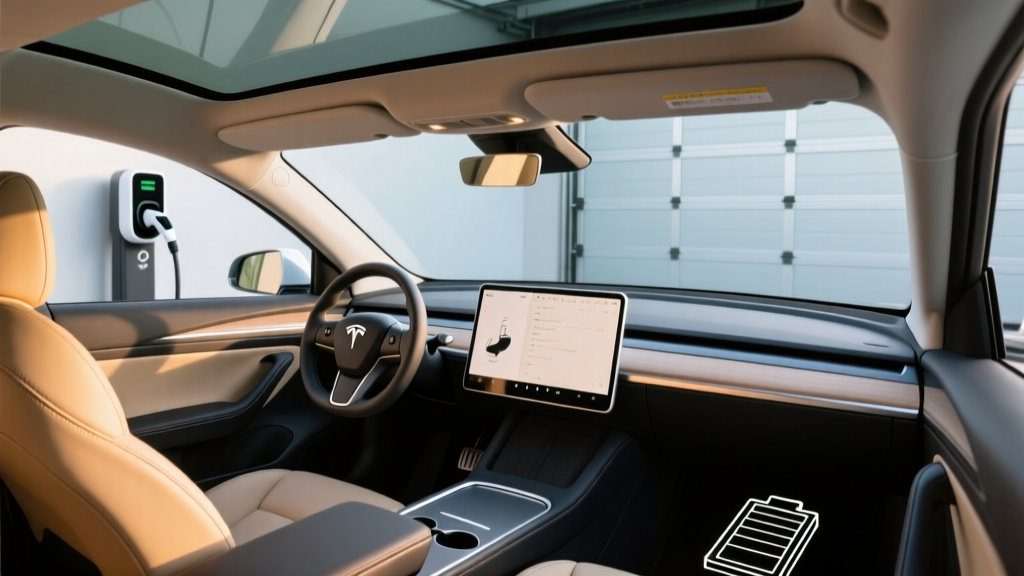
The 2022 Tesla Model 3 interior is the most debated aspect of the car. There is no instrument cluster, no physical buttons on the dash, and no traditional stalks for turn signals (they're on the steering wheel, but the wiper and cruise control functions are screen-based or stalk-minimal depending on build date). Everything routes through the 15-inch center touchscreen running Tesla's proprietary infotainment OS.
Materials & Build Quality
By 2022, Tesla had significantly improved interior fit and finish compared to the 2018–2019 launch years. The dashboard uses a combination of soft-touch vegan leather and wood or aluminum trim (depending on trim). Seats are synthetic leather across all trims — supportive on long drives but firmer than what you'll find in a Hyundai Ioniq 6 or BMW i4. Rear-seat legroom measures 35.2 inches, adequate for adults on shorter trips but tight for anyone over six feet on long hauls.
Cargo & Practicality
The trunk offers 23 cubic feet of cargo space (including the rear subtrunk), and the front trunk (frunk) adds roughly 3.1 cubic feet — enough for a charging cable bag or a small grocery run. The 60/40 split-folding rear seats expand total cargo volume to approximately 65 cubic feet, making the Model 3 surprisingly practical for its sedan footprint.
Tech & Infotainment
The 15-inch landscape touchscreen handles navigation, media, climate, vehicle settings, and even gaming (Tesla Arcade supports Bluetooth controllers). The navigation system integrates real-time Supercharger availability and routes through chargers automatically on long trips, pre-conditioning the battery for optimal charge speed upon arrival — a feature that still sets Tesla apart from most competitors in 2026.
Over-the-air (OTA) updates continue to arrive for 2022 Model 3 vehicles, adding features and refinements years after purchase. However, some features (like the full visualization of traffic lights and stop signs in Autopilot) require the FSD (Supervised) package, which was a $12,000 one-time purchase or $199/month subscription in 2022 and has since been restructured.
Performance & Driving Dynamics
| Trim | Drivetrain | 0–60 mph | Horsepower | Top Speed |
|---|---|---|---|---|
| RWD | Rear-Wheel Drive | 5.8 sec | ~283 hp | 140 mph |
| Long Range AWD | Dual-Motor AWD | 4.2 sec | ~346 hp | 145 mph |
| Performance | Dual-Motor AWD | 3.1 sec | ~450 hp | 162 mph |
Even the base RWD trim delivers instant torque that makes it feel quicker than its 5.8-second 0–60 time suggests — electric motors don't need to build revs. The Long Range strikes the best balance: dual-motor AWD provides confident traction in rain and light snow, and 4.2 seconds to 60 mph is more than adequate for any merging or passing situation.
The Performance trim adds a lower suspension, larger brakes, 20-inch Überturbine wheels, and Track Mode (which allows adjustable regen and torque bias for closed-course driving). However, the 20-inch wheels reduce EPA range by roughly 5–8% compared to the standard 18-inch Aero wheels on Long Range.
Driver Assistance: Autopilot & FSD (Supervised)
Tesla Autopilot and FSD (Supervised) are driver-assistance systems, not self-driving. You must keep your hands on the wheel and eyes on the road at all times. The system can steer, accelerate, and brake within lanes, navigate on-ramps to off-ramps (with FSD), and respond to traffic lights — but it makes errors, especially in construction zones, faded lane markings, and complex intersections. Full self-driving capability (SAE Level 4+) is not available on any consumer Tesla as of 2026.
Standard Autopilot (included on all 2022 Model 3 vehicles) provides adaptive cruise control and lane-centering on highways. It works well on clearly marked interstates but requires active supervision. The optional FSD (Supervised) package adds automatic lane changes, Navigate on Autopilot (highway on/off-ramp routing), traffic light and stop sign recognition, and Autopark. Real-world reliability of FSD varies significantly by geography and road complexity — it's a convenience feature, not a replacement for an attentive driver.
Pricing, Tax Credits & Used-EV Economics in 2026
When new, the 2022 Model 3 started at approximately $44,990 (RWD) and climbed to $53,990 (Long Range) and $58,990 (Performance), before destination fees. As of early 2026, used examples typically list between $22,000 and $35,000 depending on mileage, trim, and condition.
| Trim | Original MSRP (2022) | Est. Used Price (2026) | §25E Used-EV Credit | Effective Price |
|---|---|---|---|---|
| RWD | $44,990 | $22,000–$25,000 | Up to $4,000 | $18,000–$21,000 |
| Long Range AWD | $53,990 | $27,000–$31,000 | Up to $4,000 | $23,000–$27,000 |
| Performance | $58,990 | $30,000–$35,000 | Up to $4,000 | $26,000–$31,000 |
Federal Used-EV Tax Credit (IRS §25E)
Because the 2022 Model 3 is now a used vehicle, it is eligible for the IRS §25E Used Clean Vehicle Credit — not the §30D new-vehicle credit. Key rules for 2026:
- Credit amount: 30% of the sale price, up to a maximum of $4,000
- Vehicle price cap: The used sale price must be $25,000 or less to qualify
- Vehicle age: Must be at least 2 model years old (2022 qualifies in 2026)
- Buyer income cap: AGI must not exceed $75,000 (single), $112,500 (head of household), or $150,000 (joint)
- Dealer requirement: Must be purchased from a licensed dealer (private-party sales do not qualify)
- Transfer at sale: The credit can be transferred to the dealer as a point-of-sale discount
Important caveat: The $25,000 price cap means that many Long Range and Performance examples may be priced just above the threshold, disqualifying them. Shop carefully and negotiate with the dealer to bring the documented sale price to $25,000 or below if possible. Always consult a tax professional for your specific eligibility.
Warranty & Long-Term Battery Outlook
Tesla's warranty on the 2022 Model 3 was structured as follows:
| Component | Coverage |
|---|---|
| Basic Vehicle | 4 years / 50,000 miles |
| Battery & Drive Unit (RWD) | 8 years / 100,000 miles |
| Battery & Drive Unit (LR & Performance) | 8 years / 120,000 miles |
The battery warranty guarantees a minimum of 70% capacity retention during the warranty period. If the battery drops below 70% State of Health (SoH) within 8 years or the mileage limit, Tesla will repair or replace it. In practice, Tesla's NMC batteries have shown degradation curves that level off around 90% SoH after 30,000–50,000 miles, with gradual loss thereafter. Data from fleet analytics (cited by fueleconomy.gov) suggests most Model 3 packs retain 85–90% capacity at 100,000 miles under normal use.
LFP batteries in the RWD trim are expected to degrade more slowly in terms of cycle life, but they are more sensitive to sustained high-temperature operation and very low SoC storage. For a 2022 RWD being purchased in 2026, request a battery health report through the Tesla app or a third-party diagnostic tool like Scan My Tesla with an OBD-II dongle.
Pros & Cons of the 2022 Model 3
Pros
- Class-leading efficiency (25–27 kWh/100 mi)
- Access to 60,000+ Supercharger stalls globally
- OTA updates keep software current years after purchase
- LFP option allows daily 100% charging without degradation worry
- Strong safety ratings (5-star NHTSA overall)
- Minimal maintenance (no oil, spark plugs, or transmission fluid)
Cons
- No physical buttons — all climate/media via touchscreen
- Rear seat is tight for tall passengers (35.2" legroom)
- Turn signal buttons on steering wheel are unintuitive for some
- RWD LFP charges slower on DC (170 kW peak) and loses more range in cold
- No Apple CarPlay or Android Auto
- Insurance costs often 15–25% higher than comparable non-EV sedans
Who Should Buy the 2022 Model 3 in 2026?
Choose the 2022 Model 3 Long Range if: You take regular road trips of 200+ miles, live in a cold-weather state, or need AWD for rain and snow. The 358-mile EPA range and 250-kW peak charging make it the most versatile trim.
Choose the 2022 Model 3 Performance if: You prioritize acceleration and handling over maximum range, want Track Mode for occasional sport driving, and don't mind the firmer ride from the lowered suspension and 20-inch wheels.
Look elsewhere if: You need a large rear seat for car seats or tall passengers, prefer physical buttons and Apple CarPlay, or want a traditional dealership service experience. Consider the Hyundai Ioniq 6, BMW i4, or Chevrolet Bolt EUV (used) as alternatives.
Frequently Asked Questions
What is the real-world range of the 2022 Tesla Model 3?
The EPA rates the Long Range at 358 miles, the Performance at 315, and the RWD at 272. In real-world highway driving at 70 mph, expect roughly 300–320 miles from the Long Range, 265–285 from the Performance, and 225–245 from the RWD. Cold weather (below freezing) can reduce these figures by 20–30%.
How fast does the 2022 Model 3 charge?
On a V3 Supercharger (250 kW capable), the Long Range and Performance peak at 250 kW and charge from 10–80% in approximately 25 minutes. The RWD (LFP) peaks at about 170 kW and takes roughly 30 minutes for the same range. At home on Level 2 (11.5 kW), expect 37–44 miles of range added per hour.
Does the 2022 Model 3 qualify for a federal tax credit in 2026?
Not the new-vehicle §30D credit, but it may qualify for the §25E Used Clean Vehicle Credit of up to $4,000. The sale price must be $25,000 or less, the buyer must meet income caps ($75K single / $150K joint), and the purchase must be through a licensed dealer. Consult a tax professional for your specific situation.
Is the 2022 Model 3 worth buying vs. competitors?
Against used alternatives like the Hyundai Ioniq 6, BMW i4, or Polestar 2, the 2022 Model 3 wins on Supercharger network access, efficiency, and software updates. It loses on interior material luxury (BMW i4), rear-seat space (Ioniq 6 is comparable but different in layout), and the availability of Apple CarPlay (both Hyundai and BMW offer it). If Supercharger access and OTA updates matter most, the Model 3 is hard to beat.
What are the biggest concerns buying a used 2022 Model 3?
Check battery State of Health (request a diagnostic report), verify whether the vehicle has a salvage or rebuilt title (which voids the battery warranty), confirm whether FSD was purchased and transfers with the vehicle, and inspect the 12V lithium auxiliary battery (Tesla switched to a 12V lithium battery in late 2021/2022, which has a different failure profile than lead-acid). Also verify that any open recalls — such as the rear camera harness or suspension arm inspections — have been addressed.
Can I use non-Tesla chargers with a 2022 Model 3?
Yes. The 2022 Model 3 uses Tesla's NACS connector natively. For CCS chargers (Electrify America, EVgo, etc.), you'll need a NACS-to-CCS adapter, which Tesla sells for approximately $250. The car can also use J1772 Level 2 chargers with the included J1772 adapter.