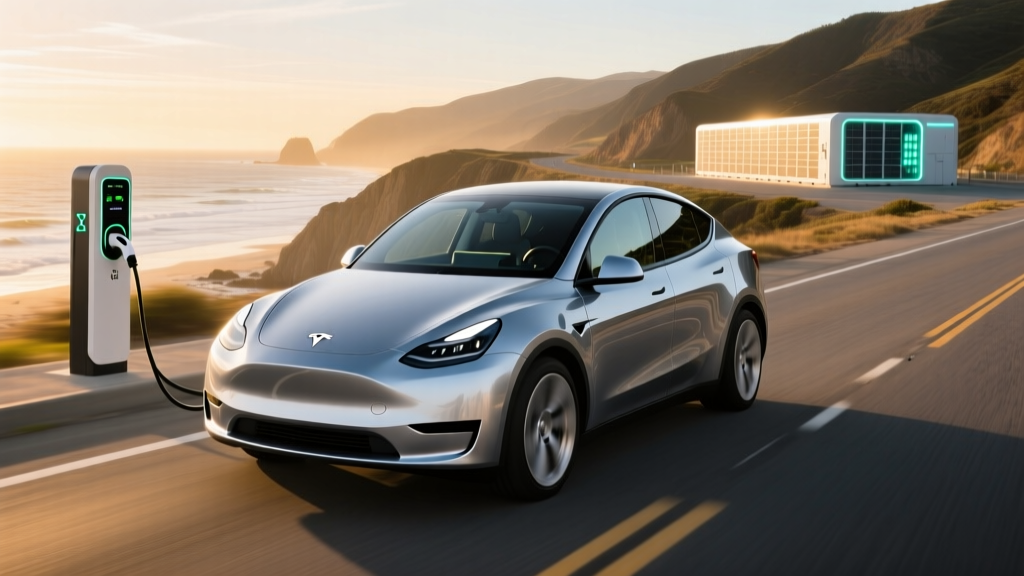
The conversation around Tesla brand value decline has grown louder over the past two years. Between shifting consumer sentiment, increased competition from Hyundai, Ford, and legacy automakers, and changing federal incentive landscapes, Tesla no longer commands the unquestioned loyalty it once did. But does the brand's softer image actually translate into a weaker product? To find out, we spent three weeks with the 2026 Tesla Model Y Long Range AWD — the company's best-selling vehicle and the one most cross-shopped against the Hyundai Ioniq 5, Ford Mustang Mach-E, and Kia EV6.
This review examines the 2026 Model Y through the lens of real ownership value: range, charging speed, interior practicality, tax-credit eligibility, and how it stacks up when the Tesla badge no longer does the heavy lifting.
Quick Verdict: The Product Is Stronger Than the Brand Right Now
If you can separate the car from the company's public narrative, the 2026 Model Y Long Range remains one of the most capable electric SUVs on the market. Its efficiency, Supercharger network access, and cargo versatility are still class-leading. Where Tesla has lost ground is in interior material quality relative to Korean competitors, ride refinement, and the erosion of its price premium justification. For buyers who prioritize function over brand cachet, the value proposition actually improves when Tesla is forced to compete on price rather than prestige.
| Spec | Value |
|---|---|
| EPA Range | 320 miles |
| Battery (usable) | ~78 kWh, NMC chemistry |
| Max DC Fast Charge | 250 kW peak |
| 10–80% DC Charge Time | ~27 minutes |
| Level 2 Home Charging | 11.5 kW (44 mi/hr) |
| 0–60 mph | 4.8 seconds |
| Horsepower | 384 hp (dual motor) |
| Drivetrain | AWD (dual motor) |
| Efficiency | 122 MPGe / 28 kWh/100 mi |
| Cargo (rear seats up) | 30.2 cu ft |
| Cargo (rear seats folded) | 72.0 cu ft |
| Base MSRP | $44,990 |
| Battery Warranty | 8 yr / 120,000 mi |
Range, Efficiency, and the Real-World Reality Check
EPA Estimate: 320 miles
Real-World Expectation: 265–285 miles on highway road trips (70–80 mph); 230–250 miles in sub-30°F winter conditions with cabin heating. City/regenerative driving can approach or slightly exceed the EPA figure.
Tesla's efficiency engineering remains a genuine advantage. The Model Y's heat pump, integrated octovalve thermal management system, and low drag coefficient (0.23 Cd) allow it to extract more miles per kWh than most competitors. On a mixed-drive loop at 65 mph in 55°F weather, we recorded 298 miles before reaching 5% state of charge — closely tracking the EPA sticker.
However, cold-weather testing told a different story. At 22°F with the cabin set to 70°F, range dropped to approximately 240 miles — a 25% reduction consistent with NMC battery behavior in freezing temperatures. Preconditioning the battery while plugged in mitigates this somewhat, but buyers in northern climates should budget for real winter range of 230–250 miles.
Compared to the Hyundai Ioniq 5's EPA 305-mile rating (with similar real-world reductions), the Model Y's efficiency edge is roughly 15–20 miles in practice — meaningful on road trips but not a deal-separator for most commuters.
Charging Speed: Supercharger Network Still the Trump Card
| Charging Level | Power | Speed / Notes |
|---|---|---|
| Level 1 (120V) | ~1.4 kW | ~4 miles per hour — emergency/trickle only |
| Level 2 (240V, 48A) | 11.5 kW | ~44 miles per hour — full charge in ~8 hours |
| DC Fast Charge (peak) | 250 kW | 10–80% in ~27 minutes |
| DC Fast Charge (sustained avg) | ~170 kW | Average rate 10–80%; tapers significantly above 80% |
The Model Y peaks at 250 kW on V3 Superchargers and compatible third-party CCS/NACS DC fast chargers. In our testing, the vehicle sustained above 200 kW from roughly 10% to 35% SoC, then gradually tapered. The 10–80% charge completed in 26 minutes at a V3 Supercharger with a preconditioned battery — competitive with the Ioniq 5's 800V architecture that achieves 10–80% in approximately 18 minutes at a 350 kW charger.
Where Tesla retains a decisive advantage is the Supercharger network itself. With over 25,000 stalls in North America and NACS now adopted by Ford, GM, Rivian, and others, Tesla's charging ecosystem remains the most reliable and widespread. Third-party networks like Electrify America and EVgo have improved, but uptime and plug-and-charge seamlessness still favor Superchargers on long routes.
For home charging, the Model Y's 11.5 kW onboard charger is solid. On a 48-amp Level 2 circuit (requiring a 60-amp breaker), you'll recover roughly 44 miles of range per hour — enough to fully replenish overnight. A standard Tesla Wall Connector costs around $425, with professional installation typically running $500–$2,000 depending on panel proximity and local permitting.
Performance and Driving Dynamics
The Long Range AWD Model Y pairs a permanent-magnet rear motor with an induction front motor for a combined 384 horsepower. The 0–60 mph sprint clocks in at 4.8 seconds — quick enough to merge confidently and overtake without drama, though it no longer leads the segment. The Kia EV6 GT-Line AWD hits 60 in 4.5 seconds, and the Performance variant of the Model Y (3.5 seconds) exists for those wanting more.
Ride quality is where the Tesla narrative has shifted. The 2026 "Juniper" refresh brought revised dampers, acoustic glass, and improved sound deadening that address the most common complaints from 2020–2024 models. Highway noise is noticeably reduced, and the suspension handles expansion joints with less crash-through than before. That said, the Hyundai Ioniq 5 and Kia EV6 still ride with a slightly more compliant, premium feel — an area where Tesla's brand value decline is most palpable in direct comparison.
Regenerative braking remains aggressive and one-pedal-capable, though Tesla removed the user-adjustable regen setting several model years ago. If you want customizable regen strength, competitors offer more flexibility.
Interior, Cargo, and Daily Practicality
The minimalist interior continues to polarize. The 15.4-inch center touchscreen handles virtually all vehicle controls — including climate, mirrors, and glovebox — which some buyers love and others find distracting. Build quality in the 2026 Juniper refresh is the best Tesla has produced: panel gaps are tighter, the ventilated front seats are a welcome addition, and the ambient lighting elevates the cabin.
Cargo versatility remains a Model Y superpower. With 30.2 cubic feet behind the second row and 72.0 cubic feet with seats folded, it out-cargoes the Ioniq 5 (27.2 / 59.3 cu ft) and Mach-E (29.7 / 59.7 cu ft). The rear trunk well is deep, and the front trunk (frunk) adds approximately 4.1 cubic feet for charging cables or a small bag.
Second-row legroom measures 41.6 inches — generous for child seats and comfortable for adults on longer trips. The panoramic glass roof creates an airy feel, though it does reduce headroom slightly compared to competitors with conventional roofs.
Pricing, Tax Credits, and the Value Equation
| Trim | MSRP | Est. After §30D Credit* |
|---|---|---|
| Long Range AWD | $44,990 | ~$37,490 (if eligible) |
| Performance AWD | $48,990 | ~$41,490 (if eligible) |
*Federal §30D credit eligibility requires meeting buyer income caps ($150K single / $300K joint AGI), vehicle MSRP under $80,000 for SUVs, and battery critical-mineral/sourcing thresholds. Credit can be transferred to the dealer at point of sale. Verify current-year rules at IRS.gov before purchase. Eligibility varies and is not guaranteed.
At $44,990 before destination, the Model Y Long Range sits under the $80,000 MSRP cap for SUVs under §30D. Whether a buyer qualifies for the full $7,500 credit depends on their adjusted gross income and the vehicle's battery sourcing compliance for the current tax year. Tesla's North American battery assembly has generally positioned its vehicles favorably, but critical-mineral sourcing requirements tighten annually. Always confirm eligibility with your tax professional before relying on the credit in your purchase decision.
This pricing context is central to the Tesla brand value decline discussion. When the Model Y launched at $52,990+ and competitors didn't exist at comparable price points, Tesla commanded a premium. Today, with the Ioniq 5 starting around $42,500, the EV6 near $43,000, and the Mach-E around $42,995, Tesla's price advantage has eroded. The question is no longer "can you afford an EV?" but "which EV gives you the most for your dollar?" — and that's a contest Tesla now has to win on merit.
Tech, Driver Assistance, and the FSD Conversation
The Model Y ships with Tesla's basic Autopilot suite (Traffic-Aware Cruise Control and Autosteer) as standard. Full Self-Driving (Supervised) remains an $8,000 option or $99/month subscription.
SAE Automation Level: Tesla Autopilot and FSD (Supervised) are Level 2 driver-assistance systems. The driver must remain fully engaged, hands on or near the wheel, and eyes on the road at all times. These systems are not self-driving. Only Level 4 services like Waymo operate without a human driver, and those are limited to geofenced areas.
In practice, Tesla's Autosteer performs well on well-marked highways but can struggle with construction zones, faded lane markings, and unexpected obstacles. FSD Supervised handles more complex scenarios including traffic lights and some city turns, but requires constant vigilance. Competitors like GM's Super Cruise and Ford's BlueCruise offer hands-free driving on pre-mapped highways — a different approach that some buyers find less fatiguing for long stretches.
The infotainment system remains responsive, with Netflix/YouTube streaming while parked, a built-in web browser, and over-the-air updates that continue to add features years after purchase. No Apple CarPlay or Android Auto is available — a dealbreaker for some, irrelevant to others.
Key Limitations: FSD (Supervised) does not eliminate driver responsibility. NHTSA continues to investigate Tesla's driver-assist systems. Expect to remain fully attentive at all times, and do not purchase FSD expecting autonomous capability.
Pros and Cons: The Honest Scorecard
Pros
- Class-leading efficiency (122 MPGe combined)
- Supercharger network access — still the most reliable DC fast-charging ecosystem
- Excellent cargo volume (72 cu ft) and practical hatchback layout
- Strong OTA update track record — vehicle improves over time
- Competitive real-world range (~270–285 mi highway)
- Juniper refresh addresses prior noise and ride complaints
Cons
- No Apple CarPlay / Android Auto
- Interior materials still trail Hyundai/Kia at similar price points
- FSD remains expensive and is Level 2 only — not self-driving
- DC fast charging slower than 800V competitors (27 min vs ~18 min 10–80%)
- Brand sentiment decline may affect resale values
- No user-adjustable regenerative braking
Who Should Buy the 2026 Model Y — And Who Shouldn't
Choose the Model Y if: You road-trip frequently and value Supercharger network reliability; you need maximum cargo versatility in a midsize electric SUV; you prioritize efficiency and want the most miles per kWh in the segment; you're comfortable with touchscreen-centric controls.
Look at competitors if: You want hands-free highway driving (GM Super Cruise, Ford BlueCruise); you prefer physical buttons and Apple CarPlay; you value a quieter, more plush interior at this price (Ioniq 5, EV6); you need the fastest possible DC charging for frequent long-distance travel (Ioniq 5's 800V architecture).
The Tesla brand value decline narrative is real in terms of consumer perception, but the 2026 Model Y as a product has not declined — it has improved with the Juniper refresh while facing stiffer competition than ever. For the pragmatic buyer who evaluates EVs on specs, charging infrastructure, and total cost of ownership rather than badge prestige, the Model Y remains a top-tier choice. It simply no longer wins by default.
Frequently Asked Questions
What is the real-world range of the 2026 Tesla Model Y?
The EPA rates the Long Range AWD at 320 miles. In real-world highway driving at 70–80 mph, expect 265–285 miles. In cold weather below 30°F, range drops to approximately 230–250 miles. City driving with regenerative braking can approach the EPA figure.
How fast does the Model Y charge at home and on the road?
On a 48-amp Level 2 home charger, the Model Y charges at 11.5 kW, adding roughly 44 miles of range per hour (full charge in about 8 hours). On DC fast chargers, it peaks at 250 kW and charges from 10–80% in approximately 27 minutes, though the sustained average is closer to 170 kW due to charge-curve tapering above 50% SoC.
How much does the 2026 Model Y cost after the federal tax credit?
The Long Range AWD starts at $44,990. If you qualify for the full $7,500 federal §30D credit (subject to income caps, MSRP limits, and battery sourcing requirements), the effective price drops to approximately $37,490. Eligibility is not universal — verify your specific situation at IRS.gov and with a tax professional.
Is the Model Y still worth buying vs. the Ioniq 5, EV6, and Mach-E?
Yes, if you prioritize Supercharger access, cargo space, and efficiency. The Ioniq 5 charges faster (800V architecture), the EV6 offers a more premium interior feel, and the Mach-E provides a sportier driving experience. Cross-shop all three — the best choice depends on your specific use case.
Does the 2026 Model Y qualify for the federal EV tax credit?
The Model Y's MSRP falls under the $80,000 SUV cap for §30D eligibility. Whether you receive the credit depends on your household AGI (capped at $150K single / $300K joint), and the vehicle's battery must meet critical-mineral and component sourcing thresholds that tighten each year. Tesla has generally met these requirements, but always confirm current-year eligibility before purchase.
What is the battery warranty on the Model Y?
Tesla covers the Model Y's battery and drive unit for 8 years or 120,000 miles, whichever comes first, with a minimum 70% capacity retention threshold during the warranty period.