Why a Tesla Brake Inspection Is Unlike Any Other Car
If you've transitioned from a gasoline vehicle to a Tesla, you might be surprised to learn that your brake pads could last well over 100,000 miles. That's not marketing hype—it's physics. Tesla's aggressive regenerative braking system handles the vast majority of deceleration, converting kinetic energy back into stored electricity rather than relying on friction brakes. But "less wear" doesn't mean "no maintenance," and skipping a routine Tesla brake inspection can lead to seized calipers, corroded rotors, and surprise repair bills that catch owners off guard.
This guide covers exactly what happens to Tesla brakes in real-world driving, when you should schedule inspections, what the process involves, and how it ties into overall EV ownership across the current Model 3, Model Y, Model S, and Model X lineup.
How Regenerative Braking Changes the Maintenance Equation
In a conventional car, every stop relies on brake pads clamping against rotors to create friction. In a Tesla, lifting off the accelerator engages the electric motor in reverse, generating resistance that slows the vehicle while simultaneously recharging the battery. This is regenerative braking, and it's responsible for an estimated 80–95% of daily deceleration events in normal driving.
The friction brakes only engage in specific scenarios:
- Hard/emergency stops where deceleration exceeds what regen alone can provide
- Battery at high State of Charge (SoC)—when the battery is near full, it can't accept regen energy, so friction brakes compensate
- Very low speeds (below ~5 mph) where regen torque tapers off
- Extremely cold battery temperatures where charge acceptance is limited until the pack warms
The result? Many Tesla owners report original brake pads at 80,000, 100,000, and even 150,000 miles. But this infrequent use creates a different problem: corrosion and seizing.
The Hidden Problem: Rust, Not Wear
Brake rotors are made of cast iron, and when they aren't regularly heated through friction use, surface rust accumulates. In regions that use road salt—think the Northeast, Midwest, and Mountain states—this corrosion accelerates. Caliper slide pins can also seize from lack of movement, leading to uneven pad contact, dragging brakes, and premature wear on one side.
Tesla's official maintenance guidance addresses this directly. The company recommends brake caliper cleaning and lubrication every 12 months or 12,500 miles in cold-weather regions, and every 2 years or 25,000 miles in warmer climates. This is the core of what a proper Tesla brake inspection should cover.
Current Tesla Lineup: Specs That Affect Brake Systems
Brake hardware varies across Tesla's 2026 lineup. Heavier vehicles with larger battery packs demand larger rotors and more robust calipers. Below is a snapshot of the current models with specs that influence brake wear and maintenance needs.
| Spec | Model 3 (Long Range AWD) | Model Y (Long Range AWD) | Model S (Dual Motor) | Model X (Dual Motor) |
|---|---|---|---|---|
| EPA Range | 363 mi | 320 mi | 402 mi | 335 mi |
| Battery (usable) | ~75 kWh (NMC) | ~75 kWh (NMC) | ~95 kWh (NMC) | ~95 kWh (NMC) |
| 0-60 mph | 4.2 sec | 4.8 sec | 3.1 sec | 3.8 sec |
| Horsepower | ~346 hp | ~384 hp | ~670 hp | ~670 hp |
| Curb Weight | ~4,034 lbs | ~4,398 lbs | ~4,561 lbs | ~5,185 lbs |
| Max DC Fast Charge | 250 kW | 250 kW | 250 kW | 250 kW |
| 10-80% DC Time | ~25 min | ~27 min | ~30 min | ~32 min |
| Efficiency (MPGe) | 131 MPGe | 122 MPGe | 120 MPGe | 109 MPGe |
| Base MSRP | $47,740 | $48,990 | $79,990 | $84,990 |
Source: EPA fueleconomy.gov and Tesla.com. Figures reflect 2026 model year estimates and may vary by configuration.
What a Tesla Brake Inspection Actually Includes
A Tesla brake inspection is not the same as the brake service you'd get at a conventional shop. Here's what a thorough inspection should cover:
Visual and Physical Checks
- Brake pad thickness measurement — Using a caliper gauge on inner and outer pads at each wheel. Minimum spec is typically 3 mm.
- Rotor surface inspection — Checking for rust pitting, scoring, thickness variation, and minimum rotor thickness (stamped on each rotor).
- Caliper slide pin operation — Ensuring pins move freely and haven't seized from corrosion. This is the #1 issue in cold-climate Teslas.
- Brake fluid level and condition — Tesla recommends brake fluid testing every 2 years; replacement as needed based on moisture content.
- Brake hose and line inspection — Checking for cracking, swelling, or damage.
- Parking brake (electronic) function test — Verifying the electronic parking brake engages and releases properly on both rear calipers.
Caliper Cleaning and Lubrication
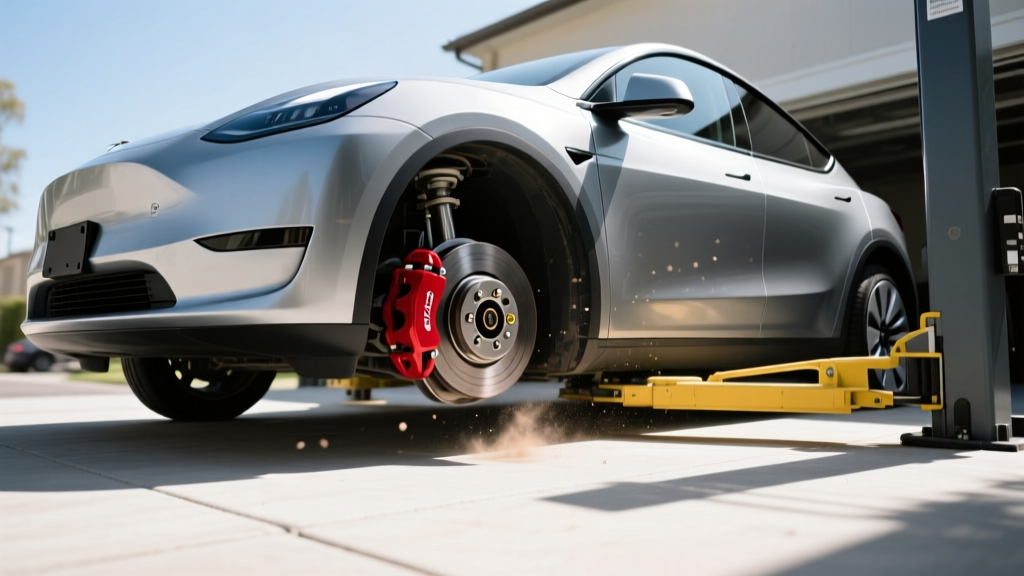
This is the most critical Tesla-specific maintenance item. The process involves:
- Removing the caliper from the mounting bracket
- Cleaning the slide pins and bores of corrosion and old grease
- Applying fresh high-temperature silicone-based brake lubricant
- Cleaning the brake pad abutment surfaces where pads contact the caliper bracket
- Reinstalling and torquing to factory specifications
Tesla Service Centers and many third-party EV-aware shops offer this as a standalone service, typically costing $150–$300 per axle depending on region. Mobile service is available in many metro areas.
Tesla Maintenance Schedule: Brakes in Context
Tesla eliminated traditional scheduled maintenance intervals (no "30,000-mile service" like legacy automakers). Instead, the company provides condition-based recommendations. Here's how brakes fit into the broader picture:
| Service Item | Interval (Warm Climate) | Interval (Cold/Salt Climate) |
|---|---|---|
| Brake caliper clean & lube | 2 years / 25,000 mi | 12 months / 12,500 mi |
| Brake fluid test | Every 2 years | Every 2 years |
| Cabin air filter (HEPA) | Every 2–3 years | Every 2 years |
| Tire rotation | Every 6,250 mi | Every 6,250 mi |
| Drive unit fluid | No scheduled replacement | No scheduled replacement |
Tesla Battery and Powertrain Warranty Coverage
While brakes are considered wear items and aren't covered under warranty, Tesla's battery and drive unit protection is among the best in the industry:
- Model 3 / Model Y: 8 years or 100,000 miles (whichever comes first), with minimum 70% battery capacity retention
- Model S / Model X: 8 years or 150,000 miles, with minimum 70% battery capacity retention
- Basic vehicle warranty: 4 years or 50,000 miles
All current Tesla models use NMC (nickel manganese cobalt) battery chemistry, which offers higher energy density than LFP but requires more careful thermal management. Tesla's active liquid cooling system keeps the pack within optimal temperature ranges, contributing to long-term State of Health (SoH). Real-world data from Tesla's Impact Report shows Model S/X packs retaining approximately 88% capacity at 200,000 miles on average.
Pricing, Tax Credits, and Ownership Costs
Understanding the full financial picture helps contextualize maintenance costs like brake inspections.
| Model / Trim | Base MSRP | §30D Credit Eligible? | Effective Price (est.) |
|---|---|---|---|
| Model 3 Long Range AWD | $47,740 | Yes (up to $7,500)* | ~$40,240 |
| Model 3 Performance | $54,990 | Yes (up to $7,500)* | ~$47,490 |
| Model Y Long Range AWD | $48,990 | Yes (up to $7,500)* | ~$41,490 |
| Model S Dual Motor | $79,990 | No (exceeds MSRP cap) | $79,990 |
| Model X Dual Motor | $84,990 | No (exceeds MSRP cap) | $84,990 |
*Federal §30D tax credit eligibility requires meeting buyer income caps (AGI ≤ $150K single / $300K joint), MSRP caps ($55K sedans / $80K SUVs/trucks), and critical-mineral/battery-component sourcing requirements. Credit may be applied at point of sale. Rules subject to change—verify at IRS.gov before purchasing.
Brake Maintenance Cost vs. Gas Vehicles
Over five years and 75,000 miles, a typical gasoline sedan might require 1–2 sets of brake pads and at least one rotor resurfacing or replacement, totaling $600–$1,200. A Tesla over the same period might need only caliper clean-and-lube services (2–3 visits in cold climates) at $150–$300 per axle, totaling $300–$900. The savings are real but not dramatic—the real advantage comes in years 6–10, when a gas car needs its second or third brake job while the Tesla may still be on original pads.
Tesla Autopilot and Its Effect on Brake Wear
Tesla's Autopilot and available Full Self-Driving (Supervised) systems use predictive algorithms that tend to decelerate more gradually than many human drivers. When Autopilot is engaged on highways, it anticipates slowing traffic ahead and lifts off power earlier, maximizing regen and minimizing friction brake use.
This predictive driving style has a measurable side effect: owners who frequently use Autopilot on commutes tend to see even less friction brake wear than those who drive manually. The trade-off is the same corrosion risk from underuse, making the periodic caliper service even more important.
Who Should Prioritize Tesla Brake Inspections?
Not all Tesla owners face the same brake maintenance risks. Here's a practical decision framework:
Inspect annually (or every 12,500 mi) if you:
- Live in a region with road salt (Northeast, Midwest, Mountain states)
- Drive fewer than 8,000 miles per year (brakes sit unused longer)
- Frequently drive in heavy stop-and-go traffic with a full battery (regen limited)
- Own a Model S or Model X (heavier vehicles, larger rotors more prone to corrosion)
Inspect every 2 years (or 25,000 mi) if you:
- Live in a warm, dry climate (California, Arizona, Texas, Southeast)
- Drive 12,000+ miles annually with regular regen use
- Store your Tesla in a garage
Pros and Cons of Tesla Brake Ownership
✓ Pros
- Brake pads often last 100,000+ miles
- No brake fluid flush on a fixed schedule—tested and replaced only as needed
- Regen braking reduces brake dust on wheels significantly
- Lower lifetime brake maintenance cost vs. ICE vehicles
- Predictive Autopilot driving further reduces friction brake use
- No brake pad break-in procedure required after replacement
✗ Cons
- Rotor corrosion is a real issue in salt-belt states
- Caliper slide pins can seize without regular lubrication
- Brake service requires EV-aware technicians (not all shops are trained)
- Replacement rotors are expensive ($200–$500+ each depending on model)
- Model S/X performance variants use larger, costlier brake hardware
- High-SoC charging before mountain descents can limit regen, forcing friction brake use
Frequently Asked Questions
How often should I get a Tesla brake inspection?
Tesla recommends brake caliper cleaning and lubrication every 12 months/12,500 miles in cold-weather regions and every 2 years/25,000 miles in warm climates. A full brake inspection (pads, rotors, fluid, lines) should accompany this service. Many owners opt for an annual visual check regardless of climate.
Do Tesla brakes really last 100,000 miles?
Many Tesla owners report original brake pads at 100,000+ miles thanks to regenerative braking handling most deceleration. However, this depends heavily on driving style, climate, and how often you drive with a fully charged battery (which limits regen). Pad life is highly variable—some owners in hilly, cold regions see wear by 60,000 miles.
What does a Tesla brake inspection cost?
At a Tesla Service Center, a brake inspection is often included with other service visits at no additional charge. A standalone caliper clean-and-lube service typically runs $150–$300 per axle. Independent EV-aware shops may charge similar rates. Full pad and rotor replacement (when needed) ranges from $800–$2,000+ per axle depending on model and parts.
Can I drive my Tesla if the brake warning light comes on?
If you see a brake system warning, reduce speed and pull over safely. While regenerative braking may still function, the friction brake system could be compromised. Contact Tesla roadside assistance or have the vehicle towed to a service center. Do not ignore brake warnings—this is a safety-critical system.
Does regenerative braking eliminate the need for brake maintenance entirely?
No. While regen dramatically reduces pad and rotor wear, it introduces corrosion risk from underuse. Brake fluid still absorbs moisture over time, caliper pins can seize, and rubber hoses can degrade. Periodic inspection and caliper lubrication remain essential, especially in harsh climates.
Are Tesla brake parts proprietary or can any shop service them?
Tesla brake components (pads, rotors, calipers) are largely standard automotive hardware—Brembo, Mando, and other suppliers manufacture them. Any qualified mechanic can perform brake service. However, EV-specific knowledge is important for proper procedures (high-voltage safety, electronic parking brake handling, software resets). Tesla-certified shops and EV-trained independents are the safest choices.
Does the Tesla warranty cover brake components?
Brake pads, rotors, and fluid are considered normal wear items and are not covered under Tesla's new vehicle or battery/drive unit warranties. However, manufacturing defects in brake hardware (e.g., a caliper that fails prematurely) would be covered under the 4-year/50,000-mile basic vehicle limited warranty.
This article references data from EPA fueleconomy.gov, IRS §30D clean vehicle credit guidelines, and Tesla's official owner documentation. Specifications reflect 2026 model year information and are subject to change. Always verify current pricing, eligibility, and service recommendations with Tesla or a qualified service provider.