The Tesla Boat Rumor: What Buyers Are Actually Searching For
Search volume for "Tesla boat" has climbed steadily through 2025 and into 2026, fueled by viral renders, Elon Musk's occasional social media teases about electric watercraft, and a growing appetite for electrification beyond cars. The question is straightforward: Can you buy a Tesla boat right now?
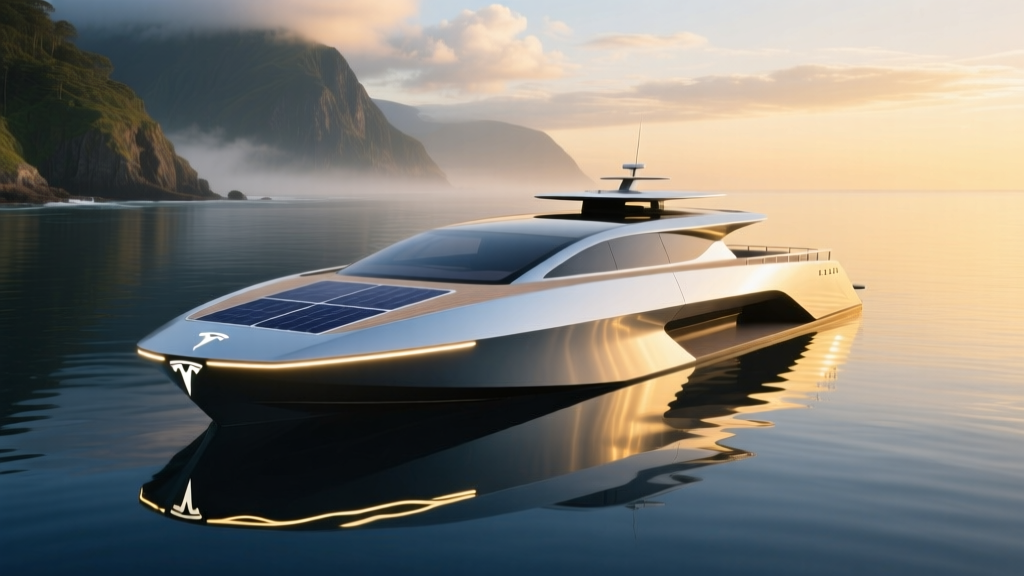
The answer, as of mid-2026, is no. Tesla does not manufacture, sell, or take orders for any marine vessel. There is no Tesla Model B, no Tesla Yacht, no Tesla Pontoon in any configuration. What does exist is a fascinating trail of patents, a few third-party electric boats that borrow Tesla battery or drivetrain components, and a rapidly maturing electric boat market that may scratch the same itch for EV-curious boaters.
This article separates fact from fiction on the Tesla boat concept, examines what Tesla's marine-related patents actually cover, and profiles the real electric watercraft you can buy today — with the kind of hard specs (battery kWh, range in nautical miles, charge times, pricing) that matter to anyone transitioning from a Tesla EV to the water.
Tesla's Marine Patents: What the Filings Actually Show
Tesla has filed a handful of patents that touch on marine applications, and these filings are the primary fuel for "Tesla boat" speculation. The most-discussed include:
- Wave-damping hull systems — A patent describing active hull surfaces that adjust to reduce drag and improve stability, conceptually similar to how Tesla's adaptive suspension manages road inputs.
- Marine battery thermal management — Filings related to waterproof, salt-air-resistant battery enclosures with active cooling loops, an extension of Tesla's industry-leading thermal management in vehicles.
- Electric propulsion integration — General patents covering sealed electric motor units suitable for submersion, though not exclusively marine-focused.
Patents, however, are not products. Companies routinely file defensive or exploratory patents that never reach production. Tesla has held patents related to vehicle-to-grid (V2G) integration, swappable batteries, and even a Tesla semi-submersible concept that have not materialized as consumer offerings. As of 2026, Tesla's official product page lists vehicles, solar panels, Powerwall, and Megapack — no watercraft of any kind.
Why the Electric Boat Market Is Ready (Even Without Tesla)
The absence of a Tesla boat hasn't stopped the electric marine market from accelerating. Much like the EV car market circa 2018, electric boats in 2026 have moved past proof-of-concept into genuine consumer products with published specs, dealer networks, and real-world range data.
Key drivers include:
- LFP and NMC battery cost declines — Marine-grade battery packs now cost roughly $140–$180/kWh at the pack level, down from over $300/kWh in 2020.
- No-wake and emissions regulations — Lakes with noise or emission restrictions (common in the EU and parts of the US) favor silent, zero-tailpipe electric propulsion.
- Dock-side charging infrastructure — Marinas increasingly offer 240V shore power, making Level 2-equivalent charging practical for slip-kept boats.
- Instant torque on water — Electric motors deliver peak torque at zero RPM, a massive advantage for planing hulls that need to push through the drag hump quickly.
Electric Boats You Can Actually Buy in 2026: Spec Comparison
Below is a data-driven comparison of the most prominent production electric boats available to US buyers in 2026. Note that marine range is typically measured in nautical miles (nm) at a specified cruising speed, since water resistance varies dramatically with velocity — much like EV highway efficiency drops at higher speeds.
| Model | Battery (kWh) | Range (nm @ speed) | Top Speed | Motor (kW) | Base Price |
|---|---|---|---|---|---|
| Candela C-8 | 63 kWh (NMC) | 57 nm @ 22 kn | 30 kn | 225 kW | ~$390,000 |
| Arc One (24-ft) | 226 kWh (NMC) | ~40 nm @ cruise | 40+ kn | 500 kW (dual) | ~$300,000 |
| X Shore Eelex 8000 | 126 kWh (NMC) | ~100 nm @ 8 kn | 40 kn | 225 kW | ~$345,000 |
| Vision Marine E-Motion 180E | ~100 kWh | ~30 nm @ cruise | ~45 kn | 180 kW | ~$120,000 (powertrain) |
| Flux Marine (repower) | Varies (25–100 kWh) | Hull-dependent | Varies | 25–100 kW | ~$15,000–$40,000 |
Sources: Manufacturer specifications, Candela, Arc Boats. Range figures are manufacturer estimates and vary with load, sea state, and speed.
Candela C-8: The Closest Thing to a "Tesla of Boats"
If any production electric boat earns the unofficial "Tesla boat" comparison, it's the Candela C-8. The Swedish manufacturer uses hydrofoiling technology — the hull lifts above the water at speed, reducing drag by roughly 80% compared to a planing hull. This is the marine equivalent of Tesla's efficiency obsession: less energy wasted means more range from the same battery.
Specs That Matter
- Battery: 63 kWh NMC lithium-ion, marine-grade sealed enclosure
- Motor: 225 kW permanent-magnet electric motor (pod drive, fully submerged)
- Range: 57 nautical miles at 22 knots (hydrofoiling cruise) — roughly 66 statute miles
- Top speed: 30 knots (34.5 mph)
- Charging: DC fast charge capable; CCS-compatible marine connector; 0–80% in approximately 40 minutes at peak rate
- Foil system: Active flight controller adjusts foils 100x/second — analogous to Tesla's traction control sampling wheel slip
- Passenger capacity: 8 (open version) or 6 (cabin version)
- Price: Starting around $390,000 (2026 pricing, varies by configuration)
Why It Feels Tesla-Like
Candela's over-the-air (OTA) software updates, minimalist helm interface, and vertically integrated flight controller draw direct parallels to Tesla's approach. The company also operates a direct-to-consumer sales model in many markets, bypassing traditional marine dealerships. Owners report that the C-8's silence, instant torque, and smooth foiling ride convert skeptical combustion-boaters quickly — the same dynamic Tesla experienced with early Model S test drives.
Charging an Electric Boat: What Dock Power Actually Looks Like
One of the biggest questions from EV owners considering an electric boat is charging logistics. The good news: if you have a slip at a marina with shore power, charging is conceptually identical to home EV charging.
| Level | Power (kW) | Typical Source | 10–80% Time (63 kWh pack) |
|---|---|---|---|
| Level 1 (120V) | ~1.4 kW | Standard outlet | ~30+ hours |
| Level 2 (240V) | 7–19 kW | Marina shore power, home dock | ~3–6 hours |
| DC Fast Charge | 40–100+ kW | Commercial marine chargers | ~35–50 minutes |
Most electric boat owners charge overnight at their slip using 240V shore power — functionally equivalent to a home Level 2 EV charger. DC fast-charging infrastructure for boats is still sparse in the US, though companies like Candela and Arc are working with marina operators to install dedicated marine DC chargers at high-traffic docks. Expect this infrastructure to expand through 2027–2028, similar to the early growth curve of Electrify America and EVgo networks.
Note: kW (kilowatts) measures charging power — the rate of energy delivery. kWh (kilowatt-hours) measures battery capacity — the total energy stored. This distinction matters just as much on the water as it does in your Tesla.
Electric Boat Tax Credits: Does the §30D Federal Credit Apply?
This is where EV owners need to recalibrate expectations. The federal §30D Clean Vehicle Credit — which provides up to $7,500 for qualifying new EVs and up to $4,000 for used EVs — applies to motor vehicles as defined by the IRS, specifically vehicles designed for use on public streets, roads, or highways. Boats do not qualify.
As of 2026, there is no equivalent federal tax credit specifically for electric boats. However, several financial tailwinds exist:
- State and local incentives: Some states with strong clean-water mandates (California, Washington, parts of the Northeast) offer rebates or grants for electric marine propulsion, often through clean-air or clean-water district funds. Check your state's energy office or Alternative Fuels Data Center for current programs.
- Marina charging incentives: Certain utility companies offer rebates for installing 240V shore-power infrastructure at private docks.
- Operating cost savings: Electric propulsion eliminates fuel costs (marine gasoline is often $5–$7/gallon at docks), oil changes, impeller replacements, and winterization of combustion engines. Owners report 70–85% lower per-hour operating costs compared to gasoline outboards.
Who Should Buy an Electric Boat (And Who Should Wait)
Buy Now If...
- You boat primarily on lakes, calm bays, or protected waterways with range to spare
- You have access to 240V shore power at your slip or private dock
- You value silence — electric boats are nearly silent, transforming the social experience on water
- You want to eliminate fuel dock visits, engine maintenance, and winterization
- You boat in areas with noise or emission restrictions that favor electric propulsion
Wait If...
- You regularly make long offshore runs exceeding 50–60 nautical miles
- Your marina lacks 240V shore power and has no plans to install it
- You need a large, heavy displacement hull (electric is less practical for 35+ ft cruisers in 2026)
- Your budget is under $50,000 — affordable electric options exist mainly as repower kits, not complete boats
- You trailer your boat long distances to remote launches without charging access
The Bottom Line: No Tesla Boat, But the Electric Marine Future Is Real
As of 2026, "Tesla boat" remains a search term driven by curiosity and speculation, not a product you can order. Tesla's core business — vehicles, energy storage, and AI/robotics — shows no signs of diverting resources to marine manufacturing in the near term. Elon Musk has occasionally mentioned interest in electric watercraft, but Tesla's product roadmap is full with the next-generation vehicle platform, Optimus robot scaling, and FSD deployment.
That said, the electric boat market has reached a genuine inflection point. Companies like Candela, Arc, and X Shore are delivering products with published specs, real-world range data, and growing dealer networks. For Tesla owners who already understand the benefits of electric propulsion — instant torque, low running costs, OTA updates, and quiet operation — the transition to an electric boat feels natural, even without the Tesla badge on the helm.
If Tesla ever does enter the marine market, it would likely leverage its battery cell production (particularly 4680 cells), its Supercharger-adjacent charging network expertise, and its software-first design philosophy. Until then, the boats profiled above represent the best electric options on the water — and they need no Tesla association to make a compelling case.
Frequently Asked Questions
Is Tesla making a boat in 2026?
No. Tesla has not announced, previewed, or opened pre-orders for any boat, yacht, or personal watercraft as of 2026. The company's product lineup remains focused on vehicles, solar energy, and battery storage.
Can I put a Tesla battery in a boat?
Some custom electric boat builders and repower shops have used Tesla-sourced battery modules (particularly from salvaged Model S and Model 3 packs) in marine conversions. However, this requires extensive custom engineering for waterproofing, marine-grade BMS (battery management system) integration, and Coast Guard compliance. It is not a plug-and-play swap.
How far can an electric boat go on a charge?
Range varies enormously by hull type and speed. The Candela C-8 achieves 57 nautical miles at 22 knots thanks to hydrofoiling. Conventional planing-hull electric boats typically manage 20–45 nautical miles at cruising speed. Displacement-speed cruising (under 8 knots) can extend range to 80–120+ nm on larger battery packs.
Do electric boats qualify for any tax credits?
The federal §30D Clean Vehicle Credit does not apply to boats — it covers highway motor vehicles only. Some state and local clean-water or clean-energy programs offer rebates for electric marine propulsion. Check your state energy office or the Alternative Fuels Data Center for current programs.
How long do electric boat batteries last?
Marine-grade NMC lithium-ion packs are typically warrantied for 8–10 years or a specified number of charge cycles (often 2,000–3,000 cycles to 80% capacity retention). With proper thermal management and avoiding sustained 100% state of charge, most packs should provide 10–15 years of usable service before capacity drops below 70–80%.
What's the cheapest electric boat I can buy?
The most affordable entry point is an electric outboard repower kit (such as from Flux Marine or ePropulsion) starting around $5,000–$15,000, which you mount on an existing hull. Complete production electric boats start around $80,000–$120,000 for smaller day-boats, with premium foiling and luxury models reaching $300,000–$400,000+.