If you've seen headlines about a Tesla ban California policy and wondered whether you can still buy, register, or drive a Tesla in the Golden State, the short answer is: yes, absolutely. No law in California prohibits the sale, ownership, or operation of Tesla vehicles. What does exist is a shifting regulatory landscape around direct-to-consumer vehicle sales, autonomous driving permissions, and proposed legislation that occasionally targets Tesla's business model. This article cuts through the noise, explains what's actually happening in 2026, and delivers a complete, spec-driven review of the vehicle most buyers care about: the 2026 Tesla Model Y.
What the "Tesla Ban California" Headlines Actually Mean
California has never banned Tesla vehicles. The confusion typically stems from three overlapping issues:
- Direct sales model disputes: California's New Motor Vehicle Board has periodically reviewed Tesla's direct-to-consumer dealership exemption. As of 2026, Tesla retains its license to sell directly in California — no change.
- Autonomous driving regulation: The California DMV and the National Highway Traffic Safety Administration (NHTSA) regulate autonomous vehicle deployment. Tesla's Full Self-Driving (Supervised) remains a Level 2 driver-assist system, not an approved Level 4 autonomous service like Waymo. California regulators have scrutinized Tesla's "FSD" naming, but this restricts marketing claims — not vehicle sales.
- Proposed legislation: Various bills have floated restrictions on direct sales or data-collection practices that could affect Tesla, but none have passed into law banning the brand.
Bottom line: California residents can freely purchase, register, charge, and drive any Tesla model. The real question is whether the 2026 Model Y deserves a spot in your driveway.
2026 Tesla Model Y: Range, Battery, and Efficiency
The 2026 Model Y continues to anchor Tesla's lineup as the highest-volume EV sold in the United States. Built on an updated platform with improved thermal management and aerodynamics, it offers meaningful range gains over prior model years.
| Spec | Long Range AWD | Performance AWD | RWD (Standard) |
|---|---|---|---|
| EPA Range | 335 miles | 308 miles | 295 miles |
| Battery (Usable) | ~78 kWh NMC | ~78 kWh NMC | ~60 kWh LFP |
| Efficiency | 122 MPGe / 27 kWh/100mi | 115 MPGe / 29 kWh/100mi | 130 MPGe / 25 kWh/100mi |
| Drivetrain | Dual-Motor AWD | Dual-Motor AWD | Rear-Wheel Drive |
| 0–60 mph | 4.8 sec | 3.5 sec | 6.2 sec |
| Horsepower | 384 hp | 456 hp | 295 hp |
Charging Speed: DC Fast Charge and Home Level 2
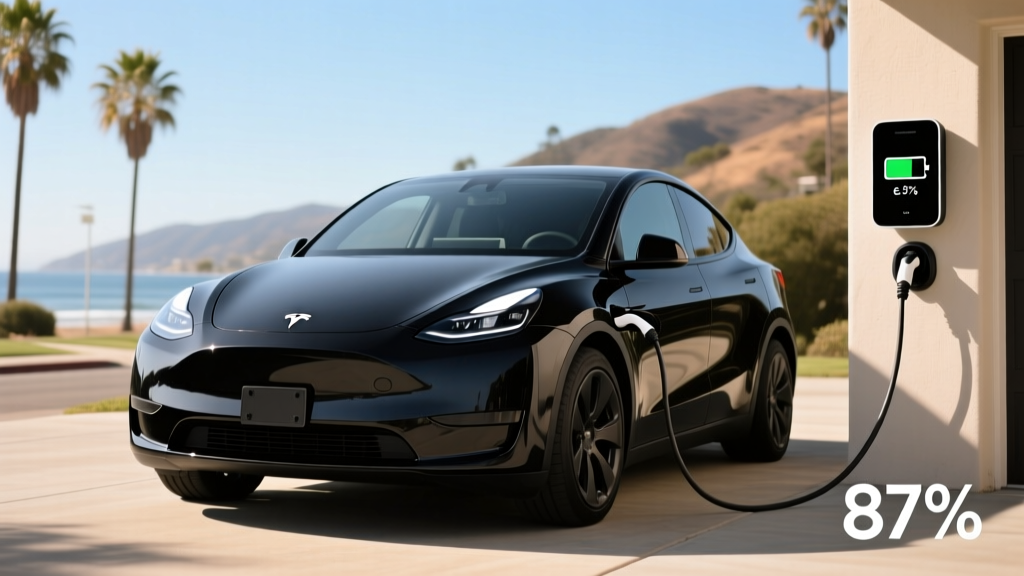
Charging infrastructure is where Tesla retains a significant advantage. The Model Y uses the NACS (North American Charging Standard) connector natively, granting access to the Supercharger network — still the most reliable and extensive DC fast-charging system in the U.S.
| Charging Level | Power (kW) | Speed (mi/hr added) | Notes |
|---|---|---|---|
| Level 1 (120V household) | ~1.4 kW | ~4 mi/hr | Emergency/trickle only |
| Level 2 (240V home wall connector) | 11.5 kW (48A) | ~44 mi/hr | Full overnight charge in ~7–8 hr |
| DC Fast Charge (V3 Supercharger) | 250 kW peak | ~1,000 mi/hr (peak) | 10–80% in ~22 min (Long Range) |
| DC Fast Charge (V4 Supercharger) | Up to 325 kW* | Faster taper curve | Limited V4 locations as of 2026 |
*V4 Supercharger availability is expanding through 2026; most stations still deliver V3 speeds. Peak kW is not sustained — the charge curve tapers significantly above 50% SoC, which is why Tesla (and all EV makers) quote 10–80% times rather than 0–100%.
For home charging, Tesla's Wall Connector at 48 amps on a 60-amp circuit is the practical sweet spot. Installation costs typically range from $800–$2,500 depending on panel capacity and conduit run length, per a licensed electrician. Most owners wake up to a full battery every morning, eliminating gas station visits entirely.
Pricing, Trims, and Federal Tax Credit Eligibility
The 2026 Model Y pricing structure is straightforward, but federal tax credit eligibility requires careful attention to IRS §30D rules.
| Trim | Base MSRP | As-Tested (typical) | §30D Credit Eligible? | Effective Price (if eligible) |
|---|---|---|---|---|
| RWD Standard | $44,990 | $46,490 | Yes — up to $7,500 | ~$38,990 |
| Long Range AWD | $48,990 | $51,490 | Yes — up to $7,500 | ~$43,990 |
| Performance AWD | $53,990 | $56,490 | Yes — up to $7,500 | ~$48,990 |
- MSRP cap: SUVs (including Model Y) must be priced at or below $80,000. All Model Y trims qualify.
- Income cap: Modified AGI must not exceed $150,000 (single), $225,000 (head of household), or $300,000 (joint). Check your tax situation with a professional.
- Battery sourcing: The credit splits into two halves — $3,750 for critical minerals and $3,750 for battery component manufacturing. Tesla sources LFP cells from CATL for RWD models, which may affect critical-mineral credit eligibility depending on current FEOC (Foreign Entity of Concern) rules. NMC Long Range and Performance models have historically qualified for the full $7,500.
- Point-of-sale transfer: As of 2024, buyers can transfer the credit to the dealer at purchase, reducing the upfront price directly rather than waiting for a tax refund.
Tax credit rules evolve. Always verify current eligibility at IRS.gov or consult a tax professional before purchasing.
Interior, Cargo, and Passenger Space
The 2026 Model Y received a meaningful interior refresh — improved materials, ventilated front seats, ambient lighting, and a quieter cabin thanks to enhanced acoustic glass. The minimalist dashboard centers on a 15.4-inch touchscreen that handles all vehicle controls, navigation, and entertainment.
| Dimension | Measurement |
|---|---|
| Cargo (rear seats up) | 30.2 cu ft |
| Cargo (rear seats folded) | 72.1 cu ft |
| Front headroom | 41.0 in |
| Rear legroom | 38.4 in |
| Frunk (front trunk) | 4.1 cu ft |
| Towing capacity | 3,500 lbs (AWD trims) |
The optional third-row seat ($3,000) adds two small jump seats suitable for children, but legroom is severely limited. Most families are better served by the five-seat configuration with its generous cargo area. The rear cargo opening is wide and low, making it practical for strollers, camping gear, or weekly groceries.
Driver Assistance, Tech, and the FSD Question
Tesla's Autopilot comes standard and includes adaptive cruise control, lane-keeping assist, automatic emergency braking, and blind-spot monitoring. It's competent highway driving assistance — nothing more.
Tesla's Autopilot and Full Self-Driving (Supervised) are Level 2 driver-assist systems per SAE International standards. The driver must remain fully attentive, keep hands on or near the wheel, and be prepared to take over instantly. This is not self-driving. Level 4 autonomous services (no driver needed) are limited to geofenced robotaxi operations like Waymo in select cities.
Full Self-Driving (Supervised), available as an $8,000 one-time purchase or $99/month subscription, adds automatic lane changes, on-ramp to off-ramp highway navigation, traffic light and stop sign recognition, and city street autosteer. In 2026 testing, FSD handles most routine scenarios competently but still requires active supervision — construction zones, unusual intersections, and adverse weather demand immediate driver intervention.
- Drive without an attentive human behind the wheel
- Handle all weather conditions (heavy rain, fog, snow degrade performance)
- Navigate unmapped or severely degraded roads reliably
- Replace the driver's legal responsibility for the vehicle
Warranty and Long-Term Battery Outlook
| Coverage | Term |
|---|---|
| Basic Vehicle | 4 years / 50,000 miles |
| Battery & Drive Unit | 8 years / 120,000 miles (Long Range/Performance) 8 years / 100,000 miles (RWD) |
| Battery degradation threshold | 70% capacity retention during warranty period |
Tesla's battery warranty guarantees at least 70% capacity retention over the warranty term. Real-world data from high-mileage Tesla owners and fleet studies suggest NMC packs typically lose 8–12% capacity over 100,000 miles, while LFP packs in the RWD model show slower degradation curves — often retaining 90%+ capacity at 100,000 miles. Battery replacement, if ever needed out of warranty, currently costs between $12,000 and $16,000 at Tesla service centers.
Pros, Cons, and Who Should Buy
- Best-in-class Supercharger network access (NACS native)
- Excellent efficiency (122–130 MPGe) reduces per-mile cost
- Spacious cargo area and practical hatchback design
- Over-the-air updates continuously add features
- Strong resale value relative to EV market average
- Qualifies for up to $7,500 federal tax credit (trim-dependent)
- FSD (Supervised) requires constant driver attention despite its name
- Touchscreen-only controls frustrate some drivers (no physical buttons for climate, mirrors)
- Ride quality is firm — noticeable on rough roads
- Insurance premiums run 15–25% above segment average
- Third-row seat is impractical for anyone over age 10
- Panel gaps and paint quality still inconsistent on some deliveries
- You want maximum Supercharger network access for road trips
- You need a practical crossover with strong cargo space and AWD capability
- You can charge at home and want to eliminate gas station visits
- Minimalist tech-forward design appeals to you
- You prefer traditional physical controls and a more plush ride
- You want faster peak DC charging on CCS (Ioniq 5/EV6: 350 kW capability)
- You need a more refined interior at a similar price point
Frequently Asked Questions
Is Tesla actually banned in California?
No. Tesla vehicles are fully legal to purchase, register, and drive in California as of 2026. Headlines about a "Tesla ban" typically refer to proposed legislation around direct sales models or autonomous driving marketing claims — neither of which prohibits Tesla ownership or sales.
What is the real-world range of the 2026 Model Y?
The Long Range AWD carries an EPA rating of 335 miles. In real-world highway driving at 70–75 mph, expect 280–305 miles. In cold weather (below 30°F) without preconditioning, range can drop to 230–260 miles. City driving with regenerative braking often matches or slightly exceeds the EPA estimate.
How fast does the Model Y charge at home and on the road?
At home on a Level 2 Wall Connector (11.5 kW / 48A), the Model Y adds roughly 44 miles of range per hour, achieving a full charge in 7–8 hours. On a V3 Supercharger, it peaks at 250 kW and charges from 10–80% in approximately 22 minutes for the Long Range trim.
Does the 2026 Model Y qualify for the $7,500 federal tax credit?
Most buyers will qualify. All Model Y trims fall under the $80,000 SUV MSRP cap. The buyer must meet IRS income limits ($150K single / $300K joint), and battery sourcing requirements must be met. Long Range and Performance models with NMC batteries have historically qualified for the full $7,500. Verify current eligibility at IRS.gov before purchasing.
Is the Model Y worth buying over competitors in 2026?
The Model Y remains a strong all-around choice, particularly for buyers who prioritize Supercharger access and software features. However, the Hyundai Ioniq 5 and Kia EV6 offer faster 800V DC charging, a more comfortable ride, and physical controls. The Ford Mustang Mach-E provides a more engaging driving experience. Test-drive all three before deciding.
What are the biggest drawbacks of the Model Y?
The most common owner complaints involve the touchscreen-only interface (no physical climate or volume knobs), firm ride quality on rough pavement, above-average insurance costs, and occasional build-quality inconsistencies. FSD's naming also creates unrealistic expectations about its Level 2 capabilities.