The phrase Tesla autonomy licensing rejection has been circulating through EV forums and investor circles alike, and for good reason. Recent regulatory decisions have made clear that Tesla's Full Self-Driving (Supervised) system remains a Level 2 driver-assist feature — not a licensed autonomous driving system. For buyers considering whether to pay the premium for FSD, understanding what this rejection means for real-world capability, vehicle value, and the ownership experience is essential. In this review, we anchor that analysis to the 2026 Tesla Model 3 Long Range AWD, examining every spec that matters: range, charging, pricing, tax credit eligibility, and how it stacks up against competitors who are taking different approaches to autonomy.
Range and Efficiency: EPA Numbers vs. Reality
The 2026 Tesla Model 3 Long Range AWD carries an EPA-estimated range of 341 miles on its 75 kWh (usable) NMC (nickel-manganese-cobalt) battery pack. That places it among the top tier of efficiency in the midsize electric sedan segment, with a combined rating of 132 MPGe and energy consumption of approximately 25 kWh per 100 miles.
Real-World Range Expectations
EPA Sticker: 341 miles
Highway (70-80 mph, moderate climate): ~280–305 miles
Cold Weather (below 32°F, highway): ~230–260 miles
City/Stop-and-Go with Regen: ~310–340 miles
Tesla's thermal management system and heat pump help mitigate cold-weather losses better than many competitors, but physics is physics. Expect a 15–25% range reduction in sustained sub-freezing highway driving. The Model 3's low drag coefficient (0.219 Cd) works in its favor at highway speeds, though aggressive acceleration and high cabin heating demands will erode range further.
Battery Chemistry, Degradation, and Warranty
The Long Range variant uses an NMC (nickel-manganese-cobalt) lithium-ion battery, which prioritizes energy density over cycle longevity compared to LFP (lithium iron phosphate). Tesla recommends charging NMC packs to 80% for daily use and 100% only for longer trips — a practice that meaningfully extends long-term battery health.
Tesla's battery and drive unit warranty covers 8 years or 120,000 miles (whichever comes first), with a guaranteed minimum 70% capacity retention over that period. Independent fleet data from sources like Recurrent Auto suggests Tesla's NMC packs typically retain 85–90% capacity at 100,000 miles under normal charging habits — better than the warranty floor but worth monitoring via the car's built-in State of Health metrics.
| Spec | Value |
|---|---|
| EPA Range | 341 miles |
| Battery (Usable) | 75 kWh, NMC |
| MPGe (Combined) | 132 MPGe |
| Energy Consumption | 25 kWh / 100 mi |
| 0–60 mph | 4.2 seconds |
| Horsepower | 346 hp (dual motor) |
| Drivetrain | AWD (dual motor) |
| Max DC Fast Charge | 250 kW (peak) |
| 10–80% DC Charge | ~25 minutes |
| Level 2 Home Charge | 11.5 kW (~44 mi/hr) |
| Cargo Volume | 23 cu ft (trunk + frunk) |
| Rear Legroom | 35.3 inches |
| Battery Warranty | 8 yr / 120,000 mi (70% retention) |
| Base MSRP | $47,740 |
Charging Speed: DC Fast, Level 2, and the Charge Curve Reality
Tesla's Supercharger network remains the gold standard for public charging reliability, and the Model 3 Long Range takes full advantage. The vehicle supports a peak DC fast-charge rate of 250 kW on V3 Superchargers, enabling a 10–80% charge in approximately 25 minutes under optimal conditions (battery preconditioned via navigation routing to a Supercharger).
However, peak kW is not sustained kW. The charging curve tapers significantly above 50–60% State of Charge. Expect roughly 170–200 kW sustained through the 20–60% window, dropping to 80–100 kW in the 60–80% range, and further below 50 kW if you push past 80%. This is normal for NMC chemistry but means the last 20% can add 15–20 minutes to a session — plan accordingly on road trips.
| Level | Power | Miles Added per Hour | Notes |
|---|---|---|---|
| Level 1 (120V) | ~1.4 kW | ~5 mi/hr | Emergency/trickle only |
| Level 2 (240V, 48A) | 11.5 kW | ~44 mi/hr | Home wall connector; full charge ~7.5 hrs |
| DC Fast (V3 Supercharger) | 250 kW peak | ~1,000+ mi/hr (peak) | 10–80% in ~25 min; tapers above 50% |
| DC Fast (CCS adapter, non-Tesla) | Up to 150–200 kW | Varies by station | Requires Tesla CCS adapter (included) |
For home charging, the Tesla Wall Connector at 48 amps delivers 11.5 kW, adding approximately 44 miles of range per hour — enough to fully replenish the battery overnight. Installation typically runs $500–$2,000 depending on your electrical panel capacity and run length; a 200-amp panel upgrade (if needed) can add $1,500–$3,000.
Performance and Driving Dynamics
The dual-motor AWD powertrain produces 346 horsepower and launches the Model 3 Long Range from 0–60 mph in 4.2 seconds. That's brisk enough for confident highway merging and genuinely fun in spirited driving, though the Performance trim (3.1 seconds, 510 hp) exists for those who want more.
Ride quality in the refreshed Model 3 (code-named "Highland" and subsequent updates) is noticeably improved over pre-2024 versions — softer damping, better sound isolation, and ventilated front seats make it a credible daily driver and road-trip companion. The steering remains quick and precise, if somewhat numb in its feedback.
The Tesla Autonomy Licensing Rejection: What FSD Buyers Must Know
SAE Automation Level: Level 2
Tesla's Autopilot and Full Self-Driving (Supervised) are classified as SAE Level 2 driver-assist systems. The driver must remain fully engaged, hands on or near the wheel, eyes on the road, and prepared to take over at any moment. This is not autonomous driving. Only Level 4 systems (e.g., Waymo's robotaxi service) operate without a human driver in defined conditions.
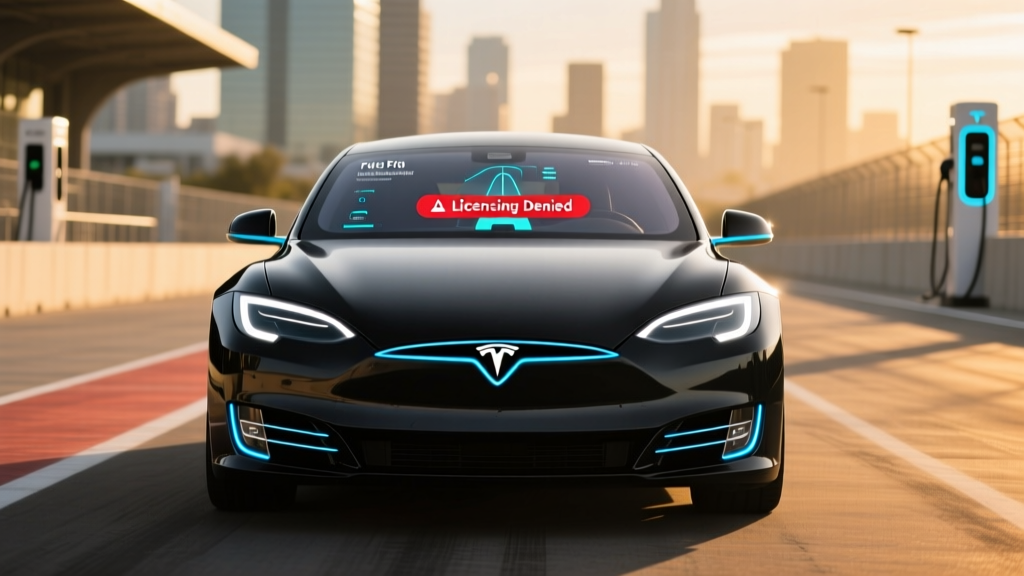
The Tesla autonomy licensing rejection refers to regulatory and legislative actions that have declined to grant Tesla's FSD system the legal classification or operational licensing reserved for true autonomous vehicles. Bodies including NHTSA and various state DMVs have maintained that FSD (Supervised) does not meet the threshold for unsupervised autonomous operation — a position consistent with the system's own naming convention and the driver-monitoring requirements Tesla itself enforces.
For buyers, this has concrete implications:
- FSD does not exempt you from liability. You are the driver. Any collision, citation, or incident is your responsibility regardless of FSD engagement.
- No regulatory body has validated FSD as a replacement for human driving. Marketing language about "full self-driving" should be weighed against the SAE Level 2 classification and the supervision requirement.
- FSD's resale value premium is uncertain. Paying $8,000 (or $99/month) for FSD is a bet on future capability that may or may not materialize, and that regulators have so far declined to license for autonomous use.
- Competitors like GM's Super Cruise and Ford's BlueCruise offer comparable Level 2 hands-free driving on mapped highways, often at lower cost and with clearer operational boundaries.
⚠️ What FSD (Supervised) Does NOT Do
FSD does not drive the car autonomously. It cannot handle all road conditions, construction zones, or adverse weather reliably. It does not eliminate the need for driver attention. It is not licensed or approved for driverless operation in any U.S. jurisdiction. Treat it as an advanced cruise control and lane-centering system — nothing more.
Pricing, Tax Credits, and Total Cost
| Item | Amount |
|---|---|
| Base MSRP | $47,740 |
| Destination Fee | $1,390 |
| FSD (Supervised) Add-On | $8,000 (or $99/mo) |
| As-Tested (with FSD, no other options) | $57,130 |
| Federal §30D Tax Credit (if eligible) | Up to $7,500 |
| Effective Price After Max Credit | ~$49,630 (without FSD) |
Federal tax credit eligibility under IRS §30D is subject to multiple requirements that change periodically:
- MSRP Cap: Sedans must be priced at or below $55,000. The Model 3 LR base ($47,740 + destination = $49,130) qualifies; adding FSD pushes it above the cap and may disqualify the credit.
- Buyer Income Cap: Modified AGI must not exceed $150,000 (single), $225,000 (head of household), or $300,000 (joint).
- Battery Sourcing: Critical minerals and battery components must meet escalating domestic/free-trade-partner sourcing thresholds. Tesla's supply chain has adapted significantly, but exact eligibility varies by production batch and model year.
- Point-of-Sale Transfer: As of 2024+, the credit can be transferred to the dealer at purchase, reducing your out-of-pocket cost immediately rather than waiting for tax filing.
Consult a tax professional and verify current eligibility at the IRS Clean Vehicle Credit page before committing. State and local incentives vary widely and are not covered here.
Interior, Tech, and Daily Livability
The Model 3's minimalist interior remains polarizing. A single 15.4-inch touchscreen handles virtually all vehicle controls — there are no physical buttons for climate, mirrors, or glovebox. Rear passengers get a dedicated 8-inch screen for climate and entertainment, which helps.
Cargo space: 23 cubic feet total (19.8 cu ft trunk + 3.1 cu ft frunk) is generous for the segment and easily handles a week's groceries or two carry-on suitcases plus duffels. Rear seats fold 60/40 for longer items.
Rear legroom: 35.3 inches is adequate for adults under 6 feet on longer trips but tighter than a Hyundai Ioniq 6 (37.2 in) or BMW i4 (36.1 in). The low-slung roofline also cuts into rear headroom for taller passengers.
Standout tech: Tesla's over-the-air update cadence remains industry-leading, the Supercharger network is the most reliable public charging ecosystem in North America, and the Tesla app's remote features (preconditioning, Sentry Mode cameras, location tracking) set the standard. The available premium audio system with 17 speakers is excellent.
Notable drawbacks: No Apple CarPlay or Android Auto (Tesla uses its own interface exclusively), the turn-signal stalk has been removed in favor of steering-wheel buttons (divisive), and panel gap consistency, while improved, still trails legacy luxury automakers.
Competitor Comparison: Is the Model 3 Still the Best Choice?
| Spec | Tesla Model 3 LR AWD | Hyundai Ioniq 6 SEL AWD | BMW i4 xDrive40 |
|---|---|---|---|
| EPA Range | 341 mi | 316 mi | 285 mi |
| Battery | 75 kWh NMC | 77.4 kWh NMC | 83.9 kWh NMC |
| 0–60 mph | 4.2 sec | 5.1 sec | 4.7 sec |
| Peak DC Charge | 250 kW | 240 kW | 205 kW |
| 10–80% Time | ~25 min | ~18 min | ~31 min |
| Base MSRP | $47,740 | $46,700 | $57,900 |
| Driver Assist | FSD (Level 2) | HDA2 (Level 2) | Driving Assist Pro (Level 2) |
| Charging Network | NACS (Supercharger native) | NACS (adapter or native) | NACS (adapter or native) |
🏆 Best Range & Efficiency
Tesla Model 3 LR — 341 miles EPA and 132 MPGe lead the segment.
🏆 Fastest 10–80% Charge
Hyundai Ioniq 6 — Its 800V architecture enables a blistering ~18-minute 10–80% session, beating Tesla by ~7 minutes despite a similar peak kW.
🏆 Interior Quality & Comfort
BMW i4 — Traditional luxury materials, physical controls, and CarPlay. But at $10K+ more.
🏆 Charging Network Reliability
Tesla Model 3 — Native Supercharger access remains the most dependable road-trip charging experience.
Who Should Buy the Model 3 Long Range?
Choose the Tesla Model 3 LR if: You prioritize maximum range, Supercharger network access, OTA software updates, and you accept the minimalist interior and FSD's Level 2 limitations.
Choose the Hyundai Ioniq 6 if: Faster DC charging speed matters to you, you want physical buttons and CarPlay, and you prefer Hyundai's 10-year powertrain warranty.
Choose the BMW i4 if: Interior luxury, brand prestige, and driving refinement are worth a $10K+ premium and shorter range.
Pros, Cons, and Verdict
✅ Pros
- Segment-leading 341-mile EPA range
- Supercharger network reliability
- Strong 250 kW DC charging capability
- Excellent OTA update cadence and app integration
- Competitive pricing after tax credit
- Improved ride quality and cabin quietness
❌ Cons
- FSD is Level 2 — autonomy licensing rejection confirms it's not self-driving
- No Apple CarPlay / Android Auto
- Adding FSD may push MSRP above §30D tax credit cap
- Turn-signal buttons on steering wheel are divisive
- Rear legroom tighter than some rivals
- NMC battery requires 80% daily charge discipline
Frequently Asked Questions
What is the real-world range of the 2026 Tesla Model 3 Long Range?
The EPA rates it at 341 miles. Expect roughly 280–305 miles on highway road trips at 70–80 mph, and 230–260 miles in sustained cold weather (below 32°F). City driving with regenerative braking can approach or match the EPA figure.
How fast does the Model 3 Long Range charge at home and on DC fast chargers?
On a V3 Supercharger, it peaks at 250 kW and charges from 10–80% in approximately 25 minutes. At home on a Level 2 Tesla Wall Connector (48A/11.5 kW), it adds ~44 miles per hour, fully charging overnight in about 7.5 hours.
How much does the Model 3 Long Range cost after the federal tax credit?
Base MSRP is $47,740. With destination, that's $49,130 — under the $55,000 sedan cap. If you meet all IRS §30D income and battery-sourcing requirements, the effective price can drop to approximately $41,630. Adding the $8,000 FSD package pushes the MSRP above the cap and likely disqualifies the credit.
Does the Tesla Model 3 qualify for the $7,500 federal EV tax credit?
It can, but eligibility depends on your income (AGI caps apply), the vehicle's MSRP staying under $55,000 for sedans, and battery critical-mineral/component sourcing meeting current-year thresholds. Always verify at IRS.gov before purchasing. Point-of-sale transfer is available.
What does the Tesla autonomy licensing rejection mean for FSD?
It confirms that FSD (Supervised) remains an SAE Level 2 driver-assist system, not a licensed autonomous driving technology. Regulatory bodies have not approved it for driverless operation. Buyers should treat FSD as an advanced convenience feature — not a replacement for attentive driving — and weigh the $8,000 cost against that reality.
Is the Model 3 Long Range worth buying over the Hyundai Ioniq 6 or BMW i4?
If range, Supercharger access, and software are your top priorities, the Model 3 LR is still the benchmark. If faster DC charging and CarPlay matter more, the Ioniq 6 is compelling. If luxury and build quality justify a premium, the i4 delivers. All three are strong — the right choice depends on your use case and values.
What is the battery warranty on the 2026 Model 3 Long Range?
Tesla covers the battery and drive unit for 8 years or 120,000 miles (whichever comes first), guaranteeing at least 70% capacity retention. Real-world data suggests most Tesla NMC packs retain 85–90% at 100,000 miles with proper charging habits (daily limit of 80%).
Sources: fueleconomy.gov (EPA range and efficiency data), IRS §30D Clean Vehicle Credit, NHTSA Automated Vehicles Safety, Tesla official specifications.