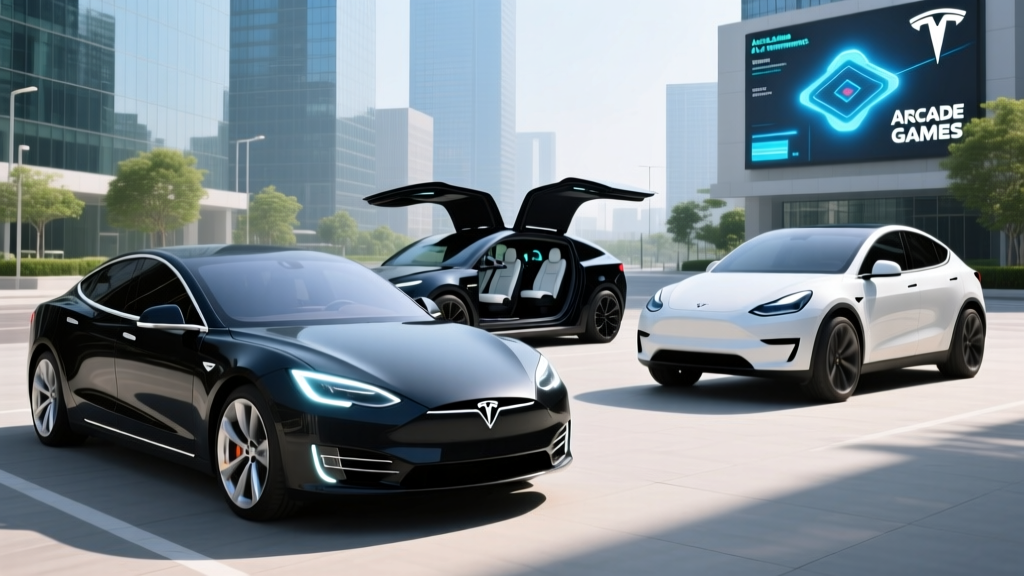
If you've searched for games Tesla offers in its vehicles, you've likely discovered that Tesla's infotainment system doubles as a surprisingly capable gaming platform. But a Tesla is still, fundamentally, an electric vehicle — and the decision to buy one should hinge on range, charging speed, efficiency, and total cost, not just whether you can play Cyberpunk 2077 while parked at a Supercharger. This review covers the full 2026 Tesla lineup — Model 3, Model Y, Model S, and Model X — with exact specs, real-world range expectations, charging data, pricing, and federal tax credit eligibility, while also detailing the gaming and entertainment features that set Tesla's cabin apart.
Tesla's Gaming Platform: What You Actually Get
Tesla's infotainment system runs a custom Linux-based OS with an integrated app store called Tesla Arcade. Available games and entertainment apps include:
- Cyberpunk 2077 — full AAA title (Model S/X with AMD Ryzen GPU, and refreshed Model 3/Y Highland/Juniper with Ryzen chip)
- Stardew Valley, Cuphead, Beach Buggy Racing 2, Stardew Valley — casual/indie titles
- Tesla Arcade classics — Asteroids, Lunar Lander, Solitaire, Sudoku, Chess
- Netflix, YouTube, Twitch, Disney+ — streaming apps (vehicle must be in Park)
- Theater mode — 15.4" (Model 3/Y) or 17" (Model S/X) center display for media
Games are playable only while the vehicle is in Park. Tesla's gaming performance depends on the onboard chip: older Intel Atom units (pre-2021) handle basic titles, while the AMD Ryzen-based infotainment (2022+ Model S/X and 2024+ Model 3/Y refreshes) delivers console-quality gaming at 60fps on the center display. Rear passengers in the Model S and Model X also get an 8" rear touchscreen with independent gaming and streaming capability.
2026 Tesla Lineup: Core EV Specs at a Glance
| Spec | Model 3 RWD | Model 3 Long Range AWD | Model Y Long Range AWD | Model S Long Range | Model X Long Range |
|---|---|---|---|---|---|
| EPA Range | 272 mi | 341 mi | 320 mi | 402 mi | 348 mi |
| Battery (usable) | ~57.5 kWh (LFP) | ~75 kWh (NMC) | ~75 kWh (NMC) | ~95 kWh (NMC) | ~95 kWh (NMC) |
| Peak DC Charge | 170 kW | 250 kW | 250 kW | 250 kW | 250 kW |
| 10–80% DC Time | ~28 min | ~25 min | ~25 min | ~27 min | ~30 min |
| Level 2 (11.5 kW) | ~30 mi/hr | ~44 mi/hr | ~44 mi/hr | ~41 mi/hr | ~35 mi/hr |
| 0–60 mph | 5.8 sec | 4.2 sec | 4.8 sec | 3.1 sec | 3.8 sec |
| Horsepower | 271 hp | 346 hp | 384 hp | 670 hp | 670 hp |
| Drivetrain | RWD | Dual-Motor AWD | Dual-Motor AWD | Dual-Motor AWD | Dual-Motor AWD |
| MPGe (combined) | 132 MPGe | 125 MPGe | 117 MPGe | 120 MPGe | 102 MPGe |
| Base MSRP | $38,990 | $44,990 | $44,990 | $74,990 | $79,990 |
Source: EPA / fueleconomy.gov and Tesla.com. Specs reflect 2026 model year. Model S/X Plaid trims excluded for brevity.
Real-World Range: What the EPA Sticker Doesn't Tell You
EPA vs. Reality: Tesla's EPA range estimates are among the most accurate in the industry, but real-world results still vary significantly based on conditions:
- Highway driving (70–80 mph): Expect 85–90% of EPA range. A Model 3 Long Range rated at 341 mi will deliver ~290–305 mi at sustained highway speeds in mild weather.
- Cold weather (below 32°F): Range loss of 20–30% is typical. The Model 3 LFP (RWD) is particularly affected — expect ~190–215 mi in freezing temps without preconditioning. Tesla's heat pump (standard on all 2026 models) mitigates this somewhat.
- City/regenerative driving: You may match or slightly exceed EPA range thanks to aggressive regen braking recapturing energy.
The LFP (lithium iron phosphate) battery in the Model 3 RWD sacrifices some energy density for lower cost and longer cycle life. Tesla recommends charging LFP packs to 100% regularly, unlike NMC packs where an 80–90% daily limit is preferred to slow degradation. For road trips, the Model S Long Range's 402-mile EPA rating makes it the standout — you'll realistically see 340–360 miles on the highway in summer conditions, enough to stretch between most Supercharger stops.
Charging Speed: Supercharger Network Advantage
Tesla's Supercharger network remains the gold standard for DC fast charging reliability in North America. All 2026 Teslas use the NACS (North American Charging Standard) connector natively — no adapter required at Tesla stalls. With other automakers now adopting NACS, Tesla's network is opening to non-Tesla EVs, but Tesla owners still benefit from the most seamless plug-and-charge experience.
| Charging Level | Power | Approximate Speed | Use Case |
|---|---|---|---|
| Level 1 (120V) | ~1.4 kW | 3–5 mi/hr | Emergency / overnight trickle |
| Level 2 (240V, 48A) | 11.5 kW | 30–44 mi/hr | Home daily charging (8–10 hr full charge) |
| DC Fast (Supercharger V3) | Up to 250 kW | ~170 mi in 15 min (peak) | Road trips |
| DC Fast (Supercharger V4) | Up to 350 kW (future) | TBD | Rolling out at select locations |
Charging curve reality: Peak 250 kW is sustained only between roughly 10–30% State of Charge (SoC). By 50% SoC, speeds taper to ~150 kW; above 80%, expect ~50–70 kW. This is why Tesla quotes 10–80% times rather than 0–100%. For daily driving, preconditioning your battery (automatic when you navigate to a Supercharger) is critical — arriving at a Supercharger with a cold battery can cut peak charge rates in half.
Pricing, Trims, and Federal Tax Credit Eligibility
| Model | Base MSRP | As-Tested (common config) | §30D Credit Eligibility |
|---|---|---|---|
| Model 3 RWD | $38,990 | $40,490 (w/ FSD, paint) | Potentially $3,750–$7,500* |
| Model 3 LR AWD | $44,990 | $48,990 | Potentially $3,750–$7,500* |
| Model Y LR AWD | $44,990 | $48,490 | Potentially $3,750–$7,500* |
| Model S LR | $74,990 | $82,990 | Not eligible (MSRP cap exceeded) |
| Model X LR | $79,990 | $89,990 | Not eligible (MSRP cap exceeded) |
Federal tax credit rules (IRS §30D, 2026): The credit is up to $7,500, but eligibility is complex:
- MSRP cap: Sedans (Model 3, Model S) must be ≤$55,000. SUVs/trucks/vans (Model Y, Model X) must be ≤$80,000. This eliminates the Model S entirely and most Model X configurations.
- Buyer income cap: AGI ≤$150,000 (single), ≤$225,000 (head of household), ≤$300,000 (joint).
- Battery sourcing: A percentage of critical minerals and battery components must be sourced from the US or FTA partners. Tesla has made significant progress in domestic sourcing (particularly with the Nevada and Texas Gigafactories), but the exact credit amount ($3,750 vs $7,500) depends on whether both the minerals AND component thresholds are met for the specific build week.
- Point-of-sale transfer: You can transfer the credit to the dealer at purchase for an immediate price reduction, rather than waiting for tax filing.
Always verify current eligibility at IRS.gov and confirm with a tax professional. Sourcing requirements tighten annually.
Interior, Cargo, and Daily Practicality
Tesla's minimalist interior centers on the touchscreen, which controls virtually everything — climate, mirrors, glovebox, and of course gaming and media. Here's how the lineup compares on space:
- Model 3: 23 cu ft trunk + rear frunk. Rear legroom is 35.2". Adequate for two adults, tight for three.
- Model Y: 30.2 cu ft behind rear seats (76.2 cu ft folded). Rear legroom 40.5". The practical family pick — significantly more cargo room than the Model 3 with a hatchback design.
- Model S: 28 cu ft trunk + front trunk. Rear legroom 35.4". Premium materials, ventilated seats, rear entertainment screen.
- Model X: Up to 88 cu ft cargo (seats folded). Available 6- or 7-seat config. Falcon Wing rear doors ease child-seat access but add mechanical complexity.
Build quality on the refreshed Model 3 (Highland) and Model Y (Juniper) has improved meaningfully — tighter panel gaps, acoustic glass, and upgraded interior materials close the gap with legacy luxury brands.
Driver Assistance: Autopilot and FSD Supervised
SAE Level 2 — Not Self-Driving: Tesla's Autopilot (standard) and Full Self-Driving (FSD) Supervised ($8,000 option or $99/month) are SAE Level 2 driver-assistance systems. The driver must remain fully attentive, keep hands on the wheel, and be prepared to take over at any time. FSD Supervised can navigate highway interchanges, stop lights, and city streets, but it makes errors and requires constant oversight. No Tesla vehicle is self-driving.
For comparison, GM's Super Cruise and Ford's BlueCruise also operate at Level 2 but are geofenced to pre-mapped highways and use more robust driver monitoring (eye-tracking cameras). Tesla's camera-only approach is more flexible geographically but has drawn scrutiny from NHTSA regarding driver engagement enforcement.
Pros, Cons, and the Verdict
Pros
- Best-in-class Supercharger network (20,000+ stalls in North America)
- Industry-leading infotainment and gaming platform
- Class-leading efficiency (kWh/mi) across the lineup
- Over-the-air updates continuously add features
- Strong resale value relative to most EV competitors
- Model 3 and Model Y qualify for partial or full §30D credit
Cons
- No physical controls — everything through the screen
- FSD Supervised is expensive and still requires full driver attention
- LFP battery (Model 3 RWD) loses more range in cold weather
- Model S/X priced out of federal tax credit eligibility
- Insurance premiums run 15–25% higher than comparable ICE vehicles
- Rear visibility in Model 3 is limited; no rear wiper on Model Y (pre-refresh)
Who Should Buy a Tesla in 2026?
- Choose the Model 3 RWD if you want the most affordable entry point, primarily commute in mild climates, and can charge at home nightly. The LFP battery's lower energy density is offset by its longevity — ideal for high-mileage commuters.
- Choose the Model 3 Long Range if you take regular road trips and need 300+ miles of real-world range, or if you live in a cold-weather region where the NMC battery and AWD are essential.
- Choose the Model Y Long Range if you need family practicality — hatchback cargo space, available tow hitch (3,500 lb), and room for rear-facing car seats. This is Tesla's best-selling model for good reason.
- Choose the Model S if you want flagship performance and 400-mile range for cross-country touring and budget is secondary. Understand you won't qualify for the federal tax credit.
- Choose the Model X only if you specifically need 3-row EV seating and value the Falcon Wing doors. The Rivian R1S and Kia EV9 offer compelling alternatives at lower prices.
Warranty Coverage
All 2026 Teslas include:
- Basic Vehicle: 4 years / 50,000 miles
- Battery & Drive Unit: 8 years / 100,000 miles (Model 3 RWD), 8 years / 120,000 miles (Model 3 LR, Model Y), 8 years / 150,000 miles (Model S, Model X)
- Capacity retention guarantee: Tesla warrants a minimum of 70% battery capacity retention over the warranty period. In practice, Tesla batteries have shown strong longevity — Tesla's Impact Report cites an average of ~12% degradation at 200,000 miles.
Frequently Asked Questions
Can you play games on a Tesla while driving?
No. Tesla Arcade games are only accessible while the vehicle is in Park. This is a hard software lock and cannot be bypassed. Streaming apps like Netflix follow the same restriction.
What games come with a Tesla?
Tesla includes a rotating library of free games (Asteroids, Solitaire, Sudoku, Chess) and supports premium titles like Cyberpunk 2077 and Stardew Valley on vehicles equipped with the AMD Ryzen infotainment chip. Some games require a purchase through the Tesla Arcade store.
Does the Tesla Model 3 qualify for the $7,500 federal tax credit?
It depends on your income, the specific build's battery sourcing, and MSRP. The Model 3 (under the $55,000 sedan cap) is eligible in principle, but the full $7,500 requires meeting both critical-mineral and battery-component sourcing thresholds. Check fueleconomy.gov for the latest per-model credit amounts.
How much does it cost to charge a Tesla at home?
At the US average electricity rate of ~$0.16/kWh, fully charging a Model 3 Long Range (75 kWh) costs roughly $12. That's approximately 3.5–4 cents per mile — about one-third the per-mile fuel cost of a 30-MPG gas car at $3.50/gallon.
Is Tesla's FSD worth the $8,000 cost?
For most buyers, no. FSD Supervised is a Level 2 assist system that still requires your full attention. Basic Autopilot (included) handles highway lane-keeping and adaptive cruise well. FSD adds city-street navigation and stop-light recognition, but the error rate means you're supervising, not relaxing. Consider the $99/month subscription to test it before committing.
How does Tesla's gaming compare to competitors?
No other mainstream automaker matches Tesla's gaming library or hardware capability. Rivian offers limited casual games; Hyundai/Kia and Ford provide basic streaming apps but no AAA gaming. Tesla's AMD Ryzen chip is genuinely a generation ahead of competitors' infotainment processors for gaming workloads.