The Quick Answer: Who Should Buy the Toyota Prius Prime EV?
The Toyota Prius Prime EV is a plug-in hybrid (PHEV), not a fully electric vehicle. It offers 44 miles of EPA-rated electric-only range on a full charge, then seamlessly switches to hybrid mode for up to 50 MPG combined. For 2026, the Prius Prime starts at $33,445 MSRP (SE trim) and qualifies for a $3,750 federal tax credit under IRS §30D rules, assuming you meet income and battery-sourcing requirements.
Best for: Drivers with short commutes (under 40 miles round-trip) who want electric daily driving but need gas-engine flexibility for road trips or lack reliable home charging.
Not ideal for: Those seeking zero tailpipe emissions, drivers wanting 200+ miles of electric range, or buyers who can't charge at home or work (you'll miss the biggest savings).
If your daily driving stays within the 44-mile electric envelope and you can plug in overnight, the Prius Prime essentially functions as an EV for weekday use while eliminating range anxiety entirely. But if you're comparing it to a full battery-electric vehicle (BEV) like the Tesla Model 3 or Hyundai Ioniq 6, you're trading electric range for gas-engine backup.
Toyota Prius Prime EV Specs: Range, Battery, and Efficiency
| Specification | 2026 Toyota Prius Prime SE | 2026 Toyota Prius Prime XSE |
|---|---|---|
| Electric-only range (EPA) | 44 miles | 40 miles |
| Battery capacity | 13.6 kWh (lithium-ion, NMC chemistry) | 13.6 kWh (lithium-ion, NMC chemistry) |
| Hybrid MPG (combined) | 52 MPG | 48 MPG |
| MPGe (electric mode) | 127 MPGe | 117 MPGe |
| 0-60 mph | 6.6 seconds | 6.6 seconds |
| Horsepower (combined system) | 220 hp | 220 hp |
| Level 2 charging time (0-100%) | ~4 hours (3.3 kW onboard charger) | ~4 hours (3.3 kW onboard charger) |
| DC fast charging | Not available | Not available |
| Base MSRP | $33,445 | $37,445 |
| Federal tax credit (§30D) | $3,750 (if eligible) | $3,750 (if eligible) |
| Battery warranty | 10 years / 150,000 miles | 10 years / 150,000 miles |
Real-world range expectation: The EPA rates the Prius Prime at 44 miles electric (SE trim). In real-world testing, expect 38-42 miles in mixed driving with moderate climate control use. Highway-heavy routes at 70+ mph may drop this to 32-36 miles. Cold weather (below 32°F) can reduce electric range by 20-30%, bringing it down to 28-35 miles in winter conditions.
The Prius Prime uses a 13.6 kWh lithium-ion battery pack with NMC (nickel-manganese-cobalt) chemistry. This is smaller than most BEVs (which typically run 60-100 kWh), but it's sized appropriately for short electric commutes. The battery sits under the rear seat, preserving cargo space compared to earlier generations.
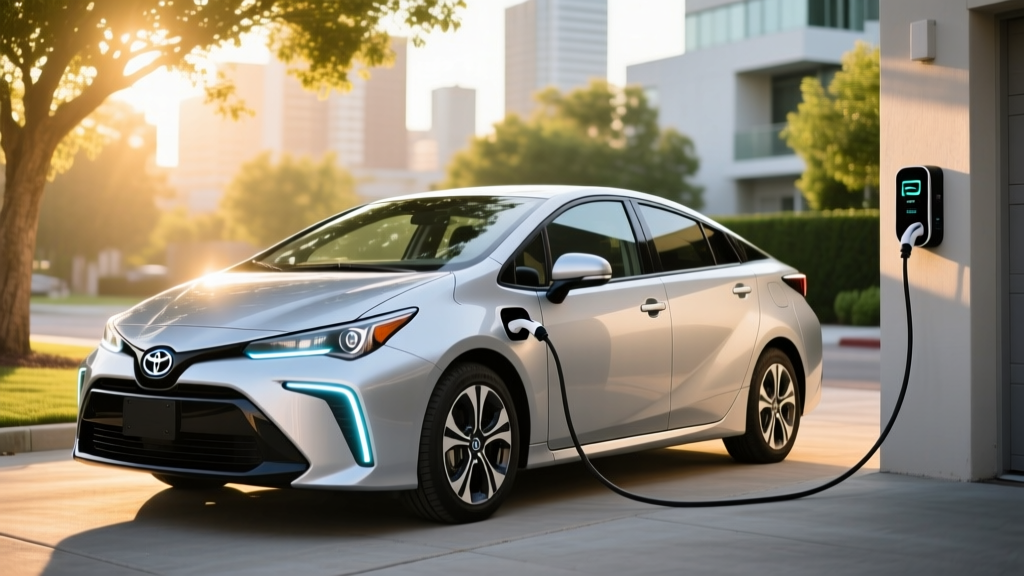
Charging is limited to Level 1 (120V, ~1.4 kW) or Level 2 (240V, 3.3 kW). There is no DC fast charging capability. A full Level 2 charge takes about 4 hours; Level 1 from a standard household outlet takes roughly 10-11 hours. For most owners, overnight Level 1 charging is sufficient to replenish the battery daily.
Prius Prime vs. Gas Car vs. Full EV: Cost Comparison
To understand whether the Toyota Prius Prime EV makes financial sense, let's compare it to a conventional gas car and a full battery-electric vehicle over a 5-year ownership period. We'll use the following assumptions: 15,000 miles/year, $3.50/gallon gas, $0.14/kWh electricity (national average), and 60% of driving within electric range for the PHEV.
| Cost Factor (5 years) | Toyota Prius Prime SE | Toyota Corolla LE (Gas) | Tesla Model 3 RWD (BEV) |
|---|---|---|---|
| Purchase price (MSRP) | $33,445 | $23,495 | $38,990 |
| Federal tax credit | -$3,750 | $0 | -$7,500 |
| Net purchase price | $29,695 | $23,495 | $31,490 |
| Fuel/energy cost (5 yr) | $4,200 | $7,875 | $3,150 |
| Maintenance (5 yr) | $2,800 | $3,500 | $1,800 |
| Insurance (5 yr avg) | $7,500 | $6,800 | $8,200 |
| Total 5-year cost | $44,195 | $41,670 | $44,640 |
| Cost per mile | $0.59 | $0.56 | $0.59 |
Key takeaways:
- The Prius Prime costs roughly $2,500 more over 5 years than a gas Corolla, but you get significantly lower tailpipe emissions and the ability to drive electric most weekdays.
- Compared to a Tesla Model 3, the Prius Prime is $445 cheaper over 5 years and eliminates range anxiety entirely.
- Fuel savings are substantial: the Prius Prime uses $3,675 less fuel than the Corolla over 5 years (assuming 60% electric driving).
- Maintenance costs are lower than gas cars (no oil changes, less brake wear from regenerative braking) but higher than BEVs (still has an engine, transmission, and exhaust system).
If you can charge at home and your commute fits within 44 miles, the Prius Prime's fuel cost drops dramatically. At $0.14/kWh, a full charge costs about $1.90, giving you 44 miles of electric driving — equivalent to $0.043 per mile. Compare that to the Corolla at $0.105 per mile on gas.
Real-World Ownership: What First-Time Buyers Should Know
Home Charging Access Is Critical
The Prius Prime's value proposition hinges on regular charging. If you can plug in at home (even a standard 120V outlet), you'll maximize electric driving and minimize gas use. But if you rely solely on public charging infrastructure, the math shifts unfavorably:
- Public Level 2 charging costs $0.25-$0.49/kWh in most markets, making electric driving more expensive than gas in some cases.
- The Prius Prime's 3.3 kW onboard charger means public charging sessions are slow (4+ hours for a full charge), which is impractical for most errands or work breaks.
- Without regular charging, you're essentially driving a very efficient hybrid — still good at 50 MPG, but you're not capturing the electric savings.
Cold Weather Reduces Electric Range
If you live in a climate with harsh winters, expect the Prius Prime's electric range to drop by 20-30% in freezing temperatures. The battery's chemistry (NMC) is less tolerant of cold than LFP (lithium iron phosphate) batteries used in some BEVs. Running the cabin heater also draws from the battery, further reducing range. In sub-freezing conditions, your 44-mile EPA range may shrink to 30-35 miles.
No DC Fast Charging Means No Road-Trip Speed-Ups
Unlike full EVs that can add 150-250 miles of range in 20-30 minutes at a DC fast charger, the Prius Prime has no DC charging capability. On long trips, you'll simply drive it as a hybrid, refueling at gas stations in 5 minutes. This is actually an advantage for road-trip convenience, but it means you can't "top up" the battery quickly on the go.
Insurance Costs Are Slightly Higher
Plug-in hybrids typically cost 10-15% more to insure than their gas counterparts due to higher repair costs for battery and powertrain components. Expect to pay $1,500-$1,800/year for the Prius Prime, depending on your location, driving record, and coverage level. Always get an insurance quote before purchasing.
Federal Tax Credit Eligibility for the Prius Prime
For 2026, the Toyota Prius Prime qualifies for a $3,750 federal tax credit under IRS §30D rules. This is half the maximum $7,500 credit because the vehicle meets critical-mineral sourcing requirements but not battery-component manufacturing requirements (per current IRS guidance).
To qualify for the $3,750 credit, you must meet ALL of these:
- Income limits: Modified adjusted gross income (MAGI) must not exceed $150,000 (single filers), $225,000 (head of household), or $300,000 (married filing jointly).
- MSRP cap: The vehicle's MSRP must not exceed $55,000 (sedans). The Prius Prime SE ($33,445) and XSE ($37,445) both qualify.
- Tax liability: You must have at least $3,750 in federal tax liability for the year. The credit is non-refundable, meaning it can't reduce your tax bill below zero.
- Point-of-sale transfer: As of 2024, you can transfer the credit to the dealer at purchase, reducing your out-of-pocket cost immediately (even if you owe less than $3,750 in taxes).
- New vehicle: The credit applies only to new vehicles purchased for personal use, not resale.
Important caveat: Tax credit rules change frequently. Battery-sourcing and critical-mineral requirements are phased in annually, and some vehicles may lose or gain eligibility. Always verify current status on fueleconomy.gov or consult a tax professional before relying on the credit in your purchase decision.
Common Misconceptions About the Prius Prime
| Myth | Fact |
|---|---|
| "It's a fully electric car." | The Prius Prime is a plug-in hybrid (PHEV), not a BEV. It has both an electric motor and a 2.0L 4-cylinder gas engine. After 44 miles of electric range, it operates as a conventional hybrid. |
| "You need a special home charger." | You can charge the Prius Prime on a standard 120V household outlet (Level 1). It takes 10-11 hours for a full charge, which works for overnight replenishment. A 240V Level 2 charger reduces this to ~4 hours but isn't required. |
| "The battery will need expensive replacement soon." | Toyota warranties the hybrid battery for 10 years or 150,000 miles. Real-world data shows Toyota hybrid batteries lasting 150,000-200,000+ miles with minimal degradation. Replacement cost (if needed out of warranty) is typically $3,000-$4,500, far less than BEV battery replacements. |
| "It qualifies for the full $7,500 tax credit." | As of 2026, the Prius Prime qualifies for $3,750, not $7,500, due to battery-component sourcing rules. The full $7,500 credit requires both critical-mineral and battery-component manufacturing compliance. |
| "I'll save money even if I never plug it in." | Without regular charging, you're driving a 50 MPG hybrid — still efficient, but you're paying a premium over the standard Prius (which gets 57 MPG and costs $5,000 less). The PHEV premium only pays off if you charge regularly. |
Decision Framework: Should You Buy the Toyota Prius Prime EV?
Buy the Prius Prime if:
- Your daily round-trip commute is under 40 miles and you can charge at home overnight.
- You want electric driving for daily use but need gas-engine flexibility for road trips, rural driving, or areas with sparse charging infrastructure.
- You live in an apartment or area where installing a Level 2 charger is impractical (Level 1 charging is sufficient for the Prius Prime's small battery).
- You're not ready to commit to a full EV but want to reduce gas consumption and emissions.
Consider a full EV (BEV) instead if:
- You want 200+ miles of electric range and don't want to think about gas at all.
- You have reliable home charging and access to DC fast chargers for road trips.
- You're motivated by zero tailpipe emissions and want to eliminate oil changes, spark plugs, and exhaust maintenance entirely.
- You qualify for the full $7,500 federal tax credit (available on BEVs like the Tesla Model 3, Hyundai Ioniq 5, and Ford Mustang Mach-E).
Stick with a standard hybrid (HEV) if:
- You cannot charge at home or work — a PHEV's premium isn't worth it without regular plug-in access.
- Your daily driving exceeds 50+ miles, meaning you'd rarely use the electric range.
- You want the lowest upfront cost and simplest ownership experience (no charging cables, no plug-in routine).
Frequently Asked Questions
How long does it take to charge the Toyota Prius Prime?
On a standard 120V household outlet (Level 1), a full charge takes 10-11 hours. On a 240V Level 2 charger, it takes approximately 4 hours. The Prius Prime does not support DC fast charging.
What happens when the battery runs out of electric range?
The Prius Prime seamlessly switches to hybrid mode, using its 2.0L 4-cylinder engine and regenerative braking to achieve 50 MPG combined (SE trim). You simply refuel at a gas station as you would with any hybrid or gas car. There's no "range anxiety" — the car operates normally.
Does the Prius Prime qualify for HOV lane access?
In many states (California, Colorado, Virginia, and others), PHEVs with sufficient electric range qualify for HOV lane stickers or decals. Check your state's DMV website for current eligibility and application requirements, as these programs have income caps and expiration dates.
How does the Prius Prime compare to the standard Prius?
The standard Prius (non-Prime) is a conventional hybrid with no plug-in capability. It gets 57 MPG combined and starts at $28,545. The Prius Prime costs ~$5,000 more but offers 44 miles of electric range. If you charge regularly, the Prime's total fuel cost is lower; if you never charge, the standard Prius is more efficient and cheaper upfront.
What's the warranty on the Prius Prime battery?
Toyota covers the hybrid battery for 10 years or 150,000 miles (whichever comes first). The warranty guarantees the battery will retain at least 70% of its original capacity. Real-world data suggests Toyota hybrid batteries often last 150,000-200,000+ miles with minimal degradation.
Can I install a Level 2 charger at home for the Prius Prime?
Yes, but it's optional. A Level 2 charger (240V, 16-32 amps) reduces charge time from 11 hours to ~4 hours. Installation costs range from $500-$2,000 depending on your electrical panel capacity and distance from the panel to the charging location. For the Prius Prime's small 13.6 kWh battery, many owners find Level 1 (120V) charging sufficient for overnight replenishment.
Is the Prius Prime good for cold climates?
The Prius Prime works well in cold weather, but expect 20-30% reduction in electric range when temperatures drop below freezing. The gas engine will engage more frequently to provide cabin heat and maintain battery temperature. Overall hybrid efficiency remains strong in winter, but your electric-only miles will decrease.