Why a Tesla Apprenticeship Matters in the EV Service Boom
As the U.S. EV fleet surpasses 12 million vehicles on the road in 2026, the demand for qualified high-voltage technicians has outpaced supply by a wide margin. The Tesla apprenticeship program — officially known as the Tesla START (Service Technician Automotive Repair Training) program and Tesla's internal technician apprenticeship tracks — has become one of the most direct pipelines into the electric vehicle service industry. Unlike traditional automotive tech programs that still spend significant time on internal combustion systems, a Tesla apprenticeship immerses you entirely in battery-electric platforms: high-voltage safety, electric drivetrain diagnostics, thermal management systems, and over-the-air software troubleshooting.
This guide breaks down what a Tesla apprenticeship actually entails, what you'll earn and learn, how the program connects to the vehicles you'll service (including exact specs on the Model 3 and Model Y you'll work on daily), and whether it's the right career move compared to competing EV technician pathways.
What Is the Tesla Apprenticeship (Tesla START) Program?
The Tesla apprenticeship ecosystem has two primary entry points:
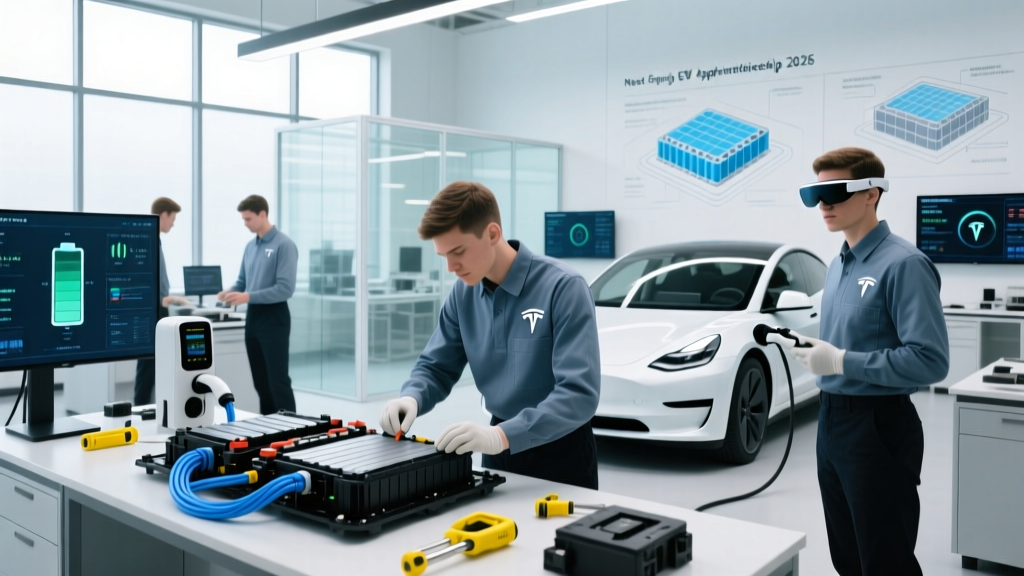
- Tesla START Program: A 12-week, full-time training course offered at select Tesla training centers (Fremont, CA; Austin, TX; and regional hubs). It covers high-voltage system safety, battery pack architecture, electric motor service, HVAC/heat pump systems, and Tesla-specific diagnostic software. Graduates receive a Tesla certification and are typically placed directly into Service Technician roles at Tesla Service Centers.
- Tesla Technician Apprenticeship (On-the-Job): A longer, paid apprenticeship track where entry-level technicians work under senior mentors at Tesla Service Centers for 12–24 months, progressively earning certifications for high-voltage battery handling, drivetrain replacement, and Advanced Driver Assistance System (ADAS) calibration.
Both tracks share a core focus: you will not touch a gas engine. Every hour is spent on BEV platforms — primarily the Tesla Model 3 and Tesla Model Y, which together represent over 90% of Tesla's U.S. service volume, with increasing exposure to the Cybertruck and updated Model S/X platforms.
What You'll Earn: Tesla Apprenticeship Pay and Benefits
Compensation is one of the strongest draws of the Tesla apprenticeship path. Based on 2026 postings and Glassdoor/Indeed aggregates:
| Role / Stage | Hourly Pay (2026) | Notes |
|---|---|---|
| Tesla START Trainee | $22–$28/hr | 12-week program; some locations offer housing stipends |
| Apprentice Technician (Level 1) | $26–$33/hr | First 6–12 months on the job |
| Service Technician (Level 2–3) | $34–$48/hr | After certification milestones; varies by metro |
| Senior / Master Technician | $48–$62+/hr | High-voltage battery & ADAS specialist |
Tesla technicians also receive vehicle purchase discounts, stock-based compensation (RSUs) at higher levels, and full benefits including health insurance and 401(k) matching. In high-cost metros like the Bay Area, Seattle, and New York, expect pay at the upper end of these ranges.
The Vehicles You'll Service: Model 3 and Model Y Specs
A Tesla apprenticeship means deep familiarity with the platforms that dominate Tesla's fleet. Here's what you need to know about the two vehicles that will make up the bulk of your service bay time in 2026.
| Spec | Model 3 Long Range AWD | Model Y Long Range AWD |
|---|---|---|
| EPA Range | 363 miles | 320 miles |
| Battery Capacity | ~79 kWh usable (NMC) | ~79 kWh usable (NMC) |
| Rear-Wheel-Drive Battery | ~60 kWh (LFP) | ~60 kWh (LFP) |
| Max DC Fast Charge | 250 kW (peak) | 250 kW (peak) |
| 10–80% DC Charge Time | ~25 minutes | ~27 minutes |
| Level 2 Home Charge Rate | 11.5 kW (~44 mi/hr) | 11.5 kW (~44 mi/hr) |
| 0–60 mph | 4.2 seconds | 4.8 seconds |
| Horsepower | 346 hp (dual motor) | 384 hp (dual motor) |
| Drivetrain | AWD (dual motor) | AWD (dual motor) |
| EPA Efficiency | 132 MPGe / 25 kWh/100mi | 122 MPGe / 28 kWh/100mi |
| Cargo Volume | 23 cu ft (rear) + 3 cu ft frunk | 30 cu ft (rear) + 4 cu ft frunk |
| Battery Warranty | 8 yr / 120,000 mi | 8 yr / 120,000 mi |
| Base MSRP (2026) | $42,380 | $44,380 |
What You'll Learn: High-Voltage Systems and Diagnostics
The Tesla apprenticeship curriculum is structured around the systems that differentiate EV service from traditional automotive repair:
High-Voltage Battery Architecture
You'll learn to identify and service both NMC (nickel manganese cobalt) and LFP (lithium iron phosphate) battery packs. NMC packs (Long Range trims) offer higher energy density but require careful state-of-charge management — Tesla recommends daily charging to 80%. LFP packs (RWD trims) tolerate regular 100% charging and have longer cycle life, but exhibit different voltage curves that affect range estimation accuracy. Understanding these differences is essential for diagnosing customer range complaints.
Thermal Management and Heat Pump Systems
Tesla's octovalve thermal management system and heat pump (standard on all 2026 Model 3/Y) are among the most complex subsystems you'll service. The heat pump scavenges waste heat from the battery and motors to warm the cabin, dramatically improving winter efficiency versus resistive heating. Apprentices learn refrigerant handling, coolant loop bleeding, and octovalve actuator diagnostics.
ADAS Calibration: Autopilot and FSD Hardware
Tesla's vision-based Autopilot and Full Self-Driving (Supervised) systems rely on a suite of cameras with no lidar or radar on current models. After windshield replacement, suspension work, or camera module service, recalibration is required. Apprentices learn that these are SAE Level 2 driver-assistance systems — the driver must remain engaged at all times. This distinction matters for service documentation and customer communication.
Federal Tax Credit: What Apprentices Should Tell Customers
As a Tesla service technician, customers will frequently ask about the federal EV tax credit. Here's the 2026 framework under IRS §30D:
- Maximum credit: Up to $7,500 for qualifying new EVs
- MSRP cap: Vehicles must be below $55,000 (sedans like Model 3) or $80,000 (SUVs/trucks like Model Y and Cybertruck)
- Buyer income cap: AGI must not exceed $150,000 (single), $225,000 (head of household), or $300,000 (joint)
- Battery sourcing: Critical minerals and battery components must meet escalating domestic/free-trade-agreement percentages — Tesla's shift toward U.S.-sourced LFP and Nevada-manufactured cells has kept most trims eligible
- Point-of-sale transfer: Buyers can transfer the credit to the dealer at purchase for an immediate price reduction
Both the Model 3 and Model Y have maintained partial or full $7,500 eligibility through 2026, but specific trim and battery-sourcing combinations vary. Always direct customers to the fueleconomy.gov credit lookup for the latest status.
Tesla Apprenticeship vs. Competing EV Tech Programs
- You want to specialize exclusively in BEV platforms with no ICE crossover
- You're targeting the largest single-brand EV service network in the U.S.
- You value direct manufacturer certification over a generalist ASE path
- You're willing to relocate to a Tesla service hub if needed
- You want flexibility to service multiple brands (Hyundai, Ford, GM, Rivian)
- You prefer a 2-year associate degree with broader automotive fundamentals
- You want to stay in a specific geographic area without Tesla service center proximity
Pros and Cons of the Tesla Apprenticeship Path
- Paid training from day one — no student debt for the START program
- Direct pipeline to employment at 300+ U.S. Tesla Service Centers
- Deep expertise in the two highest-volume EVs on American roads
- High-voltage certification commands premium pay ($34–$62/hr range)
- RSU stock compensation at senior levels
- Growing demand: BLS projects 4% growth for automotive technicians through 2034, with EV specialists growing much faster
- Tesla-only focus limits portability to other OEM service bays
- Physically demanding: battery pack service involves heavy lifting in awkward positions
- Tesla's direct-sales model means fewer independent shop opportunities
- High-voltage work carries inherent safety risk — strict PPE and protocol compliance required
- Some markets have long waitlists for START program enrollment
- Tesla's corporate culture is demanding — expect a fast-paced, metrics-driven environment
Frequently Asked Questions
What are the requirements to enter a Tesla apprenticeship?
Tesla START requires a high school diploma or GED, a valid driver's license, and the ability to pass a background check. Prior automotive or electrical experience is helpful but not mandatory — the program is designed for career-changers and recent graduates. You must be able to lift 50+ pounds and work with high-voltage systems safely.
How long does the Tesla apprenticeship take?
The START classroom program is 12 weeks. The on-the-job apprenticeship track runs 12–24 months with progressive certification milestones. Most technicians reach full Level 2/3 proficiency within 18 months of hire.
Can I work on non-Tesla EVs after completing the apprenticeship?
The high-voltage safety certification and diagnostic methodology transfer broadly, but Tesla's proprietary software, connector standards (NACS), and battery architectures are brand-specific. Technicians who leave Tesla often find roles at Rivian, Lucid, or general EV service shops, but may need additional OEM training for legacy brands transitioning to electric.
Is high-voltage battery work dangerous?
Tesla's battery packs operate at 350–400V DC — potentially lethal without proper training. The apprenticeship places heavy emphasis on lockout/tagout procedures, insulated tools, PPE (Class 0 gloves rated to 1,000V), and buddy-system protocols. With proper training and discipline, the risk is manageable; without it, the danger is real.
Where are Tesla Service Centers located?
Tesla operates over 300 service locations across the U.S. as of 2026, with the highest concentration in California, Texas, Florida, New York, and Washington. Mobile Service technicians (who perform many repairs at customer locations) extend coverage into areas without a physical service center.