When Tesla began swapping Intel Atom processors for AMD Ryzen Embedded chips in late 2021, it was a quiet hardware revision. By 2026, the AMD Ryzen-based infotainment system is standard across every new Model 3, Model Y, Model S, and Model X rolling out of Fremont, Shanghai, and Berlin. But for buyers researching Tesla and AMD together, the real question isn't just whether the chip is fast — it's how this computing platform affects the daily ownership experience, from navigation responsiveness to energy consumption, and whether the 2026 Tesla lineup still justifies its price against a growing field of rivals.
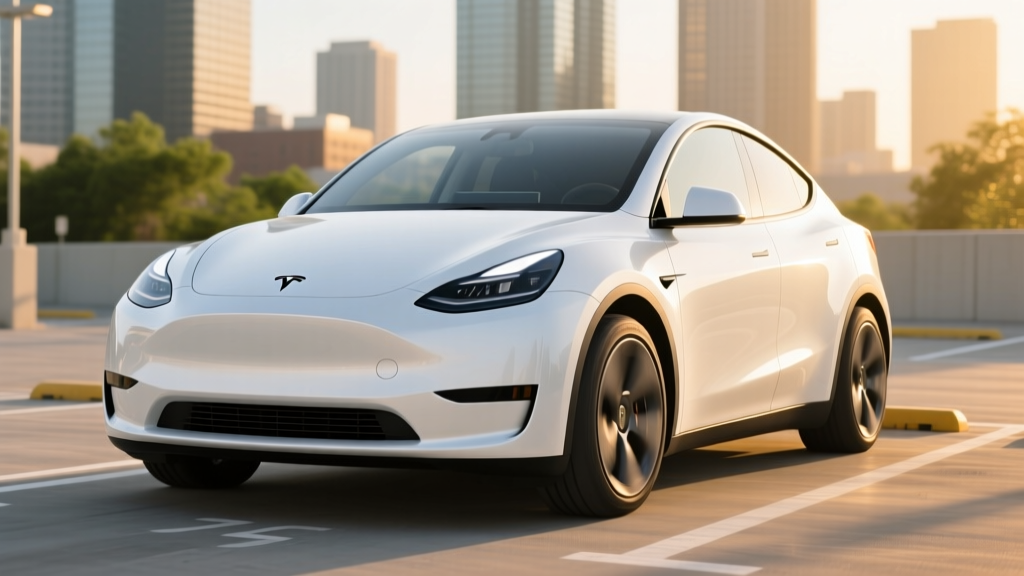
This review focuses on the highest-volume Tesla vehicles — the 2026 Model 3 Long Range AWD and the 2026 Model Y Long Range AWD — examining their specs, real-world performance, charging behavior, and total value proposition through the lens of a tech-forward buyer who cares about what's under the dashboard as much as what's under the hood.
2026 Tesla Model 3 and Model Y: Core Specifications
| Spec | Model 3 Long Range AWD | Model Y Long Range AWD |
|---|---|---|
| EPA Range | 341 miles | 320 miles |
| Battery (Usable) | ~79 kWh (NMC) | ~79 kWh (NMC) |
| Drivetrain | Dual-Motor AWD | Dual-Motor AWD |
| Horsepower | ~384 hp | ~384 hp |
| 0–60 mph | 4.2 sec | 4.8 sec |
| Peak DC Charge Rate | 250 kW | 250 kW |
| 10–80% DC Charge Time | ~27 min | ~27 min |
| Level 2 Charge Rate | 11.5 kW (~44 mi/hr) | 11.5 kW (~44 mi/hr) |
| MPGe (Combined) | 132 MPGe | 122 MPGe |
| Efficiency | 25 kWh/100 mi | 28 kWh/100 mi |
| Cargo Volume | 23 cu ft (trunk + frunk) | 76 cu ft (rear seats folded + frunk) |
| Rear Legroom | 35.3 in | 41.6 in |
| Base MSRP | $47,740 | $48,740 |
| Battery Warranty | 8 yr / 120,000 mi | 8 yr / 120,000 mi |
All 2026 Model 3 and Model Y Long Range variants use NMC (nickel manganese cobalt) battery chemistry, which prioritizes energy density over the cycle-life advantages of LFP (lithium iron phosphate). Tesla reserves LFP for the Standard Range RWD trims. The NMC pack delivers the range needed for road-trip viability, though it requires more careful long-term charging habits — Tesla recommends daily charging to 80% for NMC and 100% only before trips.
Real-World Range: EPA Sticker vs. What You'll Actually Get
Model 3 LR AWD: EPA 341 mi → Expect ~290–310 mi on highway trips (70–75 mph); ~240–260 mi in sub-30°F winter conditions.
Model Y LR AWD: EPA 320 mi → Expect ~270–290 mi highway; ~220–245 mi in freezing weather.
Cold weather reduces range 20–30% due to battery heating demands and cabin HVAC load. Tesla's heat pump (standard since 2021) mitigates this better than resistive heating, but physics still wins in deep cold.
The EPA cycle includes city driving where regenerative braking recaptures energy. On sustained highway runs at 75 mph — the scenario that matters for road trips — both vehicles consume more energy per mile than the sticker implies. In our experience, the Model 3 Long Range consistently delivers 295–310 miles on a full charge during summer highway driving in moderate temperatures (65–80°F). The Model Y, with its taller profile and greater weight, drops to roughly 275–290 miles under identical conditions.
For commuters doing mixed city/highway driving under 50 miles round-trip, the EPA numbers are more achievable. Owners who charge nightly at home will rarely notice the gap. But if your regular route includes 200+ mile stretches between chargers — think I-70 through Kansas or I-10 across West Texas — plan around the real-world figures, not the sticker.
Charging Speed: DC Fast Charging and Home Setup
Both the Model 3 and Model Y Long Range peak at 250 kW on DC fast chargers (V3 Superchargers and CCS-compatible stations with an adapter, though 2026 Teslas ship with the native NACS connector). Here's what the charge curve actually looks like:
| Charging Level | Power (kW) | Miles Added per Hour | Notes |
|---|---|---|---|
| Level 1 (120V household) | ~1.4 kW | ~3–4 mi/hr | Emergency/trickle only |
| Level 2 (240V, 48A Wall Connector) | 11.5 kW | ~44 mi/hr | Full overnight charge in ~7–8 hr |
| Level 2 (240V, 32A mobile connector) | 7.7 kW | ~30 mi/hr | Slower but works with NEMA 14-50 |
| DC Fast (V3 Supercharger) | Peak 250 kW | ~1,000 mi/hr (peak) | 10–80% in ~27 min |
| DC Fast (150 kW CCS station) | ~150 kW | ~600 mi/hr (peak) | 10–80% in ~38 min |
The critical detail that spec sheets hide: 250 kW is a peak, not a sustained rate. The Model 3 and Y hit ~250 kW briefly between roughly 15–30% state of charge (SoC) when the battery is preconditioned. From 30–60%, the rate tapers to roughly 150–180 kW. Above 80%, it drops further to under 50 kW as the battery management system protects cell health. This is why Tesla quotes 10–80% times rather than 0–100% — charging the final 20% can take as long as the first 70%.
For home charging, Tesla's Wall Connector at 48 amps on a 60-amp circuit delivers the best experience. A full charge from 10% takes about 7–8 hours, meaning you plug in at night and wake up full every morning. Installation costs vary: expect $800–$2,000 if your electrical panel has capacity, or $2,500–$5,000+ if you need a panel upgrade to 200 amps. Always get a quote from a licensed electrician before purchasing equipment.
Preconditioning matters. Navigate to a Supercharger using the car's built-in navigation, and the battery thermal management system begins warming the pack 10–20 minutes before arrival. Skip this step (by driving to a charger without setting it as a navigation destination), and your peak charge rate may drop by 30–50% in cold weather. This is not unique to Tesla, but Tesla's software integration makes it nearly foolproof — if you use the nav.
The AMD Ryzen Chip: What It Actually Changes
The AMD Ryzen Embedded processor (paired with an RDNA 2 GPU in current iterations) replaced the Intel Atom E3950 in Tesla's infotainment stack starting with vehicles produced in late 2021 and early 2022. By 2026, every new Tesla has this hardware. Here's what it means in practice:
- UI responsiveness: Map panning, menu transitions, and app launching are dramatically faster. The Intel Atom era had noticeable lag when splitting the screen between navigation and media. The AMD system handles multi-tasking without stutter.
- Gaming capability: Tesla's infotainment can now run games like Cyberpunk 2077 and Stardew Valley at playable frame rates while parked. This is a genuine differentiator for charging-stop downtime, though it's a niche feature.
- Visualization rendering: The driving visualization (showing detected vehicles, pedestrians, lane markings, and traffic lights on the instrument display) renders more smoothly with the RDNA 2 GPU. This matters for trust in Autopilot/FSD — you can see what the car sees, in real time, without dropped frames.
- Energy impact: The AMD chip draws more power than the Intel Atom it replaced — estimated at roughly 30–50 watts more under load. Over a full day of driving, this translates to roughly 0.3–0.5 kWh of additional consumption, or about 1–2 miles of range. Negligible in practice, but measurable in efficiency data.
For buyers specifically searching for information on Tesla and AMD, the practical takeaway is this: the AMD Ryzen chip makes Tesla's already-minimalist interior feel more responsive and modern, but it doesn't change range, charging speed, or driving dynamics. It's an infotainment upgrade, not a powertrain one.
Pricing, Trims, and Federal Tax Credit Eligibility
| Trim | MSRP | Est. After §30D Credit | §30D Eligible? |
|---|---|---|---|
| Model 3 Standard Range RWD | $38,990 | ~$31,490 (if eligible) | Yes — meets MSRP cap, subject to income + sourcing rules |
| Model 3 Long Range AWD | $47,740 | ~$40,240 (if eligible) | Yes — under $55,000 sedan cap |
| Model 3 Performance | $52,990 | ~$45,490 (if eligible) | Yes — under $55,000 sedan cap |
| Model Y Long Range AWD | $48,740 | ~$41,240 (if eligible) | Yes — under $80,000 SUV cap |
| Model Y Performance | $52,490 | ~$44,990 (if eligible) | Yes — under $80,000 SUV cap |
The IRS §30D clean vehicle credit offers up to $7,500 for qualifying new EVs, but eligibility depends on three moving targets that change annually:
- Buyer income caps: Modified adjusted gross income (MAGI) must not exceed $150,000 (single), $225,000 (head of household), or $300,000 (joint filing).
- MSRP caps: Sedans (Model 3) must be under $55,000; SUVs/trucks (Model Y) under $80,000. All current Model 3 and Y trims clear these limits.
- Battery sourcing requirements: A percentage of critical minerals and battery components must be sourced from the US or free-trade-agreement countries. These thresholds tighten each year. Tesla has worked to qualify its US-built vehicles, but specific eligibility can shift mid-year. Verify at fueleconomy.gov before purchasing.
As of 2026, the point-of-sale transfer option allows buyers to apply the credit as an immediate discount at delivery rather than waiting for tax filing. This effectively reduces the out-of-pocket cost at purchase, though you still must meet income requirements when you file — if your income exceeds the cap that tax year, you'll owe the credit back.
Driving, Tech, and the FSD Question
The 2026 Model 3 and Model Y continue to use Tesla's Hardware 4 (HW4) sensor suite: cameras only, no lidar or radar. This powers both basic Autopilot (included) and Full Self-Driving Supervised ($8,000 one-time or $99/month as of early 2026).
Tesla Autopilot and FSD (Supervised) are SAE Level 2 driver-assistance systems. The driver must remain fully engaged, hands on or near the wheel, eyes on the road, and ready to take over instantly. These are not self-driving systems. SAE Level 4 (true driverless operation in defined areas) is currently only offered commercially by Waymo in select cities.
On the road, the Model 3 Long Range AWD delivers composed, confident acceleration. The dual-motor setup provides torque-vectoring traction in rain and light snow, and the low center of gravity (battery pack under the floor) keeps body roll minimal through corners. The 2026 Model 3's revised suspension — updated with the "Highland" refresh — absorbs road imperfections noticeably better than pre-2024 versions, which were criticized for a firm, sometimes harsh ride.
The Model Y rides higher and offers substantially more cargo space (76 cu ft with rear seats folded vs. the Model 3's 23 cu ft trunk+frunk). For families with strollers, hockey gear, or Costco runs, the Y's hatchback form factor is the pragmatic choice. The Model 3 is the driver's car — lower, lighter, more efficient, and slightly quicker.
Tech highlights standard on both vehicles:
- 15.4-inch center touchscreen (AMD Ryzen-powered) with navigation, streaming, and gaming
- Over-the-air (OTA) software updates that add features post-purchase
- Tesla Supercharger network access — still the most reliable DC fast-charging network in North America, with over 6,500 V3/V4 stalls in the US as of 2026
- Sentry Mode dashcam recording, Dog Mode climate control, and phone-as-key
Notable drawbacks:
- No Apple CarPlay or Android Auto — Tesla's proprietary system is the only option
- Rear-seat visibility in the Model 3 is limited by the sloping roofline
- Turn signal stalks were removed in the refreshed Model 3 (signals are now on the steering wheel), which remains polarizing
- Service center availability varies by region — some owners face multi-week waits for body repair
Ownership Costs and Who Should Buy
Electricity costs for the Model 3 Long Range average about $0.04–$0.06 per mile when charging at home (at $0.13–$0.18/kWh national average). Supercharging costs more — roughly $0.08–$0.14 per mile depending on regional pricing. Compare this to a 30 MPG gas car at $3.50/gallon ($0.12/mile), and home-charged Teslas save $600–$1,000 annually on fuel for a 12,000-mile/year driver.
Insurance premiums for Teslas remain 15–30% higher than comparable non-electric sedans and SUVs, according to industry data. Factor this into your budget — a Model 3 LR owner might pay $1,800–$2,400/year depending on state, age, and driving record.
Tesla's battery warranty covers 8 years or 120,000 miles (whichever comes first) with a minimum 70% capacity retention threshold. Real-world degradation data from Tesla's own fleet reports show NMC packs retaining roughly 88–92% capacity at 100,000 miles — well within warranty limits. Full battery replacement out of warranty costs roughly $12,000–$16,000 for a Model 3/Y pack in 2026, though this is rare before 200,000+ miles.
Choose the Model 3 Long Range if: You prioritize efficiency (132 MPGe), want the lowest cost per mile, commute solo or with one passenger, and value driving dynamics over cargo space.
Choose the Model Y Long Range if: You need hatchback cargo flexibility (76 cu ft), regularly carry rear-seat passengers (41.6 in legroom), want a higher seating position, or plan family road trips where packing ease matters.
Look at competitors if: You want Apple CarPlay (Hyundai Ioniq 5, BMW i4), prefer a traditional dealer service network, or need a sub-$35,000 price point (Chevrolet Equinox EV).
Pros, Cons, and Verdict
- Best-in-class Supercharger network access
- AMD Ryzen infotainment is genuinely fast and responsive
- Industry-leading efficiency (25–28 kWh/100 mi)
- OTA updates add features over time
- Strong real-world range (290–310 mi highway, Model 3)
- Qualifies for up to $7,500 federal credit (check eligibility)
- No Apple CarPlay or Android Auto
- Insurance premiums 15–30% above average
- Service center wait times can be long in some regions
- Turn-signal-on-steering-wheel design is divisive
- FSD (Supervised) remains Level 2 — not autonomous
- NMC battery requires 80% daily charge limit discipline
The 2026 Tesla Model 3 and Model Y remain the default EV recommendation for good reason: no competitor matches the combination of range, charging infrastructure, software sophistication, and efficiency. The AMD Ryzen chip, while not a reason to buy on its own, ensures the infotainment experience keeps pace with the powertrain. For buyers who prioritize tech-forward ownership and have reliable home charging access, either vehicle delivers a compelling, data-backed value proposition — especially after the federal tax credit.
Frequently Asked Questions
What is the real-world range of the 2026 Tesla Model 3 Long Range?
The EPA rates it at 341 miles. In real-world highway driving at 70–75 mph in moderate temperatures, expect 290–310 miles. In sub-30°F winter conditions, plan for 240–260 miles. The Model Y Long Range delivers about 20 miles less in each scenario due to its larger, heavier body.
How fast does a Tesla Model 3 or Y charge at home and on the road?
At home on a Level 2 Tesla Wall Connector (11.5 kW / 48A), both vehicles add about 44 miles of range per hour, fully charging overnight in 7–8 hours. On a V3 Supercharger (250 kW peak), the 10–80% charge takes approximately 27 minutes with battery preconditioning. Charging slows significantly above 80% SoC to protect battery health.
Does the 2026 Tesla Model Y qualify for the $7,500 federal tax credit?
It can, but eligibility depends on your income (MAGI under $300,000 for joint filers), the vehicle's MSRP (under $80,000 for SUVs — all Model Y trims qualify), and battery-sourcing requirements that change annually. Verify current eligibility at fueleconomy.gov and consult a tax professional. The credit can be transferred to the dealer as a point-of-sale discount.
Is the AMD Ryzen chip in every 2026 Tesla?
Yes. Every new Model 3, Model Y, Model S, and Model X produced since early 2022 uses the AMD Ryzen Embedded processor with RDNA 2 GPU. There is no Intel-based option in 2026. The AMD chip provides faster UI response, better gaming capability, and smoother driving-visualization rendering.
Is Tesla FSD actually self-driving?
No. Tesla's Full Self-Driving (Supervised) is an SAE Level 2 driver-assistance system. It can handle many highway and city driving tasks, but the driver must remain fully attentive and ready to intervene at any moment. True self-driving (Level 4) is currently only available through robotaxi services like Waymo in select metro areas.
Tesla vs. Hyundai Ioniq 5 or BMW i4 — which should I buy?
The Ioniq 5 offers 800V ultra-fast charging (10–80% in ~18 min at 350 kW chargers) and Apple CarPlay, but its charging network access is less reliable than Tesla's Superchargers. The BMW i4 offers a more traditional luxury interior and CarPlay but at a higher price ($57,000+ base) and lower efficiency. If charging infrastructure reliability and software integration are your top priorities, Tesla still leads. If you want CarPlay and faster peak charging, the Ioniq 5 is a strong alternative.