The Tesla-Amazon Connection: Sorting Fact from Fiction
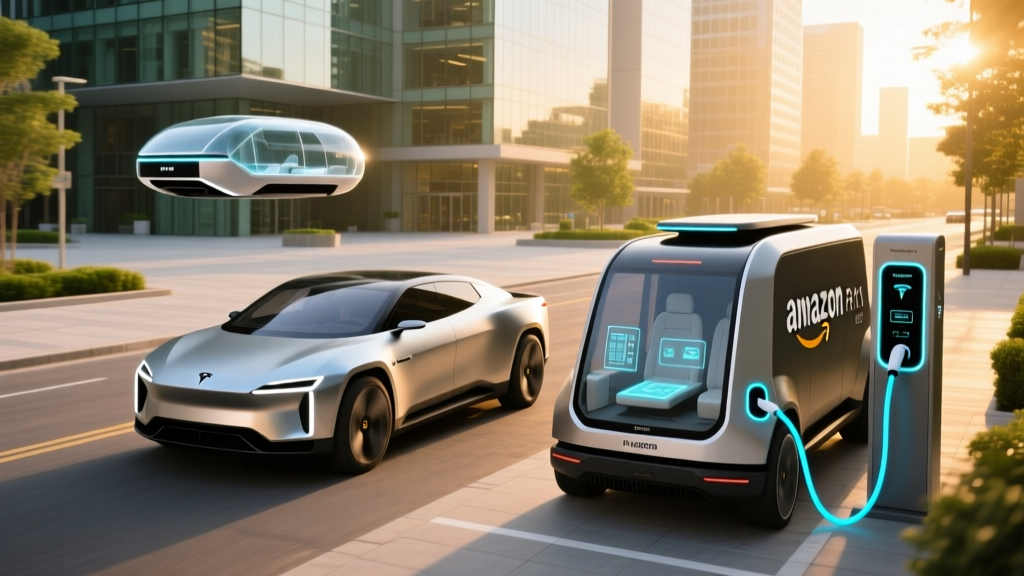
If you've searched "Tesla Amazon" recently, you've likely stumbled into a tangled web of headlines, rumors, and half-true connections. Let's clear the air immediately: Amazon does not manufacture or sell Tesla vehicles, and Tesla does not supply Amazon's delivery fleet. The real story is far more nuanced — and for EV shoppers, far more interesting.
The Tesla-Amazon intersection spans several distinct threads: Amazon's massive bet on Rivian (Tesla's most direct competitor in the electric truck/SUV space), Amazon's ownership of Zoox (a Level 4 robotaxi company), Tesla's reliance on AWS cloud infrastructure for Autopilot and FSD training, and the persistent speculation about whether Tesla vehicles will ever be sold directly on Amazon's marketplace. This guide untangles each thread and tells you what actually matters if you're shopping for an EV in 2026.
Amazon's Real EV Bet: Rivian, Not Tesla
Amazon's primary electric vehicle investment is Rivian, in which it holds a significant stake and for which it placed an order of up to 100,000 electric delivery vans. The Rivian EDV (Electric Delivery Van) has been rolling onto American roads since 2023, and by 2026, thousands are in active last-mile delivery service across major metro areas.
For consumer EV buyers, the Rivian connection matters because Amazon's financial backing helped Rivian survive its capital-intensive production ramp — the same company now sells the Rivian R1S (SUV) and Rivian R1T (pickup) directly to consumers. These are legitimate Tesla Model X and Cybertruck competitors, and Amazon's investment is a key reason they exist at scale.
Tesla Model Y: The Vehicle Amazon Employees (and Everyone Else) Actually Buy
While Amazon as a corporation doesn't partner with Tesla on vehicles, the 2026 Tesla Model Y remains the best-selling EV in America and a frequent choice among tech-sector employees, including Amazon's workforce. If your "Tesla Amazon" search was really about whether you can buy a Tesla through Amazon — you can't. Tesla sells exclusively through its own website and galleries. But here's a full profile of the vehicle most closely associated with the tech-worker demographic that overlaps with Amazon's employee base.
| Spec | Value |
|---|---|
| EPA Range | 320 miles |
| Battery Capacity | ~78 kWh usable (NMC chemistry) |
| Drivetrain | Dual-Motor AWD |
| Horsepower | 384 hp (combined) |
| 0–60 mph | 4.8 seconds |
| Efficiency | 122 MPGe / 28 kWh/100 mi |
| Max DC Fast Charge | 250 kW (peak) |
| 10–80% DC Charge | ~25 minutes |
| Level 2 Home Charge | 11.5 kW (~44 mi/hr) |
| Cargo Volume | 30.2 cu ft (rear seats up) / 72.1 cu ft (folded) |
| Base MSRP | $44,990 (Long Range AWD) |
| Battery Warranty | 8 years / 120,000 miles |
Source: EPA fueleconomy.gov, Tesla.com
Charging the Model Y: Home, Supercharger, and NACS Advantage
One of Tesla's strongest ownership advantages remains its charging ecosystem. The Model Y uses the NACS (North American Charging Standard) connector natively — the same plug now adopted by Ford, GM, Rivian, Hyundai, and most major automakers for 2025+ models.
| Charging Level | Power (kW) | Miles of Range Added per Hour | Typical Use Case |
|---|---|---|---|
| Level 1 (120V household) | ~1.4 kW | ~4–5 mi/hr | Emergency / overnight trickle |
| Level 2 (240V home, Wall Connector) | 11.5 kW | ~44 mi/hr | Daily home charging (~8 hrs for full battery) |
| DC Fast (V3 Supercharger) | 250 kW peak | ~1,000 mi/hr (peak) | Road trips; 10–80% in ~25 min |
| DC Fast (V4 Supercharger) | Up to 325 kW (vehicle-limited) | Similar; Model Y caps at ~250 kW | Future-proofed stations |
Charging curve reality: The Model Y peaks at 250 kW only between roughly 10–30% state of charge. Above 50%, the rate tapers to ~100 kW, and above 80%, it drops below 50 kW. This is why Tesla's quoted "10–80% in 25 minutes" is the meaningful figure — charging from 80–100% can add another 20+ minutes. For road trips, plan to charge from 10–80% and skip the top-off unless you need the buffer for your next leg.
Home Level 2 installation with a Tesla Wall Connector typically costs $800–$2,000 total (unit + electrician + permit), depending on whether your electrical panel needs an upgrade to support a 60-amp circuit. Most homes with a 200-amp panel can accommodate this without a panel upgrade.
Pricing, Trims, and Federal Tax Credit Eligibility
| Trim | MSRP | Est. After §30D Credit* |
|---|---|---|
| Long Range AWD | $44,990 | ~$37,490 |
| Performance | $48,990 | ~$41,490 |
*Federal tax credit eligibility is not automatic. Under current IRS §30D rules, you must meet ALL of the following:
- MSRP cap: SUVs/vans must be ≤ $80,000 (Model Y qualifies)
- Buyer income cap: Modified AGI ≤ $150,000 (single) / $300,000 (joint)
- Battery sourcing: Critical minerals and battery components must meet phased-in percentage thresholds from US/FTA countries — Tesla's US-built batteries generally comply, but verify at purchase
- Point-of-sale transfer: As of 2024+, you can transfer the credit to the dealer at purchase for an immediate price reduction, rather than waiting for tax filing
The Model Y's pricing puts it under the $80,000 SUV cap comfortably. Most dual-income households under the $300,000 AGI threshold will qualify. However, battery-sourcing rules tighten annually — always confirm current-year compliance on the IRS website or with your tax professional before assuming the full $7,500.
Autopilot, FSD, and the Amazon/Zoox Autonomous Contrast
This is where the Tesla-Amazon comparison gets genuinely illuminating. Tesla's Full Self-Driving (Supervised) and Amazon-owned Zoox represent fundamentally different approaches to vehicle automation — and understanding the gap matters for any EV buyer evaluating "smart" features.
Tesla FSD (Supervised) costs $8,000 as a one-time purchase or $99/month as of 2026. It handles highway lane changes, city street navigation, stop signs, and traffic lights — but requires constant driver supervision and can make errors requiring immediate intervention. It is an impressive Level 2 system, not a Level 3 or Level 4 autonomous vehicle.
Amazon's Zoox, by contrast, is a purpose-built, bidirectional robotaxi with no steering wheel. It operates commercially in limited zones in Las Vegas and Foster City, CA as of 2026, with plans to expand. You cannot buy a Zoox — it's a ride-hail service competing with Waymo. Amazon acquired Zoox in 2020 for ~$1.2 billion and has invested heavily since.
For a Tesla Model Y buyer, this means: buy FSD if you value advanced highway assistance and are comfortable supervising an imperfect system. Do not buy it expecting to nap, text, or disengage. The technology is genuinely useful for reducing fatigue on long commutes, but it is not autonomy.
Model Y Pros, Cons, and Competition
Pros
- Best-in-class Supercharger network (20,000+ stalls in North America)
- Class-leading efficiency (122 MPGe)
- Strong real-world range (~260–285 mi highway)
- Over-the-air updates add features post-purchase
- Excellent cargo space (72.1 cu ft with seats folded)
- NACS connector now the industry standard
- Low maintenance costs (no oil, minimal brake wear via regen)
Cons
- No physical instrument cluster — all info on center screen
- Rear visibility compromised by sloping roofline
- Insurance premiums 15–30% higher than comparable gas SUVs
- FSD ($8,000) is expensive and still Level 2 only
- Ride quality firm on rough pavement (sport-tuned suspension)
- Panel gaps and interior finish inconsistent vs. luxury rivals
- No Apple CarPlay or Android Auto
Key Competitors at a Glance
| Vehicle | EPA Range | Max DC Charge | Base MSRP | Key Advantage vs. Model Y |
|---|---|---|---|---|
| Hyundai Ioniq 5 (Long Range AWD) | 290 mi | 350 kW (800V) | $46,500 | Faster peak charging; physical buttons |
| Ford Mustang Mach-E (Extended Range) | 312 mi | 150 kW | $43,995 | Traditional SUV feel; Apple CarPlay |
| Rivian R1S (Dual-Motor) | 330 mi | 200 kW | $74,900 | 3-row seating; genuine off-road |
Who Should Buy the Tesla Model Y — and Who Shouldn't?
- You want access to the largest, most reliable DC fast-charging network in North America
- You prioritize efficiency and low cost-per-mile above luxury interior finishes
- Your daily commute is under 100 miles and you can charge at home overnight
- You value OTA software updates that improve the vehicle over time
- You want strong cargo capacity in a compact footprint (city-friendly dimensions)
- You need three rows of seating (Rivian R1S, Kia EV9)
- You want a traditional instrument cluster and physical climate buttons
- You require Apple CarPlay/Android Auto integration
- You tow heavy loads regularly (Model Y is rated for 3,500 lbs — adequate for light trailers, not boats)
- You live in a region with sparse Supercharger coverage and no home charging access
Frequently Asked Questions
Can I buy a Tesla on Amazon?
No. Tesla sells vehicles exclusively through its own website (tesla.com) and company-owned galleries. Amazon does not sell new or used Tesla vehicles. You may find Tesla accessories, chargers, and merchandise on Amazon, but not the cars themselves.
Does Amazon use Tesla vehicles in its delivery fleet?
No. Amazon's electric delivery fleet is built by Rivian (the EDV van). Amazon also uses traditional gas-powered vehicles from Ram, Ford, and Mercedes-Benz for routes not yet electrified. Tesla's Semi truck is in limited pilot programs with other logistics companies (PepsiCo, for example), but not Amazon.
What is Amazon's connection to autonomous driving?
Amazon owns Zoox, a Level 4 robotaxi company operating driverless ride-hail service in limited zones in Las Vegas and Foster City, California as of 2026. Zoox vehicles have no steering wheels and are not available for purchase. This is separate from Tesla's Level 2 FSD system.
Does the Tesla Model Y qualify for the $7,500 federal tax credit?
The Model Y generally qualifies under current IRS §30D rules, as it is assembled in the US, falls under the $80,000 SUV MSRP cap, and meets battery-sourcing requirements. However, eligibility depends on your personal income (≤$150K single / ≤$300K joint), and sourcing rules tighten annually. Verify on IRS.gov before purchasing.
How does Tesla's AWS connection affect me as a buyer?
Tesla uses Amazon Web Services (AWS) cloud infrastructure for Autopilot/FSD neural network training and data processing. This is a backend infrastructure relationship — it doesn't affect your purchase, vehicle features, or data privacy in any direct way. Your vehicle's driving data is governed by Tesla's privacy policy, not Amazon's.
Is the Rivian R1S (Amazon-backed) a better choice than the Model Y?
They serve different buyers. The R1S starts at ~$74,900 (vs. Model Y at ~$44,990), offers three rows, genuine off-road capability, and a 330-mile range. The Model Y is far more affordable, more efficient, and has access to a denser charging network. If budget is primary, Model Y wins. If you need 7 seats or off-road capability, R1S is the answer.