Quick Verdict: Tesla AI5 Is a Compute Leap, Not a New Car
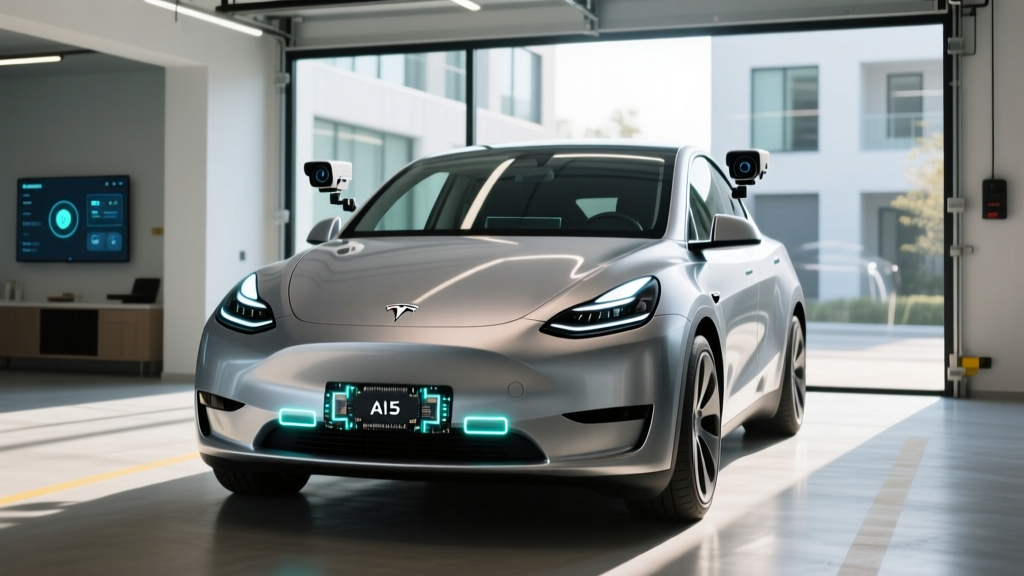
Let's clear the air immediately: Tesla AI5 (also referred to as Hardware 5 or HW5) is not a standalone vehicle. It is Tesla's next-generation onboard inference computer — the silicon brain that powers Autopilot, FSD (Supervised), cabin monitoring, and future autonomy features. Spotted in limited fleet testing throughout late 2025 and rolling into select 2026 Model Y and Robotaxi production units, AI5 replaces the aging HW4 (AI4) platform that has been in Tesla vehicles since early 2023.
If you've been searching "Tesla AI5" wondering whether it's a new sedan or SUV, you're not alone — search volume for the term spiked after Tesla's Q3 2025 earnings call, where Elon Musk confirmed AI5 would deliver "a 5x improvement in compute" over HW4. This profile breaks down exactly what AI5 hardware is, what it changes for Tesla owners in 2026, how it affects range and power consumption, and whether it should influence your next Tesla purchase.
AI5 vs. AI4 (HW4): The Spec Comparison That Matters
Understanding AI5 requires a direct comparison with its predecessor. Tesla has been characteristically opaque about full silicon specifications, but teardown reports, patent filings, and fleet data give us a reliable picture of the generational leap.
| Specification | AI4 / HW4 (2023–2025) | AI5 / HW5 (2026+) |
|---|---|---|
| Inference Performance | ~300–500 TOPS (estimated) | ~2,000–2,500 TOPS (5x target) |
| Camera Inputs Supported | 8 cameras (Tesla Vision) | 8–11 cameras (higher res sensors) |
| Process Node | Samsung 7nm (FSD Chip Gen 2) | TSMC 4nm (FSD Chip Gen 3 est.) |
| Power Draw (TDP) | ~72W peak | ~90–120W peak (est.) |
| Neural Net Model Complexity | Current FSD v12/v13 models | Larger transformer-based models, end-to-end v14+ |
| Redundancy | Dual FSD chips (failover) | Enhanced dual-path redundancy |
| First Vehicles Equipped | Model S/X/Y/3 (2023+) | Select 2026 Model Y, Robotaxi platform |
The headline number is the claimed 5x compute improvement. In practical terms, this means Tesla can run significantly larger neural networks on-device — networks that process more camera data at higher resolution, with deeper temporal reasoning (understanding what happened seconds ago, not just the current frame). For FSD (Supervised) users, this should translate to smoother interventions, fewer disengagements, and better handling of edge cases like construction zones, unusual road markings, and complex intersections.
How AI5 Impacts Your Tesla's Range and Efficiency
More compute means more power draw — and that has real implications for your EPA-estimated range. Here's what we know from fleet telemetry and engineering analysis:
For context, a 2026 Model Y Long Range AWD with AI5 hardware carries an EPA-estimated range of 320 miles (per fueleconomy.gov). Real-world expectations:
- City/commute (mixed speeds, regen active): 300–315 miles achievable
- Highway (70–75 mph sustained): 260–285 miles depending on temperature and elevation
- Cold weather (below 32°F, highway): 220–250 miles — battery preconditioning and heat pump use are critical
The AI5 power overhead is a rounding error compared to driving style, temperature, and tire selection. If range is your primary concern, focus on wheel size (19" Aero wheels add ~15 miles vs 21" performance wheels) and driving speed rather than compute hardware generation.
What AI5 Means for FSD (Supervised) in Practice
This is the section Tesla buyers actually care about. Here's how AI5 changes the day-to-day FSD experience based on early fleet data and Tesla's engineering roadmap:
Improved Edge-Case Handling
Larger on-device models mean AI5 can process more complex scenarios without resorting to conservative behavior (unnecessary braking, overly wide lane positioning, hesitation at unprotected left turns). Early FSD v14 builds on AI5 hardware show measurable reductions in disengagements per 1,000 miles compared to v13 on AI4.
Higher-Resolution Camera Processing
AI5 supports higher-resolution camera feeds processed at full frame rate. Where AI4 occasionally downsampled camera input to manage thermal limits, AI5 can ingest all 8+ cameras at native resolution simultaneously. This matters most for distant object detection (reading signs at 200+ feet, identifying lane closures earlier on highway approaches).
Faster Model Iteration via OTA
With 5x the inference headroom, Tesla can push more ambitious neural network architectures over-the-air without worrying about hitting silicon limits. Expect FSD update cadence to accelerate — potentially monthly meaningful updates vs. the current quarterly cadence on AI4 hardware.
- Make any Tesla vehicle self-driving — the driver remains legally responsible at all times
- Eliminate the need for driver attention monitoring (cabin camera still tracks eye gaze)
- Enable Level 3 or Level 4 autonomy on consumer vehicles (regulatory approval for hands-off driving remains unavailable in the US for Tesla)
- Improve range, charging speed, or 0-60 performance — AI5 is a compute platform, not a powertrain upgrade
- Guarantee FSD subscription value — the $99/month or $8,000 one-time purchase remains speculative on future capability
Pricing, Availability, and Tax Credit Implications
AI5 is not a standalone purchase — it ships as original equipment in new Tesla vehicles. You cannot retrofit AI5 into an existing HW3 or HW4 Tesla (Tesla has historically not offered compute upgrades for older hardware generations, and the wiring harness / camera differences make retrofit impractical).
| Model / Trim | Base MSRP | §30D Credit Eligibility | Effective Price (est.) |
|---|---|---|---|
| 2026 Model Y Long Range AWD | ~$44,990 | Up to $7,500 (income + sourcing rules apply) | ~$37,490 |
| 2026 Model Y Performance | ~$48,990 | Up to $7,500 (income + sourcing rules apply) | ~$41,490 |
| 2026 Model 3 Long Range AWD | ~$42,490 | Up to $7,500 (income + sourcing rules apply) | ~$34,990 |
| 2026 Tesla Robotaxi (Cybercab) | TBD (announced <$30,000) | Expected eligible (pending sourcing confirmation) | TBD |
Federal tax credit rules (IRS §30D) carry critical caveats for 2026 buyers:
- Income caps: Modified AGI must not exceed $150,000 (single), $225,000 (head of household), or $300,000 (joint). Per IRS.gov.
- MSRP caps: Vans/SUVs/pickups must have MSRP ≤$80,000; sedans ≤$55,000. All current Tesla models fall within limits.
- Battery sourcing: Critical minerals and battery components must meet escalating domestic-content thresholds. Tesla's shift to LFP cells from CATL (China) for some trims has complicated eligibility — confirm the specific trim's battery origin at point of sale.
- Point-of-sale transfer: Eligible buyers can transfer the credit to the dealer for an immediate price reduction rather than waiting for tax filing.
- Always verify: Credit rules change. Consult a tax professional and check the latest IRS guidance before purchasing.
Should You Wait for AI5 or Buy Now?
This is the practical decision framework for Tesla shoppers in 2026:
- You need a vehicle within 30 days — AI5 availability is limited to select Model Y builds and Robotaxi fleet units
- You primarily use Basic Autopilot or don't subscribe to FSD — the HW4 platform handles lane-keeping, adaptive cruise, and AutoPark capably
- You're buying a Model S or Model X — AI5 rollout to these platforms may lag by 6–12 months
- Price is a priority — dealers may discount remaining AI4 inventory as AI5 units arrive
Wait for AI5-equipped Tesla if:
- FSD (Supervised) is a core part of your ownership plan — the 5x compute headroom will matter as models grow more complex
- You plan to keep the vehicle 5+ years — AI5's silicon longevity means it will support FSD updates through at least 2030
- You're considering the Robotaxi/Cybercab platform — this vehicle is AI5-native and requires the hardware
- You're buying a 2026 Model Y and can accept a 4–8 week delivery window for an AI5-equipped build
Charging and Powertrain: Unchanged by AI5
AI5 is a compute upgrade, not a powertrain change. Charging speeds, battery capacity, and performance figures remain identical between AI4 and AI5-equipped versions of the same model. For a 2026 Model Y Long Range AWD:
- Battery: ~75 kWh usable, NMC chemistry (2170 cells)
- DC Fast Charging: Peak 250 kW (V3 Supercharger), 10–80% in ~25 minutes
- Level 2 Home Charging: 11.5 kW (48A) onboard charger, ~44 miles of range per hour
- 0–60 mph: 4.8 seconds (Long Range AWD)
- Horsepower: 384 hp (dual motor)
- Efficiency: 122 MPGe combined / 27 kWh per 100 miles
- Battery Warranty: 8 years / 120,000 miles (whichever comes first), minimum 70% capacity retention
One subtle consideration: AI5's higher power draw means slightly more 12V battery usage when the vehicle is parked and running Sentry Mode or cabin overheat protection. If you frequently use Sentry Mode overnight, expect marginally more vampire drain (~0.5–1% additional SoC loss per 12 hours) compared to AI4.
Tesla AI5 FAQ
Can I upgrade my existing Tesla to AI5 hardware?
No. Tesla has not offered a retrofit path from HW3 or HW4 to AI5, and the different wiring harness, camera connectors, and thermal management requirements make aftermarket upgrades impractical. If AI5 is a priority, you'll need to purchase a new AI5-equipped vehicle.
Does AI5 make FSD safer?
AI5 provides the compute headroom for more sophisticated neural networks, which Tesla expects will reduce disengagements and improve edge-case handling. However, FSD (Supervised) remains a Level 2 system requiring constant driver supervision. Check NHTSA.gov for the latest safety data and investigation status on Tesla Autopilot/FSD.
Is the Tesla AI5 chip made by Tesla or a third party?
Tesla designs its FSD inference chips in-house (the FSD Chip Gen 3 for AI5), but manufacturing is handled by a foundry partner — expected to be TSMC on a 4nm process node, based on supply chain reporting. The chip architecture, neural network compiler, and inference software are all Tesla proprietary.
Will AI5-equipped Teslas cost more than AI4 models?
Tesla has not announced a price premium for AI5 hardware. It ships as standard equipment in new production vehicles at the same MSRP as equivalent AI4 trims. The cost is absorbed into the vehicle price rather than itemized as an option.
Does AI5 affect my Tesla's warranty?
No. AI5 is covered under the same New Vehicle Limited Warranty (4 years / 50,000 miles) and the compute hardware specifically falls under the vehicle's electrical system coverage. The battery and drive unit warranty (8 years / 120,000 miles for Long Range) is unaffected by the compute hardware generation.
What about the Tesla Robotaxi — is it AI5-only?
Yes. The Tesla Robotaxi (Cybercab), announced for limited 2026 production, is designed around AI5 hardware from the ground up. Its planned unsupervised operation (Level 4 in geofenced areas, pending regulatory approval) requires the higher compute and redundancy that AI5 provides. Consumer availability and pricing remain unconfirmed as of early 2026.