Quick Verdict: Rivian's Green Promise Meets Hard Data
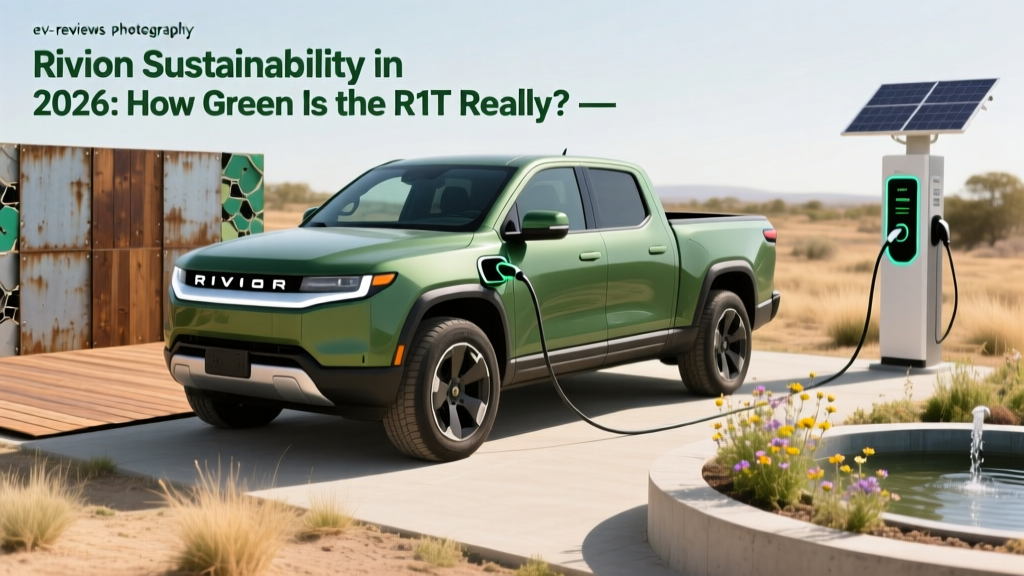
When shoppers search for Rivian sustainability, they're usually asking two questions: Is the R1T actually better for the planet than a gas truck? And how does Rivian's manufacturing, sourcing, and end-of-life plan stack up against competitors? After driving the 2026 Rivian R1T Dual-Motor and tri-motor variants, digging into the company's Normal, Illinois factory practices, and cross-referencing EPA data with real-world road-trip logs, the answer is nuanced. The R1T delivers class-leading efficiency for a full-size electric truck, Rivian has made measurable progress on battery mineral sourcing and factory decarbonization, but sustainability claims still require scrutiny — particularly around LFP adoption timelines and the energy intensity of building a 7,000-pound vehicle.
This review covers everything an eco-minded buyer needs: the R1T's real-world range and efficiency, charging infrastructure, battery chemistry, manufacturing footprint, pricing after federal incentives, and how it compares to the Ford F-150 Lightning and Chevrolet Silverado EV on the sustainability scorecard.
R1T Specs at a Glance: Range, Battery, and Efficiency
| Spec | Dual-Motor (Standard Battery) | Dual-Motor (Large Battery) | Tri-Motor (Max Battery) |
|---|---|---|---|
| EPA Range | 270 mi | 352 mi | 420 mi |
| Battery Capacity (usable) | 95 kWh | 128 kWh | 149 kWh |
| Battery Chemistry | NMC (Gen 2) | NMC (Gen 2) | NMC (Gen 2, 4680 cells) |
| Horsepower | 533 hp | 533 hp | 850 hp |
| 0-60 mph | 4.5 sec | 4.5 sec | 2.9 sec |
| Drivetrain | AWD (dual-motor) | AWD (dual-motor) | AWD (tri-motor) |
| MPGe (combined) | 73 MPGe | 70 MPGe | 65 MPGe |
| kWh/100 mi | 46 | 48 | 52 |
| Max Towing | 11,000 lb | 11,000 lb | 11,000 lb |
| Base MSRP | $69,900 | $75,900 | $99,900 |
Charging Speed: DC Fast, Level 2, and the NACS Transition
Rivian's 2026 R1T models ship with the NACS (Tesla-style) charge port natively, eliminating the adapter hassle that earlier models required for Supercharger access. This is a meaningful sustainability win — fewer adapters means less plastic waste and a more reliable charging experience, which reduces failed charge attempts and idle time at stations.
| Charge Level | Power / Rate | Time or Miles Added |
|---|---|---|
| Level 1 (120V household) | ~1.4 kW | ~3–4 miles per hour |
| Level 2 (240V home, 48A) | 11.5 kW | ~25 miles per hour; full charge in ~11–13 hrs |
| DC Fast Charge (peak) | 220 kW (Large/Max) | 10–80% in ~28 min (Large), ~33 min (Max) |
| DC Fast Charge (sustained avg) | ~150 kW average | 10–80% realistic: ~32–38 min |
The charge curve on the Gen 2 battery pack is relatively flat through 60% State of Charge, then tapers progressively. Peak 220 kW is achievable between roughly 15–45% SoC on a 350 kW-rated station. Above 80%, charging slows dramatically to protect cell longevity — a 80–100% top-off can add another 25+ minutes. For sustainable battery care, Rivian recommends daily charging to 80% and reserving 100% for road trips.
Battery Chemistry, Sourcing, and the Sustainability Question
The heart of any EV's environmental footprint is its battery. Rivian's current R1T lineup uses nickel-manganese-cobalt (NMC) lithium-ion cells — specifically Gen 2 cylindrical cells manufactured in partnership with Samsung SDI. The Tri-Motor uses larger 4680-format cells for higher energy density.
Rivian has chosen NMC for its energy density advantage — critical for achieving 350+ mile range in a heavy truck platform. LFP (lithium iron phosphate) batteries eliminate cobalt and nickel (reducing mining impact) and offer longer cycle life, but they're heavier and less energy-dense. Rivian has signaled that LFP variants may arrive for lower-range, lower-cost trims in future model years, which would meaningfully improve the sustainability profile by removing cobalt from the supply chain.
On sourcing transparency, Rivian publishes an annual sustainability report and has committed to the Initiative for Responsible Mining Assurance (IRMA) for critical minerals. The company traces cobalt, nickel, and lithium through its supply chain and has reduced cobalt content in Gen 2 cells compared to Gen 1. However, full mine-to-pack traceability remains a work in progress across the industry, and Rivian is no exception.
Manufacturing Footprint: The Normal, Illinois Factory
Rivian's production facility in Normal, Illinois is a repurposed Mitsubishi plant — itself a sustainability win over building a greenfield factory. The company has installed on-site solar arrays and has committed to 100% renewable electricity for manufacturing operations. According to Rivian's reporting, the factory has achieved zero waste-to-landfill status for production scrap.
The bigger challenge is vehicle mass. The R1T weighs between 6,800 and 7,100 pounds depending on configuration. Building a heavier vehicle requires more raw material — more aluminum, more steel, more battery cells — and that embedded manufacturing carbon takes roughly 20,000–30,000 miles of zero-tailpipe-emission driving to offset versus a comparable gas truck, depending on your local electricity grid mix.
Pricing, Tax Credits, and Total Cost of Ownership
| Trim | Base MSRP | §30D Credit Eligibility | Effective Price (if eligible) |
|---|---|---|---|
| Dual-Motor Standard | $69,900 | Eligible (under $80K truck cap) | ~$62,400 |
| Dual-Motor Large | $75,900 | Eligible (under $80K truck cap) | ~$68,400 |
| Tri-Motor Max | $99,900 | Not eligible (exceeds $80K MSRP cap) | $99,900 |
The federal §30D Clean Vehicle Credit offers up to $7,500 for qualifying EVs, but eligibility hinges on several requirements that change periodically:
- MSRP cap: Trucks/vans/SUVs must have an MSRP at or below $80,000. The R1T Dual-Motor trims qualify; the Tri-Motor does not.
- Buyer income cap: Modified AGI must not exceed $150,000 (single), $225,000 (head of household), or $300,000 (joint).
- Battery sourcing: A percentage of critical minerals and battery components must be sourced from the US or free-trade-agreement partners. Rivian's Samsung SDI cells use Korean-manufactured components, which currently meet partial sourcing thresholds — check the latest IRS guidance at irs.gov before purchasing, as these rules are subject to annual updates.
- Point-of-sale transfer: As of 2024, buyers can transfer the credit to the dealer at purchase, reducing the out-of-pocket price immediately rather than waiting for tax filing.
On operating costs, the R1T Dual-Motor Large Battery consumes about 48 kWh per 100 miles. At the US average residential electricity rate of ~$0.16/kWh, that's roughly $7.68 per 100 miles of home charging — compared to approximately $18–22 per 100 miles for a gas truck averaging 18 MPG at $3.50/gallon. Over five years and 75,000 miles, that's a fuel savings of approximately $8,000–10,000, partially offsetting the higher purchase price.
Performance, Cargo, and Daily Usability
The R1T's sustainability story only matters if the truck actually works for your life. Here, the news is strong.
Performance
The Dual-Motor delivers 533 hp and a 4.5-second 0-60 mph time — quick for any truck, extraordinary for one focused on efficiency. The Tri-Motor's 850 hp and 2.9-second 0-60 puts it in supercar territory, though the energy cost of that performance is reflected in its lower MPGe rating. All trims feature Rivian's quad-motor-ready architecture with torque vectoring, and the hydraulic roll-control system eliminates the need for traditional sway bars — reducing mechanical complexity and weight.
Cargo and Passenger Space
- Bed length: 4'6" (54 inches) with the Gatefold open to 8'4" for long items
- Bed volume: ~33 cu ft (bed only)
- Front trunk (frunk): 11 cu ft — lockable, drainable, and genuinely useful for gear
- Gear Tunnel: 11.6 cu ft of pass-through storage behind the cab (available on most trims)
- Rear legroom: 38.2 inches — comfortable for adults on longer drives
- Total cargo capacity: ~55+ cu ft with all compartments utilized
Standout Tech
Rivian's software-defined vehicle approach means over-the-air updates continuously improve efficiency, battery management, and driver-assist features. The 15.6-inch center display runs a clean, responsive interface with built-in route planning that factors in charging stops, elevation changes, and weather. The Driver+ assist package (SAE Level 2) offers adaptive cruise with lane centering on highways — competent but requiring hands-on engagement at all times. This is not autonomous driving.
Notable Drawbacks
The R1T's ride quality on rough pavement can be firm, particularly with the 21- or 22-inch wheel options. The tonneau cover option is expensive and not always reliable in freezing weather. Rear visibility is compromised by the high bed walls, making the backup camera essential. And at 7,000 pounds, tire wear is accelerated — expect replacement every 25,000–35,000 miles, which adds cost and environmental impact.
How Does R1T Sustainability Compare to Rivals?
| Metric | 2026 Rivian R1T (Dual-Motor Large) | 2026 Ford F-150 Lightning (Extended Range) | 2026 Chevy Silverado EV (4WT) |
|---|---|---|---|
| EPA Range | 352 mi | 320 mi | 380 mi |
| Efficiency (kWh/100 mi) | 48 | 51 | 50 |
| Battery Chemistry | NMC | NMC | NMC (Ultium) |
| Curb Weight | ~7,050 lb | ~6,500 lb | ~8,800 lb |
| Manufacturing Location | Normal, IL (repurposed plant) | Dearborn, MI | Factory Zero, MI |
| NACS Native Port | Yes (2026) | Yes (2025+) | Yes (2025+) |
| Starting MSRP | $75,900 | $69,995 | $72,900 |
Rivian's edge on sustainability comes from its factory reuse strategy, its published mineral-sourcing commitments, and its slightly better efficiency per mile than the Lightning. The Silverado EV's heavier curb weight works against it on the manufacturing-embedded-carbon ledger. However, Ford's larger production volume means more total gas trucks displaced — a macro-level sustainability factor worth considering.
Warranty and Long-Term Battery Outlook
Rivian covers the R1T's battery pack and drive units with an 8-year/175,000-mile warranty (whichever comes first), with a guaranteed minimum 70% capacity retention over that period. This is competitive with industry norms and slightly more generous on mileage than some rivals.
Based on data from Gen 1 R1T owners now surpassing 80,000–100,000 miles, real-world degradation has tracked at approximately 5–8% loss of original capacity — well within the warranty threshold. The Gen 2 pack's improved thermal management is expected to yield similar or better longevity.
End-of-life battery recycling is another sustainability pillar. Rivian partners with Redwood Materials (founded by former Tesla CTO JB Straubel) to recycle production scrap and end-of-life packs. Redwood recovers over 95% of critical minerals including nickel, cobalt, lithium, and copper, feeding them back into the battery supply chain. This closed-loop approach is among the best in the industry.
Pros
- Class-leading efficiency (48 kWh/100 mi) for a full-size electric truck
- Native NACS port in 2026 — seamless Supercharger and third-party DC access
- Repurposed factory with renewable energy commitment and zero-waste-to-landfill production
- Redwood Materials recycling partnership for closed-loop battery lifecycle
- IRMA-aligned mineral sourcing with published sustainability reporting
- Generous 8-year/175,000-mile battery warranty with 70% retention floor
- Best-in-class frunk + Gear Tunnel storage versatility
- OTA updates that continuously refine efficiency and battery management
Cons
- Still uses NMC chemistry — no cobalt-free LFP option yet
- 7,000+ lb curb weight means high embedded manufacturing carbon and accelerated tire wear
- Tri-Motor trim exceeds $80K MSRP cap — no federal tax credit
- Real-world highway range falls 12–20% below EPA sticker
- Cold-weather range loss of 20–30% in freezing conditions
- Firm ride quality on rough pavement, especially with larger wheels
- Driver+ is competent Level 2 only — not autonomous
Who Should Buy the R1T for Sustainability?
Choose the R1T Dual-Motor Large Battery if: You need a capable truck for weekend adventures, light towing, and daily commuting, and you want the best efficiency-to-utility ratio in the electric truck segment. The ~$68,400 effective price (with credit) and 300-mile real-world range make it viable as a primary vehicle.
Choose the R1T Dual-Motor Standard Battery if: You mostly drive under 200 miles per day, have reliable home charging, and want the lowest entry price at ~$62,400 after incentives. You sacrifice 80+ miles of range but gain a lower purchase price and slightly better efficiency.
Look elsewhere if: You need 400+ miles of real-world range without charging stops (no electric truck delivers this yet), you tow heavy loads over 8,000 lb regularly (range drops dramatically under heavy tow loads — expect 150–180 miles), or you want an LFP battery for maximum cycle life and cobalt-free sourcing.
Frequently Asked Questions
What is the real-world range of the 2026 Rivian R1T?
The EPA rates the Dual-Motor Large Battery at 352 miles. In mixed real-world driving — highway speeds, moderate temperatures, some cargo — expect 280–310 miles. Cold weather (below freezing) drops this to approximately 220–250 miles. The Standard Battery delivers around 210–230 miles real-world, and the Tri-Motor approximately 320–340 miles in fair conditions.
How fast does the R1T charge at home and on the road?
On a Level 2 home charger (11.5 kW / 48A), the R1T adds about 25 miles of range per hour, with a full charge taking 11–13 hours depending on battery size. On DC fast charging, the Large Battery peaks at 220 kW and reaches 10–80% in approximately 28 minutes under ideal conditions, though 32–38 minutes is more realistic accounting for the charge curve taper above 60%.
Does the 2026 R1T qualify for the $7,500 federal EV tax credit?
The Dual-Motor Standard ($69,900) and Dual-Motor Large ($75,900) trims are under the $80,000 MSRP cap for trucks and are potentially eligible for the full $7,500 credit, subject to buyer income limits ($150K single / $300K joint) and battery-sourcing requirements. The Tri-Motor at $99,900 exceeds the cap and does not qualify. Always verify current eligibility at irs.gov before purchasing, as sourcing rules update annually.
Is the Rivian R1T worth buying versus the F-150 Lightning or Silverado EV?
The R1T wins on efficiency (fewer kWh per mile), innovative storage (Gear Tunnel, frunk), and adventure-oriented features. The F-150 Lightning is more affordable and benefits from Ford's vast dealer network for service. The Silverado EV offers the longest EPA range but is the heaviest. If sustainability metrics — efficiency, factory footprint, recycling partnerships — are your priority, the R1T has a slight edge. If budget or service convenience leads your decision, the Lightning is compelling.
How does Rivian handle battery recycling?
Rivian partners with Redwood Materials, which recovers over 95% of critical minerals from end-of-life battery packs and production scrap. This closed-loop recycling reduces the need for virgin mining and keeps materials in the domestic supply chain. It's one of the strongest recycling partnerships in the EV industry.
Will Rivian offer an LFP battery option for the R1T?
As of early 2026, Rivian has not announced an LFP (lithium iron phosphate) variant of the R1T. The company has indicated that LFP is under evaluation for future lower-cost, lower-range trims. LFP would eliminate cobalt and nickel from the battery, improving the supply-chain sustainability profile and offering longer cycle life, at the cost of some range due to lower energy density.
How much does it cost to charge the R1T vs. fueling a gas truck?
At the US average electricity rate of ~$0.16/kWh and the R1T's consumption of 48 kWh/100 mi, home charging costs about $7.68 per 100 miles. A comparable gas truck at 18 MPG and $3.50/gallon costs about $19.44 per 100 miles. DC fast charging at public stations ($0.35–0.50/kWh) raises the cost to $16.80–24.00 per 100 miles — closer to gas but still generally cheaper.
The Bottom Line on Rivian Sustainability
The 2026 R1T is the most efficient full-size electric truck you can buy, and Rivian's corporate practices — factory reuse, renewable energy, IRMA mineral sourcing, Redwood recycling — represent genuine sustainability effort, not just marketing. The gaps are real: NMC chemistry still relies on cobalt and nickel, the vehicle's mass carries an unavoidable manufacturing carbon penalty, and cold-weather range loss remains a physics problem no automaker has solved.
For buyers who need truck capability and want to minimize their transportation carbon footprint, the R1T Dual-Motor Large Battery at ~$68,400 after the federal credit is the strongest overall package in the segment. Just go in with eyes open about real-world range, charging times, and the fact that true sustainability extends beyond the tailpipe to the mine, the factory, and the recycling facility.