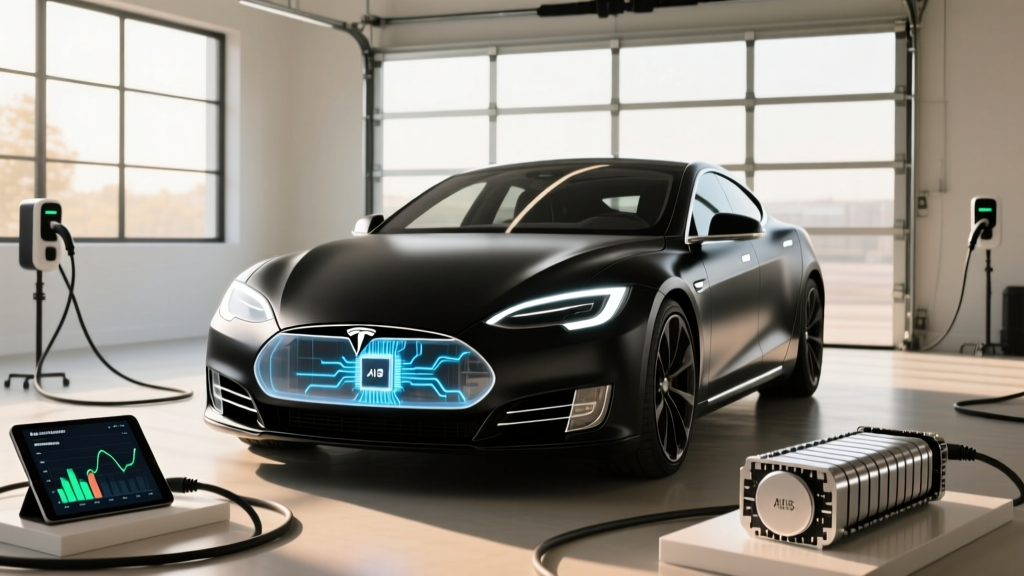
When Elon Musk first mentioned "AI5" in mid-2024, it was a throwaway line on X about Tesla's next-generation inference silicon. By early 2026, AI5 has become the centerpiece of Tesla's Hardware 5 (HW5) computer — the processing backbone expected to underpin Full Self-Driving (Supervised) on the refreshed Model Y, next-generation Robotaxi platform, and eventually the Optimus humanoid robot. But AI5 is not a vehicle. It is a chip. And understanding what it does — and what it doesn't yet deliver — is critical before you base a purchase decision on it.
This profile breaks down what Tesla has disclosed about the AI5 processor, how it fits into the broader HW5 architecture, what it means for FSD capability and vehicle efficiency, and how prospective buyers should weigh it against today's HW4-equipped Teslas.
What Is Tesla AI5 and Where Does It Fit?
AI5 is Tesla's fifth-generation custom inference chip, designed in-house to run the neural networks that power Autopilot and FSD (Supervised). It succeeds the dual-chip configuration in HW3 (introduced 2019) and the upgraded HW4 (introduced 2023 on Model S/X, later Model Y). Tesla has stated that AI5 will deliver roughly 5× the compute performance of HW4 while consuming approximately 2× the power — a trade-off the company believes is justified by the leap in perception and planning capability.
Key disclosed or strongly signaled specifications for AI5/HW5:
| Attribute | HW4 (Current) | HW5 / AI5 (Projected) |
|---|---|---|
| Inference Chip | Dual FSD chips (144 TOPS combined est.) | AI5 (est. 500+ TOPS) |
| Camera Count | 8 cameras | 8–11 cameras (higher resolution) |
| Camera Resolution | 1.2 MP front, 1.2 MP surround | Up to 5 MP (front & key angles) |
| Power Draw (compute) | ~72W | ~140–150W (est.) |
| Radar | None (Tesla Vision only) | Possible high-res radar reintroduction (unconfirmed) |
| Manufacturing Node | Samsung 7nm-class | TSMC 4nm-class (projected) |
| Target Platform | Model S/3/X/Y (current) | Refreshed Model Y, Robotaxi, Optimus |
These figures are based on Musk's public statements, supply-chain reporting, and Tesla's patent filings. Final production specs may differ. Tesla has not published an official AI5 datasheet as of early 2026.
FSD Capability: What AI5 Actually Changes
The core argument for AI5 is that current FSD (Supervised) is bottlenecked not by software architecture — Tesla's end-to-end neural network approach has been broadly praised — but by perception fidelity. Higher-resolution cameras feeding a chip with 5× the inference throughput allows Tesla's models to:
- Process 5 MP frames at full frame rate (36 fps) across all cameras simultaneously, rather than subsampling or cropping
- Run larger, more parameter-rich neural networks on-vehicle without latency penalties
- Maintain redundant perception pipelines (e.g., parallel object-detection and occupancy-network models) in real time
- Reduce the "phantom braking" and late-detection edge cases that have plagued HW4 in low-contrast scenarios
What AI5 does not do is eliminate the driver's legal and practical responsibility. Tesla's FSD (Supervised) remains a Level 2 system under NHTSA's framework, and Tesla's own owner's manuals require continuous driver attention. Buyers who conflate "more compute" with "self-driving" are setting themselves up for disappointment — and liability.
Range and Efficiency Impact: The Power-Draw Trade-Off
One under-discussed consequence of AI5 is its higher power consumption. A ~70W increase in compute load translates to roughly 0.5–1.0 kWh of additional energy draw per 100 miles of mixed driving, depending on how often FSD is actively engaged. On a 75 kWh battery pack, that's a 3–6 mile reduction in effective range when FSD is active versus HW4 — a small but measurable hit.
AI5 itself does not change a vehicle's EPA range rating — that's determined by battery capacity, motor efficiency, and aerodynamics. But buyers should expect the same real-world caveats as current Teslas: highway driving at 75 mph typically yields 85–90% of EPA range; cold-weather (below 32°F) can reduce range by 20–30% without preconditioning; and sustained FSD use on HW5 may trim another 1–2% off versus HW4.
For a refreshed Model Y Long Range (projected EPA ~330 miles on HW5), real-world highway range would land around 280–300 miles in moderate weather, dropping to 230–260 miles in sub-freezing conditions. These are consistent with current Model Y ownership data aggregated on fueleconomy.gov.
Charging Specs: AI5 Doesn't Change the Battery
Because AI5 is a compute platform, not a powertrain upgrade, charging speeds on AI5-equipped vehicles will mirror the battery architecture they're paired with. For a projected 2026 refreshed Model Y on the NACS connector and Tesla Supercharger network:
| Charging Level | Power (kW) | Speed (mi/hr) | 10–80% Time |
|---|---|---|---|
| Level 1 (120V household) | ~1.4 kW | 3–5 mi/hr | N/A (days) |
| Level 2 (240V home, 48A) | ~11.5 kW | 37–44 mi/hr | ~6–7 hours |
| DC Fast (V4 Supercharger) | Peak ~250 kW | Up to 1,000 mi/hr (peak) | ~22–25 min |
Important charging-curve reality: peak 250 kW is sustained only between roughly 10–30% State of Charge (SoC). Above 50%, the curve tapers significantly, and above 80% it drops below 50 kW. This is physics (lithium-ion charge acceptance), not a Tesla-specific limitation. Preconditioning the battery via navigation to a Supercharger is essential to hitting peak rates — without it, expect 30–40% slower initial charge speeds.
Pricing, Tax Credits, and the HW5 Upgrade Question
Tesla has not announced a standalone price for HW5/AI5 as an option. Historically, Tesla bundles hardware revisions into vehicle refreshes rather than selling them as upgrades. Based on the current Model Y lineup and projected refresh pricing:
| Trim (Projected) | Base MSRP | FSD (Supervised) Add-On | §30D Credit Eligibility |
|---|---|---|---|
| Model Y Long Range (HW5) | ~$48,000 | $8,000 | Up to $7,500 (see rules) |
| Model Y Performance (HW5) | ~$53,000 | $8,000 | Up to $7,500 (see rules) |
| Robotaxi Platform (AI5) | TBA (announced) | Included | Not applicable (fleet) |
Federal §30D tax credit eligibility is not guaranteed and depends on three factors that change frequently: (1) buyer adjusted gross income caps ($150K single / $300K joint), (2) vehicle MSRP caps ($55K sedans / $80K SUVs/trucks), and (3) battery-component and critical-mineral sourcing requirements that have tightened annually since 2023. The point-of-sale transfer option lets eligible buyers apply the credit as a purchase-price reduction at the dealer. Always verify current rules at IRS.gov before committing.
Should You Wait for AI5 or Buy HW4 Now?
This is the practical question, and the honest answer depends on your timeline and risk tolerance:
Wait for AI5/HW5 if: Your purchase timeline extends into late 2026 or 2027, you plan to keep the vehicle 7+ years (future-proofing matters), and you believe Tesla's end-to-end FSD will meaningfully benefit from 5× compute. Understand that AI5 vehicles may carry a price premium and early-production software may need months of OTA refinement.
- ~5× inference throughput enables larger on-vehicle neural nets
- Higher-resolution camera support (up to 5 MP)
- Future-proof for next-gen FSD software releases
- Shared architecture with Optimus robot (long-term R&D synergy)
- ~70W higher compute power draw (minor range penalty)
- No official specs or datasheet published yet
- FSD remains Level 2 regardless of compute headroom
- Early-production HW5 vehicles may face OTA teething issues
- Unclear if HW4 vehicles will receive any AI5-era software backports
Competitor Context: AI5 vs. the Industry
Tesla's vertical integration — designing its own silicon, training its own models, deploying on its own fleet — gives AI5 a data advantage competitors can't easily replicate. Waymo's Level 4 robotaxis run on custom compute but are geofenced and fleet-only. Mobileye's EyeQ6 (used by Porsche, VW) targets ~34 TOPS. NVIDIA's DRIVE Thor (targeting 2,000 TOPS, slated for 2025–2026 vehicles from Mercedes, Jaguar) offers raw throughput but lacks Tesla's closed-loop data pipeline. Qualcomm's Snapdragon Ride platform powers ADAS in several OEMs but again relies on third-party software stacks.
The moat isn't just TOPS — it's the billions of real-world miles Tesla's fleet feeds back into training. AI5's value is proportional to how effectively Tesla's AI team converts that compute headroom into measurable safety and capability gains, something that won't be verifiable until HW5 vehicles accumulate millions of supervised miles.
Frequently Asked Questions
What is the real-world range of AI5-equipped Teslas?
AI5 itself doesn't change EPA range ratings. A refreshed Model Y Long Range on HW5 is projected at ~330 miles EPA, with real-world highway driving yielding 280–300 miles in moderate weather and 230–260 miles in sub-freezing conditions — consistent with current Model Y data on fueleconomy.gov.
How fast does an AI5 Tesla charge?
Charging speed is a function of the battery, not the compute chip. Expect peak ~250 kW on V4 Superchargers, 10–80% in ~22–25 minutes with proper preconditioning, and ~11.5 kW on a 48A home Level 2 setup (37–44 mi/hr).
How much does an AI5 Tesla cost after tax credits?
Projected Model Y Long Range HW5 base MSRP is ~$48,000. With full §30D eligibility (income, MSRP, and sourcing requirements met), the effective price could drop to ~$40,500. FSD (Supervised) adds $8,000. Verify eligibility at IRS.gov.
Is AI5 worth waiting for vs. buying HW4?
If you're buying within 6 months, HW4 is mature and capable. If your timeline is late 2026+, AI5 offers meaningful future-proofing for FSD software evolution — but understand that FSD remains Level 2 regardless of hardware.
Does an AI5 Tesla qualify for the federal EV tax credit?
Eligibility depends on the specific vehicle's MSRP, the buyer's income, and battery-sourcing compliance — not the compute chip. Current §30D rules are published by the IRS and change annually. Do not assume $7,500 without verifying all three criteria.
Will HW4 Teslas get AI5-level FSD features via OTA?
Tesla has not committed to this. Historically, major hardware leaps (HW2→HW3, HW3→HW4) have resulted in diverging software capabilities over time. HW4 owners should not assume parity with future AI5 features.