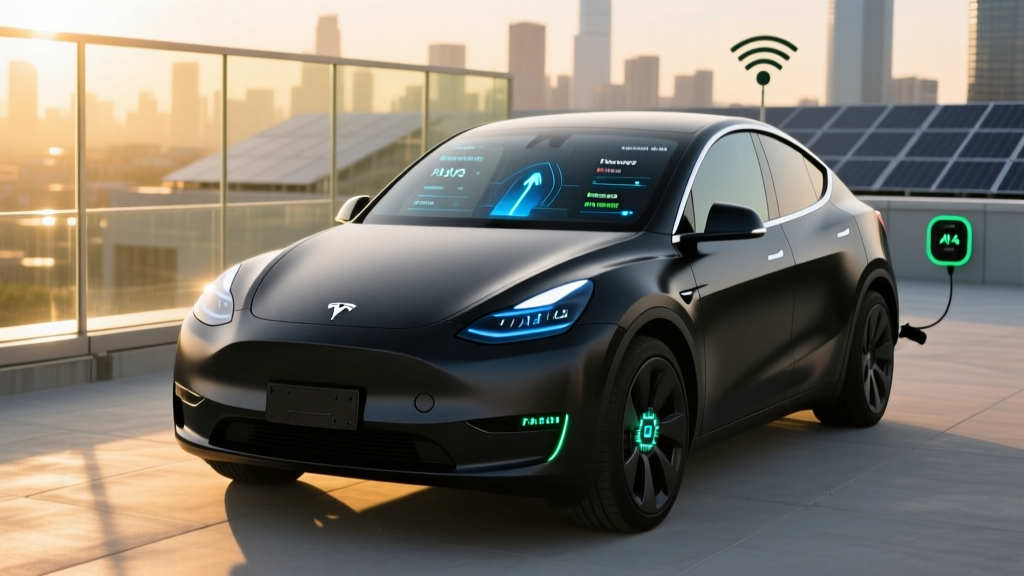
The Tesla AI4 chip — also known internally as Hardware 4 (HW4) — is the computational backbone of Tesla's current-generation Full Self-Driving (Supervised) system. First deployed in 2023 Model S and Model X vehicles and subsequently rolled out across the Model 3 and Model Y lines, AI4 represents a generational leap in onboard processing for advanced driver-assistance systems (ADAS). For 2026, every new Model Y rolling out of Giga Texas and Giga Berlin ships with AI4 as standard equipment.
But AI4 isn't just a silicon story. The 2026 Model Y built around it remains one of the most popular electric vehicles in the United States, and buyers deserve a clear-eyed look at what the car actually delivers: range, charging, practicality, and cost — not just the tech headline. This review covers the full ownership picture.
Tesla AI4 Chip: What It Actually Does
The AI4 chip is Tesla's second-generation custom inference processor designed specifically for neural-network-based vision processing. Compared to the previous HW3 (AI3) chip, AI4 delivers roughly 3–5× the compute throughput for Tesla's FSD neural nets, enabling higher-resolution camera input processing, faster object detection, and more complex path-planning models to run in real time.
Key hardware differences in the AI4 suite:
- Cameras: Upgraded camera stack with higher-resolution sensors (5 MP+ on key forward-facing units) and improved low-light performance
- Chip architecture: Custom Tesla-designed SoC on a 7nm-class process, with dedicated neural-network accelerator cores
- Redundancy: Dual-compute paths for safety-critical functions
- Thermal management: Improved cooling to sustain peak inference loads without throttling
For the 2026 model year, Tesla has continued to iterate on FSD software (v13.x series), leveraging AI4's additional headroom to run more sophisticated end-to-end neural networks that handle complex urban scenarios with fewer disengagements than prior versions. However, real-world FSD performance still varies significantly by geography, weather, and road complexity.
2026 Model Y: Full Spec Sheet
| Specification | Long Range AWD | Performance |
|---|---|---|
| EPA Range | 320 miles | 285 miles |
| Battery (usable) | ~75 kWh, NMC | ~75 kWh, NMC |
| Drivetrain | Dual-motor AWD | Dual-motor AWD |
| Horsepower | ~384 hp | ~456 hp |
| 0–60 mph | 4.8 seconds | 3.5 seconds |
| MPGe (combined) | 120 MPGe | 111 MPGe |
| Efficiency | 28 kWh/100 mi | 30 kWh/100 mi |
| Max DC Fast Charge | 250 kW | 250 kW |
| 10–80% DCFC Time | ~22 minutes | ~22 minutes |
| Level 2 Home Charging | 11.5 kW / ~37 mi/hr | 11.5 kW / ~37 mi/hr |
| Connector | NACS (native) | NACS (native) |
| Cargo Volume | 30.2 cu ft (rear up) / 72.1 cu ft (rear folded) | 30.2 cu ft / 72.1 cu ft |
| Rear Legroom | 41.6 inches | 41.6 inches |
| Battery Warranty | 8 years / 120,000 miles | 8 years / 120,000 miles |
| Base MSRP | $48,590 | $53,590 |
Source: EPA / fueleconomy.gov, Tesla.com. Specs based on 2026 model year data; confirm with dealer.
Real-World Range vs. EPA Sticker
EPA Sticker: 320 miles
Real-world highway (70 mph, 72°F): ~270–285 miles
Real-world mixed driving: ~290–310 miles
Cold weather (20°F, highway): ~220–250 miles
Cold weather + cabin heat, city: ~240–270 miles
The Model Y Long Range's 320-mile EPA figure is among the best in the midsize electric SUV segment, but real-world results tell a more nuanced story. At sustained highway speeds of 70–75 mph, expect to see roughly 270–285 miles of usable range before you'd want to stop for a charge (practically, you'll charge at 10–15% remaining, so usable range is closer to 250–260 miles between stops).
Cold weather is the more significant variable. The Model Y uses a heat pump (standard on all current trims), which mitigates some of the efficiency penalty that plagues resistive-heater EVs. Still, at 20°F with highway driving, range drops to roughly 70–78% of the EPA sticker. This is physics — lithium-ion internal resistance increases at low temperatures, and cabin/climate energy draw rises. Tesla's battery preconditioning feature (which warms the pack before you navigate to a Supercharger) helps restore charging speed but does not recover lost range during the drive itself.
For daily commuting under 60 miles round-trip, range is a non-issue even in cold weather. For road trips, plan charging stops at roughly 200–220 mile intervals in winter to maintain a comfortable buffer.
Charging Speed: DC Fast and Home Level 2
| Charging Level | Power (kW) | Speed (mi/hr added) | Notes |
|---|---|---|---|
| Level 1 (120V outlet) | 1.4 kW | ~4 mi/hr | Emergency/top-up only |
| Level 2 (240V, 48A) | 11.5 kW | ~37 mi/hr | Full charge in ~7 hrs; ideal home setup |
| DC Fast (Tesla Supercharger V3) | 250 kW peak | ~1,000 mi/hr (peak) | 10–80% in ~22 min; tapers above 80% |
| DC Fast (CCS adapter, EA/Ionity) | Up to 250 kW | Variable | Works via included NACS-to-CCS adapter |
The Model Y's 250 kW peak DC fast-charge rate on Tesla's V3 Superchargers remains competitive, though it no longer leads the segment — the Hyundai Ioniq 5 and Kia EV6 can peak at 350 kW on 800V architecture. The key metric is the 10–80% time of roughly 22 minutes on a V3 Supercharger with a preconditioned battery.
Charging curve reality check: The 250 kW figure is a peak, not a sustained rate. The Model Y's charge curve typically holds near peak output between 10–30% State of Charge (SoC), then progressively tapers. From 50–80%, expect roughly 100–130 kW average. This means the last 30% (80–100%) can take as long as the first 70% — a pattern common to all NMC lithium-ion packs. Tesla recommends charging to 80% daily and only going to 100% when needed for long trips.
For home charging, the 11.5 kW onboard charger (48A on a 60A circuit) is robust. A typical overnight session of 8 hours adds roughly 296 miles — more than enough to fully replenish even after a heavy driving day. Installation of a 240V/60A circuit typically costs $500–$2,000 depending on your electrical panel's proximity to the garage and whether a panel upgrade is needed. The Tesla Wall Connector itself retails for around $475.
Pricing, Trims, and Federal Tax Credit
| Trim | Base MSRP | §30D Credit Eligibility | Est. After Credit |
|---|---|---|---|
| Long Range AWD | $48,590 | Up to $7,500 (if sourcing rules met) | ~$41,090 |
| Performance | $53,590 | Up to $7,500 (if sourcing rules met) | ~$46,090 |
| + FSD (Supervised) | +$8,000 option | Not eligible for additional credit | — |
- MSRP cap: SUVs/vans/pickups must be ≤ $80,000 MSRP ✅ (Model Y qualifies)
- Buyer income cap: AGI ≤ $150,000 (single) / $225,000 (head of household) / $300,000 (joint)
- Battery sourcing: Critical minerals + battery components must meet phased-in domestic/free-trade sourcing thresholds — this changes annually; verify current-year compliance on IRS.gov qualifying vehicle list
- Point-of-sale transfer: Eligible buyers can transfer the credit to the dealer at purchase, reducing the purchase price directly (rather than waiting for a tax refund)
- Assembly: Must be assembled in North America ✅ (Giga Texas)
Credit eligibility varies by buyer and changes with IRS sourcing rule updates. Consult a tax professional and check the official IRS list before purchasing.
The Model Y's pricing places it squarely in the premium-midsize SUV territory. The Long Range AWD at $48,590 is the volume trim and the one most buyers should target — it offers the best range, the lowest efficiency penalty, and a more comfortable ride than the Performance variant (which trades some range and compliance for a sportier suspension and 3.5-second 0–60 time).
The $8,000 FSD (Supervised) add-on is a significant upsell. Given that FSD remains a Level 2 system requiring driver supervision, the value proposition is debated. Basic Autopilot (lane centering + adaptive cruise) comes standard and handles highway driving competently. FSD adds city-street capabilities, stop-sign/light recognition, and more assertive lane changes — but still requires constant driver oversight.
Tech, Interior, and the AI4 Advantage
The 2026 Model Y interior follows Tesla's minimalist ethos: a single 15.4-inch center touchscreen controls virtually all vehicle functions, with no physical instrument cluster. Build quality has improved meaningfully since the Juniper refresh — panel gaps are tighter, acoustic glass reduces cabin noise, and the ventilated front seats are a welcome addition for warm climates.
Where the AI4 chip matters for owners:
- FSD responsiveness: AI4's additional compute enables faster neural-net inference, meaning the system reacts more quickly to complex scenarios (construction zones, irregular intersections, pedestrians near the roadway)
- Camera clarity: The HW4 camera suite provides higher-resolution feeds, improving Tesla's vision-only approach in challenging lighting (dawn/dusk, rain, backlit scenarios)
- Future-proofing: Tesla has stated that future FSD versions will require AI4 or later — HW3 vehicles will not receive the most advanced neural-net models
- Safety systems: Automatic emergency braking, blind-spot monitoring, and lane-departure avoidance all benefit from the improved sensor processing pipeline
The infotainment system remains one of the best in the EV space: native Spotify/Apple Music/Tidal, a capable web browser, Netflix/YouTube/Disney+ while parked, and regular over-the-air (OTA) updates that add features post-purchase. The Model Y also supports Tesla's Sentry Mode (360° parking surveillance using the camera suite) and Dog Mode (climate control with a display notification for passersby).
Notable drawbacks:
- No Apple CarPlay or Android Auto — the Tesla UI is the only interface
- Turn-signal stalk removal (steering-wheel buttons instead) remains polarizing and takes adaptation
- Visibility from the rear is compromised by the sloping roofline; the camera-based rearview mirror helps but isn't a full replacement for a physical mirror
- Rear-seat headroom is tighter than boxier competitors like the Hyundai Ioniq 5 or Ford Mustang Mach-E
Pros, Cons, and Best Use Cases
✅ Pros
- 320-mile EPA range (Long Range) is segment-leading
- Tesla Supercharger network — the most reliable DC fast-charging ecosystem in North America
- AI4 chip provides best-in-class ADAS compute with a clear upgrade path
- OTA updates continuously improve the vehicle post-purchase
- Strong efficiency: 28 kWh/100 mi translates to low per-mile electricity cost
- Spacious cargo area (72.1 cu ft with seats folded) with front trunk (frunk)
- Qualifies for up to $7,500 federal tax credit (subject to sourcing/income rules)
❌ Cons
- FSD (Supervised) is $8,000 extra and still Level 2 — not autonomous
- 250 kW peak DCFC is outpaced by 800V competitors (Ioniq 5/EV6 at 350 kW)
- No Apple CarPlay/Android Auto
- Steering-wheel turn-signal buttons require a learning curve
- Insurance premiums tend to be higher than segment average
- Service center wait times can be long in high-volume metro areas
- Rear-seat headroom is compromised vs. boxier SUV rivals
Who the 2026 Model Y Suits Best
- Daily commuters (30–80 mi round-trip): Ideal. Home Level 2 charging fully replenishes overnight; efficiency keeps electricity costs low (~$0.04–$0.06/mile at national average electricity rates).
- Families with 1–2 children: The rear seat accommodates two car seats comfortably, and the 30.2 cu ft cargo area handles strollers and groceries. The third-row option (available on some trims) is best for small children only.
- Road trippers: Tesla's Supercharger network makes long-distance travel more seamless than any competing EV. Plan stops every 200–250 miles (winter) or 250–280 miles (summer).
- Tech-forward buyers: If OTA updates, FSD iteration, and a software-defined vehicle appeal to you, the Model Y + AI4 combination offers the most actively developed ADAS platform on the market.
- Not ideal for: Buyers who want Apple CarPlay, prefer physical buttons, need maximum rear headroom, or want the absolute fastest DC charging available.
Warranty and Long-Term Ownership
Tesla provides the following warranty coverage for the 2026 Model Y:
- Basic vehicle: 4 years / 50,000 miles
- Battery & drive unit: 8 years / 120,000 miles (Long Range/Performance) with a minimum 70% capacity retention guarantee
The 8-year/120,000-mile battery warranty is competitive. Tesla's NMC packs have historically shown roughly 10–12% degradation over the first 100,000 miles based on fleet data, with the curve flattening significantly after the initial break-in period. The 70% retention threshold means Tesla will repair or replace the battery if it drops below that level within the warranty window — though in practice, most packs retain well above 80% at 100,000 miles.
For the AI4 hardware specifically, Tesla's warranty covers the autopilot computer and camera suite under the basic 4-year/50,000-mile vehicle warranty. Extended service agreements are available but vary by region. Given that AI4 is a sealed, passively-cooled unit with no moving parts, failure rates are expected to be low — but if a replacement is needed out of warranty, the cost is estimated at $1,500–$2,500 based on prior HW3 replacement pricing.
Is the 2026 Model Y with AI4 Worth It vs. Competitors?
The Model Y's key competitors in the midsize electric SUV space include the Hyundai Ioniq 5, Kia EV6, Ford Mustang Mach-E, and Volkswagen ID.4. Here's how the Model Y stacks up on the metrics that matter:
- Range: Model Y LR (320 mi) beats the Ioniq 5 Long Range (305 mi), EV6 (310 mi), and Mach-E Extended Range (305 mi). Only the ID.4 Pro S (291 mi) trails more significantly.
- Charging speed: Ioniq 5 and EV6 win here — 800V architecture enables 350 kW peak and 10–80% in ~18 minutes. The Model Y's 22-minute 10–80% is still fast but not class-leading.
- Charging network: Tesla's Supercharger network remains the most reliable and widespread DC fast-charging ecosystem. Other brands now have NACS access agreements, but Tesla owners still enjoy native, plug-and-charge seamlessness.
- ADAS: The AI4 chip gives the Model Y a compute advantage for FSD. Hyundai/Kia's Highway Driving Assist 2 and Ford's BlueCruise are competent Level 2 systems, but Tesla's vision-based approach has more development velocity and a larger real-world data set.
- Cargo space: Model Y (72.1 cu ft) leads the Ioniq 5 (59.3 cu ft) and EV6 (50.2 cu ft) significantly.
- Price after credit: All four competitors also qualify for the §30D credit (subject to the same sourcing/income rules). The Model Y's ~$41,090 after-credit price is competitive but not the cheapest — the ID.4 and base Ioniq 5 can undercut it.
- Choose the Model Y if: You prioritize range, Supercharger network access, cargo space, and want the most actively developed ADAS platform (AI4/FSD). Best for Tesla-ecosystem buyers who value OTA updates and software iteration.
- Choose the Ioniq 5/EV6 if: You want the fastest DC charging (350 kW / 18-min 10–80%), prefer physical controls alongside touchscreen, or want a more distinctive design language. 800V architecture is a genuine technical advantage for road-trippers who charge publicly often.
- Choose the Mach-E if: You prefer a more traditional driving feel with physical buttons, want Ford dealer service access, or are cross-shopping against a Ford ICE vehicle for fleet/family consistency.
- Choose the ID.4 if: Budget is the primary driver — it's often the most affordable option after incentives, with a comfortable ride and straightforward controls.
Frequently Asked Questions
What is the real-world range of the 2026 Tesla Model Y?
The EPA rates the Long Range AWD at 320 miles. In real-world mixed driving, expect 290–310 miles. Sustained highway driving at 70+ mph reduces this to roughly 270–285 miles. In cold weather (below freezing), plan for 220–250 miles of usable range on the highway. These figures assume a healthy battery with typical degradation.
How fast does the Model Y charge at home and on DC fast chargers?
On a 240V Level 2 home charger (48A/11.5 kW), the Model Y adds roughly 37 miles of range per hour — a full charge takes about 7 hours. On a Tesla V3 Supercharger, it peaks at 250 kW and charges from 10–80% in approximately 22 minutes with a preconditioned battery. Charging above 80% slows dramatically to protect battery health.
How much does the 2026 Model Y cost after the federal tax credit?
The Long Range AWD starts at $48,590 MSRP. If you qualify for the full $7,500 §30D credit (meeting income, MSRP, and battery-sourcing requirements), the effective price drops to approximately $41,090. The Performance trim at $53,590 would be roughly $46,090 after credit. The $8,000 FSD option does not affect credit eligibility. Always verify current-year sourcing compliance on the IRS website before purchase.
Does the Model Y qualify for the federal EV tax credit?
The Model Y is assembled at Giga Texas (North American assembly ✅) and its MSRP is under the $80,000 SUV cap ✅. Eligibility for the full $7,500 credit depends on your income (AGI caps apply), and whether the battery's critical minerals and components meet the phased-in domestic sourcing thresholds for the current tax year. Check the IRS qualifying vehicles list for the most current status, as sourcing compliance can change with model-year production updates.
What does the Tesla AI4 chip do, and is it worth caring about?
The AI4 (Hardware 4) chip is Tesla's current-generation ADAS processor. It provides 3–5× more neural-network inference throughput than the prior HW3, enabling higher-resolution camera processing and more sophisticated FSD models. For buyers, it means the best available Tesla driver-assist experience today and a clearer path to receiving future FSD software improvements. Tesla has indicated that advanced future FSD versions will require AI4 or later hardware.
Is Tesla FSD (Supervised) actually self-driving?
No. FSD (Supervised) is an SAE Level 2 driver-assistance system. Despite the "Full Self-Driving" name, the driver must remain fully engaged — eyes on the road, hands available to take over — at all times. The system handles many driving scenarios impressively, but it can and does make errors. Only Level 4 services like Waymo operate without a human driver, and only in limited geofenced areas.
What's the battery warranty, and how long will the Model Y battery last?
Tesla warrants the Model Y Long Range/Performance battery for 8 years or 120,000 miles, guaranteeing at least 70% capacity retention. Real-world fleet data suggests NMC packs typically lose 10–12% capacity in the first 100,000 miles, with degradation slowing considerably afterward. Many Tesla packs from 2018–2020 still retain 85%+ capacity at 100,000+ miles. Full battery replacement (if needed out of warranty) is estimated at $12,000–$16,000 depending on pack configuration.
How does the Model Y compare to the Hyundai Ioniq 5 and Ford Mach-E?
The Model Y leads on EPA range (320 vs. 305 mi), cargo volume (72.1 vs. 59.3 cu ft), and charging-network seamlessness. The Ioniq 5 wins on DC charging speed (350 kW / 18 min 10–80%) and offers Apple CarPlay. The Mach-E provides a more conventional interior with physical controls. All three qualify for the §30D credit. Your best choice depends on whether you prioritize range/network (Tesla), charging speed (Hyundai/Kia), or traditional ergonomics (Ford).
Sources: EPA / fueleconomy.gov, Tesla.com Model Y specifications, IRS §30D qualifying vehicles. All specifications and pricing reflect 2026 model year data available at time of writing. Confirm final pricing, credit eligibility, and specifications with Tesla and a qualified tax professional before purchase.