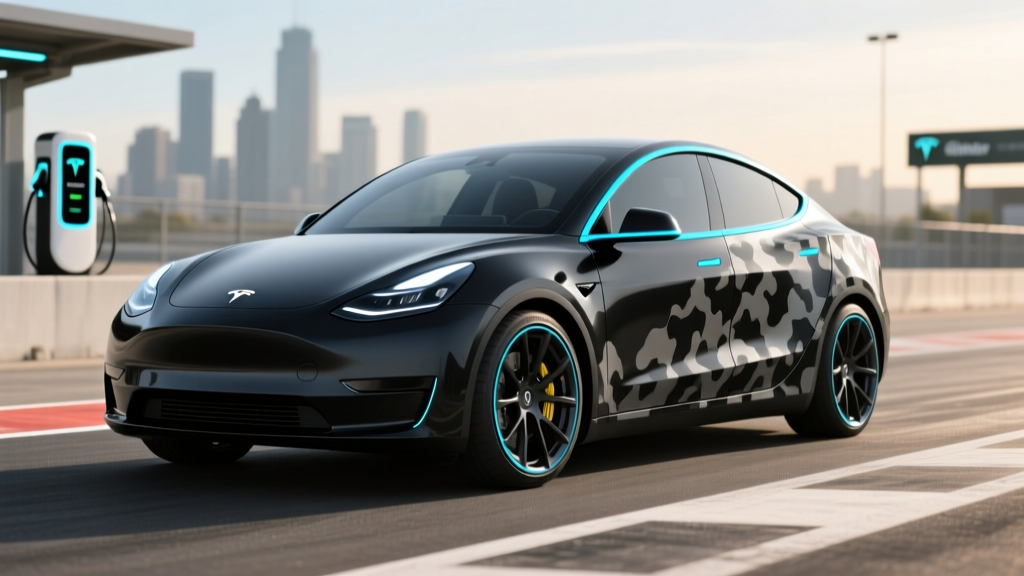
For years, Elon Musk has teased a sub-$30,000 Tesla. Now, a wave of Tesla affordable model spy shots from testing grounds in California and China, combined with supply-chain leaks and gigafactory tooling orders, has given us the clearest picture yet of what the enthusiast press is calling the "Model 2" or "Redwood." As of early 2026, Tesla has not officially confirmed the vehicle's name, full spec sheet, or on-sale date — but the camouflage-wrapped prototypes tell a detailed story. Below, we break down every credible data point, separate confirmed engineering from speculation, and project what ownership will actually look like if this compact EV hits its rumored price target.
What the Tesla Affordable Model Spy Shots Show Us
Camouflaged hatchback prototypes have been spotted testing near Gigafactory Texas and on public roads around the Fremont, California plant since mid-2025, with frequency intensifying into early 2026. The mules reveal several key design and engineering decisions:
- Body style: A compact 5-door hatchback, shorter wheelbase than the Model 3 by roughly 6-8 inches, with a sloping roofline reminiscent of a scaled-down Model Y.
- Front fascia: No grille — confirming a dedicated BEV platform (not a converted ICE chassis). Slim LED headlights sit lower than the Model 3's, with a smoother hood line for improved aerodynamics.
- Wheels and tires: Test mules wear 18-inch aero wheel covers over narrower tires (~215 mm width), prioritizing low rolling resistance and efficiency over grip — a clear signal that range maximization is the engineering priority.
- Rear design: A full-width light bar (similar to the refreshed Model 3 "Highland") and a compact liftgate, suggesting modest cargo space optimized for urban use.
- Charging port: NACS (North American Charging Standard) connector, consistent with Tesla's unified charging ecosystem and the NACS standard Tesla open-sourced.
Interior spy shots — limited to blurred glimpses through tinted test-vehicle windows — suggest a minimalist cabin with a single center-mounted touchscreen (estimated 15.4 inches), no instrument cluster, and a flat floor enabled by a structural battery pack.
Projected Specs: Range, Battery, and Chemistry
Based on the vehicle's physical dimensions, supply-chain intelligence regarding CATL and BYD cell orders, and Tesla's own efficiency track record, we can project the following specifications with moderate confidence:
| Attribute | Projected Spec | Confidence Level |
|---|---|---|
| EPA Est. Range | 250–275 miles (base RWD) | Medium |
| Battery Capacity | ~50–55 kWh usable | Medium-High |
| Battery Chemistry | LFP (Lithium Iron Phosphate) | High |
| Drivetrain | RWD (single motor), AWD possible later | High (RWD base) |
| 0-60 mph | ~6.5–7.5 seconds (est.) | Low |
| Horsepower | ~200–250 HP (single motor) | Medium |
| Efficiency | ~120–130 MPGe / 25–27 kWh/100mi | Medium |
| Base MSRP (target) | ~$25,000–$28,000 | Medium |
Battery Chemistry: Why LFP Is Nearly Certain
Multiple supply-chain reports indicate Tesla is sourcing LFP (lithium iron phosphate) prismatic cells from CATL for this platform — the same chemistry used in the standard-range Model 3 and Model Y. LFP offers distinct trade-offs compared to NMC (nickel manganese cobalt):
| Factor | LFP (Expected) | NMC (Model 3 LR) |
|---|---|---|
| Energy Density | Lower — requires larger pack for same range | Higher — more range per kg |
| Cycle Life | 3,000+ cycles — excellent longevity | 1,500–2,000 cycles |
| Cold-Weather Performance | Greater range loss (~30-40% in sub-freezing) | Moderate loss (~20-30%) |
| Charging to 100% | Recommended regularly for BMS calibration | 80% daily recommended |
| Cost | ~20-30% cheaper per kWh | Higher — cobalt/nickel exposure |
| Cobalt Content | Zero — fewer ethical sourcing concerns | Contains cobalt |
The LFP choice is strategic: it reduces per-kWh cost (critical for a ~$25K vehicle), eliminates cobalt supply-chain risk, and provides exceptional cycle life. The trade-off is lower energy density (meaning a ~50 kWh pack won't deliver Model 3 Long Range distances) and greater cold-weather range loss.
EPA Estimated Range: ~250–275 miles (projected, based on ~50-55 kWh LFP pack and Tesla's ~4.0-4.3 mi/kWh efficiency target)
Real-World Expectations:
• City/commuter driving (mild weather): ~260-280 miles — LFP excels here with regenerative braking
• Highway driving (70-80 mph): ~200-230 miles — aerodynamic drag cuts efficiency by ~15-20%
• Cold weather (below 32°F): ~150-190 miles — LFP chemistry suffers greater capacity loss in freezing temps; heat pump helps but can't eliminate the physics
• Mixed driving (55/45 city/highway): ~230-250 miles
Note: These projections assume Tesla achieves its targeted efficiency of ~25-27 kWh/100mi. The smaller, lighter platform should help, but LFP's weight penalty partially offsets the size advantage.
Charging Speed: DC Fast and Home Level 2
Charging speed will be a make-or-break factor for buyers comparing this Tesla against the Hyundai Kona Electric, Chevrolet Equinox EV, and Nissan Leaf successor. Based on the projected battery size and Tesla's current Supercharger architecture, here's what we expect:
| Charging Level | Power / Rate | Time / Range Added |
|---|---|---|
| Level 1 (120V household) | ~1.4 kW | ~4-5 miles per hour |
| Level 2 (240V, 48A home charger) | ~11.5 kW | ~35-40 miles per hour / full charge in ~5 hrs |
| DC Fast Charge (Supercharger) | ~150–170 kW peak | 10-80% in ~25-30 minutes (projected) |
Understanding the Charge Curve Limitation
A ~50 kWh LFP battery cannot accept the 250 kW peak rates that the Model 3 Long Range can. LFP cells have a lower C-rate (charge rate relative to capacity), and the smaller pack means even at a 3C charge rate, peak power caps around 150-170 kW. Expect the charge curve to taper significantly above 60% SoC, with the final 20% (80-100%) taking an additional 15-20 minutes. This is normal LFP behavior, not a deficiency — but it means road-trip charging stops will average ~30 minutes for a meaningful range addition, not the 15-minute stops Tesla advertises for larger packs.
The NACS connector gives this vehicle native access to the entire Tesla Supercharger network, which remains the most reliable and geographically complete DC fast-charging network in North America, with over 25,000 stalls as of 2026. This is a significant competitive advantage over CCS-equipped rivals that must rely on Electrify America or third-party networks with lower uptime.
Pricing, Trims, and Federal Tax Credit Eligibility
The headline number — and the reason these spy shots generate such intense interest — is the rumored ~$25,000 starting price. Here's how the pricing structure might shake out, and whether the federal EV tax credit applies:
| Trim (Projected) | Est. MSRP | §30D Credit Eligible? | Est. Net Price |
|---|---|---|---|
| Base RWD | ~$25,000 | Likely — see caveats below | ~$17,500–$25,000 |
| Long Range RWD | ~$30,000–$32,000 | Likely | ~$22,500–$32,000 |
| AWD / Performance | ~$35,000 (if offered) | Likely | ~$27,500–$35,000 |
Federal Tax Credit (§30D) — Critical Caveats
Under current IRS §30D rules for 2026, a new clean vehicle can qualify for up to $7,500 in federal tax credits — but eligibility depends on a web of requirements that buyers must verify individually:
- MSRP Cap: The vehicle must have a base MSRP at or below $55,000 for sedans/hatchbacks. The affordable Tesla easily clears this bar at a projected $25,000-$35,000 range.
- Buyer Income Cap: Modified adjusted gross income (MAGI) must not exceed $150,000 (single), $225,000 (head of household), or $300,000 (joint). Buyers above these thresholds receive $0 credit regardless of the vehicle.
- Battery Sourcing — Critical Minerals (up to $3,750): A percentage of critical minerals must be sourced from the U.S. or FTA partners. CATL-sourced LFP cells (China) may jeopardize this half of the credit, depending on 2026 sourcing thresholds and any applicable Foreign Entity of Concern (FEOC) restrictions.
- Battery Sourcing — Components (up to $3,750): Battery components must be manufactured or assembled in North America above a rising threshold. Tesla's U.S. cell manufacturing partnerships may satisfy this, but LFP cells from CATL complicate the picture.
- Point-of-Sale Transfer: Eligible buyers can transfer the credit to the dealer at purchase, reducing the out-of-pocket price immediately rather than waiting for a tax refund.
- FEOC Restriction: Vehicles with battery components from a Foreign Entity of Concern (including certain Chinese companies) are disqualified entirely. This is the single biggest risk to the affordable Tesla's credit eligibility.
Bottom line: The $25,000 Tesla should qualify for at least a partial credit ($3,750) if Tesla can satisfy component-sourcing rules with U.S.-assembled packs. The full $7,500 is less certain due to LFP critical-mineral sourcing from China. Buyers should verify eligibility at fueleconomy.gov and consult a tax professional before relying on the credit in their purchase budget.
Interior, Cargo, and Technology
The spy shots reveal a cabin that prioritizes cost reduction and software-driven functionality over physical controls and premium materials — a continuation of Tesla's "unboxed" manufacturing philosophy.
Projected Dimensions and Space
- Seating: 5-passenger (tight rear — expect ~34-35 inches rear legroom, similar to a Chevrolet Bolt EV)
- Cargo volume: ~18-22 cu ft behind rear seats (hatchback utility), ~45-50 cu ft with seats folded
- Frunk: Likely minimal (~2-3 cu ft) or eliminated entirely to reduce cost and complexity
- Overall length: ~175-180 inches (roughly 10-12 inches shorter than Model 3)
This is a city-oriented vehicle. Rear-seat passengers over 6 feet tall will find legroom tight on longer trips, and cargo space is adequate for groceries and carry-on luggage but not weekend camping gear for a family. Think Chevrolet Bolt EV or Hyundai Kona Electric, not Model Y.
Tech and Driver Assistance
Expect Tesla to carry forward its current-generation infotainment and ADAS stack, potentially with cost-reduced hardware:
- Infotainment: Single 15.4-inch center touchscreen, Tesla OS with navigation, streaming, and over-the-air updates. No Apple CarPlay or Android Auto (Tesla has never offered these).
- Autopilot (standard): SAE Level 2 driver assistance — adaptive cruise control, lane centering, automatic emergency braking. The driver must remain fully engaged with hands on the wheel and eyes on the road at all times.
- FSD Supervised (optional, ~$8,000 or $99/mo): Enhanced Level 2 system with city-street navigation capability. Despite the name, FSD does not make the vehicle autonomous — the driver is legally and operationally responsible at all times.
- Vision-only approach: No LiDAR or ultrasonic sensors — Tesla continues to rely solely on cameras and neural-network processing.
- Connectivity: Built-in LTE/5G for navigation, streaming, and OTA updates (subscription likely required after trial period).
Tesla Autopilot and FSD (Supervised) are SAE Level 2 systems. They do not drive the car autonomously. The driver must continuously monitor the road, keep hands on the steering wheel, and be prepared to take over instantly. NHTSA has investigated multiple Tesla Autopilot-related crashes. No consumer vehicle sold in 2026 is "self-driving." Only Level 4 robotaxi services (Waymo, Zoox) operate without a human driver, and only in geofenced areas.
How It Compares: Affordable Tesla vs. the Competition
If the spy-shot projections hold, the Tesla compact will enter a segment with established players. Here's how it stacks up against the most relevant 2026 competitors:
| Spec | Tesla "Model 2" (Proj.) | Chevy Equinox EV | Hyundai Kona Electric |
|---|---|---|---|
| Est. Base MSRP | ~$25,000 | ~$33,000 | ~$33,000 |
| EPA Range | ~250-275 mi | 319 mi | 261 mi |
| DC Fast Charge Peak | ~150-170 kW | ~150 kW | ~100 kW |
| Connector | NACS (native Supercharger) | CCS → NACS adapter | CCS → NACS adapter |
| Charging Network | Tesla Supercharger (best uptime) | Mixed public networks | Mixed public networks |
| Cargo Space | ~18-22 cu ft | 26.4 cu ft | 25.5 cu ft |
| §30D Credit | Partial likely ($3,750-$7,500) | Up to $7,500 | $0 (Korea-built) |
The Tesla's primary advantage is price and charging-network access. The Equinox EV offers significantly more range and cargo space for ~$8,000 more. The Kona Electric has been redesigned with better efficiency but lacks DC fast-charge competitiveness and doesn't qualify for the federal credit when imported from Korea.
Who Should Wait for This EV — And Who Shouldn't
- You want the lowest possible entry price into a new EV (~$25K before credits)
- Supercharger network access is a priority for road trips
- Your daily commute is under 50 miles round-trip (city/suburban)
- You value OTA updates, Tesla's software ecosystem, and resale-value track record
- You can wait until late 2026 or 2027 for delivery
- You need a car now — this vehicle is not yet on sale
- You regularly drive 200+ mile highway trips in cold weather (LFP + small pack = range stress)
- You need family-friendly cargo and rear-seat space (Equinox EV or Model Y are far better)
- You want proven reliability data — this is an all-new platform with no track record
- You need the full $7,500 tax credit and can't risk FEOC sourcing disqualification
Warranty and Long-Term Ownership
Tesla has not published warranty details for the affordable model, but based on the current Model 3/Y structure, we can project:
- Basic Vehicle Warranty: 4 years / 50,000 miles (expected)
- Battery & Drive Unit: 8 years / 100,000 miles, with a minimum 70% capacity retention guarantee
- LFP longevity advantage: LFP cells degrade slower than NMC, meaning real-world capacity retention at 100,000 miles may be 85-90%+ — well above the warranty floor
LFP's superior cycle life (3,000+ full cycles vs. ~1,500 for NMC) means the battery in this vehicle could theoretically outlast the car itself under normal use. A 50 kWh pack at 3,000 cycles represents ~150,000 charge-discharge cycles, or roughly 37.5 million miles of theoretical throughput — far beyond any realistic ownership scenario. The real degradation risk is calendar aging and cold-weather exposure, not cycle wear.
Frequently Asked Questions
What is the real-world range of the Tesla affordable model?
Based on the projected ~50-55 kWh LFP battery and Tesla's efficiency targets, expect ~250-275 miles EPA. In real-world use: ~260-280 miles in mild city driving, ~200-230 miles on the highway, and as low as ~150-190 miles in freezing weather. LFP chemistry is more susceptible to cold-weather capacity loss than NMC, so buyers in northern climates should plan accordingly.
How fast does the affordable Tesla charge?
Projected DC fast-charge peak is ~150-170 kW, delivering a 10-80% charge in approximately 25-30 minutes. The smaller LFP battery cannot accept the 250 kW peak rates of larger Tesla packs. Home Level 2 charging at 11.5 kW (48A, 240V) adds roughly 35-40 miles per hour, fully replenishing the pack in about 5 hours.
How much does it cost after tax credits?
If the base MSRP lands at ~$25,000 and the vehicle qualifies for the full $7,500 §30D credit, the effective price drops to ~$17,500 — making it the cheapest new EV ever sold in the U.S. However, the full credit is not guaranteed due to LFP battery-sourcing requirements. A more conservative estimate is $3,750-$7,500 off, putting the net price between $17,500 and $21,250 for eligible buyers. Always verify current eligibility on fueleconomy.gov and consult a tax professional.
Is the Tesla affordable model worth buying vs. competitors?
If price is your primary driver, yes — a ~$25K Tesla with Supercharger access is unmatched. But the Equinox EV offers more range (319 mi EPA) and cargo space for ~$8K more, and it currently qualifies for the full $7,500 credit. The Kona Electric is competitive on range but weak on DC charging speed and lacks credit eligibility. The decision hinges on whether you value the Tesla ecosystem and price over proven specs and immediate availability.
When will the Tesla affordable model be available?
Tesla has not confirmed an on-sale date. Industry projections based on spy-shot frequency and factory tooling timelines suggest a reveal in mid-to-late 2026, with initial deliveries potentially beginning in late 2026 or early 2027. Production is expected at Gigafactory Texas and possibly Gigafactory Shanghai for global markets. Tesla's timeline projections have historically been optimistic — plan for potential delays.
Does it qualify for the federal EV tax credit?
Very likely for at least a partial credit ($3,750), assuming Tesla assembles the battery pack in North America (satisfying the component-sourcing threshold). The full $7,500 is uncertain because LFP cells from CATL (China) may conflict with critical-mineral sourcing rules and FEOC restrictions under §30D. The MSRP cap ($55K for hatchbacks) and buyer income caps ($150K single / $300K joint) are easily met. Check IRS.gov for the most current eligibility list before purchasing.