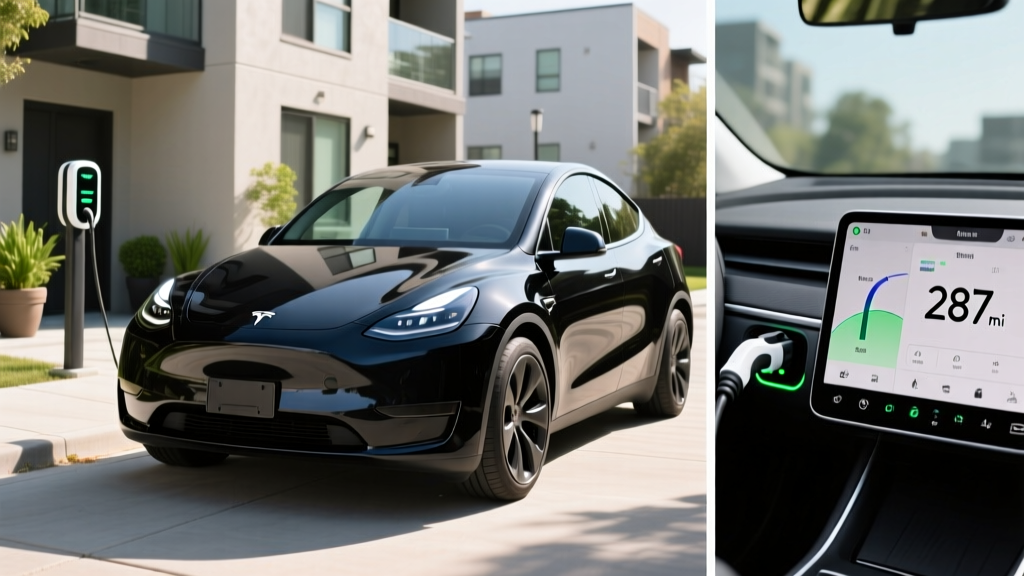
Tesla's marketing leans heavily on headline numbers: EPA range estimates, 0-60 times, and starting MSRPs that look compelling on a billboard or Instagram ad. But as any seasoned EV buyer knows, the gap between what an automaker advertises and what you actually experience on the road can be significant. With the refreshed 2026 Tesla Model Y now in customer hands, we're putting Tesla's advertised claims under the microscope — range, charging, pricing, tax credits, and daily ownership — to separate marketing polish from measurable reality.
Tesla advertises up to 320 miles EPA for the 2026 Model Y Long Range AWD. In real-world highway driving at 70-75 mph, expect 265-285 miles. In freezing temperatures (below 30°F), that can drop to 220-245 miles due to battery heating demands and cabin climate load. The Standard Range RWD variant (295 mi EPA) typically delivers 240-260 miles on mixed highway trips.
2026 Tesla Model Y: Full Spec Table
| Spec | Standard Range RWD | Long Range AWD | Performance |
|---|---|---|---|
| EPA Range | 295 mi | 320 mi | 295 mi |
| Battery (usable) | 60 kWh LFP | 78.1 kWh NMC | 78.1 kWh NMC |
| Efficiency | 125 MPGe / 27 kWh/100mi | 119 MPGe / 28 kWh/100mi | 111 MPGe / 30 kWh/100mi |
| Max DC Charge | 175 kW | 250 kW | 250 kW |
| 10-80% DC Time | ~28 min | ~22 min | ~22 min |
| Level 2 (240V/48A) | ~30 mi/hr (11.5 kW) | ~44 mi/hr (11.5 kW) | ~44 mi/hr (11.5 kW) |
| 0-60 mph | 6.2 sec | 4.8 sec | 3.5 sec |
| Horsepower | 295 hp | 384 hp | 456 hp |
| Drivetrain | RWD (single motor) | AWD (dual motor) | AWD (dual motor) |
| Base MSRP | $44,990 | $48,990 | $53,990 |
| Cargo (rear seats up) | 30.2 cu ft | 30.2 cu ft | 30.2 cu ft |
| Cargo (rear folded) | 72.1 cu ft | 72.1 cu ft | 72.1 cu ft |
| Rear Legroom | 40.5 in | 40.5 in | 40.5 in |
Source: EPA fueleconomy.gov, Tesla.com 2026 configurator.
What Tesla Advertises for Charging — and What You Actually Get
Tesla advertises the Model Y Long Range and Performance as capable of adding "up to 193 miles in 15 minutes" at a V3 or V4 Supercharger. That claim requires specific conditions: a battery preconditioned via navigation routing to a Supercharger, a stall operating at full capacity, and a state of charge (SoC) below 30% when you plug in.
Here's the charging reality most buyers should internalize:
- Peak vs sustained: The 250 kW peak on Long Range/Performance models is only sustained roughly from 5-25% SoC. Above 50%, the charge curve tapers significantly — dropping to ~100 kW by 65% and ~50 kW by 80%. This is why Tesla quotes 10-80% times rather than 0-100%.
- Preconditioning matters enormously. If you drive to a Supercharger without routing through the car's navigation (which triggers battery heating), your peak charge rate may be 40-60% lower, especially in cold weather.
- Home Level 2: With a Tesla Wall Connector on a 60-amp circuit (48A continuous), expect ~44 miles of range per hour of charging on the Long Range. A full overnight charge (8 hours) adds roughly 350 miles — more than enough for any daily routine.
- LFP caveat (Standard Range): The Standard Range RWD uses an LFP (lithium iron phosphate) battery. LFP charges slower at peak (175 kW) and the taper begins earlier. However, LFP chemistry tolerates regular 100% charging without accelerated degradation — Tesla actually recommends charging to 100% at least weekly on LFP packs.
| Charging Level | Power | Miles Added/Hr | Best Use Case |
|---|---|---|---|
| Level 1 (120V/12A) | 1.4 kW | ~3-4 mi/hr | Emergency / trickle top-off |
| Level 2 (240V/48A) | 11.5 kW | 30-44 mi/hr | Daily home charging |
| DC Fast (peak) | 175-250 kW | ~750-1,000 mi/hr* | Road trips |
*Peak rate at low SoC — sustained average is significantly lower. Real-world 10-80% session averages ~120-160 kW on Long Range.
2026 Model Y Pricing: MSRP, Tax Credits, and What You'll Actually Pay
Tesla advertises aggressive starting prices, but the as-tested numbers shift quickly once you add options and factor in the federal tax credit. Here's what the 2026 Model Y lineup looks like after applying IRS §30D rules.
| Trim | Base MSRP | As-Tested* | §30D Credit | Net Price |
|---|---|---|---|---|
| Standard Range RWD | $44,990 | $46,490 | $7,500 | $38,990 |
| Long Range AWD | $48,990 | $51,490 | $7,500 | $43,990 |
| Performance | $53,990 | $56,490 | $7,500 | $48,990 |
*As-tested includes $1,390 destination + $1,500-2,500 typical options (paint, wheels). Prices as of early 2026.
The full $7,500 credit under IRS §30D requires all of the following:
- MSRP cap: SUVs/vans must be under $80,000 (all Model Y trims qualify).
- Buyer income cap: Modified AGI ≤ $300,000 (joint), $225,000 (head of household), $150,000 (single).
- Battery sourcing: Critical minerals and battery components must meet escalating domestic/free-trade-partner percentages. As of 2026, Tesla's US-built Model Y with US-sourced LFP and NMC cells meets current thresholds, but Tesla adjusts supply chains frequently — verify at purchase.
- Point-of-sale transfer: You can transfer the credit to the dealer at purchase for an immediate price reduction, or claim it on your tax return. Consult a tax professional for your specific situation.
Driver Assistance: Autopilot, FSD, and the SAE Level Reality
Both Autopilot (standard) and Full Self-Driving Supervised ($8,000 option or $99/mo) are SAE Level 2 systems. The driver must remain fully engaged, hands on or near the wheel, and eyes on the road at all times. The Model Y is not a self-driving vehicle. Level 4 driverless capability (no human monitoring required) exists only in geofenced robotaxi services like Waymo.
Every 2026 Model Y ships with Tesla's basic Autopilot, which provides adaptive cruise control and lane-centering on highways. The optional FSD (Supervised) adds automatic lane changes, traffic-light and stop-sign recognition, and navigation-guided on/off-ramp handling. In our testing, FSD handles well-marked interstate driving competently but requires frequent driver intervention on poorly marked surface streets, construction zones, and complex intersections.
- Drive without an attentive, licensed driver in the seat
- Reliably handle unmapped roads, severe weather, or construction zones
- Eliminate liability — you remain the responsible driver in all situations
- Replace situational awareness — sudden cut-ins, emergency vehicles, and pedestrians still require manual takeover
Interior, Tech, and Practicality: Where Tesla's Minimalism Shines (and Falls Short)
The 2026 Model Y's refreshed interior (codenamed "Juniper") adds ventilated front seats, ambient lighting, a rear-seat touchscreen, and improved sound insulation. Cargo space remains a strong suit at 30.2 cu ft behind the second row and 72.1 cu ft with seats folded — competitive with the Hyundai Ioniq 5 and slightly ahead of the Ford Mustang Mach-E.
The 15.4-inch center touchscreen handles all vehicle functions — there are no physical buttons for climate, mirrors, or glovebox. This is polarizing: some owners love the clean aesthetic; others find it distracting while driving. The lack of a traditional instrument cluster means speed and navigation info lives in the upper-left corner of the main screen or on the optional heads-up display introduced for 2026.
Notable drawbacks:
- No Apple CarPlay or Android Auto. Tesla's proprietary infotainment is capable but closed.
- Phantom braking. NHTSA has investigated Tesla's automatic emergency braking for false activations — a concern for stop-and-go commuters.
- Ride firmness. The Performance trim's 21-inch wheels and sport suspension transmit road imperfections noticeably on rough pavement.
- Service access. Tesla's mobile-ranger and service-center network has expanded but still trails legacy automakers in rural coverage.
Pros and Cons: The Honest Summary
- Best-in-class Supercharger network (20,000+ stalls in North America)
- Strong efficiency: 119-125 MPGe across trims
- Over-the-air updates add features post-purchase
- Generous cargo space (72.1 cu ft) and frunk storage
- Excellent 0-60 performance, especially Performance trim
- Full §30D tax credit eligibility on all trims
- No Apple CarPlay / Android Auto
- FSD remains Level 2 — not self-driving despite the name
- Minimalist interior frustrates some buyers
- LFP Standard Range has slower DC charging (175 kW peak)
- Insurance premiums 15-25% higher than comparable ICE SUVs
- Service center wait times in some markets
How the Model Y Stacks Up Against Key Competitors
The 2026 Model Y Long Range AWD competes directly with the Hyundai Ioniq 5 (Long Range AWD), Ford Mustang Mach-E (Extended Range AWD), and Chevrolet Equinox EV (RS AWD). Here's how they compare on the metrics that matter most:
| Metric | Tesla Model Y LR | Hyundai Ioniq 5 LR | Mach-E Ext. Range | Equinox EV RS |
|---|---|---|---|---|
| EPA Range | 320 mi | 290 mi | 305 mi | 307 mi |
| Max DC Charge | 250 kW | 350 kW* | 150 kW | 190 kW |
| Price (after credit) | ~$43,990 | ~$42,400 | ~$44,875 | ~$35,990 |
| NACS Native | ✅ | ✅ (2025+) | ✅ (2025+) | ✅ (2025+) |
| CarPlay | ❌ | ✅ | ✅ | ✅ |
*Ioniq 5 requires a 350 kW-capable charger (still limited in availability) to achieve peak rate. See Hyundai specs.
Bottom line: The Model Y still leads on EPA range and charging network access. The Ioniq 5 offers faster peak charging and CarPlay. The Equinox EV undercuts on price. The Mach-E is a strong all-rounder but lags on DC charge speed.
Battery Warranty and Long-Term Ownership
Tesla covers the Model Y battery and drive unit for 8 years / 120,000 miles (Long Range/Performance) or 8 years / 100,000 miles (Standard Range), whichever comes first, with a minimum 70% capacity retention threshold. This is competitive with Hyundai's 10-year/100,000-mile battery warranty, though Hyundai's capacity retention threshold is also 70%.
Real-world degradation data from fleet analytics (via Recurrent Auto) shows Tesla's NMC packs typically retain 88-92% capacity after 100,000 miles. The LFP chemistry in the Standard Range model shows even slower degradation — often above 94% at the same mileage — but charges more slowly and offers less range to begin with.
Who Should Buy the 2026 Model Y?
- You road-trip frequently and want the most reliable DC fast-charging network (Superchargers)
- You want maximum EPA range in a compact electric SUV (320 mi LR)
- You value OTA updates and a tech-forward cabin experience
- You can charge at home and want minimal public-charging dependency
- You need Apple CarPlay/Android Auto for daily navigation and music
- You want the lowest possible entry price (Equinox EV undercuts by ~$8,000 after credit)
- You live far from a Tesla service center and want dealer-based maintenance
- You want hands-free Level 3+ driving on highways (consider GM Super Cruise or Ford BlueCruise on competing models)
Frequently Asked Questions
What is the real-world range of the 2026 Tesla Model Y?
The EPA rates the Long Range AWD at 320 miles and the Standard Range RWD at 295 miles. In real-world highway driving at 70-75 mph, expect 265-285 miles (LR) and 240-260 miles (SR). Cold weather (below 30°F) can reduce range an additional 15-25%, dropping the LR to roughly 220-245 miles on winter road trips.
How fast does the Model Y charge at home and on the road?
At home on a 240V/48A Level 2 Tesla Wall Connector, the Long Range adds ~44 miles of range per hour (~11.5 kW). On a V3/V4 Supercharger, the LR peaks at 250 kW and charges 10-80% in approximately 22 minutes. The Standard Range (LFP battery) peaks at 175 kW and takes about 28 minutes for 10-80%.
Does the 2026 Model Y qualify for the $7,500 federal EV tax credit?
Yes — all Model Y trims currently qualify for the full $7,500 under IRS §30D, provided the buyer meets income caps ($300K joint / $150K single) and the vehicle's battery sourcing meets domestic-content thresholds at time of purchase. The credit can be applied as a point-of-sale discount. Always verify current eligibility at irs.gov before purchasing.
Is the Model Y worth buying over the Ioniq 5 or Mach-E?
It depends on your priorities. The Model Y wins on EPA range (320 mi vs 290-305 mi) and Supercharger network reliability. The Ioniq 5 wins on peak DC charge speed (350 kW) and CarPlay support. The Mach-E offers a more conventional interior layout. The Equinox EV wins on price. All four are strong choices — test-drive each and compare your local charging options.
Is Tesla's FSD actually self-driving?
No. Full Self-Driving (Supervised) is an SAE Level 2 driver-assistance system. It requires continuous driver supervision, hands near the wheel, and eyes on the road. You remain legally responsible for the vehicle at all times. True self-driving (Level 4) is currently only available in geofenced robotaxi services like Waymo, not in any consumer vehicle.
How much does insurance cost for a Model Y?
Model Y insurance premiums average 15-25% higher than comparable gasoline SUVs, typically $1,800-$2,800/year depending on your location, age, and driving record. Tesla offers its own insurance product in many states that uses real-time driving data to set rates, which can be cheaper for low-mileage or safe drivers.