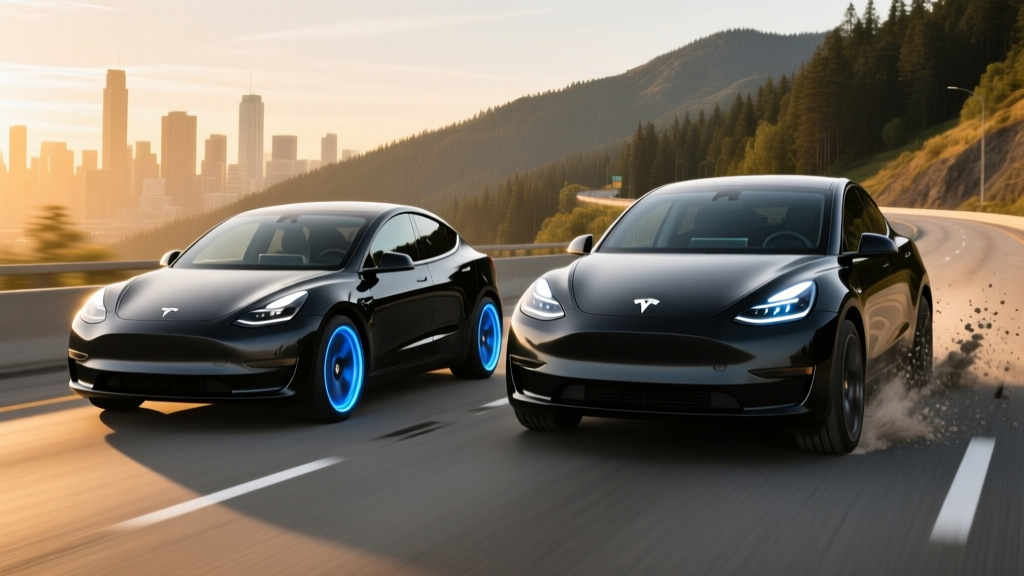
Tesla built its reputation on one visceral sensation: instant, relentless acceleration. Whether you're merging onto a fast-moving highway or simply pulling away from a stoplight, the way a Tesla accelerates reshapes what drivers expect from an everyday sedan or crossover. But in 2026, the EV performance landscape has shifted. Hyundai, Porsche, BMW, and even Ford now deliver sub-4-second 0-60 times. So how does Tesla acceleration stack up today — and does straight-line speed still justify the purchase?
This profile covers the current 2026 Tesla Model 3 and Model Y lineups — the two vehicles most buyers consider when they search for Tesla performance data. We'll give you exact 0-60 figures, EPA range, charging speeds, pricing after federal tax credits, and the real-world ownership calculus that spec sheets leave out.
2026 Tesla Model 3 & Model Y: Acceleration and Performance Specs
Tesla offers three primary performance tiers across the Model 3 and Model Y. The dual-motor and Performance variants deliver the acceleration numbers that made Tesla famous, while the base Long Range models trade a few tenths for better efficiency and lower pricing.
| Spec | Model 3 Long Range AWD | Model 3 Performance | Model Y Long Range AWD | Model Y Performance |
|---|---|---|---|---|
| 0-60 mph | 4.2 sec | 2.9 sec | 4.8 sec | 3.5 sec |
| Horsepower | ~384 hp | ~510 hp | ~384 hp | ~456 hp |
| Drivetrain | Dual-Motor AWD | Dual-Motor AWD | Dual-Motor AWD | Dual-Motor AWD |
| Top Speed | 125 mph | 163 mph | 135 mph | 155 mph |
| EPA Range | 341 mi | 296 mi | 310 mi | 277 mi |
| Battery (usable) | ~75 kWh (NMC) | ~75 kWh (NMC) | ~75 kWh (NMC) | ~75 kWh (NMC) |
| Efficiency | 130 MPGe / 26 kWh/100mi | 115 MPGe / 29 kWh/100mi | 122 MPGe / 28 kWh/100mi | 111 MPGe / 30 kWh/100mi |
The Model 3 Performance's 2.9-second 0-60 time remains one of the quickest in its price class — undercutting the BMW i4 M50 (3.7 sec) and rivaling the Porsche Taycan 4S (3.8 sec) at a fraction of the cost. The Model Y Performance, while slower at 3.5 seconds, still outpaces nearly every three-row crossover on the market, gas or electric.
What makes Tesla acceleration feel so distinctive isn't just peak power — it's the instant torque delivery from dual permanent-magnet and induction motors with no gear shifts. The result is linear, uninterrupted thrust from 0 mph through highway speeds. Track Mode on Performance trims also allows adjustable torque bias and regenerative braking intensity for closed-course driving.
Real-World Range: What the EPA Sticker Doesn't Tell You
The Model 3 Long Range carries a 341-mile EPA estimate. In mixed real-world driving at 70-75 mph highway speeds, expect 270-300 miles before needing a charge. In cold weather (below 30°F), that range can drop to 230-260 miles due to battery resistance and cabin heating demands. The Model Y Long Range's 310-mile EPA figure translates to roughly 250-280 miles highway and 210-240 miles in winter conditions.
Performance trims sacrifice 30-50 miles of range for the additional power output and wider tires.
Source: EPA Fuel Economy — always cross-reference the specific trim and model year.
Tesla's thermal management system, including the octovalve heat pump introduced with the Model Y and carried into the refreshed Model 3, mitigates some cold-weather losses by scavenging waste heat from the drivetrain. However, physics is physics: any EV loses 15-30% of rated range in sub-freezing temperatures, and Teslas are no exception. Preconditioning the battery while plugged in — a feature Tesla enables via the app and scheduled departure settings — recovers a meaningful portion of that loss.
Charging Speed: DC Fast Charge and Home Level 2
Tesla's Supercharger network remains the gold standard for public charging reliability, and the 2026 Model 3 and Model Y support peak DC fast-charge rates up to 250 kW on V3 Superchargers. Here's what that translates to in actual charging sessions:
| Charging Level | Power / Rate | Time or Miles Added |
|---|---|---|
| DC Fast Charge (V3 Supercharger) | Peak 250 kW | 10-80% in ~25-28 min |
| DC Fast Charge (V4 Supercharger) | Peak 250 kW (vehicle-limited) | Similar to V3 for current vehicles |
| Home Level 2 (Tesla Wall Connector, 48A) | 11.5 kW | ~44 miles of range per hour |
| Home Level 2 (Generic J1772 w/ NACS adapter) | Up to 11.5 kW | ~44 mi/hr at 48A; varies by unit |
| Level 1 (120V household outlet) | ~1.4 kW | ~3-4 miles per hour |
A critical nuance that spec sheets obscure: the 250 kW peak only sustains between roughly 10-30% State of Charge. Above 50%, the charge curve tapers significantly — you'll see 100-120 kW through the mid-range, dropping below 50 kW past 80%. This is why Tesla's own navigation system recommends charging to 80% on road trips rather than waiting for a full battery. The 10-80% time of 25-28 minutes is realistic when the battery is properly preconditioned (the car does this automatically when a Supercharger is set as your navigation destination).
At home, the Tesla Wall Connector on a 60A circuit delivers 48A continuous (11.5 kW), adding roughly 44 miles of range per hour. An overnight 8-hour session restores approximately 350 miles — more than enough for any daily driving scenario. Installation typically requires a 60A breaker on a 240V circuit; if your electrical panel is at capacity, a panel upgrade ($1,500-$3,000) may be necessary. Always consult a licensed electrician for final specifications.
Pricing, Trims, and Federal Tax Credit Eligibility
Tesla's pricing has fluctuated frequently over the past two years. As of early 2026, here are the base MSRPs and approximate out-the-door figures after the federal tax credit:
| Trim | Base MSRP | Est. Federal Credit (§30D) | Effective Price |
|---|---|---|---|
| Model 3 Long Range AWD | $42,380 | Up to $7,500* | ~$34,880 |
| Model 3 Performance | $49,380 | Up to $7,500* | ~$41,880 |
| Model Y Long Range AWD | $44,380 | Up to $7,500* | ~$36,880 |
| Model Y Performance | $48,380 | Up to $7,500* | ~$40,880 |
*Federal EV tax credit eligibility under IRS §30D requires meeting all of the following conditions:
- Buyer income cap: Modified AGI must not exceed $150,000 (single), $225,000 (head of household), or $300,000 (joint filers)
- MSRP cap: Vehicle MSRP must be $55,000 or below for sedans (Model 3); $80,000 or below for SUVs/trucks (Model Y)
- Battery sourcing: Critical minerals and battery components must meet phased-in domestic-sourcing thresholds that tighten annually through 2029
- Point-of-sale transfer: As of 2024, the credit can be transferred to the dealer at purchase, reducing your out-of-pocket cost immediately
Both the Model 3 and Model Y currently fall under their respective MSRP caps. However, battery-sourcing requirements are the variable that changes most frequently. Tesla has shifted significant battery supply chain sourcing to meet §30D thresholds, but buyers should verify current eligibility on the IRS qualified vehicles list before purchasing, as eligibility can change mid-year.
Destination fees ($1,390), paint upgrades ($1,000-$2,500), FSD capability ($8,000 one-time or $99/month), and Enhanced Autopilot ($6,000) add to the final price. A fully optioned Model 3 Performance with FSD can approach $58,000 — still under the sedan cap but eroding the value proposition.
Interior, Cargo, and Technology
The 2026 Model 3 (the "Highland" refresh) brought meaningful interior improvements: ventilated front seats, ambient lighting, rear-seat touchscreen, improved sound insulation, and a removal of stalk-mounted turn signals in favor of steering-wheel buttons (a polarizing choice). The Model Y received its "Juniper" refresh for 2025-2026 with similar upgrades.
Model 3 cargo: 23 cu ft trunk + rear frunk. Passenger volume: 97 cu ft. Rear legroom: 35.2 inches — adequate for adults on shorter trips, tight for long highway rides.
Model Y cargo: 30 cu ft behind the second row (76 cu ft with seats folded) + rear frunk. Passenger volume: 106 cu ft. Rear legroom: 40.5 inches. The Model Y's hatchback design and available third-row seat (best suited for children) make it the more practical family vehicle.
The 15.4-inch center touchscreen controls virtually everything — climate, mirrors, glovebox, wiper speed. There is no traditional instrument cluster; speed and navigation appear on the left third of the main screen. This minimalist approach divides opinion, but the interface itself is responsive and well-organized.
On the driver-assistance front, Tesla's Autopilot (included) provides adaptive cruise control and lane-centering. Full Self-Driving (Supervised) adds automated lane changes, traffic-light recognition, and city-street navigation — but remains a SAE Level 2 system requiring continuous driver attention and hands-on-wheel engagement. It is not autonomous driving. Tesla's FSD has drawn scrutiny from NHTSA for incidents involving driver inattention; buyers should understand exactly what this system does and does not do before paying for it.
Battery Warranty, Degradation, and Long-Term Ownership
Tesla provides an 8-year / 120,000-mile battery and drive unit warranty on the Model 3 Long Range and Performance (the standard RWD Model 3 gets 8 years / 100,000 miles). The Model Y carries the same 8-year / 120,000-mile coverage. The warranty guarantees that the battery will retain at least 70% of its original capacity over the warranty period.
Real-world degradation data from fleet analyses and owner reports suggests that Tesla's NMC (nickel-manganese-cobalt) batteries typically lose 5-8% of capacity in the first 50,000 miles, then degrade more slowly — often retaining 88-92% capacity at 100,000 miles. Best practices for longevity include:
- Charging to 80% for daily use (the car's built-in charge-limit setting)
- Avoiding frequent DC fast charging when Level 2 is available
- Not leaving the vehicle at 100% SoC for extended periods
- Allowing the battery management system to balance cells by occasionally charging to 100% (once a month is reasonable)
Battery replacement outside of warranty remains expensive — estimates range from $12,000 to $16,000 for a Model 3/Y pack, though third-party refurbishment options are becoming more available.
Pros, Cons, and the Competition
Pros
- Class-leading acceleration per dollar (Model 3 Performance: 2.9 sec at ~$42K after credit)
- Supercharger network — still the most reliable DC fast-charge ecosystem
- OTA updates continuously add features and refine performance
- Strong efficiency (130 MPGe on Model 3 LR) reduces electricity cost
- Excellent resale value relative to most EVs
Cons
- Minimalist interior and stalkless controls polarize buyers
- FSD (Supervised) is expensive and remains Level 2 — not autonomous
- Rear-seat comfort in Model 3 trails competitors (Hyundai Ioniq 6, BMW i4)
- No Apple CarPlay or Android Auto
- Service center availability varies significantly by region
Key competitors to cross-shop: The Hyundai Ioniq 6 offers comparable range (361 mi EPA) at a lower starting price, though with slower acceleration. The BMW i4 delivers a more traditional luxury interior with CarPlay but costs significantly more. The Ford Mustang Mach-E GT (3.5 sec 0-60) competes with the Model Y Performance on speed but trails on range and charging infrastructure access. The Polestar 4 offers strong performance and a premium cabin at a higher price point.
Who Should Buy a Tesla for Its Acceleration?
Decision Framework
Choose the Model 3 Performance if: You want sub-3-second acceleration on a budget under $50K, prioritize driving dynamics, and don't need cargo space for a family.
Choose the Model Y Performance if: You need crossover practicality (cargo, optional third row, easier child-seat installation) but still want sports-sedan acceleration for highway merging and passing.
Choose the Long Range AWD trims if: You value maximum range and lower cost over peak acceleration — the 4.2-4.8 second 0-60 times are still quicker than most gas-powered vehicles in their price range.
Look elsewhere if: You want Apple CarPlay, a traditional instrument cluster, a luxury-branded dealership experience, or rear-seat comfort that rivals a midsize luxury sedan.
Frequently Asked Questions
What is the real-world range of a 2026 Tesla Model 3?
The Model 3 Long Range AWD carries a 341-mile EPA estimate. In real-world highway driving at 70-75 mph, expect 270-300 miles. In cold weather below 30°F, plan for 230-260 miles. The Performance trim sacrifices roughly 45 miles due to wider tires and higher power output.
How fast does a Tesla charge at home and on the road?
On a V3 Supercharger, the Model 3 and Model Y peak at 250 kW, achieving a 10-80% charge in approximately 25-28 minutes with battery preconditioning. At home on a Tesla Wall Connector (48A / 11.5 kW), you'll add about 44 miles of range per hour — a full overnight session restores the entire battery.
How much does a 2026 Tesla cost after the federal tax credit?
The Model 3 Long Range AWD starts at $42,380 and can drop to approximately $34,880 after the $7,500 §30D credit — if you meet income caps ($150K single / $300K joint) and the vehicle's battery sourcing qualifies at time of purchase. Always verify on the IRS qualified vehicles list before buying.
Does Tesla's Full Self-Driving make the car autonomous?
No. FSD (Supervised) is an SAE Level 2 driver-assistance system. The driver must remain fully attentive, keep hands on the wheel, and be prepared to take over at any moment. It is not self-driving. Only Level 4 services like Waymo operate without a driver in defined geographic zones.
Is a Tesla worth buying vs. competitors in 2026?
If acceleration-per-dollar, Supercharger access, and efficiency are your top priorities, the Model 3 Performance and Model Y Long Range remain compelling. If you prioritize interior luxury, rear-seat comfort, or smartphone integration (CarPlay/Android Auto), the BMW i4, Hyundai Ioniq 6, or Polestar 4 deserve serious consideration. Test-drive both sides before deciding.