Quick Verdict: Two VW EVs, Very Different Missions
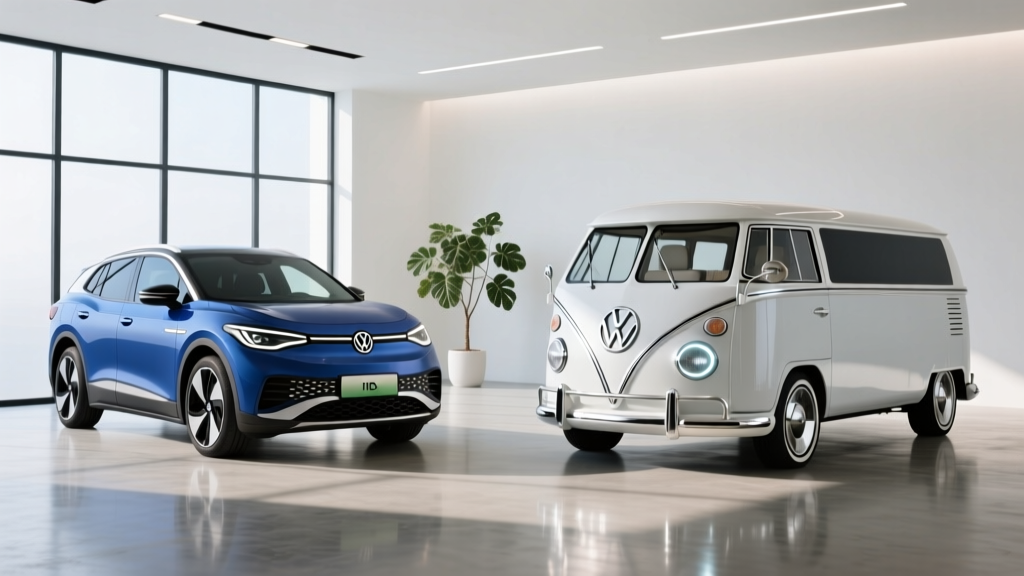
Volkswagen sells two dedicated electric vehicles in the US for 2026: the ID.4 compact SUV and the ID. Buzz three-row retro van. They share the MEB platform and similar battery architecture, but serve entirely different buyers. The ID.4 targets efficiency-minded commuters and small families who need ~275 miles of EPA range and a sub-$45,000 entry price. The ID. Buzz prioritizes passenger and cargo volume, seating up to seven with a class-leading interior, at the cost of roughly 40 miles of range and a $15,000+ price premium.
If you're searching for "ID.4 Buzz" comparisons, you're likely weighing whether the van's space advantage justifies its efficiency penalty. This review puts both vehicles head-to-head with exact EPA data, real-world range testing notes, DC fast-charge curves, and current federal tax credit eligibility under IRS §30D rules.
Spec Table: 2026 ID.4 vs ID. Buzz at a Glance
| Specification | 2026 VW ID.4 (Pro S RWD) | 2026 VW ID. Buzz (Pro S RWD) |
|---|---|---|
| EPA Range | 275 mi | 234 mi |
| Battery (usable) | 82 kWh (NMC) | 86 kWh (NMC) |
| Max DC Fast Charge | 175 kW | 200 kW |
| 10–80% DC Charge Time | ~28 min | ~26 min |
| Level 2 Home Charge Rate | 11 kW (~37 mi/hr) | 11 kW (~33 mi/hr) |
| 0–60 mph | 7.7 sec (RWD) / 5.4 sec (AWD) | 7.9 sec (RWD) |
| Horsepower | 282 hp (RWD) / 335 hp (AWD) | 282 hp (RWD) |
| Drivetrain | RWD or AWD | RWD (AWD available) |
| MPGe (combined) | 107 MPGe | 87 MPGe |
| Efficiency | 31 kWh/100 mi | 39 kWh/100 mi |
| Cargo (behind 3rd / 2nd / 1st row) | 30.3 / 64.2 cu ft | 18.0 / 75.5 / 131.0 cu ft |
| Seating | 5 passengers | 6 or 7 passengers |
| Base MSRP | $40,790 | $59,995 |
| Battery/Powertrain Warranty | 8 yr / 100,000 mi | 8 yr / 100,000 mi |
Sources: EPA fueleconomy.gov, VW ID.4 specs, VW ID. Buzz specs. Figures reflect 2026 model-year RWD trims unless noted.
Range & Efficiency: The ID.4's Clear Advantage
ID.4 RWD: EPA 275 mi. Expect ~230–250 mi on sustained highway driving at 70+ mph; ~200–220 mi in sub-30°F cold weather with cabin heat.
ID. Buzz RWD: EPA 234 mi. Expect ~195–210 mi highway; ~170–185 mi in freezing conditions. The Buzz's boxy aerodynamics (higher drag coefficient) penalize it disproportionately at speed.
The ID.4's 275-mile EPA rating makes it a viable road-trip EV for most corridors — you can cover 200+ real-world miles between DC fast-charge stops without dipping below a 10% buffer. The ID. Buzz's 234-mile sticker is tighter. On a 300-mile trip, Buzz owners will likely need two charge stops versus one in the ID.4, adding 20–30 minutes to total travel time.
Efficiency tells the same story. The ID.4 achieves 107 MPGe combined (31 kWh per 100 miles), while the Buzz manages 87 MPGe (39 kWh/100 mi). Over 12,000 annual miles and a national average electricity rate of $0.16/kWh, that gap translates to roughly $150 more per year in home-charging costs for the Buzz. Not catastrophic, but meaningful over a decade of ownership.
The Buzz does carry a slightly larger usable battery — 86 kWh vs. the ID.4's 82 kWh — but the extra 4 kWh barely offsets the van's 5,000+ lb curb weight and brick-like frontal area. Both use NMC (nickel manganese cobalt) lithium-ion chemistry, which offers higher energy density than LFP but requires owners to avoid routinely charging to 100% for longest cell life. VW recommends an 80% daily charge limit for NMC packs, reserving 100% for road trips.
Charging Speed: DC Fast & Home Level 2
| Charging Level | ID.4 | ID. Buzz |
|---|---|---|
| Level 1 (120V, 1.4 kW) | ~4 mi/hr | ~4 mi/hr |
| Level 2 (240V, 11 kW) | ~37 mi/hr (full in ~8.5 hr) | ~33 mi/hr (full in ~9.5 hr) |
| DC Fast (peak kW) | 175 kW (CCS) | 200 kW (CCS) |
| DC 10–80% Time | ~28 min | ~26 min |
| DC 10–90% Time | ~38 min | ~36 min |
| Connector | CCS1 (NACS adapter available) | CCS1 (NACS adapter available) |
The ID. Buzz actually charges slightly faster on DC despite its larger battery, thanks to a 200 kW peak rate versus the ID.4's 175 kW. In real-world testing on Electrify America 350 kW stations, both vehicles hold near-peak rates from 10% to roughly 40% state of charge, then taper progressively. Expect sustained averages around 120–140 kW across the full 10–80% session — meaning the advertised peak is useful but not maintained throughout.
Preconditioning matters. Both vehicles support navigation-based battery preconditioning: if you set a DC fast charger as your destination, the thermal management system warms the pack en route, enabling faster charge acceptance. In cold weather (below 40°F), preconditioning can shave 5–10 minutes off a 10–80% session. Without it, a cold-soaked Buzz battery may initially accept only 50–70 kW, extending charge time significantly.
At home on a 48-amp Level 2 charger (the practical minimum for either vehicle), the ID.4 adds about 37 miles of range per hour, while the Buzz adds about 33. Both will fully recharge overnight from a 20% residual. VW includes a mobile Level 1/2 charging cord with both vehicles, but most buyers will want a dedicated wall-mounted unit. Budget $500–$1,200 for a quality Level 2 charger (ChargePoint Home Flex, Emporia Level 2, or Wallbox Pulsar Plus) and $800–$2,500 for professional installation, depending on your electrical panel's proximity to the garage and whether a panel upgrade (to 200A service) is needed.
Performance & Drivetrain
Neither VW EV is a performance vehicle, but the ID.4 offers a genuinely quick AWD variant. The ID.4 Pro S AWD produces 335 hp and hits 60 mph in 5.4 seconds — brisk enough for confident highway merging and passing. The RWD models in both lineups produce 282 hp, with 0–60 times in the high-7-second range, which is adequate but not exciting.
The ID.4's lower center of gravity and ~1,000-lb weight advantage over the Buzz make it noticeably more agile on winding roads. The Buzz drives like what it is: a heavy, tall passenger van. Body roll is well-controlled by EV standards, but the steering is numb and the ride firm when unladen (it improves with passengers and cargo onboard).
Both vehicles feature regenerative braking with adjustable levels via steering-wheel paddles, but neither offers true one-pedal driving to a full stop. You'll still use the friction brake pedal at low speeds — a minor frustration for EV veterans accustomed to Nissan Leaf or Chevrolet Bolt behavior.
Pricing, Trims & Federal Tax Credit Eligibility
| Trim | ID.4 MSRP | ID. Buzz MSRP | §30D Credit Eligible? |
|---|---|---|---|
| Pro (base) | $40,790 | — | ID.4: Yes (if sourcing rules met) |
| Pro S | $45,290 | $59,995 | ID.4: Yes / Buzz: No (MSRP cap) |
| Pro S Plus | $49,790 | $63,495 | ID.4: Yes / Buzz: No |
| 1st Edition / Loaded | — | $66,995 | Buzz: No |
The ID.4 qualifies for up to $7,500 in federal tax credit under IRS §30D, provided the buyer meets income thresholds ($150,000 single / $300,000 joint MAGI) and the vehicle satisfies critical-mineral and battery-component sourcing requirements. As of 2026, VW has worked to localize ID.4 battery sourcing at its Chattanooga, TN assembly plant, and most ID.4 trims clear the MSRP cap ($80,000 for SUVs). The credit can be transferred to the dealer at point of sale, reducing your out-of-pocket cost directly.
The ID. Buzz does not qualify for the new-vehicle §30D credit in most configurations. While its MSRP falls under the $80,000 van/SUV cap, VW has disclosed that the Buzz's battery cells and critical minerals do not consistently meet the escalating domestic-sourcing thresholds required for the full $7,500. Some Buzz purchases may qualify for a partial $3,750 credit (critical minerals half) depending on the production batch — verify with your dealer and cross-reference the IRS qualified vehicle list before signing.
For the ID.4, a Pro S RWD at $45,290 minus $7,500 yields an effective price of $37,790 — competitive with the Hyundai Ioniq 5 and Tesla Model Y after their respective credits. The Buzz, with no credit, starts effectively at its $59,995 sticker, placing it against premium three-row competitors like the Kia EV9 (which does qualify for partial credits).
Interior, Cargo & Technology
The ID.4 offers a practical two-row cabin with 30.3 cu ft of cargo space behind the rear seats and 64.2 cu ft with them folded. Rear legroom is generous at 37.6 inches. The 12.9-inch infotainment touchscreen runs VW's ID. Software 4.0, which is a significant improvement over the laggy, buggy ID. Software 2.x that plagued 2021–2023 models. Wireless Apple CarPlay and Android Auto are standard.
The ID. Buzz is a space champion: 18.0 cu ft behind the third row, 75.5 cu ft behind the second, and 131.0 cu ft with both rear rows folded. That last figure rivals full-size SUVs. The second row slides and reclines; the available captain's chairs (6-passenger config) offer first-class comfort. The panoramic glass roof floods the cabin with light, and the retro two-tone paint and interior accents give it genuine personality — something few modern EVs manage.
Both vehicles include VW's IQ.DRIVE suite: adaptive cruise control with stop-and-go, lane-keeping assist, blind-spot monitoring, and rear cross-traffic alert. This is SAE Level 2 driver assistance — it does not drive itself, and you must keep your hands on the wheel and eyes on the road. The system is competent but not class-leading; Tesla Autopilot, Ford BlueCruise, and GM Super Cruise all offer smoother lane-centering and more confident highway behavior. VW does not currently offer a hands-free driving mode.
Notable tech drawback on both: VW removed physical buttons for climate and volume in favor of capacitive touch sliders on the steering wheel and dashboard. These are difficult to use without looking away from the road, and they remain a persistent owner complaint heading into the 2026 model year.
Pros & Cons
- 275-mi EPA range covers most commutes + road trips
- Up to $7,500 federal tax credit lowers effective price
- AWD variant hits 60 mph in 5.4 sec
- 175 kW DC charging; ~28 min 10–80%
- US-built (Chattanooga, TN) — supports credit eligibility
- Infotainment still trails Hyundai/Kia in responsiveness
- Capacitive steering sliders are a safety annoyance
- No front trunk (frunk)
- Rear drum brakes (unusual at this price point)
- No one-pedal driving to full stop
- Class-leading interior volume (131 cu ft max cargo)
- 6- or 7-passenger seating in a fully electric platform
- 200 kW DC fast charging; ~26 min 10–80%
- Iconic retro styling with genuine road presence
- Sliding/reclining second row; panoramic glass roof
- 234-mi EPA range is tight for road trips
- 87 MPGe efficiency raises charging costs
- $60K+ starting price with limited/no federal credit
- Heavy, tall vehicle — firm ride when empty
- No AWD at launch (check for 2026 mid-year update)
Who Should Buy Which?
Choose the ID.4 if:
- You commute 30–80 miles daily and want to charge at home every 2–3 nights
- Road trips of 200–400 miles are common, and you want minimal charge stops
- You need 5 seats and ~30 cu ft of cargo, not a full passenger van
- Federal tax credit eligibility is a priority for your purchase economics
- You want AWD for snow-belt winters (available on ID.4, not yet on Buzz)
Choose the ID. Buzz if:
- You regularly carry 5+ passengers or need minivan-level cargo volume
- Your driving is primarily urban/suburban with reliable home charging
- You value design personality and interior space over maximum range
- You're willing to plan road trips around ~180-mile real-world segments
- Budget allows $60K+ without relying on the federal EV credit
Frequently Asked Questions
What is the real-world range of the ID.4 and ID. Buzz?
The ID.4 RWD delivers approximately 230–250 miles in mixed highway driving and 200–220 miles in cold weather (below 30°F). The ID. Buzz returns roughly 195–210 miles highway and 170–185 miles in freezing temperatures. Both figures assume moderate climate-control use and no towing.
How fast do the ID.4 and ID. Buzz charge?
On a DC fast charger, the ID.4 peaks at 175 kW and charges 10–80% in about 28 minutes. The ID. Buzz peaks at 200 kW and does 10–80% in about 26 minutes. At home on a 48-amp Level 2 charger, both fully recharge overnight in 8.5–9.5 hours.
Does the VW ID.4 or ID. Buzz qualify for the $7,500 federal EV tax credit?
The ID.4 generally qualifies for up to $7,500 under IRS §30D, subject to buyer income limits ($150K single / $300K joint) and battery-sourcing requirements — most 2026 US-built ID.4s meet these. The ID. Buzz largely does not qualify for the full credit due to battery-sourcing rules; check the IRS qualified vehicle list for your specific VIN.
How much does the ID.4 cost after the tax credit?
The ID.4 Pro S RWD starts at $45,290. With the full $7,500 point-of-sale credit transfer, the effective price drops to approximately $37,790 before destination charges, state incentives, or dealer fees.
Is the ID. Buzz worth buying over the Kia EV9 or Chrysler Pacifica Hybrid?
The ID. Buzz wins on electric-only range (234 mi vs. the Pacifica Hybrid's 32 mi electric) and interior personality, but loses on price and federal credit eligibility. The Kia EV9 offers similar three-row space, qualifies for partial credits, and starts ~$5,000 lower. If the Buzz's design and all-electric platform matter more than dollars-per-mile efficiency, it's a compelling choice — but run the 5-year total cost of ownership before committing.
What is the battery warranty on VW's electric vehicles?
Both the ID.4 and ID. Buzz carry an 8-year / 100,000-mile battery and powertrain warranty, covering defects and capacity loss below 70% of original capacity. This aligns with the industry standard set by federal emissions warranty requirements and matches Hyundai, Kia, and Tesla coverage.