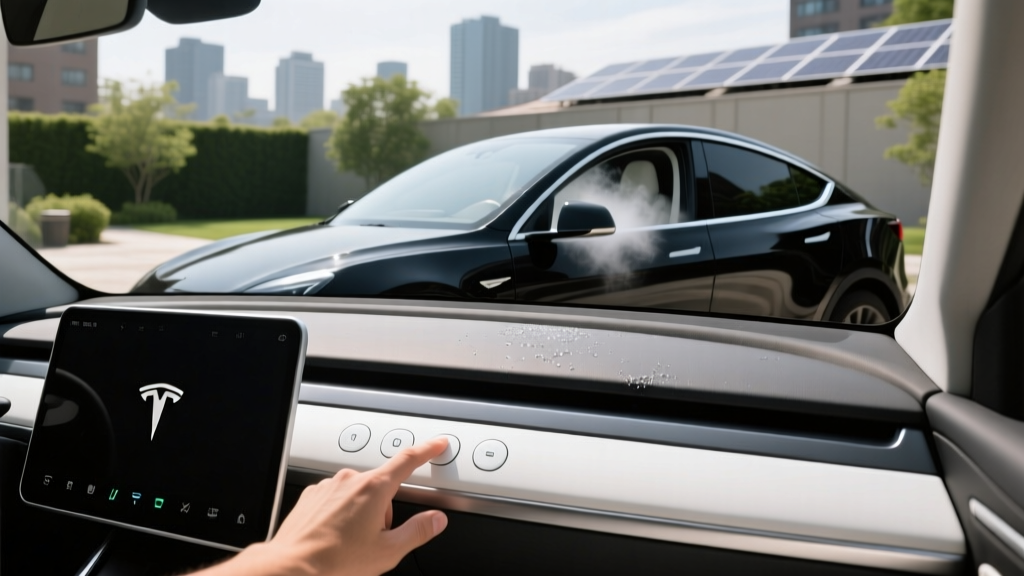
If you've noticed a musty, sour, or "dirty socks" odor blasting from your Tesla's vents, you aren't alone. The Tesla air conditioning smell is one of the most frequently reported ownership quirks across Model Y, Model 3, Model S, and Model X forums. It's rarely a sign of mechanical failure — but it is a sign that your cabin air filtration system needs attention.
Below, we break down exactly why this smell develops in Tesla's HVAC system, the proven fixes (including the HEPA filter upgrade path), and what Tesla has changed in its 2026 models to address the issue. Then, because many readers searching for this topic are also evaluating whether to buy a Tesla, we've included a full 2026 Model Y Long Range AWD profile with real-world range data, charging specs, and tax credit details.
Why Teslas Develop That Air Conditioning Smell
The odor originates from microbial growth — mold, mildew, and bacteria — on the evaporator coil inside the HVAC assembly. This happens in every car to some degree, but Teslas are particularly susceptible for three engineering reasons:
- No cabin air recirculation default after shutdown. Unlike many ICE vehicles that run the blower briefly after the engine stops to dry the evaporator, older Teslas shut the HVAC system down completely when you exit. Moisture lingers on the cold coil, creating a breeding ground.
- Single-stage cabin filter design (pre-2025 models). Earlier Model 3 and Model Y units used a single particulate filter that didn't adequately manage humidity or trap organic compounds before they reached the evaporator.
- Heat pump efficiency mode. Tesla's octovalve heat pump system (introduced in the Model Y and refreshed Model 3) cycles refrigerant in ways that can leave the evaporator colder and wetter for longer periods, especially in mild, humid climates.
The result: a distinct musty or vinegar-like smell during the first 30–60 seconds of AC operation, particularly after the car has sat overnight or in humid conditions.
Proven Fixes for Tesla Air Conditioning Smell
1. Replace Cabin Air Filters (Every 6 Months)
Tesla's official maintenance schedule recommends cabin air filter replacement every 2 years. Most owners dealing with odor issues find that every 6 months is more realistic, especially in humid climates (Florida, Texas, the Gulf Coast, Pacific Northwest). Use OEM Tesla HEPA-grade filters or high-quality aftermarket equivalents rated for activated carbon — carbon media adsorbs volatile organic compounds that standard particulate filters miss.
2. Run the "Cabin Overheat Protection" and Preconditioning Cycles
Running Cabin Overheat Protection keeps the blower active intermittently after you exit, which helps dry the evaporator. Similarly, preconditioning the cabin while plugged in before your commute dries the system with fresh outside air before you're sitting in it.
3. Aftermarket Evaporator Cleaning Kits
Products like the Kool-It evaporator foam cleaner can be sprayed into the HVAC intake (located at the base of the windshield) while the blower is running on fresh-air mode. This coats the evaporator coil with an antimicrobial treatment. Expect to do this every 12 months if the smell recurs.
4. 2025+ Model Y Refresh: Improved HVAC Logic
Tesla's 2025 Model Y "Juniper" refresh introduced updated HVAC software that runs a post-shutdown drying cycle — the blower continues at low speed for approximately 3 minutes after the vehicle is locked, actively drying the evaporator. Early owner reports suggest this significantly reduces odor recurrence. If you're buying new in 2026, this fix is already baked in.
2026 Tesla Model Y Long Range AWD: Full Spec Profile
With the HVAC smell context out of the way, here's the complete buyer's profile for the 2026 Model Y Long Range All-Wheel Drive — the highest-volume Tesla and the one most shoppers cross-shop against the Hyundai Ioniq 5, Ford Mustang Mach-E, and Chevrolet Equinox EV.
| Attribute | Specification |
|---|---|
| EPA Range | 320 miles |
| Battery (Usable) | ~75 kWh, NMC (Nickel Manganese Cobalt) |
| Drivetrain | Dual-Motor AWD |
| Horsepower | 384 hp combined |
| 0–60 mph | 4.8 seconds |
| Peak DC Fast Charge | 250 kW |
| 10–80% DC Fast Charge | ~25 minutes |
| Level 2 Home Charging (11.5 kW) | ~44 miles per hour |
| MPGe (Combined) | 111 MPGe |
| Efficiency | 30 kWh / 100 miles |
| Cargo (Behind 2nd Row) | 30.2 cu ft |
| Cargo (2nd Row Folded) | 72.0 cu ft |
| Rear Legroom | 40.5 inches |
| Battery Warranty | 8 years / 120,000 miles |
| Base MSRP | $48,990 (including destination) |
Charging: Home, Public, and the Supercharger Advantage
| Charging Level | Power | Miles Added per Hour | Notes |
|---|---|---|---|
| Level 1 (120V household) | ~1.4 kW | ~5 mi/hr | Emergency/trickle only |
| Level 2 (240V, 48A Wall Connector) | 11.5 kW | ~44 mi/hr | Full charge in ~7 hours |
| DC Fast Charge (Supercharger V3/V4) | 250 kW peak | ~200+ mi in 15 min | 10–80% in ~25 min |
| DC Fast Charge (CCS via adapter) | Up to 150 kW | Varies | Non-Tesla networks; NACS now standard |
The Model Y charges on the NACS (North American Charging Standard) connector natively. As of 2025, Tesla opened the Supercharger network to most non-Tesla EVs, but Tesla owners still benefit from the most seamless plug-and-charge experience in the industry — no app required, no payment fumbling.
Charging curve reality check: The 250 kW peak is achieved between approximately 10–30% state of charge. Above 50%, the rate tapers to roughly 100–120 kW. Above 80%, it drops further to under 40 kW. This is why Tesla (and all EV manufacturers) quote 10–80% times rather than 0–100%. For road trips, plan your stops around the 10–80% sweet spot to minimize total charging time.
Pricing, Trims, and Federal Tax Credit Eligibility
| Trim | MSRP | Est. After §30D Credit |
|---|---|---|
| Long Range AWD | $48,990 | ~$41,490 (if eligible) |
| Performance AWD | $53,490 | ~$45,990 (if eligible) |
The IRS §30D Clean Vehicle Credit offers up to $7,500 for qualifying new EVs, but eligibility depends on three factors that change frequently:
- MSRP cap: SUVs (including the Model Y) must have an MSRP at or below $80,000. Both trims qualify.
- Buyer income cap: Modified adjusted gross income must not exceed $150,000 (single), $225,000 (head of household), or $300,000 (joint filers).
- Battery sourcing requirements: A percentage of critical minerals and battery components must be sourced from the US or free-trade-agreement countries. Tesla has significantly localized its supply chain, and the Model Y built at Giga Texas has generally qualified for the full $7,500 credit in recent years — but this can change as sourcing rules tighten annually.
As of 2026, the credit can be transferred to the dealer at point of sale, reducing your purchase price upfront rather than waiting for tax filing. Always verify current eligibility on fueleconomy.gov before purchasing, as battery-sourcing compliance is updated periodically.
Tech, Driver Assistance, and Interior
The 2026 Model Y continues Tesla's minimalist interior approach — a single 15.4-inch center touchscreen handles everything from climate to navigation to media. The refreshed "Juniper" interior adds ventilated front seats, ambient lighting, a rear-seat touchscreen, and improved sound deadening over the pre-2025 model.
Standout tech: Over-the-air updates continue to add features post-purchase. The Tesla app provides best-in-class remote preconditioning, charging monitoring, and Sentry Mode camera access. The integrated navigation with real-time Supercharger routing is the most seamless road-trip planner in the EV market.
Notable drawbacks: No physical buttons for climate or volume (everything is on-screen or voice-controlled). No Apple CarPlay or Android Auto. Panel gap quality, while improved, still lags Hyundai and BMW at similar price points. The panoramic glass roof provides no shade — an aftermarket sunshade is a near-universal owner purchase.
Pros and Cons
- Supercharger network — best public charging infrastructure available
- Class-leading efficiency (30 kWh/100 mi)
- Spacious cargo area (72 cu ft with seats folded)
- Over-the-air updates add features continuously
- Strong resale value relative to non-Tesla EVs
- Heat pump standard — better cold-weather range retention
- Cabin AC smell in pre-2025 models requires proactive maintenance
- No Apple CarPlay / Android Auto
- Minimalist interior not for everyone — no physical controls
- Ride quality firm on 20-inch wheels
- Insurance premiums run 15–25% above segment average
- FSD (Supervised) costs $8,000 extra and remains Level 2
Who the 2026 Model Y Suits Best
Buy it if: You want the most practical all-around EV with the best public charging network, you regularly carry cargo or passengers (the 72 cu ft cargo space rivals midsize SUVs), and you can charge at home on Level 2. It's the default choice for EV-first families and daily commuters who also take 2–4 road trips per year.
Look elsewhere if: You want a more traditional interior with physical buttons (consider the Hyundai Ioniq 5 or BMW iX), you need a truck bed (Rivian R1T or Ford F-150 Lightning), or you're on a tighter budget (the Chevrolet Equinox EV starts ~$10,000 lower).
Frequently Asked Questions
What is the real-world range of the 2026 Tesla Model Y?
The EPA rates it at 320 miles. Real-world highway driving yields 275–290 miles in moderate weather and 230–260 miles in sub-freezing temperatures. Preconditioning while plugged in helps mitigate cold-weather losses.
How fast does the Model Y charge at home and on the road?
At home on a 240V/48A Tesla Wall Connector (11.5 kW), you'll add about 44 miles of range per hour — a full charge takes roughly 7 hours. On a V3/V4 Supercharger, the Model Y peaks at 250 kW and charges from 10–80% in about 25 minutes.
Does the 2026 Model Y qualify for the $7,500 federal EV tax credit?
It likely qualifies for the full $7,500 under §30D, provided you meet the income caps ($150K single / $300K joint) and the battery sourcing requirements are met for the specific build quarter. The credit can be applied at point of sale. Always confirm on fueleconomy.gov before purchasing.
Is the Tesla Model Y worth buying vs. the Hyundai Ioniq 5 or Ford Mach-E?
The Model Y wins on charging infrastructure (Supercharger network), efficiency, and cargo space. The Ioniq 5 offers faster peak charging (up to 350 kW on 800V architecture), a more conventional interior, and Apple CarPlay. The Mach-E offers a more engaging driving feel. All three are strong — your decision likely hinges on charging access and interior preference.
How do I permanently fix the Tesla air conditioning smell?
Replace cabin filters every 6 months with activated-carbon media, run an evaporator foam cleaning treatment annually, enable Cabin Overheat Protection, and precondition while plugged in. The 2025+ "Juniper" Model Y includes a post-shutdown evaporator drying cycle that significantly reduces recurrence. If the smell persists after all of the above, have the HVAC system inspected for a clogged condensate drain line.
What is the battery warranty on the Model Y?
Tesla covers the battery and drive unit for 8 years or 120,000 miles, whichever comes first, with a minimum 70% capacity retention threshold. This is competitive with Hyundai's 10-year/100,000-mile battery warranty and above the industry standard of 8 years/100,000 miles.