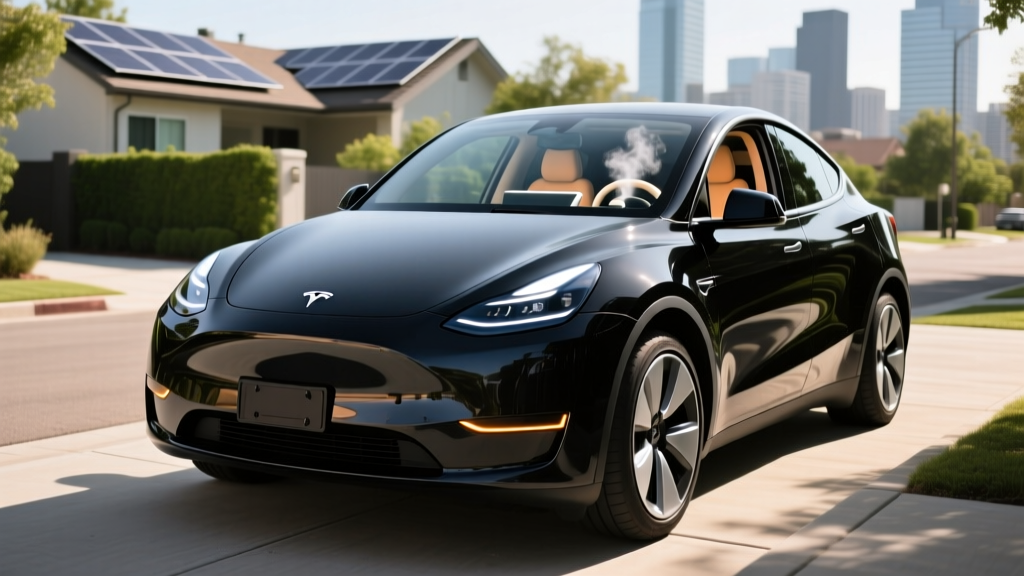
If you've climbed into your Tesla on a hot day, turned on the climate system, and been greeted by a sour, musty, or "wet dog" odor from the vents, you're far from alone. The search phrase "why does Tesla AC smell bad" consistently ranks among the top ownership complaints across Model 3, Model Y, Model S, and Model X forums. The good news: the cause is almost always identifiable, and the fix is usually inexpensive.
In this guide, we'll diagnose exactly why your Tesla's air conditioning smells, walk through proven fixes, and then pivot to a full review of the vehicle most affected by this issue — the 2026 Tesla Model Y — covering its range, charging, pricing, tax-credit eligibility, and whether it still deserves a spot on your shortlist.
Why Does Tesla AC Smell Bad? The 4 Main Causes
Tesla's HVAC system is fundamentally similar to any modern car's, but a few design and usage patterns make odor buildup more common in these vehicles.
1. Evaporator Coil Condensation and Microbial Growth
When you run the AC, moisture condenses on the evaporator coil behind the dashboard. If that moisture doesn't fully evaporate between drives — especially in humid climates or during short trips — mold, mildew, and bacteria colonize the damp surface. The result is a sour or musty smell that blasts through the vents the next time you turn on the fan. This is the number-one cause of Tesla AC odor and is not unique to Tesla; it affects virtually every automaker. However, Tesla's large, flat evaporator design and the tendency of owners to precondition the cabin (which cycles the AC frequently in short bursts) can accelerate buildup.
2. Cabin Air Filter Saturation
Tesla vehicles use one or two cabin air filters (the Model Y uses two) located behind the glovebox area. These filters trap pollen, dust, and particulates. Over time, they also trap moisture and organic matter. A saturated filter becomes a breeding ground for mold and will emit a musty or dirty-sock odor. Tesla's official maintenance schedule recommends replacing cabin air filters every 2 years (or every 3 years for the HEPA filter in Model S/X), but owners in humid or high-pollen areas often need to swap them annually.
3. "Camp Mode" and Recirculation Habits
Tesla's Camp Mode keeps the HVAC running while parked, which is great for temperature control but can leave the evaporator damp for extended periods without sufficient airflow to dry it. Similarly, running the system exclusively in recirculation mode traps humid cabin air against the coil. Both habits promote microbial growth.
4. External Contaminants and Drain Blockage
Leaves, debris, and road grime can accumulate near the HVAC air intake at the base of the windshield, introducing organic matter into the system. Additionally, the AC condensate drain tube — which channels water out from under the car — can become partially clogged, leaving standing water in the HVAC housing.
How to Fix the Tesla AC Smell (Step by Step)
Here's a practical, escalating approach from cheapest to most thorough:
- Replace the cabin air filter(s). A set of two aftermarket HEPA-grade filters for the Model Y costs $20–$40 on Amazon. The swap takes about 20 minutes with a Torx T20 driver and a trim removal tool. Tesla's official parts run ~$40–$55 for the pair.
- Run the fan on high with AC off for 5–10 minutes before shutting down the car. This dries the evaporator coil. You can automate this by setting a departure routine in the Tesla app that runs the fan without cooling for the last few minutes before you typically arrive.
- Use an evaporator coil foaming cleaner. Products like Kool-It or EZ-Evit are sprayed into the evaporator housing through the drain tube or filter access port. The foam kills mold and bacteria on the coil surface. Cost: ~$15–$25 per can.
- Run an ozone generator in the cabin (with the HVAC set to recirculate) for 30–60 minutes. This is the nuclear option and eliminates deeply embedded odors. Ozone generators can be rented or purchased for $40–$80. Ensure no people or pets are in the vehicle during treatment, and air out the cabin thoroughly afterward.
- Clear the condensate drain tube. Located under the car near the passenger footwell, this tube can be cleared with compressed air or a flexible brush. If water is pooling under your glovebox carpet, this is likely your issue.
For most owners, steps 1 and 2 eliminate 80% of odor complaints. If the smell persists after a filter change and coil cleaning, the issue may be a blocked drain or a deeper contamination that warrants a service center visit.
2026 Tesla Model Y: Full Review and Specs
Now that we've addressed the AC smell issue, let's look at the vehicle most commonly associated with it — the Tesla Model Y. The 2026 Model Y (internally the "Juniper" refresh that launched in early 2025) carries forward with minor software and trim updates. It remains the best-selling EV in the United States and one of the best-selling vehicles of any kind.
| Spec | Long Range AWD | Performance AWD |
|---|---|---|
| EPA Range | 320 miles | 285 miles |
| Battery (usable) | ~75 kWh, NMC | ~75 kWh, NMC |
| Drivetrain | Dual-Motor AWD | Dual-Motor AWD |
| Horsepower | 384 hp | 456 hp |
| 0–60 mph | 4.8 sec | 3.5 sec |
| Peak DC Charge Rate | 250 kW | 250 kW |
| 10–80% DC Time | ~25 min | ~25 min |
| Level 2 Rate (11.5 kW) | ~44 mi/hr | ~44 mi/hr |
| MPGe (combined) | 122 MPGe | 111 MPGe |
| Efficiency | 28 kWh/100 mi | 30 kWh/100 mi |
| Cargo (rear seats up) | 30.2 cu ft | 30.2 cu ft |
| Cargo (rear seats folded) | 72.1 cu ft | 72.1 cu ft |
| Rear Legroom | 40.5 in | 40.5 in |
| Base MSRP | $46,630 | $52,130 |
| Battery Warranty | 8 yr / 120,000 mi | 8 yr / 120,000 mi |
Sources: EPA fueleconomy.gov, Tesla Model Y design page.
Real-World Range vs. EPA Estimate
EPA Estimate: 320 miles (Long Range AWD)
Real-World Expectation:
- Mixed city/suburban driving (65–75°F): 290–310 miles — Tesla's heat pump and strong regen deliver near-EPA numbers in moderate conditions.
- Highway at 75 mph (75°F): 255–275 miles — aerodynamic drag dominates at speed; expect a 12–18% reduction.
- Highway at 75 mph (30°F, winter): 210–240 miles — cold temperatures reduce battery efficiency and increase cabin heating load. The heat pump helps but doesn't eliminate the penalty.
- Mountain/towing: Significant further reduction; the Model Y is rated for 3,500 lbs towing, but range can drop 30–40% with a loaded trailer on inclines.
The Juniper refresh improved thermal management slightly, but the fundamental physics of a 75 kWh NMC pack in a crossover haven't changed. If your daily commute is under 80 miles round-trip, you'll rarely think about range. If you road-trip frequently in winter or mountainous terrain, plan charging stops conservatively.
Charging Speed and Infrastructure
The 2026 Model Y ships with the NACS (North American Charging Standard) connector natively — no adapter needed at Tesla Superchargers. Tesla's Supercharger network remains the most reliable DC fast-charging ecosystem in the U.S., with over 20,000 stalls nationally.
| Level | Power | Miles Added | Notes |
|---|---|---|---|
| Level 1 (120V) | ~1.4 kW | ~3–5 mi/hr | Emergency/trickle only |
| Level 2 (240V, 48A) | 11.5 kW | ~44 mi/hr | Full charge in ~7–8 hours; ideal for home |
| DC Fast (Supercharger V3/V4) | Peak 250 kW | ~162 mi in 15 min | 10–80% in ~25 min; tapers sharply above 80% |
| DC Fast (CCS via adapter) | Up to ~150–175 kW typical | Varies | Use NACS-to-CCS adapter for Electrify America, EVgo, etc. |
Charging curve reality check: The Model Y peaks at 250 kW only below ~30% state of charge and only at a V3/V4 Supercharger with a preconditioned battery. By 50% SoC, the rate drops to ~150 kW; by 80%, it's under 60 kW. That's why Tesla (and we) quote 10–80% times rather than 0–100%. Charging from 80–100% can take nearly as long as 10–80%.
For home charging, a Wall Connector on a 60-amp circuit delivers the full 48A/11.5 kW. Most owners charge overnight and start each day at 80–90% (Tesla recommends daily charging to 80% for NMC batteries to preserve longevity).
Pricing, Trims, and Federal Tax Credit
The 2026 Model Y is available in two primary trims:
- Long Range AWD: $46,630 MSRP (including destination)
- Performance AWD: $52,130 MSRP (including destination)
Both trims fall under the $80,000 MSRP cap for SUVs under IRS §30D. However, tax credit eligibility depends on several factors that change periodically:
Federal EV Tax Credit (§30D) Requirements — 2026 Rules:
- Vehicle MSRP must not exceed $80,000 (SUVs/trucks) — ✅ Model Y qualifies
- Buyer AGI must not exceed $150,000 (single), $225,000 (head of household), or $300,000 (joint) — varies by buyer
- Battery components must meet escalating domestic-content and critical-mineral sourcing thresholds — check IRS.gov for current-year Model Y eligibility, as sourcing rules tighten annually
- Credit can be transferred to the dealer at point of sale for an instant price reduction
Important: As of early 2026, the Model Y Long Range has qualified for the full $7,500 credit in recent model years, but battery-sourcing rules change every January 1. Always verify eligibility on fueleconomy.gov before purchasing. If eligible, the effective price drops to approximately $39,130 for the Long Range — a compelling value for a 320-mile AWD crossover.
Technology, Safety, and Driver Assistance
The Juniper-refreshed Model Y brought meaningful interior and tech upgrades:
- 15.4-inch center touchscreen with faster Ryzen-based processor — UI responsiveness is noticeably improved over pre-2025 models.
- Ambient lighting, ventilated front seats, and power-folding second row now standard on Long Range.
- 8-camera vision system powering Tesla's Autopilot (standard) and Full Self-Driving (Supervised) ($8,000 option or $99/month).
- Air quality: The Model Y uses a standard cabin air filter system (two filters). Unlike the Model S/X, it does not include the "Bioweapon Defense Mode" HEPA filter, which is partly why AC odor complaints are more common in the Model Y — the smaller filters saturate faster.
SAE Automation Level: Tesla Autopilot and FSD (Supervised) are Level 2 driver-assistance systems. The driver must remain fully engaged, hands on or near the wheel, and eyes on the road at all times. These systems do not make the vehicle self-driving. Only Level 4 services like Waymo operate without a human driver in geofenced areas.
Safety ratings remain strong: the Model Y earned a 5-star overall rating from NHTSA and continues to perform well in IIHS testing.
Pros, Cons, and Who Should Buy
Pros
- 320-mile EPA range covers most use cases comfortably
- Supercharger network remains the gold standard for road trips
- Class-leading efficiency (28 kWh/100 mi) keeps charging costs low
- Strong performance: 4.8-sec 0–60 on Long Range is quicker than most competitors
- Excellent cargo space (72.1 cu ft) for a compact crossover
- OTA updates continuously add features
- Strong resale value relative to most EVs
Cons
- AC odor / cabin filter issues are a recurring ownership annoyance
- No Bioweapon Defense Mode HEPA filter (unlike Model S/X)
- Ride quality is firm — road noise is noticeable on coarse surfaces
- FSD (Supervised) remains a Level 2 system despite the name and $8,000 price
- Minimal physical controls — everything routes through the touchscreen
- Service center wait times can be long in high-volume metro areas
Who it suits best: The Model Y is the default choice for tech-savvy commuters and small families who want one vehicle to handle daily driving, weekend road trips, and occasional cargo hauling. If you have reliable home charging and your commute is under 100 miles round-trip, the Model Y is nearly frictionless to own. It's less ideal for buyers who prioritize ride comfort, want physical buttons, or live in areas with limited Tesla Service infrastructure.
Frequently Asked Questions
Why does my Tesla AC smell like vinegar or dirty socks?
This is almost always microbial growth on the evaporator coil or a saturated cabin air filter. Moisture from AC use gets trapped in the HVAC housing, creating an environment for mold and bacteria. Replacing the cabin filters ($20–$55) and running an evaporator foaming cleaner resolves the issue in most cases.
How often should I replace the cabin air filter in a Tesla Model Y?
Tesla recommends every 2 years. However, if you live in a humid climate, drive in high-pollen areas, or notice odors sooner, annual replacement is a good practice. Aftermarket HEPA-grade filters are widely available and inexpensive.
Does the Tesla Model Y have a HEPA filter like the Model S?
No. The Model Y uses standard cabin air filters (two of them). The larger "Bioweapon Defense Mode" HEPA filter is exclusive to the Model S and Model X. This is one reason AC odor issues are more frequently reported in the Model Y — the smaller filters saturate faster and provide less filtration capacity.
What is the real-world range of the 2026 Model Y Long Range?
EPA-rated at 320 miles, expect 290–310 miles in moderate mixed driving, 255–275 miles at sustained highway speeds (75 mph), and 210–240 miles in cold winter highway conditions. Preconditioning the battery before driving helps recover some winter range.
Does the 2026 Tesla Model Y qualify for the $7,500 federal tax credit?
The Model Y's MSRP is under the $80,000 SUV cap, which is one requirement. Full eligibility under IRS §30D also depends on your income (AGI caps apply) and whether the battery meets current-year critical-mineral and domestic-component sourcing thresholds. Verify on IRS.gov and fueleconomy.gov at the time of purchase, as rules tighten annually.
How fast does the Model Y charge at home?
On a Level 2 Wall Connector (240V, 48A, 11.5 kW), the Model Y adds approximately 44 miles of range per hour, or a full charge in about 7–8 hours. On a standard 120V outlet (Level 1), expect only 3–5 miles per hour — suitable only for overnight top-ups or emergencies.
Is the Model Y worth buying over the Hyundai Ioniq 5 or Ford Mustang Mach-E?
The Model Y wins on Supercharger access, efficiency, and cargo space. The Ioniq 5 offers faster 10–80% DC charging (~18 min at 350 kW on 800V architecture) and a more comfortable ride. The Mach-E provides a more traditional interior layout. If road-trip charging reliability is your top priority, the Model Y and its Supercharger network remain hard to beat. If ride comfort or interior design matter more, test-drive the Ioniq 5 before committing.