The Lucid Air Trunk: Luxury Sedan or Genuinely Practical Daily Driver?
The Lucid Air occupies a strange space in the EV market: a six-figure luxury sedan that posts supercar-rivaling range and efficiency numbers. But for buyers cross-shopping the Tesla Model S, Mercedes EQS, or even a loaded BMW i7, one question keeps surfacing in forums and showroom conversations — what about the Lucid Air trunk? Can a sleek, aerodynamic sedan with a sloping roofline actually swallow luggage, golf clubs, or a week's worth of groceries?
This review goes beyond the headline 516-mile EPA figure to examine the Air's real-world cargo utility, charging behavior, ownership economics, and where it genuinely fits in a buyer's garage. We tested the Air Pure, Touring, and Grand Touring trims to give you the data you need before writing a check.
Cargo and Trunk: What Actually Fits Inside the Lucid Air?
The Lucid Air uses a traditional sedan trunk rather than a hatchback or liftback design — a deliberate choice that preserves the car's aerodynamic profile (a drag coefficient of just 0.197 Cd, among the lowest of any production car). That decision has real trade-offs.
Rear Trunk Volume and Dimensions
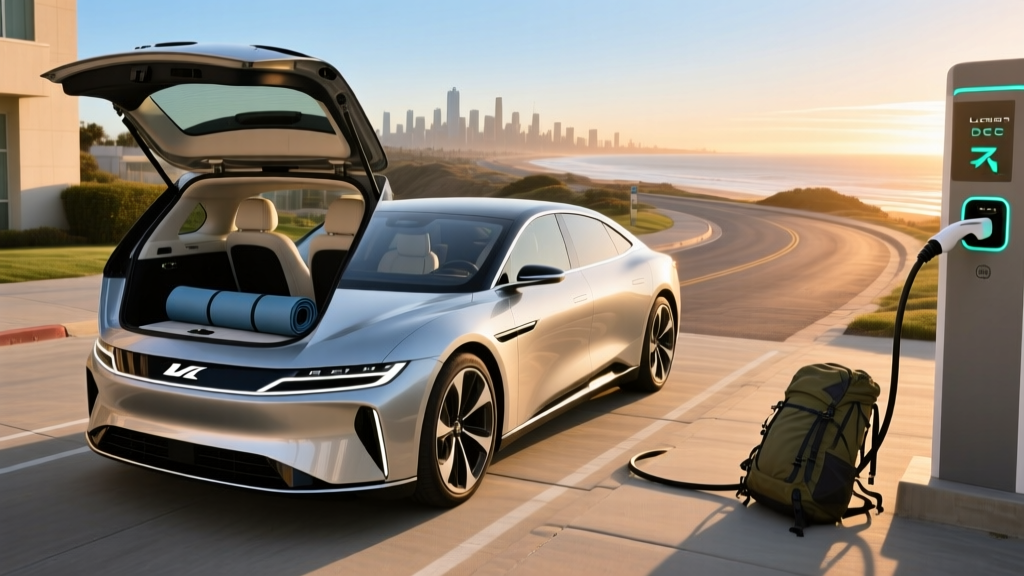
The Air's rear trunk offers 22.1 cubic feet of space behind the rear seats, with a total of 32.0 cubic feet when the 60/40 split rear seats are folded. The trunk opening is relatively wide but the lid height is limited by the sedan's fastback styling — expect roughly 18 inches of vertical clearance at the hinge point. In practice, this means:
- Two large rolling suitcases (26-inch) fit side by side with room for a duffel on top
- A standard set of golf clubs fits diagonally but requires some maneuvering
- A full-size stroller fits with the wheels detached or collapsed tightly
- The trunk floor sits low, so loading heavy items requires more bending than a crossover
The Frunk (Front Trunk)
Lucid's compact drive units free up a 10.0-cubic-foot front trunk — large enough for a carry-on bag, a charging cable kit, or several grocery bags. The frunk lid is power-operated and includes a drain, making it practical for wet items or ice on a tailgate. Combined, the Air's 32 cu-ft total (frunk + rear trunk with seats folded) trails a Tesla Model S (28 cu-ft rear + hatchback utility) in pure versatility but beats it in sealed, secure rear storage.
Passenger Space Context
Where the Air gives back is rear-seat room. With 41.3 inches of rear legroom and 37.9 inches of rear headroom, the back seat is genuinely limousine-like — more generous than a Model S or EQS. The trade-off for trunk volume is cabin volume, and Lucid clearly prioritized passenger comfort over maximum cargo.
| Dimension | Measurement |
|---|---|
| Rear trunk (seats up) | 22.1 cu ft |
| Total cargo (seats folded + frunk) | 32.0 cu ft |
| Front trunk (frunk) | 10.0 cu ft |
| Rear legroom | 41.3 in |
| Rear headroom | 37.9 in |
| Front headroom | 39.6 in |
| Trunk opening width | ~46 in |
Range and Efficiency: EPA Sticker vs. Real-World Miles
The Lucid Air lineup spans from the efficient Pure to the performance-oriented Sapphire, and range varies dramatically by trim. The Air Grand Touring with the available 21-inch wheels still achieves an extraordinary 516 miles EPA, while the Pure with 19-inch AeroDream wheels hits 419 miles EPA. These are not incremental advantages — they are class-leading by wide margins.
EPA estimate: 419–516 miles depending on trim and wheel size.
Expect on a 75°F highway road trip (65–70 mph): ~370–460 miles. The Air's best-in-class efficiency (as low as 235 Wh/mi in the Pure) means highway losses are smaller than most EVs.
Cold-weather (below 32°F): Plan for 25–35% range reduction, yielding ~290–380 miles. The Air's standard heat pump mitigates cabin-heating losses, but battery chemistry still loses output in freezing temps.
Mountainous terrain / sustained 80+ mph: Expect ~330–420 miles. Aerodynamic efficiency helps here — the Air loses less at speed than taller crossovers.
Efficiency by the Numbers
According to fueleconomy.gov, the Air Grand Touring achieves 146 MPGe combined (131 city / 163 highway) and consumes just 23 kWh per 100 miles. The Air Pure is rated at 140 MPGe combined. For context, the Tesla Model S Long Range achieves 124 MPGe, and the Mercedes EQS 580 posts 97 MPGe. Lucid's miniaturized drive units and 900V+ architecture deliver measurable efficiency gains, not just marketing claims.
Battery, Charging Speed, and Home Setup
The Air's battery pack is a Wunderbox — a modular, structurally integrated unit using NMC (nickel manganese cobalt) lithium-ion cells. The standard pack (Pure) holds approximately 88 kWh usable, while the extended-range pack (Touring, Grand Touring, Sapphire) holds 112 kWh usable. Lucid has not transitioned to LFP chemistry in the Air, prioritizing energy density over the cycle-life advantages LFP offers in lower-cost vehicles.
DC Fast Charging
The Air's 900V+ electrical architecture enables charging speeds that remain among the fastest available on public infrastructure:
| Spec | Air Pure (88 kWh) | Touring / Grand Touring (112 kWh) |
|---|---|---|
| Max DC fast-charge rate | 200 kW (peak) | 300+ kW (peak, on V4+ stalls) |
| 10–80% DCFC time | ~27 minutes | ~20 minutes (on 350 kW charger) |
| Sustained rate (10–50%) | ~170 kW average | ~250 kW average |
| Miles added in 15 min (DCFC) | ~180 miles | ~250 miles |
| Level 2 home rate (19.2 kW) | ~47 mi/hr | ~56 mi/hr |
| Level 2 home rate (11.5 kW / 48A) | ~28 mi/hr | ~33 mi/hr |
| Level 1 (120V / 12A) | ~3 mi/hr | ~3 mi/hr |
| Connector | CCS1 (NACS adapter available) | CCS1 (NACS adapter available) |
Charge curve reality: The Air Grand Touring peaks above 300 kW only in the 10–30% SoC window on a 350 kW charger, then tapers progressively. From 50–80%, expect ~150 kW. The 20-minute 10–80% claim requires a functioning Electrify America 350 kW or Tesla Supercharger V4 stall — at a 150 kW EA station, plan for ~30 minutes.
Home Charging Setup
The Air comes with a mobile charge cord (up to 32A / 7.7 kW on 240V). For full-speed home charging, Lucid's Connected Home charge station delivers up to 19.2 kW / 80A, which requires a dedicated 100A circuit — meaning many homes will need a panel upgrade. A more common 60A circuit with a 48A wall connector delivers 11.5 kW, adding ~30 miles per hour and fully recharging any Air overnight. According to Lucid's official specifications, the onboard charger supports up to 19.2 kW AC.
Performance and Drivetrain
The Air lineup covers an unusually wide performance envelope:
- Air Pure (RWD): 430 hp, single rear motor, 0–60 mph in 5.0 seconds. The lightest, most efficient trim.
- Air Touring (AWD): 620 hp, dual motor, 0–60 in 3.4 seconds. The value performance pick.
- Air Grand Touring (AWD): 1,050 hp (1,234 hp on 2025+ models), dual motor, 0–60 in 2.6 seconds. Hypercar acceleration with limousine comfort.
- Air Sapphire (AWD): 1,234 hp, tri-motor, 0–60 in 1.89 seconds. Track-capable, limited production.
All trims feature adaptive air suspension with automatic ride-height adjustment, regenerative braking with adjustable intensity (but not true one-pedal driving to a full stop in all conditions), and a low center of gravity from the floor-mounted battery pack.
Pricing, Trim Levels, and Federal Tax Credit Eligibility
The Air's pricing positions it firmly in the luxury segment, but the gap between the Pure and the Grand Touring is substantial:
| Trim | Base MSRP | As-Tested (typical config) | §30D Federal Credit |
|---|---|---|---|
| Air Pure | $69,900 | $74,000–$78,000 | Eligible up to $7,500 (subject to income + sourcing rules) |
| Air Touring | $77,900 | $85,000–$92,000 | Eligible up to $7,500 (sedan MSRP cap: $55,000 — NOT eligible) |
| Air Grand Touring | $125,600 | $130,000–$145,000 | Not eligible (exceeds $55K sedan MSRP cap) |
| Air Sapphire | $249,000 | $249,000+ | Not eligible (exceeds $55K sedan MSRP cap) |
Understanding §30D Eligibility for the Air Pure
Under current IRS §30D rules, the Air Pure is the only trim that can potentially qualify for the federal clean vehicle credit. However, eligibility requires meeting all of the following:
- MSRP cap: Sedans must have an MSRP at or below $55,000. The Air Pure's base of $69,900 currently exceeds this threshold, meaning no Lucid Air trim qualifies for the $7,500 new-vehicle credit as of the 2025/2026 model year.
- Buyer income cap: AGI must not exceed $150K single / $225K head of household / $300K joint.
- Battery sourcing: Critical minerals and battery component requirements phase in annually.
- Point-of-sale transfer: If eligible, the credit can be transferred to the dealer at purchase.
Bottom line: No Lucid Air currently qualifies for the federal new-EV tax credit due to the MSRP cap. Buyers should not factor a $7,500 credit into their Air purchase budget. Consult a tax professional for your specific situation and check the latest IRS guidance before purchasing.
Technology, Driver Assistance, and Interior
The Air's cabin centers on a 34-inch curved glass cockpit display (the "Glass Canopy") and a retractable lower touchscreen called the Pilot Panel for climate and secondary controls. The interface is visually striking but draws criticism for burying some functions behind menus — Apple CarPlay is not supported, though Android Auto is available via wireless connection on 2025+ models.
DreamDrive ADAS
Lucid's DreamDrive system uses up to 32 sensors (cameras, radar, ultrasonic, and available LiDAR on higher trims) to deliver SAE Level 2 driver assistance. This includes adaptive cruise, lane centering, automatic lane changes, and highway driving assist. It is not self-driving — the driver must maintain hands-on-wheel awareness and visual attention at all times. DreamDrive Pro (standard on Touring and above) adds features like automated parking assist and a more sophisticated surround-view camera.
Notable Tech Features
- Surreal Sound Pro: 21-speaker Dolby Atmos audio system (optional on Touring, standard on Grand Touring)
- Over-the-air updates for powertrain, infotainment, and ADAS
- Phone-as-key with Bluetooth LE
- Vehicle-to-load (V2L) capability via the frunk outlet (limited wattage, check owner's manual)
- Available Executive Rear Seat package with reclining, massaging rear seats and a center console
Warranty, Ownership Costs, and Who the Air Suits Best
Lucid provides a competitive luxury-EV warranty package:
- Basic vehicle: 4 years / 50,000 miles
- Battery and drive units: 8 years / 100,000 miles (capacity retention threshold: 70% of original)
- Roadside assistance: 4 years / 50,000 miles
Insurance premiums for the Air are notably high — expect $3,500–$5,500/year depending on trim, location, and driver profile, according to industry averages. The Grand Touring and Sapphire command premiums comparable to Porsche Taycan or Tesla Model S Plaid insurance rates. Depreciation data is still maturing for the brand, but early indicators suggest the Air holds value better than the EQS but trails the Model S and Taycan in 3-year retention.
Who Should Buy the Lucid Air?
Choose the Air Pure if: You want best-in-class range and efficiency, rear-seat comfort for tall passengers, and a sedan that can handle 300+ mile road trips without range stress — and you accept the trunk's sedan limitations.
Choose the Air Touring if: You want dual-motor AWD and sub-3.5-second acceleration without the Grand Touring's six-figure price, and you prioritize performance-per-dollar.
Choose the Air Grand Touring if: You want hypercar-level acceleration with genuine 400+ mile real-world range, and budget is not a primary constraint.
Look elsewhere if: You need hatchback/liftback cargo versatility (consider the Tesla Model S or Porsche Taycan Sport Turismo), require Apple CarPlay, or want a proven dealer/service network in a rural area.
Lucid Air Trunk and Practicality: Pros and Cons
Pros
- Class-leading EPA range (419–516 mi) and efficiency (23 kWh/100 mi)
- Spacious rear seat with 41.3 in legroom — best in luxury EV sedans
- 22.1 cu-ft trunk is deep and secure for sedan-style cargo
- 10 cu-ft frunk adds genuine utility
- 300+ kW DC fast charging (Grand Touring) on compatible stalls
- Stunning design and interior material quality
- 900V architecture enables future-proof charging compatibility
Cons
- Sedan trunk opening limits tall/bulky item loading vs hatchbacks
- No Apple CarPlay support
- No Lucid Air trim qualifies for the §30D federal tax credit
- Limited service center network outside major metro areas
- High insurance premiums across all trims
- DreamDrive ADAS lags Tesla FSD and GM Super Cruise in real-world polish
- Brand is young — long-term reliability data still accumulating
Frequently Asked Questions
What is the real-world range of the Lucid Air?
The EPA rates the Air Grand Touring at 516 miles and the Pure at 419 miles. In real-world highway driving at 65–70 mph in moderate temperatures, expect roughly 370–460 miles depending on trim. In freezing weather, plan for 25–35% less. The Air's exceptional efficiency means real-world losses are smaller than most competitors, but physics still applies.
How fast does the Lucid Air charge at home and on the road?
On a 350 kW DC fast charger, the Grand Touring peaks above 300 kW and charges 10–80% in approximately 20 minutes. The Pure peaks at ~200 kW and takes about 27 minutes. At home on a 48A / 11.5 kW Level 2 charger, expect 28–33 miles of range per hour — a full overnight charge from empty. The Air's 19.2 kW onboard charger can accept faster home charging if your electrical panel supports a 100A circuit.
Does the Lucid Air qualify for the federal EV tax credit?
As of the 2025/2026 model year, no Lucid Air trim qualifies for the $7,500 §30D new clean vehicle credit. The federal MSRP cap for sedans is $55,000, and even the base Air Pure starts at $69,900. Always verify current rules at IRS.gov and consult a tax professional before purchasing.
How does the Lucid Air trunk compare to the Tesla Model S?
The Air's 22.1 cu-ft rear trunk is a sealed sedan trunk with a narrower opening, while the Model S uses a hatchback/liftback design (28 cu-ft rear) that accommodates taller, bulkier items more easily. However, the Air's 10 cu-ft frunk is comparable, and its combined cargo with seats folded (32 cu-ft) is competitive. The Air trades hatchback versatility for superior rear-seat comfort and a quieter, more sealed trunk environment.
Is the Lucid Air worth buying over the Mercedes EQS or BMW i7?
If range and efficiency are your top priorities, the Air wins decisively — 516 EPA miles vs. the EQS's ~350 and the i7's ~318. The Air's rear seat is roomier, and its energy consumption is measurably lower. However, the EQS and i7 have far more established dealer and service networks, richer luxury option catalogs, and Apple CarPlay. The Air is worth test-driving if you're in a metro area with Lucid service access; the EQS or i7 may be safer bets if dealer proximity matters to you.
What is the battery warranty on the Lucid Air?
Lucid covers the battery and drive units for 8 years or 100,000 miles, whichever comes first, with a capacity retention threshold of 70%. This is standard for the luxury EV segment and comparable to Tesla, Mercedes, and BMW. Battery replacement costs for the Air's 112 kWh pack are estimated in the $20,000–$30,000 range if out of warranty, though Lucid's modular Wunderbox design may allow partial module replacement at lower cost.