The Tesla A15 Chip: Inside HW5 and What It Means for Buyers
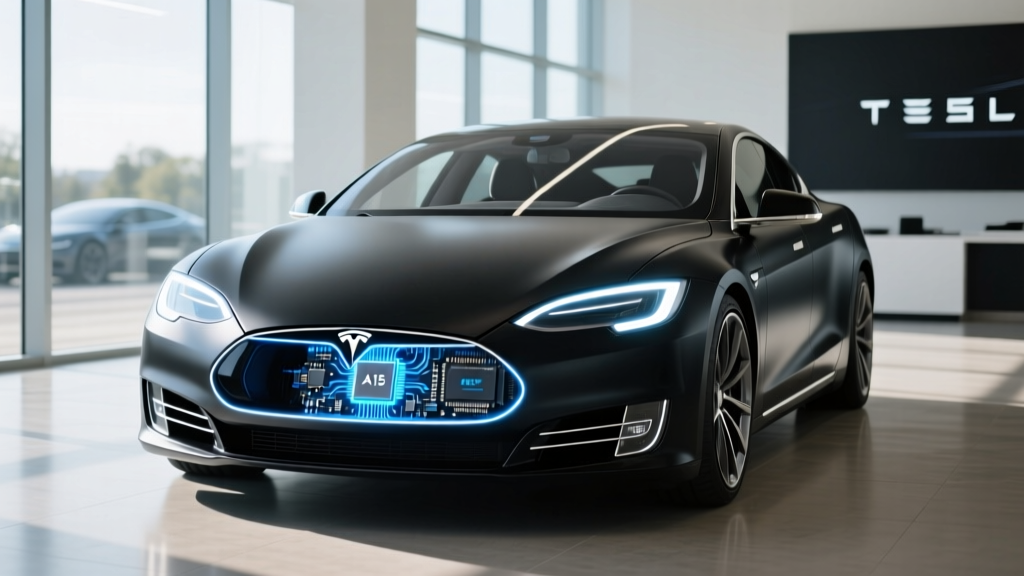
Tesla's transition to its custom A15 inference chip — the silicon heart of the Hardware 5 (HW5) computer — marks the most significant compute upgrade since the company moved from NVIDIA Drive PX2 to its in-house FSD Chip in 2019. First appearing in refreshed Model S and Model X builds in late 2025 and expanding into Model 3 and Model Y production in early 2026, the A15 chip isn't just a spec-sheet footnote. It fundamentally changes what Tesla's FSD (Supervised) software can perceive, process, and react to in real time.
For buyers shopping Tesla's 2026 lineup, understanding the A15 chip matters because it directly affects the vehicle's driver-assistance capabilities, over-the-air upgrade ceiling, and long-term software support. If you're choosing between a discounted 2025 HW4 vehicle and a 2026 HW5 build, this silicon generation gap is the deciding technical factor beyond range and price.
A15 Chip Specifications vs. Previous Tesla Silicon
Tesla does not publish a traditional semiconductor datasheet for the A15, but teardowns and company disclosures at the 2025 AI Day confirmed key architectural details. The A15 is fabricated on TSMC's 4nm process node (compared to the 7nm Samsung fab used for the HW3/HW4 FSD Chip), yielding substantial gains in transistor density and power efficiency.
| Specification | HW3 (FSD Chip) | HW4 (FSD Chip 2) | HW5 (A15 Chip) |
|---|---|---|---|
| Process Node | 14nm (Samsung) | 7nm (Samsung) | 4nm (TSMC) |
| TOPS (INT8 Inference) | ~144 TOPS | ~300+ TOPS | ~700+ TOPS (est.) |
| Camera Inputs Supported | 8 cameras | 8 cameras (higher res) | 11+ cameras (higher res + HDR) |
| Power Draw (typical) | ~72W | ~60W | ~50W (est.) |
| Redundant Compute | Dual-chip | Dual-chip | Dual-chip + enhanced fallback |
| Model Year Introduced | 2019 | 2023 | 2025–2026 |
The headline number is the estimated 700+ TOPS (trillions of operations per second at INT8 precision) of inference throughput. That's roughly 2.3× the HW4 chip and nearly 5× the original HW3 FSD Chip. In practical terms, this lets Tesla's neural networks run at higher resolution, process more sensor inputs simultaneously, and execute more complex planning models — all within a similar or lower thermal envelope than the previous generation.
The jump to 11+ camera inputs is equally important. HW5 vehicles incorporate additional high-resolution sensors, including wider-angle front cameras and improved low-light/HDR capability. The A15 chip processes these feeds concurrently without the frame-rate compromises that HW4 occasionally exhibited in complex urban scenes.
Which 2026 Tesla Models Have the A15 Chip?
As of mid-2026, the A15/HW5 computer is confirmed in the following Tesla models:
- Model S (2025.5+ refresh and all 2026 builds) — Standard on all trims
- Model X (2025.5+ refresh and all 2026 builds) — Standard on all trims
- Model 3 (2026 model year, all trims) — Phased in starting Q1 2026 production
- Model Y (2026 Juniper refresh, all trims) — Standard from launch
- Cybertruck (2026 builds) — HW5 integrated in late 2025 production changeover
Buyers should note that late-2025 Model 3 and Model Y inventory at dealerships may still carry HW4 hardware. Tesla does not prominently display the hardware generation on the window sticker. To confirm, check the vehicle's software menu under Controls → Software → Additional Vehicle Information, which lists the Autopilot computer version. VIN decoding through Tesla's service team can also confirm hardware generation pre-delivery.
Real-World FSD Performance: What the A15 Chip Actually Changes
Compute alone doesn't make a driver-assist system better — software does. But the A15 chip removes processing bottlenecks that previously limited Tesla's neural-network architecture. Here's what early HW5 owners and independent testers have observed with FSD (Supervised) v13.x running on A15 hardware:
- Higher-resolution perception: The A15 processes camera feeds at full sensor resolution rather than downscaled frames, improving detection of small objects (curbs, debris, partially obscured signage) at distance.
- Faster reaction latency: End-to-end neural network inference cycles complete in under 50 milliseconds, compared to ~80–100 ms on HW4 in equivalent scenarios.
- Improved low-light and HDR performance: Combined with upgraded camera sensors, the A15's image signal processor handles high-contrast scenes (tunnel exits, oncoming headlights) with fewer perception dropouts.
- More complex path planning: The chip supports larger transformer-based planning models, resulting in smoother lane changes and more confident navigation through unprotected left turns and construction zones.
- It does not make FSD a self-driving system. You remain the responsible driver at all times.
- It does not guarantee zero disengagements. HW5 vehicles still require driver intervention in construction zones, unmapped areas, severe weather, and complex parking scenarios.
- It does not retroactively upgrade to HW4 or HW3 vehicles. Tesla has confirmed no retrofit path exists.
- It does not unlock any features on vehicles without an active FSD (Supervised) subscription or purchase.
Tesla Model Y (2026 HW5) — Full Vehicle Specs
Since the Model Y remains Tesla's highest-volume vehicle and the primary entry point for HW5 hardware, here's the complete spec breakdown for the 2026 Long Range AWD — the most popular configuration.
| EPA Range | 330 miles |
| Real-World Range (highway/cold) | ~265–290 mi highway; ~240–260 mi in freezing temps |
| Battery Capacity | ~78 kWh usable (NMC chemistry) |
| Efficiency | 122 MPGe combined / 27 kWh/100 mi |
| Peak DC Fast Charge | 250 kW (V3 Supercharger) |
| 10–80% DC Charge Time | ~25 minutes (with preconditioning) |
| Level 2 Home Charging | 11.5 kW / ~44 miles per hour |
| 0–60 mph | 4.8 seconds |
| Horsepower | 384 hp (dual-motor AWD) |
| Drivetrain | Dual-motor AWD |
| Cargo Volume | 30.2 cu ft (rear seats up) / 72.1 cu ft (folded) |
| Rear Legroom | 41.6 inches |
| Battery/Drive Unit Warranty | 8 years / 120,000 miles |
| Base MSRP | $47,990 (before destination) |
| As-Tested (FSD + Paint + 20" wheels) | ~$58,490 |
Charging Speed and Infrastructure
The A15 chip doesn't directly affect charging speed — that's governed by the battery management system and cell chemistry — but HW5 vehicles benefit from Tesla's latest thermal management firmware, which optimizes battery preconditioning for DC fast charging.
| Charging Method | Power (kW) | Rate | 10–80% Time |
|---|---|---|---|
| Level 1 (120V household) | ~1.4 kW | ~5 miles/hour | ~48+ hours |
| Level 2 (240V Wall Connector) | 11.5 kW | ~44 miles/hour | ~6.5 hours |
| DC Fast (V3 Supercharger) | 250 kW peak | ~175 mi in 15 min | ~25 minutes |
| DC Fast (V4 Supercharger) | Up to 250 kW* | Similar to V3 | ~25 minutes |
*V4 Supercharger cabinets can deliver higher power to compatible future vehicles; the 2026 Model Y's charge architecture peaks at 250 kW.
The charge curve on the Model Y's NMC battery follows a typical taper pattern: peak 250 kW is sustained from roughly 10–30% State of Charge (SoC), then progressively steps down through 50%, 65%, and 80%. Above 80%, charging slows dramatically to protect cell longevity — adding the final 20% can take as long as the first 70%. For road trips, charge to 80% and move on rather than waiting for a full battery.
Home charging at 11.5 kW (48A on a 60A circuit) via Tesla's Wall Connector remains the ownership sweet spot. Most owners wake to a full battery every morning. Installation typically costs $500–$2,000 depending on panel proximity and whether your home's electrical panel needs an upgrade to 200A service. Always get a quote from a licensed electrician before purchasing equipment.
Pricing, Trims, and Federal Tax Credit Eligibility
The 2026 Tesla Model Y lineup and current federal tax credit situation under IRS §30D rules:
| Trim | Base MSRP | Destination | Total Before Credit | Est. §30D Credit | Effective Price |
|---|---|---|---|---|---|
| RWD (Standard Range) | $42,990 | $1,390 | $44,380 | Up to $7,500* | ~$36,880* |
| Long Range AWD | $47,990 | $1,390 | $49,380 | Up to $7,500* | ~$41,880* |
| Performance AWD | $52,490 | $1,390 | $53,880 | Up to $7,500* | ~$46,380* |
*Federal tax credit eligibility under IRS §30D is subject to multiple requirements that change periodically:
- MSRP Cap: SUVs/vans must be ≤$80,000; sedans ≤$55,000. All Model Y trims qualify on MSRP.
- Buyer Income Cap: Modified AGI must not exceed $150,000 (single), $225,000 (head of household), or $300,000 (joint). Above these thresholds, no credit.
- Battery Sourcing: Critical minerals and battery components must meet escalating domestic-content thresholds. Tesla's supply chain has adapted, but verify current-year compliance at fueleconomy.gov before purchasing.
- Point-of-Sale Transfer: As of 2024+, eligible buyers can transfer the credit to the dealer at purchase, reducing the upfront price rather than waiting for a tax refund. Tesla supports this at checkout.
- Consult a tax professional — individual eligibility varies based on tax liability, prior credit usage, and filing status.
Should You Buy a Tesla with the A15 Chip vs. Competitors?
The A15 chip's primary competitive advantage is Tesla's vertically integrated software-hardware stack. No other automaker currently designs its own inference silicon and trains its own neural networks on proprietary fleet data at scale. Here's how HW5 Teslas compare to key rivals on the driver-assist front:
- vs. Ford BlueCruise / GM Super Cruise: Both rely on Mobileye EyeQ or Qualcomm Snapdragon Ride platforms. These systems are excellent on mapped highways (and Super Cruise's LiDAR-based mapping is arguably more predictable on limited-access roads), but neither matches Tesla's urban surface-street coverage. The A15's raw compute advantage gives Tesla more headroom for future model complexity.
- vs. Hyundai/Kia (with HDA2/Mobileye EyeQ5H): Competitive highway assist, but no city-street capability. Lower compute ceiling limits future OTA potential.
- vs. Waymo (Level 4 robotaxi): Different category entirely. Waymo operates without a driver in geofenced areas using LiDAR-heavy sensor suites and centimeter-precise maps. Tesla FSD is a consumer Level 2 system available everywhere but requiring constant supervision.
- You want the highest-compute consumer driver-assist platform with the most OTA upgrade potential
- You value access to the Tesla Supercharger network (now with NACS adapter access for non-Teslas, but native integration is still superior)
- You're buying for long-term software support — Tesla has never deprecated a hardware generation's software updates mid-lifecycle
- Urban and surface-street driver assist matters to your commute, not just highway cruising
- You prefer LiDAR-backed redundancy (GM Super Cruise, certain Chinese-market EVs)
- You want hands-off highway driving on mapped routes today with verified eyes-off capability (BlueCruise 1.4, Super Cruise)
- Tesla's panel-gap consistency, service-center wait times, or minimalist interior are dealbreakers
- You need a third row (Model Y lacks one in most markets; consider Rivian R1S or Kia EV9)
Pros and Cons of Tesla's A15/HW5 Platform
- Class-leading inference compute (~700+ TOPS) provides substantial software headroom
- Best-in-class energy efficiency (27 kWh/100 mi) stretches every charge
- Access to 6,000+ Tesla Superchargers globally with native plug-and-charge
- Continuous OTA updates — HW5 vehicles will receive FSD improvements for years
- Strong resale value relative to non-Tesla EVs
- 330-mile EPA range covers most commutes and road trips comfortably
- Minimalist interior maximizes cargo space (72.1 cu ft with seats folded)
- FSD (Supervised) still requires constant driver attention — not autonomous
- $8,000 FSD purchase or $99/month subscription adds significantly to cost
- No LiDAR redundancy — pure vision approach remains debated in the industry
- Service center wait times in high-growth markets can stretch to weeks
- NACS connector is now the industry standard, reducing Tesla's former charging moat
- Build quality (panel gaps, paint) improved but still trails legacy luxury automakers
- High insurance premiums in many states compared to equivalent ICE vehicles
- HW4 vehicles receive no hardware upgrade path — early 2024–2025 buyers may feel shortchanged
Frequently Asked Questions
Can I upgrade my HW3 or HW4 Tesla to the A15 chip?
No. Tesla has confirmed there is no retrofit path from HW3 or HW4 to HW5. The A15 chip requires different board layouts, wiring harnesses, and cooling systems that are not backward-compatible. If you want A15 hardware, you need to purchase a vehicle built with HW5 from the factory.
Does the A15 chip improve range or charging speed?
Indirectly at best. The A15 is a compute platform for perception and planning — it doesn't change the battery chemistry, motor efficiency, or charge architecture. However, the lower power draw (~50W vs. ~60W for HW4) marginally reduces parasitic load. Any range difference attributable to the chip alone is negligible (likely under 1 mile).
Is FSD (Supervised) worth buying on an A15-equipped Tesla?
This depends on your tolerance for beta software and your commute profile. FSD (Supervised) v13.x on HW5 handles most urban and highway scenarios competently but still disengages in construction zones, unmapped areas, and severe weather. At $8,000 upfront or $99/month, it's a premium for a Level 2 system. If your commute involves repetitive highway miles, BlueCruise or Super Cruise on competing vehicles may offer a more polished (if geofenced) experience today. If you want the platform with the most future potential and you actively supervise, the A15 hardware provides the strongest foundation.
What's the real-world range of a 2026 Model Y with HW5?
The EPA rates it at 330 miles. In real-world mixed driving at moderate speeds and temperatures, expect 280–300 miles. Sustained highway driving at 75 mph drops this to roughly 265–290 miles. In freezing weather with cabin heating, plan for 240–260 miles. These figures are consistent with the EPA's testing data on fueleconomy.gov when adjusted for real-world conditions.
Does the 2026 Model Y qualify for the $7,500 federal tax credit?
It can, but eligibility depends on your income, the vehicle's battery sourcing compliance in the current tax year, and MSRP caps (all Model Y trims fall under the $80,000 SUV cap). Verify current sourcing compliance at fueleconomy.gov and consult a tax professional for your specific situation. The credit can be transferred at point of sale to reduce your upfront cost.
Will Tesla release a HW6 or A16 chip?
Tesla has not announced any successor to the A15/HW5 platform as of mid-2026. Given the typical 2–3 year silicon cadence, a next-generation chip is plausible for 2028–2029 vehicles, but no specs, timelines, or compatibility details exist. Buy based on current capability, not speculation about future hardware.