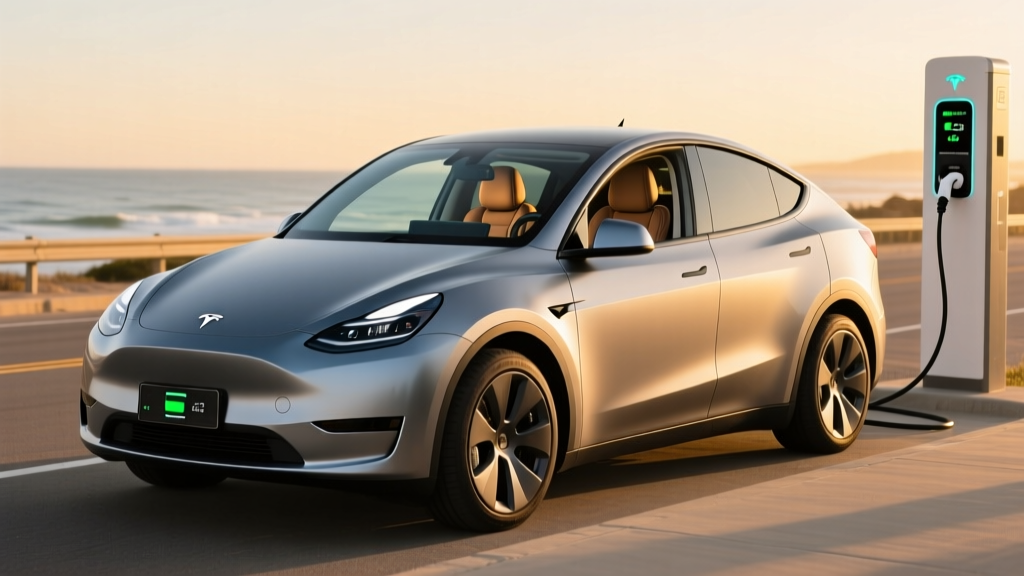
The 6-Seater Model Y at a Glance: What Changed for 2026
The Tesla Model Y has been the best-selling EV in the world for good reason, but for families needing more than five seats, the third-row option has always been the critical differentiator. For the 2026 model year — following the major "Juniper" refresh introduced in early 2025 — the 6-seater Model Y returns with a 2+2+2 seating configuration, a revised interior, improved ride quality, and updated battery management. But does that tiny third row actually work for real families, and what do you sacrifice in range and cargo space to get it?
We've spent time with the 2026 Model Y Long Range AWD with the optional third row to answer exactly that. Below you'll find EPA range figures, real-world highway and cold-weather expectations, exact charging speeds, pricing with federal tax credit context, and a clear-eyed look at who should — and who absolutely shouldn't — opt for the six-seat layout.
| Specification | Value |
|---|---|
| EPA Range (Long Range AWD, 6-seat) | 305 miles (est.) |
| Battery Capacity (usable) | ~75 kWh (NMC) |
| Drivetrain | Dual-Motor AWD |
| Horsepower | ~384 hp (combined) |
| 0–60 mph | 4.8 seconds |
| MPGe (combined) | 111 MPGe (est.) |
| Efficiency | ~30 kWh/100 mi |
| Max DC Fast Charge Rate | 250 kW (peak) |
| 10–80% DC Fast Charge Time | ~27 minutes |
| Level 2 Home Charge Rate | 11.5 kW (~44 mi/hr) |
| Seating | 6 (2+2+2) |
| Cargo (behind 3rd row) | ~12 cu ft |
| Cargo (3rd row folded) | ~34 cu ft |
| Cargo (all rows folded) | ~72 cu ft |
| Battery Warranty | 8 years / 120,000 miles |
| Base MSRP (6-seat Long Range AWD) | ~$50,490 |
EPA Range vs. Real-World Expectations
EPA Estimated Range: 305 miles (Long Range AWD, 6-seat)
Real-World Expectations:
- City / mixed driving (moderate climate): ~290–310 miles — EVs thrive in stop-and-go thanks to regenerative braking.
- Sustained highway (70–75 mph): ~250–270 miles — aerodynamic drag cuts efficiency significantly above 65 mph.
- Cold weather (below 32°F / 0°C): ~210–240 miles — expect a 20–30% range reduction from battery chemistry limitations and cabin heating demands. The Model Y's heat pump helps mitigate this compared to older resistance-heater EVs, but physics still wins in deep cold.
- Towing (if equipped): ~150–180 miles — towing near the 3,500-lb max rating roughly halves range.
The 6-seat configuration costs roughly 10–15 miles of EPA range versus the 5-seat Long Range AWD due to added weight (approximately 100–120 lbs for the third-row seat hardware) and slightly reduced aerodynamic efficiency from the modified interior air management. On paper, that's modest. On a cold January road trip from Denver to Grand Junction, it's the difference between arriving with a 30-mile buffer and needing a quick Supercharger stop in Glenwood Springs.
Tesla's onboard navigation is excellent at predicting real range based on elevation, temperature, and driving style — trust it over the dashboard percentage estimate. According to fueleconomy.gov, the Long Range AWD Model Y achieves a combined 111 MPGe, which translates to roughly 30 kWh per 100 miles of driving.
Charging Speed: Supercharger, Home, and the Curve Reality
The 2026 Model Y Long Range AWD supports a peak DC fast-charge rate of 250 kW on Tesla's V3 Superchargers (and compatible NACS-equipped third-party networks). But as any experienced EV owner knows, peak kW is not sustained kW — the charging curve tapers significantly as the battery fills.
| Charging Level | Power / Rate | Speed | Notes |
|---|---|---|---|
| Level 1 (120V household) | ~1.4 kW | ~4–5 mi/hr | Emergency / overnight trickle only |
| Level 2 (240V home, 48A) | 11.5 kW | ~44 mi/hr | Full charge in ~7 hours; requires 60A circuit |
| Level 2 (240V, 32A Mobile Connector) | 7.7 kW | ~30 mi/hr | Standard Mobile Connector on NEMA 14-50 |
| DC Fast (V3 Supercharger) | 250 kW peak | 10–80% in ~27 min | Tapers sharply above 80% |
| DC Fast (V4 Supercharger) | Up to 250 kW | 10–80% in ~25 min | Newer stalls with improved cable management |
The charge curve reality: The Model Y will pull its peak 250 kW only between roughly 10–30% State of Charge (SoC) when the battery is properly preconditioned. From 30–60%, expect ~150–180 kW. Above 80%, the rate drops to under 50 kW as the battery management system protects cell longevity. This is why we quote 10–80% times rather than 0–100% — charging from 80–100% at a DC fast charger is painfully slow and rarely worth the wait.
Preconditioning matters. If you navigate to a Supercharger in the Tesla nav, the car will automatically warm or cool the battery to optimal charging temperature before you arrive. Without preconditioning — say, pulling into a charger on a cold morning without nav routing — your peak charge rate may be limited to 100–150 kW for the first several minutes. Always route through the car's navigation for the fastest charging experience.
Home charging setup: For the 11.5 kW / 44 mi/hr rate, you'll need Tesla's Wall Connector installed on a dedicated 60-amp circuit (240V). Most owners report installation costs between $500–$1,500 depending on panel proximity and local permitting. If your electrical panel is at capacity, a panel upgrade to 200A service can add $1,500–$3,000. A licensed electrician should assess your specific situation.
Performance, Battery Chemistry, and Drivetrain
The 2026 Model Y Long Range AWD uses a dual-motor setup — a permanent-magnet synchronous motor on the rear axle and an induction motor up front. Combined output is approximately 384 horsepower, delivering a 4.8-second 0–60 mph time. That's brisk for a 6-seat crossover, and the instant electric torque makes highway merging and passing effortless.
Battery chemistry: The Long Range AWD uses an NMC (nickel manganese cobalt) lithium-ion pack with approximately 75 kWh of usable capacity. NMC offers higher energy density than LFP (lithium iron phosphate), which is why the Long Range achieves more miles in a similar physical pack size. However, NMC cells benefit from being stored at partial charge (20–80% daily) rather than sitting at 100% for extended periods. Tesla's battery management system handles this well, but for daily commuting, set your charge limit to 80% and save 100% for road trips.
The base RWD Model Y uses an LFP battery, which can be charged to 100% daily without degradation concerns — but that variant is only available in the 5-seat configuration. If you want six seats, you're getting NMC.
Ride quality: The Juniper refresh brought meaningfully improved suspension tuning. The 2026 Model Y absorbs highway expansion joints and broken pavement far better than pre-2025 models. It's still firmer than a Toyota RAV4 or Hyundai Ioniq 5, but no longer harsh. Road noise has also been reduced through additional acoustic glass and insulation.
Third-Row Practicality: Who Actually Fits Back There?
This is the question every prospective 6-seat Model Y buyer needs answered honestly. The third row is best described as occasional-use seating for children or compact adults on short trips.
Third-row dimensions (approximate):
- Legroom: ~26 inches — tight for anyone over 5'4"
- Headroom: ~35 inches — adequate for children, snug for adults
- Seat width: Fits two children in boosters or two slim adults
- Access: Second-row seats tilt and slide forward; the opening is narrow
Cargo trade-off: With the third row upright, you get roughly 12 cubic feet behind it — enough for a couple of grocery bags or a small stroller, but not a week's luggage for six people. Fold the third row flat and you reclaim ~34 cu ft, which is practical for daily family life if you only need those extra seats a few times a month. Fold everything and you get ~72 cu ft, competitive with midsize SUVs.
Bottom line: If you regularly transport more than five people, the Model Y's third row will disappoint. Look at the Kia EV9, Rivian R1S, or a three-row PHEV like the Toyota Grand Highlander Hybrid instead. But if you need six seats for school carpools, occasional grandparent visits, or weekend sports-team shuttles — and value efficiency, Supercharger access, and a lower price point — the 6-seat Model Y fills a narrow but real niche.
Pricing, Trim Levels, and Federal Tax Credit Eligibility
| Trim | Base MSRP | Est. After §30D Credit | Destination |
|---|---|---|---|
| Long Range AWD (6-seat) | ~$50,490 | ~$42,990* | $1,390 |
| Long Range AWD (6-seat) + FSD | ~$58,490 | ~$50,990* | $1,390 |
| Performance (6-seat not available) | N/A | N/A | N/A |
*Tax credit estimates assume full §30D eligibility. Actual credit depends on individual tax liability, income, vehicle sourcing, and MSRP caps. See IRS guidance below.
The 6-seat option is available exclusively on the Long Range AWD trim and typically adds approximately $2,000–$2,500 to the base MSRP over the 5-seat configuration. Tesla periodically adjusts pricing, so check Tesla's configurator for current figures.
Federal tax credit (§30D) eligibility for 2026:
- Maximum credit: Up to $7,500, split into two halves — $3,750 for battery component manufacturing (North America) and $3,750 for critical minerals sourcing (U.S. or FTA partners).
- MSRP cap: SUVs/crossovers must be under $80,000 MSRP. The Model Y qualifies on all trims.
- Buyer income caps: Modified AGI must not exceed $300,000 (married filing jointly), $225,000 (head of household), or $150,000 (single).
- Battery sourcing: The Model Y's battery is assembled at Tesla's Gigafactory Nevada, but critical mineral sourcing compliance varies by production batch. Tesla indicates on the window sticker and their website whether a specific VIN qualifies for the full, partial, or no credit.
- Point-of-sale transfer: As of 2024, buyers can transfer the credit to the dealer at purchase, reducing the purchase price directly rather than waiting for a tax refund. This applies at Tesla as well.
Always verify eligibility for your specific VIN and tax situation. Consult IRS.gov's clean vehicle credit page and consider speaking with a tax professional before relying on the full $7,500 figure. State and local incentives (such as California's CVRP or Colorado's state credit) may stack on top but vary by jurisdiction — check your state's energy office for current programs.
Tech, Driver Assistance, and the Autopilot Reality
The Juniper-refreshed Model Y features a 15.4-inch center touchscreen running Tesla's latest software, a rear-seat 8-inch display for climate and entertainment controls, ambient lighting, ventilated front seats, and power-folding second-row seats. The minimalist interior remains polarizing — there are no physical buttons for climate, mirrors, or glovebox. Everything runs through the screen or voice commands.
SAE Automation Level: Level 2 (Driver Assistance, NOT Self-Driving)
Tesla's Autopilot and Full Self-Driving (Supervised) are Level 2 driver-assistance systems under the SAE J3016 framework. This means the driver must remain fully attentive, keep hands on the wheel (or demonstrate engagement via camera monitoring), and be prepared to take over at any moment. These systems do not make the Model Y a self-driving vehicle. Only Level 4 robotaxi services like Waymo operate without a human driver in defined areas.
What Autopilot does well: Highway lane-centering, adaptive cruise control, and automatic lane changes (with FSD) are competent for reducing fatigue on long drives. Tesla's vision-only system handles most highway scenarios smoothly.
Where it falls short: Construction zones, faded lane markings, complex urban intersections, and adverse weather (heavy rain, snow) can confuse the system. FSD (Supervised) requires constant vigilance and is not a substitute for an attentive driver. The $8,000 FSD purchase (or $99/month subscription) is a personal choice — many owners find basic Autopilot sufficient and skip the upgrade.
Notable tech features:
- Over-the-air software updates that add features over time
- Sentry Mode (360° parking surveillance with recording)
- Dog Mode (climate control for pets left in the vehicle)
- Tesla app with remote preconditioning, location tracking, and charging management
- Native NACS connector — full access to Tesla's Supercharger network (17,000+ stalls in North America) plus growing third-party networks adopting NACS
Key Drawbacks to Consider:
- No Apple CarPlay or Android Auto — Tesla's proprietary infotainment only
- No physical buttons or stalks (turn signals are on the steering wheel face in the Juniper refresh)
- Third row is cramped and eliminates significant cargo space
- No spare tire — tire repair kit only
- Insurance costs tend to be 15–30% higher than comparable non-Tesla crossovers
- Service center wait times can be lengthy in some markets
Ownership Costs: Warranty, Efficiency, and 5-Year Outlook
Warranty coverage:
- Basic vehicle: 4 years / 50,000 miles
- Battery and drive unit: 8 years / 120,000 miles (with minimum 70% capacity retention guaranteed)
The 8-year/120,000-mile battery warranty is competitive. Tesla guarantees the battery will retain at least 70% of its original capacity during the warranty period. Real-world degradation data from Tesla's fleet suggests most Model Y packs retain 88–92% capacity at 100,000 miles, though individual results vary based on charging habits and climate.
Efficiency and fuel savings: At 30 kWh/100 miles and a national average electricity rate of ~$0.16/kWh, the 6-seat Model Y costs approximately $4.80 per 100 miles to charge at home. A comparable gas-powered 3-row SUV averaging 24 MPG at $3.40/gallon costs ~$14.17 per 100 miles. That's roughly $9.37 saved per 100 miles, or about $1,125 annually for a driver covering 12,000 miles per year — before accounting for public fast-charging costs, which run higher.
5-Year Total Cost of Ownership (estimated, 60,000 miles):
- Purchase (after $7,500 credit): ~$44,380
- Electricity (home + public mix): ~$3,600
- Insurance (average): ~$10,500
- Maintenance (tires, cabin filter, fluid top-offs): ~$1,800
- Estimated depreciation: ~$18,000
- Estimated 5-year TCO: ~$78,280
Compare this to a gas-powered 3-row crossover at a similar price point, and the Model Y typically wins on fuel and maintenance but loses on insurance and potentially depreciation. Your mileage — literally — will vary.
Pros, Cons, and the Competition
Pros
- Access to Tesla's Supercharger network — the most reliable and extensive DC fast-charging network in North America
- Class-leading efficiency (30 kWh/100 mi) means lower fuel costs and more range per kWh
- Strong performance (4.8s 0–60) even in the 6-seat configuration
- Over-the-air updates continuously improve the vehicle
- NACS connector is now the North American standard — future-proof
- Lower starting price than any other 6- or 7-seat EV (Kia EV9, Rivian R1S)
- Heat pump standard for better cold-weather range and efficiency
Cons
- Third row is extremely cramped — children only for anything beyond short trips
- Cargo space behind third row (12 cu ft) is barely usable for family gear
- No Apple CarPlay or Android Auto
- Turn signals on the steering wheel face take adjustment
- Insurance premiums are above average for the segment
- FSD is expensive and still Level 2 — not autonomous
- Service availability varies significantly by region
Key competitors to consider:
- Kia EV9 (7-seat): Starts ~$56,000; genuinely usable third row with 31 inches of legroom; 230–304 mi EPA range; CCS charging (slower network access). Better if you truly need three rows regularly.
- Rivian R1S (7-seat): Starts ~$75,000+; excellent off-road capability and spacious third row; higher price puts it out of §30D MSRP cap territory for some buyers.
- Toyota Grand Highlander Hybrid (7-seat, HEV): Not a BEV, but ~35 MPG combined, usable third row, ~$42,000 starting. A practical alternative if charging access is limited.
Choose the 6-seat Model Y if:
- You need a third row only occasionally (carpool, visiting family)
- You prioritize Supercharger access and charging convenience
- You want the lowest cost-per-mile electric 6-seater available
- Your daily commute is under 80 miles round-trip
Choose a competitor if:
- You need three rows of seating daily for full-size passengers
- You require maximum cargo space with all seats in use
- You prefer physical controls and Apple CarPlay/Android Auto
- You frequently tow more than 2,500 lbs
Frequently Asked Questions
What is the real-world range of the 6-seat Tesla Model Y?
The EPA rates the 2026 Model Y Long Range AWD (6-seat) at approximately 305 miles. In real-world driving, expect 290–310 miles in moderate city/mixed conditions, 250–270 miles on sustained highway trips at 70+ mph, and 210–240 miles in freezing temperatures. Range varies based on driving style, terrain, temperature, and tire condition.
How fast does the 6-seat Model Y charge at home and on the road?
On a V3 or V4 Supercharger, the Model Y peaks at 250 kW and charges from 10–80% in approximately 27 minutes when preconditioned. At home on a 240V/48A Wall Connector, it charges at 11.5 kW, adding about 44 miles of range per hour — a full overnight charge takes roughly 7 hours. On a standard 120V outlet, expect just 4–5 miles per hour.
How much does the 6-seat Model Y cost after the federal tax credit?
The 2026 Model Y Long Range AWD with the 6-seat option starts at approximately $50,490 before destination. With full §30D eligibility ($7,500 credit transferred at point of sale), the effective price drops to roughly $42,990. However, eligibility depends on your income (under $300K joint / $150K single), the vehicle's battery sourcing compliance, and your tax liability. Verify with your tax professional and Tesla's configurator for your specific VIN.
Does the 6-seat Model Y qualify for the federal EV tax credit?
The Model Y qualifies as an SUV under the §30D MSRP cap ($80,000), so price is not a barrier. However, the full $7,500 credit depends on two factors: battery components manufactured in North America ($3,750) and critical minerals sourced from the U.S. or FTA partners ($3,750). Tesla's battery sourcing compliance has fluctuated — check the specific VIN's eligibility on Tesla's website or the IRS clean vehicle credit listing before purchasing. Buyer income caps also apply.
Is the 6-seat Model Y worth it vs. the Kia EV9 or a 3-row hybrid?
It depends entirely on your third-row usage. If you need six seats daily for older children or adults, the Kia EV9 or a Toyota Grand Highlander Hybrid offers far more usable space. If you need the extra seats only a few times a month for small children and otherwise value low running costs, Supercharger access, and a lower entry price, the 6-seat Model Y is a compelling and efficient choice that no other EV matches at this price point.
Can I install a home charger for the Model Y myself?
Tesla's Wall Connector requires a dedicated 60-amp, 240V circuit installed by a licensed electrician. While the unit itself costs approximately $425, professional installation typically runs $500–$1,500 depending on the distance from your electrical panel. If your panel lacks capacity, a 200A service upgrade can add $1,500–$3,000. Always hire a licensed electrician and pull the required permits — improper EV charger installation is a fire risk and may void your homeowner's insurance coverage.
How long will the Model Y battery last before needing replacement?
Tesla warranties the battery for 8 years or 120,000 miles with a minimum 70% capacity retention guarantee. Fleet data suggests most Model Y NMC packs retain 88–92% capacity at 100,000 miles with normal use. Full battery replacement out of warranty currently costs approximately $12,000–$16,000 depending on the pack and service center, though prices continue to decline. Best practices for longevity: charge to 80% daily, avoid frequent DC fast charging when Level 2 is available, and don't leave the car at 0% or 100% SoC for extended periods.
Sources: U.S. Department of Energy / fueleconomy.gov, IRS Clean Vehicle Credit, Tesla Model Y Specifications.