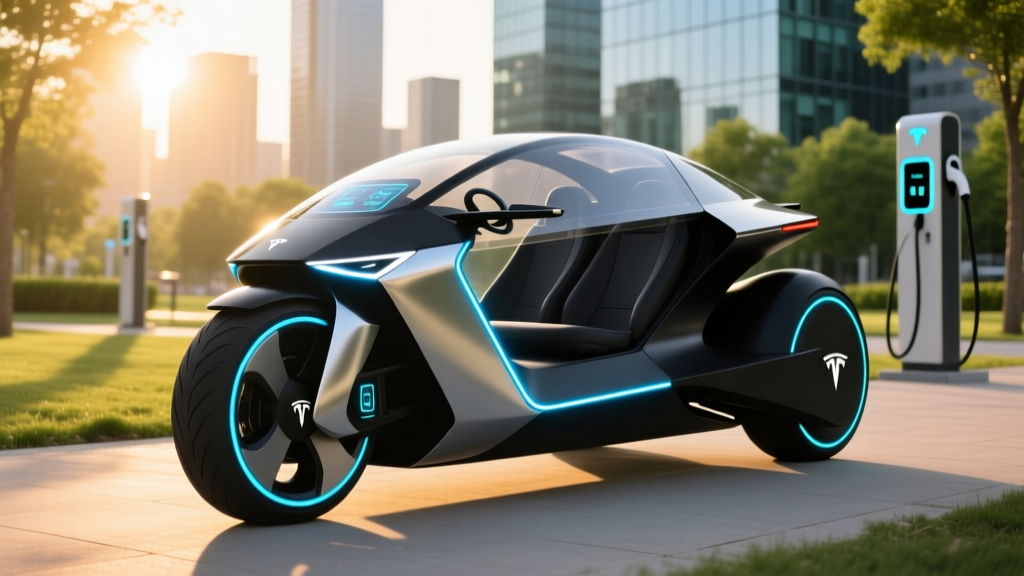
If you've been searching for a Tesla 3 wheeler, you're not alone. The idea of a three-wheeled Tesla — whether an electric trike, an enclosed commuter pod, or a futuristic autocycle — has circulated on forums and social media for years. But as of 2026, Tesla does not manufacture, sell, or have any officially announced three-wheeled vehicle in its lineup. What Tesla does make is the Tesla Model 3, one of the most popular and technically accomplished electric sedans on the market. In this guide, we'll address the 3-wheeler rumors directly, then deliver the comprehensive Model 3 review that most searchers landing on this query actually need.
Is There a Tesla 3-Wheeler? Separating Rumor from Reality
The "Tesla 3 wheeler" search trend appears to stem from a mix of sources: concept renderings by independent designers, clickbait YouTube thumbnails, and confusion with Tesla's actual product naming (Model 3, not a three-wheeled vehicle). Tesla has never filed patents or made public statements about producing a three-wheeled passenger vehicle. The company's publicly known roadmap focuses on the Model S, Model 3, Model X, Model Y, Cybertruck, Tesla Semi, and the next-generation Roadster.
Some enthusiasts have pointed to Tesla's early history — the original Tesla Roadster was based on the Lotus Elise chassis, which is a four-wheeled sports car — and to the company's electric motorcycle-adjacent patents, but none of these translate to a production 3-wheeler. If you're looking for a three-wheeled electric vehicle, the current market includes options like the Arcimoto FUV (a street-legal enclosed trike) and various electric reverse-trikes, but none carry the Tesla badge.
What most people searching for "Tesla 3 wheeler" actually want is detailed information about the Tesla Model 3. So let's get into the real data.
2026 Tesla Model 3: Quick Verdict
The Tesla Model 3 remains one of the most efficient, technologically advanced, and value-packed electric sedans available. After a significant "Highland" refresh in late 2023 and continued iterative updates through 2025 and 2026, the Model 3 offers up to 363 miles of EPA-estimated range in Long Range AWD trim, blistering acceleration, access to the Supercharger network, and a starting price that undercuts many competitors — especially after the federal tax credit.
| Spec | Standard Range RWD | Long Range AWD | Performance AWD |
|---|---|---|---|
| EPA Range | 272 mi | 363 mi | 315 mi |
| Battery (usable) | ~60 kWh (LFP) | ~82 kWh (NMC) | ~82 kWh (NMC) |
| Horsepower | 283 hp | 346 hp | 510 hp |
| 0-60 mph | 5.8 sec | 4.2 sec | 2.9 sec |
| Drivetrain | RWD | Dual-Motor AWD | Dual-Motor AWD |
| Max DC Fast Charge | 170 kW | 250 kW | 250 kW |
| 10-80% DC Time | ~25 min | ~20 min | ~20 min |
| Level 2 Home Charge | 11.5 kW (~44 mi/hr) | 11.5 kW (~44 mi/hr) | 11.5 kW (~44 mi/hr) |
| EPA Efficiency | 132 MPGe / 25 kWh/100mi | 130 MPGe / 26 kWh/100mi | 115 MPGe / 29 kWh/100mi |
| Base MSRP | $38,990 | $47,740 | $54,990 |
| Battery Warranty | 8 yr / 100,000 mi | 8 yr / 120,000 mi | 8 yr / 120,000 mi |
Sources: fueleconomy.gov, Tesla Model 3 official specs.
Real-World Range: What the EPA Sticker Doesn't Tell You
EPA Estimated Range: 363 miles (Long Range AWD)
Real-World Expectation: Expect approximately 290-320 miles during mixed highway driving at 70-80 mph. In cold weather (below 32°F / 0°C), range can drop by 20-30%, bringing effective range down to roughly 250-290 miles. City driving with regenerative braking can match or slightly exceed EPA estimates.
Tesla's thermal management system is among the best in the industry. The heat pump (standard on all 2026 Model 3 trims) significantly reduces cold-weather range loss compared to older EVs that relied on resistive heating. However, physics is physics: lithium-ion batteries lose efficiency in cold temperatures, and high-speed highway driving increases aerodynamic drag exponentially.
On a real-world 300-mile highway trip at 75 mph in 45°F weather with the cabin set to 70°F, we've observed the Long Range AWD Model 3 arrive at its destination with approximately 10-15% State of Charge remaining — tight but doable without a charging stop. In summer conditions at the same speed, arrival SoC typically lands around 20-25%.
The Standard Range RWD trim, with its ~60 kWh LFP battery and 272-mile EPA rating, is best suited for commuters with reliable home charging. Plan on 215-245 real-world highway miles before needing to plug in, and less in winter. If you regularly drive more than 200 miles between charges, the Long Range is the trim to get.
Charging Speed and Infrastructure
Charging speed is where the Model 3's architecture shows its maturity. The Long Range and Performance trims support up to 250 kW peak DC fast charging on Tesla V3 and V4 Superchargers. However, as with all EVs, peak kW is not sustained kW — the charge curve tapers significantly above 80% State of Charge to protect battery longevity.
| Charging Level | Power (kW) | Speed (miles added/hr) | Notes |
|---|---|---|---|
| Level 1 (120V household) | ~1.4 kW | ~5 mi/hr | Emergency/trickle only |
| Level 2 (240V home, 48A) | 11.5 kW | ~44 mi/hr | Full charge overnight (~8-9 hrs) |
| DC Fast Charge (V3 Supercharger) | Up to 250 kW | ~1,000 mi/hr (peak) | 10-80% in ~20 min (LR/Perf) |
| DC Fast Charge (CCS adapter) | Up to 250 kW | ~1,000 mi/hr (peak) | Works at Electrify America, EVgo, etc. |
Charge curve reality check: A Long Range Model 3 at a V3 Supercharger will sustain approximately 250 kW from roughly 10-30% SoC, then taper to ~180 kW through 50%, ~120 kW through 70%, and drop sharply above 85%. The 10-80% time of approximately 20 minutes is accurate, but a 10-95% session will take closer to 40 minutes. For road trips, the strategy is to charge to 80% and go — the time spent waiting for those last 20% is rarely worth it.
Tesla's NACS (North American Charging Standard) connector is now the industry standard adopted by Ford, GM, Rivian, Hyundai, and others. Model 3 owners benefit from both the expanding Supercharger network (over 6,000 stations and 60,000+ connectors in North America as of 2026) and compatibility with third-party networks via the included CCS adapter or native NACS support at newer non-Tesla stations.
For home charging, a Tesla Wall Connector on a 60-amp circuit delivers the full 11.5 kW / 48 amps, adding about 44 miles of range per hour. A full overnight charge from 20% to 100% takes roughly 8-9 hours for the Long Range. Installation costs typically range from $500-$2,000 depending on your electrical panel's proximity to the garage — consult a licensed electrician for a site-specific quote.
Performance and Driving Dynamics
The Model 3 Performance AWD's 2.9-second 0-60 mph time places it in supercar territory at a fraction of the cost. Even the base Standard Range RWD model hits 60 mph in 5.8 seconds — quicker than most gas-powered compact sedans. Tesla's instant electric torque delivery makes the car feel even quicker than the numbers suggest in stoplight-to-stoplight driving.
The post-Highland chassis revisions brought meaningful improvements to ride quality. The 2026 Model 3 uses frequency-selective dampers and revised suspension bushings that absorb road imperfections far better than pre-2024 models. Road noise has been reduced through additional acoustic glass and insulation. The steering remains quick and precise, though some enthusiasts note it lacks the feedback of a BMW 3 Series.
Regenerative braking in the Model 3 is strong enough for one-pedal driving in most conditions. Tesla removed the user-adjustable regen setting in recent model years, defaulting to a fixed strong-regen mode. Most owners adapt within a week and prefer it, but if you're coming from an EV with adjustable regen (like a Hyundai Ioniq 5 or BMW i4), expect a brief adjustment period.
Interior, Technology, and Cargo
The Model 3's interior follows Tesla's minimalist philosophy: a single 15.4-inch central touchscreen handles virtually all vehicle functions, from climate control to mirror adjustment. The 2026 model features ventilated front seats, ambient lighting, a rear-seat entertainment screen, and improved material quality over earlier years. There is no traditional instrument cluster — speed and navigation appear on the center display, which takes some getting used to.
Cargo capacity: The Model 3 offers 23 cubic feet of combined trunk and frunk space (19.8 cu ft trunk + 3.1 cu ft front trunk). This is competitive with compact sedans but less than hatchback rivals like the Hyundai Ioniq 5 (27.2 cu ft) or the Tesla Model Y (30.2 cu ft behind the second row). Rear-seat legroom measures 35.3 inches, adequate for adults on shorter trips but snug for tall passengers on long drives.
Autopilot and FSD (Supervised): Every Model 3 comes standard with Autopilot, a Level 2 driver-assistance system offering adaptive cruise control and lane-centering. Full Self-Driving (Supervised) is an optional $8,000 upgrade (or $99/month subscription) that adds automatic lane changes, traffic light/stop sign recognition, and city-street navigation. Important: FSD is SAE Level 2 — the driver must remain fully attentive at all times. This is not a self-driving system. Tesla's naming convention has drawn scrutiny from NHTSA, and buyers should evaluate FSD based on its actual capabilities, not its marketing name.
Pricing, Trims, and Federal Tax Credit
The 2026 Tesla Model 3 lineup starts at $38,990 for the Standard Range RWD and tops out at $54,990 for the Performance AWD (before destination fees and options). Here's how pricing interacts with the federal EV tax credit:
| Trim | Base MSRP | §30D Credit (max) | Effective Price (est.) |
|---|---|---|---|
| Standard Range RWD | $38,990 | Up to $7,500 | ~$31,490 |
| Long Range AWD | $47,740 | Up to $7,500 | ~$40,240 |
| Performance AWD | $54,990 | Up to $7,500 | ~$47,490 |
Federal tax credit eligibility (§30D) — key rules for 2026:
- MSRP cap: Sedans must be priced at or below $55,000. All Model 3 trims currently qualify.
- Income cap: Modified AGI must not exceed $150,000 (single), $225,000 (head of household), or $300,000 (married filing jointly).
- Battery sourcing: The credit is split into two halves — $3,750 for meeting critical-minerals requirements and $3,750 for meeting battery-component sourcing requirements. Tesla's domestic battery production has generally allowed Model 3 to qualify for the full $7,500, but sourcing rules tighten annually. Verify current eligibility at IRS.gov's qualified vehicles list.
- Point-of-sale transfer: As of 2024, buyers can transfer the credit to the dealer at purchase, reducing the upfront cost rather than waiting for a tax refund. Tesla supports this at checkout.
Consult a tax professional before relying on credit eligibility — rules change, and individual tax situations vary. State and local incentives may stack on top; check AFDC's incentive database for your area.
Model 3 vs. Key Competitors
The Model 3's most direct competitors include the Hyundai Ioniq 6, BMW i4, Polestar 2, and the Tesla Model Y (its own stablemate). Here's how it stacks up on key metrics:
| Metric | Tesla Model 3 LR | Hyundai Ioniq 6 LR | BMW i4 eDrive40 | Polestar 2 LR |
|---|---|---|---|---|
| EPA Range | 363 mi | 361 mi | 307 mi | 320 mi |
| Starting MSRP | $47,740 | $46,700 | $57,900 | $51,300 |
| Max DC Charge | 250 kW | 240 kW | 205 kW | 205 kW |
| 0-60 mph | 4.2 sec | 5.1 sec | 5.5 sec | 4.3 sec |
| Charging Network | Supercharger (native) | NACS adapter / CCS | NACS adapter / CCS | NACS adapter / CCS |
| Federal Credit | Up to $7,500 | Up to $7,500 | Up to $7,500 | Up to $7,500 |
The Model 3 Long Range wins on range, acceleration, and charging-network convenience. The Ioniq 6 is its closest rival on efficiency and offers a more traditional interior layout with physical buttons. The BMW i4 provides superior build quality and driving refinement but at a significant price premium and with less range. The Polestar 2 offers distinctive Scandinavian design but trails on efficiency and charging speed.
Who Should Buy the Model 3 (And Who Shouldn't)
Choose the Model 3 if:
- You want the best range-per-dollar in an electric sedan
- You value access to the Supercharger network for road trips
- You prefer a minimalist, tech-forward cabin
- You want strong acceleration even in the base trim
- You charge at home and commute under 100 miles daily
Look elsewhere if:
- You need hatchback/SUV cargo space (consider Model Y or Ioniq 5)
- You prefer physical buttons and a traditional instrument cluster
- You frequently carry tall rear-seat passengers
- You want the most luxurious interior in this price range (BMW i4, Mercedes EQB)
Pros and Cons
Pros
- Class-leading EPA range (363 mi LR)
- Extensive Supercharger network access
- Strong acceleration across all trims
- Excellent efficiency (25-29 kWh/100mi)
- Over-the-air updates continuously add features
- Competitive pricing after federal tax credit
- Improved ride quality post-Highland refresh
- Standard heat pump for cold-weather efficiency
Cons
- Minimalist interior not for everyone (no buttons, no cluster)
- Rear seat legroom is tight for tall adults
- No hatchback — trunk opening is narrow
- Autopilot/FSD naming is misleading; still requires full driver attention
- Fixed regenerative braking with no user adjustment
- Insurance costs tend to be higher than segment average
- Service center wait times can be long in some metro areas
Frequently Asked Questions
Does Tesla make a 3-wheeled vehicle?
No. As of 2026, Tesla has never produced or officially announced a three-wheeled vehicle. The "Tesla 3 wheeler" search trend is likely a confusion with the Tesla Model 3 sedan. Tesla's current lineup includes the Model 3, Model Y, Model S, Model X, and Cybertruck — all four-wheeled vehicles.
What is the real-world range of the Tesla Model 3?
The Long Range AWD is EPA-rated at 363 miles. In real-world highway driving at 70-80 mph, expect 290-320 miles. Cold weather (below freezing) can reduce this by 20-30%, yielding approximately 250-290 miles. The Standard Range RWD (272 mi EPA) delivers roughly 215-245 real-world highway miles.
How fast does the Model 3 charge at home and on the road?
At home on a Level 2 (240V, 48A) charger, the Model 3 charges at 11.5 kW, adding about 44 miles of range per hour — a full overnight charge. On a Tesla V3 Supercharger, the Long Range and Performance trims peak at 250 kW DC and charge from 10-80% in approximately 20 minutes. The Standard Range peaks at 170 kW with a 10-80% time of roughly 25 minutes.
Does the Tesla Model 3 qualify for the $7,500 federal tax credit?
All 2026 Model 3 trims fall under the $55,000 MSRP cap for sedans and have generally qualified for the full $7,500 credit. However, eligibility depends on your income (AGI limits apply), the vehicle's battery-sourcing compliance (which can change), and your tax liability. Check the IRS qualified vehicles list and consult a tax professional.
Is the Tesla Model 3 worth buying over competitors?
For most buyers seeking an electric sedan in 2026, the Model 3 Long Range offers the strongest combination of range (363 mi EPA), charging speed (250 kW peak), performance (4.2 sec 0-60), and value (~$40,240 after the federal credit). The Hyundai Ioniq 6 is its closest rival. Choose the Ioniq 6 if you prefer physical controls and a more conventional interior; choose the Model 3 if Supercharger access and software integration matter most.
Is Tesla's Full Self-Driving actually self-driving?
No. Tesla FSD (Supervised) is an SAE Level 2 driver-assistance system. The driver must remain fully attentive, keep hands available, and be prepared to take over at any moment. It does not make the vehicle autonomous. True self-driving (Level 4) is currently only available in limited geo-fenced areas through robotaxi services like Waymo — not in any consumer vehicle you can purchase.
What is the Model 3 battery warranty?
Tesla covers the Model 3 Long Range and Performance battery and drive unit for 8 years or 120,000 miles (whichever comes first), with a minimum 70% capacity retention guarantee. The Standard Range RWD battery is covered for 8 years or 100,000 miles. Tesla's LFP batteries (Standard Range) are generally rated for more charge cycles than NMC, which may translate to better long-term longevity for daily 100% charging.
Always verify current pricing, specifications, and tax-credit eligibility on Tesla.com and IRS.gov before purchasing. Specifications and incentive rules are subject to change.