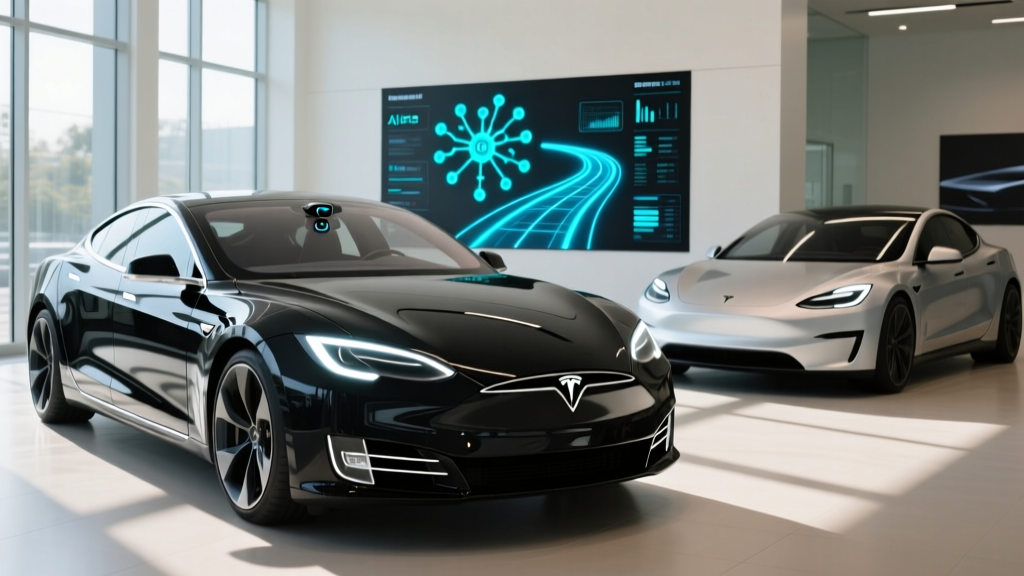
Tesla's approach to vehicle intelligence is unlike any other automaker's. Instead of licensing driver-assist stacks from Bosch or Mobileye, Tesla builds its own silicon, trains its own neural networks, and deploys over-the-air updates to millions of cars simultaneously. For buyers researching what AI does Tesla use, the answer spans custom inference chips, vision-only perception, end-to-end neural-network planning, and a massive cloud-training pipeline. But the real question for owners is simpler: does this AI make Tesla's cars better to drive, charge, and live with every day?
This guide dissects Tesla's AI stack as it exists in the 2026 model year, then walks through how that technology plays out across the current lineup — Model 3, Model Y, Model S, and Model X — with the exact range, charging, pricing, and ownership numbers you need to make a purchase decision.
Tesla's AI Stack: Custom Silicon, Vision-Only Perception, and End-to-End Neural Nets
Tesla's in-vehicle AI runs on the Hardware 4 (HW4) computer, introduced in early 2023 and standard on all new vehicles as of 2026. HW4 features a dual-chip redundant inference processor Tesla designed in-house, paired with a camera suite of up to eight external cameras (reduced from eight to a streamlined configuration on refreshed models) running at higher resolution than the legacy HW3 system. Tesla removed ultrasonic sensors (USS) and radar from new production vehicles, relying entirely on Tesla Vision — a camera-only perception system.
The software stack has evolved significantly. Tesla's Full Self-Driving (Supervised) system now uses an end-to-end neural network architecture (introduced with FSD v12 and refined through v13 and into the current v14.x series in 2026). Instead of hand-coded rules for lane-keeping, stopping, and turning, the system uses a single neural network that takes raw camera pixels as input and outputs steering, braking, and acceleration commands. This approach mimics how a human driver processes visual information, and Tesla trains it on billions of miles of real-world driving data collected from its fleet.
Tesla Autopilot and FSD (Supervised) are SAE Level 2 driver-assistance systems. The driver must remain fully attentive, keep hands on the steering wheel (or demonstrate engagement via the cabin camera), and be prepared to take over instantly. These systems are not self-driving. Only Level 4 services like Waymo operate without a human driver in defined zones.
On the cloud side, Tesla trains its models on a GPU cluster it calls Cortex, supplemented by its custom Dojo training tiles designed specifically for video-based neural-network training. The result is a continuous feedback loop: fleet data → cloud training → OTA deployment → improved driving behavior → more fleet data.
How Tesla's AI Translates to Real-World Driving in 2026
The on-road result of Tesla's AI investment is a driver-assist system that handles highway merging, urban intersections, and parking maneuvers with increasing fluency. FSD (Supervised) in its 2026 iteration navigates unprotected left turns, construction zones, and four-way stops more smoothly than earlier rule-based versions. However, limitations persist: heavy rain, direct sun glare, and faded lane markings still challenge the vision-only system, and the driver must remain engaged at all times.
Tesla's AI also powers features beyond driving. The cabin camera monitors driver attention, the thermal management system uses predictive algorithms to precondition the battery for Supercharging, and route planning factors in elevation, wind, temperature, and traffic to estimate range more accurately than static calculations.
2026 Tesla Lineup: Range, Charging, and Performance by Model
Below is a consolidated spec table for Tesla's four current consumer vehicles. All figures reflect 2026 model-year EPA data and manufacturer specifications.
| Spec | Model 3 Long Range AWD | Model Y Long Range AWD | Model S Long Range | Model X Long Range |
|---|---|---|---|---|
| EPA Range | 363 mi | 320 mi | 402 mi | 335 mi |
| Battery (usable) | ~79 kWh, NMC | ~79 kWh, NMC | ~100 kWh, NMC | ~100 kWh, NMC |
| Max DC Charge | 250 kW | 250 kW | 250 kW | 250 kW |
| 10–80% DC Time | ~25 min | ~27 min | ~30 min | ~32 min |
| Level 2 (11.5 kW) | ~44 mi/hr | ~42 mi/hr | ~38 mi/hr | ~36 mi/hr |
| 0–60 mph | 4.2 sec | 4.8 sec | 3.1 sec | 3.8 sec |
| Horsepower | ~384 hp | ~384 hp | ~670 hp | ~670 hp |
| Drivetrain | Dual-Motor AWD | Dual-Motor AWD | Dual-Motor AWD | Dual-Motor AWD |
| MPGe (combined) | 132 MPGe | 122 MPGe | 120 MPGe | 105 MPGe |
| Cargo Volume | 23 cu ft (trunk+frunk) | 76 cu ft (max) | 28 cu ft (rear+frunk) | 88 cu ft (max) |
Tesla's EPA range figures assume mixed driving. In real-world highway use at 70–75 mph, expect 85–90% of the EPA number (~310 mi for Model 3 LR, ~280 mi for Model Y LR). In cold weather (below 30°F), range can drop 20–30% due to cabin heating and battery resistance. Tesla's heat pump (standard on all 2026 models) mitigates this somewhat, but winter commuters should plan for ~250 mi usable range from a Model 3 LR in freezing conditions. Always precondition the battery via the Tesla app before Supercharging in cold weather to restore charge speed.
Charging Speed and Infrastructure: The Supercharger Advantage
Tesla's charging story remains its strongest competitive moat. The Supercharger network now exceeds 60,000 stalls globally, with V4 cabinets delivering up to 350 kW (though current Tesla vehicles peak at 250 kW due to their 400V architecture). Non-Tesla EVs with NACS connectors are increasingly accessing Superchargers, but Tesla owners still benefit from seamless plug-and-charge integration and automatic battery preconditioning when navigating to a Supercharger.
| Charging Level | Power | Miles Added per Hour | Best Use Case |
|---|---|---|---|
| Level 1 (120V) | ~1.4 kW | 3–5 mi/hr | Overnight trickle, emergencies |
| Level 2 (240V, 48A) | 11.5 kW | 36–44 mi/hr | Home daily charging |
| DC Fast (Supercharger V3/V4) | Up to 250 kW | ~1,000 mi/hr (peak) | Road trips, 10–80% in ~25–32 min |
Charging curve reality: Tesla's 250 kW peak rate applies only between roughly 10–30% State of Charge. Above 50%, the rate tapers significantly — expect ~100 kW at 60% SoC and ~50 kW above 80%. This is why Tesla quotes 10–80% times rather than 0–100%. Charging from 80–100% at a Supercharger can add another 25–30 minutes and is best reserved for when you genuinely need the full battery.
For home charging, a Tesla Wall Connector on a 60-amp circuit delivers 48 amps (11.5 kW), adding roughly 44 miles of range per hour for a Model 3. A full overnight charge (8 hours) restores ~350 miles — more than enough for any daily commute. Home installation typically costs $500–$2,000 depending on panel proximity and whether a 200-amp service upgrade is needed.
Pricing, Trims, and Federal Tax Credit Eligibility (2026)
Tesla pricing shifts frequently — sometimes weekly — based on demand and production costs. Below are approximate base MSRPs as of early 2026. The federal §30D EV tax credit of up to $7,500 is available as a point-of-sale transfer at the dealer, but eligibility depends on several factors that change annually.
| Model / Trim | Base MSRP | Est. After $7,500 Credit | Credit Eligible? |
|---|---|---|---|
| Model 3 RWD | ~$38,990 | ~$31,490 | ✅ Yes (within MSRP cap) |
| Model 3 Long Range AWD | ~$44,990 | ~$37,490 | ✅ Yes (within MSRP cap) |
| Model Y Long Range AWD | ~$47,990 | ~$40,490 | ✅ Yes (SUV MSRP cap $80K) |
| Model S Long Range | ~$79,990 | ~$72,490 | ⚠️ Borderline (sedan cap $55K may exclude) |
| Model X Long Range | ~$84,990 | N/A | ❌ Exceeds $80K SUV cap |
- MSRP Caps: Sedans/wagons ≤ $55,000; SUVs/trucks/vans ≤ $80,000. Model 3 and Model Y qualify; Model S and X generally do not. (Source: IRS §30D)
- Buyer Income Caps: Modified AGI ≤ $300,000 (joint), $225,000 (head of household), $150,000 (single). Exceed these and you're ineligible regardless of vehicle.
- Battery Sourcing: A percentage of critical minerals and battery components must be sourced from the U.S. or free-trade-agreement countries. Tesla's U.S.-built vehicles with CATL/Panasonic cells have generally met thresholds, but verify at fueleconomy.gov for the specific VIN.
- Point-of-Sale Transfer: As of 2024+, you can transfer the credit to the dealer at purchase, reducing your out-of-pocket cost immediately rather than waiting for tax filing.
Interior, Cargo, and Daily Practicality
Model 3 (Highland refresh): The cabin is minimalist — a single 15.4-inch touchscreen controls everything, including climate vents (no physical louvers). Rear legroom is 35.2 inches, adequate for adults but tighter than a midsize sedan. Cargo is 23 cu ft combined (trunk + frunk), enough for a week's groceries but not furniture. Build quality has improved significantly post-Highland, with ventilated front seats and ambient lighting now standard on Long Range.
Model Y (Juniper refresh): The crossover body style delivers 76 cu ft of cargo with rear seats folded, making it a genuine family hauler. Rear legroom is 41.6 inches. The optional third row (very small) is best suited to children. A power-folding rear cargo door and flat load floor make it practical for Costco runs and camping gear alike.
Model S and X: These flagship vehicles offer more premium materials, a 17-inch touchscreen with gaming-capable AMD Ryzen processor, a rear-seat entertainment display, and (on Model X) the signature falcon-wing rear doors. Model X offers up to 88 cu ft of cargo and standard towing up to 5,000 lbs. Model S rear legroom is generous at 41.7 inches.
Warranty and Long-Term Battery Durability
Tesla's warranty structure is straightforward:
- Basic Vehicle: 4 years / 50,000 miles
- Battery & Drive Unit: 8 years / 120,000 miles (Model 3 RWD with LFP); 8 years / 120,000 miles (Model 3/Y Long Range, NMC); 8 years / 150,000 miles (Model S/X)
- Capacity Retention Threshold: Tesla warrants that the battery will retain at least 70% of original capacity during the warranty period. Below that, Tesla replaces or refurbishes the pack at no charge.
Real-world degradation data from fleet analytics (including Teslanomics tracking) shows most Tesla NMC packs lose roughly 5–8% capacity in the first 50,000 miles, then flatten to a slow linear decline. At 150,000 miles, most packs retain 88–92% of original capacity — well above the warranty threshold. LFP packs (used in Model 3 RWD) show even less degradation and can be charged to 100% daily without longevity concerns, making them ideal for high-mileage commuters.
Tesla vs. Key Competitors: Is It Worth Buying?
✅ Tesla Pros
- Supercharger network: most reliable DC fast-charging ecosystem in North America
- Industry-leading efficiency (kWh/100mi) translates to more range per kWh
- OTA updates continuously add features and improve FSD
- Strong resale value relative to most EV competitors
- Minimalist interior means fewer parts to break
- Best-in-class app integration and remote features
❌ Tesla Cons
- No physical buttons — touchscreen-only controls frustrate some drivers
- FSD (Supervised) costs $8,000 extra and still requires full driver attention
- Vision-only system struggles more than radar-equipped rivals in heavy rain/snow
- Service center wait times can be long in growing markets
- Panel gaps and paint quality, while improved, still trail legacy luxury brands
- No Apple CarPlay or Android Auto
Model 3 vs. Hyundai Ioniq 6 / BMW i4: The Ioniq 6 offers comparable range (361 mi EPA) and faster 800V charging (10–80% in ~18 min), but lacks Supercharger access (though NACS adapters are coming). The BMW i4 is more refined inside but costs significantly more and offers less range. Model 3 wins on value, efficiency, and charging infrastructure.
Model Y vs. Hyundai Ioniq 5 / Ford Mustang Mach-E: The Ioniq 5 charges faster (800V architecture) and has a more distinctive design. The Mach-E drives more engagingly. But the Model Y offers more cargo space, better range, and the Supercharger advantage for road trips. For families who travel beyond their metro area, Model Y remains the default choice.
Who Should Buy a Tesla in 2026?
Decision Framework
Choose Model 3 RWD if: You're a commuter with home charging, want the lowest entry price (~$31,490 after credit), and don't need AWD. The LFP battery is ideal for daily 100% charging.
Choose Model 3 Long Range AWD if: You need all-weather capability, want 363 mi of range for road trips, and value the extra horsepower.
Choose Model Y Long Range AWD if: You have a family, need cargo versatility (76 cu ft), and want a crossover that can handle road trips with minimal charging stops.
Choose Model S or X if: Budget is flexible, you want flagship performance (3.1 sec 0–60 for Model S), and value premium features like the yoke steering option, rear-seat entertainment, and falcon-wing doors (X). Be aware these likely won't qualify for the federal tax credit.
Look elsewhere if: You want physical buttons, need Apple CarPlay, prefer a traditional dealer service experience, or live in an area with limited Tesla Service Centers.
Frequently Asked Questions
What AI does Tesla use for self-driving?
Tesla uses a custom end-to-end neural network architecture for its Full Self-Driving (Supervised) system. The neural net takes raw video input from external cameras and directly outputs steering, braking, and acceleration decisions. It's trained on billions of miles of fleet data using Tesla's Cortex GPU cluster and custom Dojo training supercomputer. The in-car inference runs on Tesla's proprietary HW4 chip. This is an SAE Level 2 system — the driver must remain fully engaged at all times.
What is the real-world range of a Tesla in 2026?
Real-world range depends heavily on driving style, speed, and temperature. For the Model 3 Long Range AWD (363 mi EPA), expect ~310–325 mi in mixed driving at moderate speeds, ~280–300 mi at sustained highway speeds of 70–75 mph, and ~250–270 mi in freezing winter conditions. The Model Y Long Range (320 mi EPA) typically delivers ~275–290 mi highway and ~230–250 mi in cold weather.
How fast does a Tesla charge at home and on the road?
At home on a Level 2 Tesla Wall Connector (11.5 kW / 48A), a Model 3 gains roughly 44 miles of range per hour — a full charge takes about 8 hours. On a V3 or V4 Supercharger, Tesla vehicles peak at 250 kW and charge from 10–80% in approximately 25–32 minutes depending on the model. The charging rate tapers significantly above 50% SoC, so the last 20% takes disproportionately longer.
Does Tesla qualify for the $7,500 federal EV tax credit?
The Model 3 (all trims) and Model Y qualify for the full $7,500 federal tax credit under IRS §30D, provided the buyer meets income caps ($150K single / $300K joint) and the vehicle meets battery-sourcing requirements. The credit can be transferred at point of sale, reducing your purchase price immediately. Model S and Model X generally exceed the MSRP caps ($55K for sedans, $80K for SUVs) and do not qualify. Always verify current eligibility at fueleconomy.gov and consult a tax professional.
Is Tesla's FSD worth the $8,000 cost?
This depends on your driving patterns and expectations. FSD (Supervised) reduces fatigue on long highway drives and handles urban navigation increasingly well, but it is not autonomous — you must monitor it constantly. For daily commuters on predictable routes, standard Autopilot (included) may suffice. For frequent road-trippers who value reduced cognitive load, FSD can be worthwhile. Note that FSD does not transfer to a new vehicle if you sell, which affects resale economics. Tesla occasionally offers monthly subscriptions (~$99/month), which may be more cost-effective than the outright purchase for occasional use.
How does Tesla's AI compare to competitors like GM Super Cruise or Ford BlueCruise?
GM's Super Cruise and Ford's BlueCruise use a different approach: they rely on pre-mapped highways, LiDAR map data, and driver-monitoring cameras, and they only operate on approved divided highways (hands-free but eyes-off on those specific roads). Tesla's FSD attempts to work everywhere — city streets, parking lots, rural roads — but requires hands-on engagement at all times. Super Cruise/BlueCruise are more constrained in where they work but offer true hands-free driving in those zones. Tesla's AI is more ambitious in scope but has not yet achieved the reliability needed for eyes-off operation anywhere.
Sources: EPA fuel-economy data via fueleconomy.gov; Tesla manufacturer specifications; IRS §30D clean vehicle credit rules via irs.gov. Pricing and credit eligibility are approximate and subject to change. Verify with Tesla and a tax professional before purchasing.