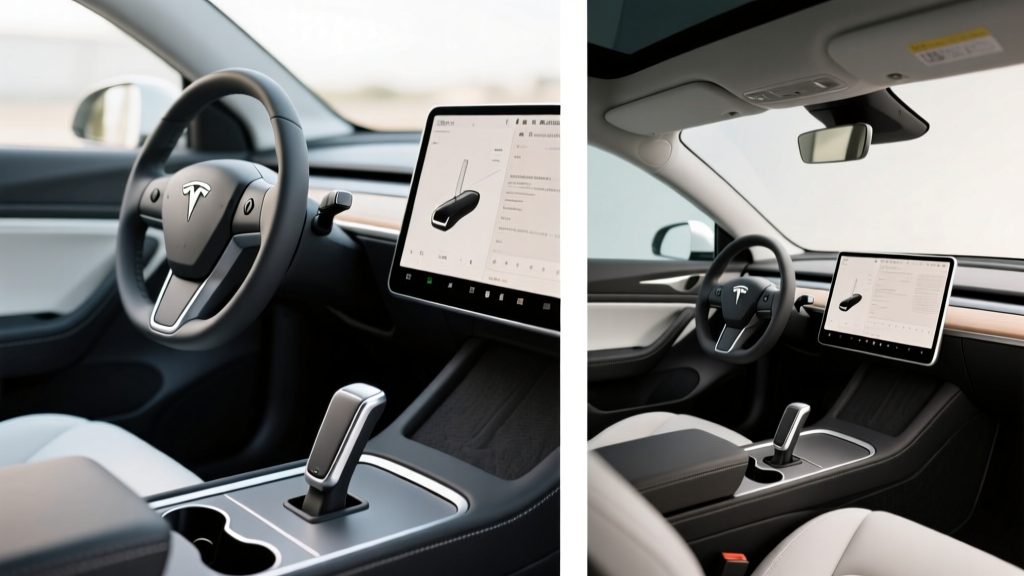
Tesla's 2025 model-year refresh brought one of the most polarizing interior changes in the brand's history: the elimination of the traditional column-mounted gear shifter in the Model 3 and Model Y. Referred to across forums and owner communities as the Tesla 2025 shifter update, this redesign shifts (pun intended) gear selection to a combination of touchscreen controls, steering-wheel buttons, and an overhead console. Whether you view it as a bold step toward minimalist interiors or an unnecessary removal of muscle-memory controls, the change is here — and it affects how you interact with the car every single drive.
This review covers the 2025 Tesla Model 3 Long Range AWD and Model Y Long Range AWD as the most popular configurations, examining how the shifter redesign fits into the broader ownership picture: range, charging, pricing, and whether these cars still make sense against growing competition.
The Tesla 2025 Shifter: What Actually Changed
Prior to the 2025 refresh, Tesla used a column-mounted stalk on the right side of the steering wheel to select Drive, Reverse, Neutral, and Park. It was intuitive, required no looking away from the road, and mirrored the behavior of decades of automatic transmissions.
The 2025 update removes that stalk entirely. Gear selection now happens through:
- Touchscreen slider: A vertical gear indicator on the left edge of the center display — swipe up for Drive, down for Reverse.
- Steering-wheel button: A dedicated Park button on the wheel itself.
- Overhead console: Backup physical buttons near the dome light for Drive, Reverse, Neutral, and Park — designed as a redundant fallback.
- Auto-shift logic: Tesla's software attempts to predict whether you want Drive or Reverse based on context (facing a wall? It selects Reverse). This can be disabled in settings.
2025 Model 3 Long Range AWD: Specs and Real-World Performance
| Spec | Value |
|---|---|
| EPA Range | 363 miles |
| Battery (usable) | ~75 kWh, NMC (2170 cells) |
| Drivetrain | Dual-motor AWD |
| Horsepower | ~384 hp combined |
| 0–60 mph | 4.2 seconds |
| Efficiency | 132 MPGe combined / 25 kWh/100 mi |
| Max DC Fast Charge | 250 kW (peak) |
| 10–80% DC Charge | ~25 minutes |
| Level 2 Home Charge | 11.5 kW / ~44 mi/hr |
| Cargo Volume | 23 cu ft (trunk) + 3 cu ft (frunk) |
| Rear Legroom | 35.3 inches |
| Battery/Powertrain Warranty | 8 years / 120,000 miles |
| Base MSRP | $47,740 (before destination) |
2025 Model Y Long Range AWD: The Family-Oriented Sibling
The Model Y received a similar shifter removal in its 2025 refresh (often called the "Juniper" update). It trades some range and efficiency for substantially more cargo room, making it the default pick for families.
| Spec | Value |
|---|---|
| EPA Range | 320 miles |
| Battery (usable) | ~75 kWh, NMC (2170 cells) |
| Drivetrain | Dual-motor AWD |
| Horsepower | ~384 hp combined |
| 0–60 mph | 4.8 seconds |
| Efficiency | 122 MPGe combined / 28 kWh/100 mi |
| Max DC Fast Charge | 250 kW (peak) |
| 10–80% DC Charge | ~25 minutes |
| Level 2 Home Charge | 11.5 kW / ~38 mi/hr |
| Cargo Volume | 76 cu ft (rear seats folded) + 4 cu ft (frunk) |
| Rear Legroom | 41.6 inches |
| Battery/Powertrain Warranty | 8 years / 120,000 miles |
| Base MSRP | $48,240 (before destination) |
According to fueleconomy.gov, the Model Y's higher curb weight and less aerodynamic profile cost it roughly 43 miles of EPA range compared to the Model 3 on the same battery pack. That trade-off buys you nearly three times the cargo volume — a calculation most families will gladly make.
Charging Speed: What the 2025 Teslas Actually Deliver
Both the 2025 Model 3 and Model Y Long Range AWD support a peak DC fast-charge rate of 250 kW on Tesla's V3 Superchargers. However, peak rate is not sustained rate. Here's what the charging curve actually looks like:
- 10–30% SoC: Sustains near 250 kW — fastest portion of the curve.
- 30–60% SoC: Tapers to ~170–190 kW.
- 60–80% SoC: Drops further to ~100–120 kW.
- Above 80%: Slows dramatically to ~40–50 kW (standard lithium-ion behavior to protect cell health).
The result: a 10–80% session takes roughly 25 minutes under optimal conditions (battery preconditioned, V3 Supercharger, moderate ambient temperature). If you arrive at a charger with a cold battery and haven't preconditioned via navigation routing, add 5–10 minutes while the car warms the pack.
For home charging on a Level 2 Wall Connector (48A circuit on a 60A breaker), both vehicles accept 11.5 kW, adding approximately 44 miles of range per hour in the Model 3 and 38 miles per hour in the Model Y. An overnight session from 20% to 80% takes roughly 5–6 hours — more than adequate for daily use.
Pricing, Trims, and Federal Tax Credit Eligibility
Tesla's pricing has shifted frequently, but as of the 2025 model year, the key trims and MSRPs are:
| Model / Trim | Base MSRP | §30D Credit Eligibility | Effective Price (if eligible) |
|---|---|---|---|
| Model 3 RWD | $38,990 | $3,750 (partial — battery sourcing) | ~$35,240 |
| Model 3 Long Range AWD | $47,740 | $3,750 (partial — battery sourcing) | ~$43,990 |
| Model Y Long Range AWD | $48,240 | $3,750 (partial — battery sourcing) | ~$44,490 |
| Model Y Performance | $52,490 | $3,750 (partial — battery sourcing) | ~$48,740 |
- MSRP caps: Sedans (Model 3) must be ≤ $55,000; SUVs/trucks/vans (Model Y) must be ≤ $80,000.
- Buyer income limits: AGI ≤ $150,000 (single), $225,000 (head of household), $300,000 (joint).
- Battery sourcing: Critical minerals and battery component requirements phase in annually. Tesla's current battery supply chain qualifies for the $3,750 critical-minerals half but not the full $7,500 for most 2025 trims.
The credit can be transferred to the dealer at point of sale as an instant discount. Consult a tax professional to confirm your individual eligibility.
Living with the Touchscreen Shifter: Daily Usability
After extended driving in both the 2025 Model 3 and Model Y, the shifter change lands somewhere between "adaptable" and "mildly annoying" depending on the scenario:
Where it works fine: Normal forward driving. You swipe up once, and you're in Drive. The auto-shift feature correctly guesses your intent about 90% of the time (backing out of a garage, it selects Reverse). The overhead backup buttons are reachable without much effort.
Where it frustrates: Multi-point turns and parking maneuvers. When you're rapidly toggling between Drive and Reverse in a tight parking lot, swiping a screen is slower and requires more visual attention than flicking a physical stalk. The steering-wheel Park button works well, but it's one more thing to remember.
The learning curve: Most owners report full adaptation within 1–2 weeks. The bigger concern is passenger usability — a spouse or friend unfamiliar with the car may struggle to put it in gear without instruction, which matters in an emergency.
Pros and Cons: The Honest Scorecard
Pros
- Class-leading efficiency (132 MPGe combined for Model 3)
- Extensive Supercharger network with reliable plug-and-charge
- Over-the-air updates continuously add features
- Strong resale value relative to most EV competitors
- Excellent regenerative braking and one-pedal driving
- 250 kW peak charging still competitive in 2025
- Model Y offers 76 cu ft cargo — best-in-class for electric SUVs
Cons
- Touchscreen shifter is less intuitive for parking maneuvers
- No physical speedometer or instrument cluster
- FSD (Supervised) costs extra and remains Level 2 — not autonomous
- Only qualifies for partial $3,750 federal credit (not full $7,500)
- Rear visibility in Model 3 is limited; no rear wiper on Model Y
- Ride quality firm on larger wheel options (19"+)
- Turn-signal buttons on steering wheel (replacing stalk) take adaptation
Is the 2025 Tesla Worth It vs. Key Competitors?
The 2025 Model 3 and Model Y no longer dominate by default. Here's how they stack up against the most relevant alternatives:
Model 3 Long Range vs. Hyundai Ioniq 6 SEL AWD: The Ioniq 6 offers 316 miles of EPA range, 800V architecture (charging 10–80% in ~18 minutes at 350 kW), and a traditional gear selector. It's a faster charger and a more conventional interior, but the Tesla wins on Supercharger network access and software ecosystem.
Model Y Long Range vs. Ford Mustang Mach-E Premium AWD: The Mach-E offers 290 miles EPA range and a more engaging driving feel, but the Model Y's cargo space (76 cu ft vs. 60 cu ft) and efficiency advantage are significant for family buyers.
Model Y vs. Kia EV9 (3-row SUV): If you need three rows, the EV9 is the only electric option in this price range. But for two-row cargo hauling, the Model Y's efficiency and Supercharger network remain hard to beat.
Who Should Buy the 2025 Tesla Model 3 or Model Y?
Choose the Model 3 Long Range AWD if: You prioritize maximum range and efficiency, commute long distances, rarely carry more than two passengers, and want the lowest cost-per-mile electric sedan available.
Choose the Model Y Long Range AWD if: You need serious cargo space for a family, frequently haul gear or child seats, and can accept 43 fewer miles of range for a dramatically more practical interior.
Look elsewhere if: You strongly prefer physical controls and traditional interfaces, need the fastest possible DC charging (Hyundai/Kia's 800V platform is quicker), or require the full $7,500 tax credit to make the math work.
Frequently Asked Questions
What is the real-world range of the 2025 Tesla Model 3 and Model Y?
The EPA rates the Model 3 Long Range AWD at 363 miles and the Model Y Long Range AWD at 320 miles. In real-world highway driving at 70–75 mph, expect 290–320 miles (Model 3) and 260–290 miles (Model Y). Cold weather below freezing can reduce range an additional 15–25%.
How fast does the 2025 Tesla charge at home and on the road?
On a V3 Supercharger, both vehicles peak at 250 kW and charge from 10–80% in approximately 25 minutes (with a preconditioned battery). At home on a Level 2 Wall Connector (11.5 kW), a full overnight charge takes 6–8 hours.
Does the 2025 Tesla qualify for the full $7,500 federal EV tax credit?
No. As of the 2025 model year, most Tesla vehicles qualify for a partial $3,750 credit under the critical-minerals requirement. The battery-component half ($3,750) is not currently met due to supply-chain sourcing rules. Eligibility also depends on buyer income (AGI caps) and MSRP limits. Always verify current rules at irs.gov.
Is the touchscreen shifter a safety concern?
NHTSA has not issued any recalls specific to the 2025 shifter redesign. Tesla includes redundant overhead buttons and auto-shift logic as backups. However, multi-point parking maneuvers do require more visual attention to the screen than a physical stalk would, which some drivers find distracting.
Can I still get a Tesla with a traditional gear stalk?
No. As of the 2025 model year, all new Model 3 and Model Y vehicles use the touchscreen/overhead-button shifter design. The Model S and Model X retain the column-mounted stalk. Used pre-2025 vehicles with the stalk are available on the secondary market.
What's the battery warranty on the 2025 Model 3 and Model Y?
Tesla covers the battery and drive unit for 8 years or 120,000 miles (whichever comes first) with a minimum 70% capacity retention guarantee. If the battery degrades below 70% of its original capacity within the warranty period, Tesla will repair or replace it.