Tesla's over-the-air updates remain one of the brand's strongest ownership differentiators, and the latest software drop is no exception. As of late 2025, Tesla's 2025 holiday update is rolling out with new features spanning navigation improvements, entertainment additions, and driver-assist refinements across the Model 3, Model Y, Model S, and Model X lineup. Unlike legacy automakers that lock software at the point of sale, Tesla continues to push meaningful capability upgrades to existing vehicles — sometimes years after delivery.
This article breaks down every confirmed feature in the 2025 Holiday Update (software version 2025.44.x), then pairs that with the hard ownership data buyers actually need: real-world range, charging speeds, pricing, tax credit eligibility, and whether a Tesla still makes sense against an expanding field of competitors in the 2026 model year.
What's New in Tesla's 2025 Holiday Update
The 2025 Holiday Update (build 2025.44.25 and subsequent point releases) began deploying to US and Canadian fleets in early December 2025. Tesla does not publish a single unified changelog; instead, features roll out in waves based on hardware generation (HW3 vs. HW4/AI4), vehicle model, and region. Here is what has been confirmed across the fleet as of this writing:
- Adaptive High Beams: Automatic high-beam dipping that responds to oncoming traffic and street lighting with improved latency over the prior implementation. Available on HW4/AI4-equipped vehicles.
- Updated Trip Planner with Battery Preconditioning Transparency: The navigation system now displays a more granular preconditioning status, showing estimated battery temperature and projected charge-curve taper before you arrive at a Supercharger.
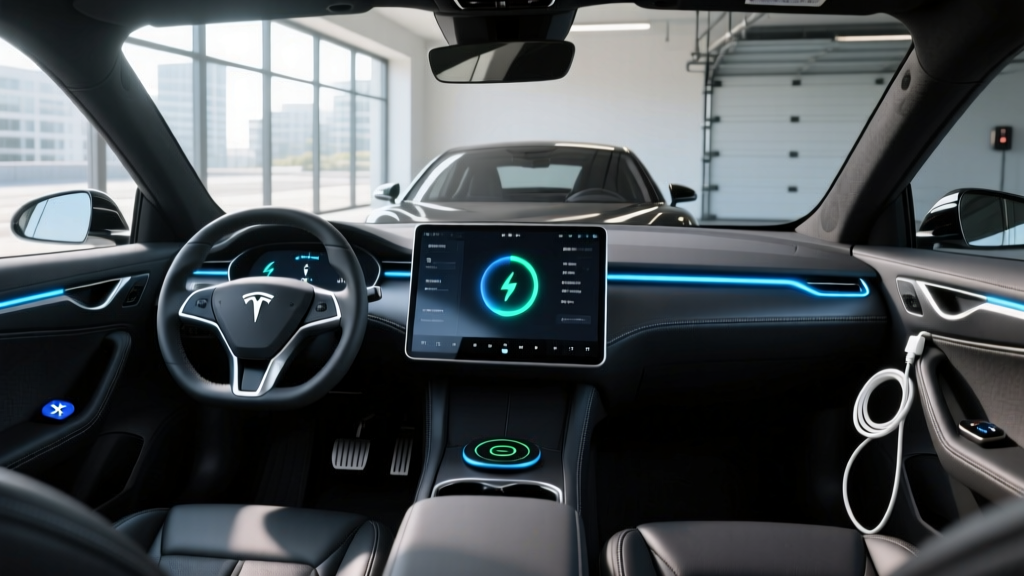
- Ambient Lighting Customization (Model 3 Highland / Model Y Juniper): Owners can now select from a broader color palette and set lighting schedules tied to time of day or drive mode.
- Dashcam and Sentry Clip Improvements: Clips now include a speed and G-force overlay, and the USB export format has been restructured for easier file management.
- Enhanced Voice Commands: Expanded natural-language recognition for climate, navigation, and media — now supports multi-step commands like "Navigate to the nearest Supercharger and set cabin to 70 degrees."
- Holiday Entertainment: Seasonal light-show choreographies (set to new music tracks), holiday-themed Boombox sounds, and an updated arcade selection including a new multiplayer title.
- FSD (Supervised) Visual Refinements: Improved rendering of construction zones, better lane-line visualization in low-visibility conditions, and smoother merge behavior on highway on-ramps. Note: FSD Supervised remains a SAE Level 2 system requiring full driver engagement.
- Energy App Redesign: The consumption graph now overlays elevation data and ambient temperature, helping owners understand range variance across trips.
2026 Tesla Lineup: Range, Battery, and Efficiency by Model
The holiday update applies across the current fleet, but the underlying hardware varies significantly. Below is a consolidated spec reference for the most popular Tesla models as of the 2026 model year. All range figures are EPA-estimated; real-world expectations follow.
| Spec | Model 3 LR AWD | Model Y LR AWD | Model S LR | Model X LR |
|---|---|---|---|---|
| EPA Range | 363 mi | 320 mi | 402 mi | 335 mi |
| Battery (usable) | ~75 kWh (NMC) | ~75 kWh (NMC) | ~95 kWh (NMC) | ~95 kWh (NMC) |
| MPGe (combined) | 134 MPGe | 122 MPGe | 124 MPGe | 109 MPGe |
| kWh/100 mi | 25 | 28 | 27 | 31 |
| 0-60 mph | 4.2 sec | 4.8 sec | 3.1 sec | 3.8 sec |
| Horsepower | ~346 hp | ~384 hp | ~670 hp | ~670 hp |
| Drivetrain | Dual-Motor AWD | Dual-Motor AWD | Dual-Motor AWD | Dual-Motor AWD |
| Base MSRP (2026) | $47,740 | $48,630 | $79,990 | $84,990 |
Sources: fueleconomy.gov, Tesla.com specifications. Pricing reflects MSRP before destination fees and before any applicable federal or state incentives.
Real-World Range: What the EPA Sticker Doesn't Tell You
Model 3 Long Range (EPA 363 mi): Expect ~300–320 mi on a mixed highway commute at 65–70 mph in moderate temperatures. Sustained 80 mph highway driving drops this to ~270–290 mi. In freezing conditions (below 32°F), plan for 240–280 mi due to cabin heating demand and increased battery internal resistance, even with Tesla's heat pump.
Model Y Long Range (EPA 320 mi): Real-world highway range sits around ~265–285 mi in fair weather. Cold-weather highway driving can reduce this to ~220–245 mi. The Model Y's taller, less aerodynamic profile costs it roughly 5–8% efficiency vs. the Model 3 at highway speed.
Model S Long Range (EPA 402 mi): The largest battery in the fleet delivers ~340–370 mi in real-world mixed driving. Highway-only at 75+ mph: ~310–340 mi. Cold weather: ~280–320 mi.
Model X Long Range (EPA 335 mi): Expect ~275–300 mi in moderate conditions, dropping to ~230–260 mi in winter highway driving. The Model X's weight and frontal area penalize efficiency most at sustained speed.
Tesla's heat pump (standard on all current models) mitigates cold-weather range loss better than resistive heating, but physics still wins: battery chemistry slows ion movement in cold temperatures, and cabin climate demand is substantial. Preconditioning the battery while plugged in — now more transparent thanks to the 2025 Holiday Update's energy app redesign — is the single most effective habit for preserving range in winter.
Charging Speed: DC Fast, Supercharger, and Home Level 2
Charging speed is where Tesla's vertically integrated Supercharger network continues to provide a tangible ownership advantage. Here are the charging specifications across the lineup:
| Charging Method | Model 3 / Y | Model S / X |
|---|---|---|
| Max DC Fast Charge | 250 kW (peak) | 250 kW (peak) |
| 10–80% DC Time | ~25–28 min | ~30–35 min |
| Level 2 (240V / 48A Wall Connector) | 11.5 kW / ~44 mi/hr | 11.5 kW / ~40 mi/hr |
| Level 1 (120V standard outlet) | ~1.4 kW / ~3–5 mi/hr | ~1.4 kW / ~3–4 mi/hr |
| Connector (North America) | NACS (native) | NACS (native) |
Understanding the charge curve: The 250 kW peak rate is not sustained across the entire session. Tesla's NMC batteries typically hold peak rate between ~10% and ~45% State of Charge (SoC), then taper progressively. By 80% SoC, charge speed drops to roughly 50–70 kW. This is why manufacturers quote 10–80% times rather than 0–100% — charging above 80% is painfully slow and best reserved for overnight Level 2 sessions at home.
Home charging reality: A Tesla Wall Connector on a 60-amp circuit (48A continuous) adds roughly 44 miles of range per hour for a Model 3. An overnight 10-hour session replenishes ~440 miles — more than enough for any daily commute. Installation costs vary widely: expect $800–$2,000 if your electrical panel has capacity, or $2,500–$5,000+ if a panel upgrade (to 200A service) is needed. Always consult a licensed electrician for a site-specific quote.
The 2025 Holiday Update's improved trip planner now shows estimated battery temperature on approach to a Supercharger, helping you understand why preconditioning matters: arriving at a Supercharger with a cold battery can cut peak charge rates by 30–50%, stretching a 25-minute stop to 40+ minutes.
Pricing, Trims, and Federal Tax Credit Eligibility
Tesla's pricing has stabilized after years of volatility. Here is the current lineup with federal tax credit context:
| Model / Trim | Base MSRP | Under §30D MSRP Cap? | Est. Credit |
|---|---|---|---|
| Model 3 RWD | $38,990 | ✅ Yes ($55K sedan cap) | Up to $7,500* |
| Model 3 Long Range AWD | $47,740 | ✅ Yes | Up to $7,500* |
| Model 3 Performance | $54,990 | ⚠️ Borderline — verify | Varies |
| Model Y LR AWD | $48,630 | ✅ Yes ($80K SUV cap) | Up to $7,500* |
| Model S LR / Plaid | $79,990+ | ❌ Exceeds $55K sedan cap | $0 |
| Model X LR / Plaid | $84,990+ | ❌ Exceeds $80K SUV cap | $0 |
*"Up to $7,500" is not guaranteed. Under IRS §30D rules, the full credit requires meeting both critical-mineral and battery-component sourcing thresholds, which shift annually. Additionally, buyer income caps apply: $150K single / $225K head of household / $300K joint filers (modified AGI). The credit can now be transferred to the dealer at point of sale, reducing your purchase price directly. Always verify current-year eligibility with a tax professional and the IRS Clean Vehicle provisions before committing.
Cargo, Passenger Space, and Practicality
Tesla's skateboard architecture (battery pack under the floor, motors at the axles) frees up interior volume that competitors with adapted ICE platforms can't match. Here's how the lineup stacks up:
- Model 3: 23 cu ft trunk + 3.1 cu ft frunk. Rear legroom: 35.3 in. Tight for tall rear passengers on long trips, but adequate for two adults. The Highland refresh improved rear seat cushion angle and acoustic insulation.
- Model Y: 30.2 cu ft cargo behind second row (76.2 cu ft with seats folded) + 4.1 cu ft frunk. Rear legroom: 40.5 in. This is the practicality sweet spot — compact-SUV footprint with near-midsize cargo volume. The optional third row (small children only) is best avoided for anyone over 5'4".
- Model S: 28 cu ft trunk (hatchback-style liftgate) + 3.1 cu ft frunk. Rear legroom: 35.4 in. Premium cabin materials and ventilated seats, but the rear seat remains surprisingly snug for a $80K+ sedan.
- Model X: Up to 88.1 cu ft with both rear rows folded (5-seat config). Falcon Wing rear doors provide dramatic stand-up access but add mechanical complexity. Third row is genuinely usable for adults on short trips — a rarity in the EV SUV segment.
Warranty, Reliability, and Long-Term Battery Outlook
Tesla's warranty structure is competitive but not class-leading:
- Basic Vehicle: 4 years / 50,000 miles
- Battery & Drive Unit (Model 3 RWD with LFP): 8 years / 100,000 miles
- Battery & Drive Unit (Model 3 LR, Model Y, Model S, Model X — NMC): 8 years / 120,000 miles (Model S/X: 150,000 miles)
- Capacity retention threshold: Tesla warrants that the battery will retain at least 70% of original capacity during the warranty period. Below 70%, Tesla will repair or replace at their discretion.
Real-world degradation data from fleet analytics (aggregated by third-party sources like Recurrent Auto) suggests Tesla's NMC packs lose roughly 5–8% capacity in the first 50,000 miles, then degrade at a much slower linear rate. Many high-mileage Teslas (150K+ miles) still report 85–90% State of Health. The LFP packs in the Model 3 RWD show even flatter degradation curves, with the trade-off of lower energy density (hence shorter range) and a recommendation to charge to 100% regularly — unlike NMC, which prefers a daily 80% ceiling.
Pros and Cons: The Honest Assessment
- Supercharger network remains the most reliable DC fast-charging ecosystem in North America
- Industry-leading software update cadence — the 2025 Holiday Update adds genuine utility, not just gimmicks
- Class-leading efficiency (kWh/100 mi) across Model 3 and Model Y
- Strong resale value relative to non-Tesla EVs
- Over-the-air improvements mean your car gains features post-purchase
- Heat pump standard on all models — better cold-weather range retention
- Model S and Model X no longer qualify for the federal tax credit (MSRP cap)
- FSD (Supervised) costs $8,000 or $99/mo but remains Level 2 — not autonomous
- Minimalist interior lacks physical controls for climate, mirrors, and glovebox (screen-dependent)
- No Apple CarPlay or Android Auto — Tesla's native infotainment only
- Service center capacity still lags fleet growth in many metro areas
- Model Y Juniper refresh pricing positions it closer to premium competitors without the premium badge cachet
Tesla vs. the Competition in 2026
The EV market has matured considerably. Here is how Tesla's core models stack up against key rivals:
Model 3 vs. Hyundai Ioniq 6: The Ioniq 6 SE Long Range offers an EPA 361 mi (nearly matching the Model 3 LR) at a lower starting price and with faster 800V charging architecture (~350 kW peak, 10–80% in ~18 min). However, the Ioniq 6 lacks Supercharger access (though Hyundai has gained NACS-equipped access to Tesla's network starting in 2025) and has a tighter rear seat. For pure efficiency and software, Tesla wins. For charging speed and value, Hyundai is compelling.
Model Y vs. Ford Mustang Mach-E / Chevrolet Equinox EV: The Model Y still leads in cargo volume and Supercharger convenience. The Mach-E Extended Range offers a similar EPA range (~312 mi) with a more traditional interior layout. The Equinox EV undercuts on price significantly but trails in performance. The Model Y remains the default for families who road-trip, but the gap has narrowed.
Model S vs. Lucid Air Pure / BMW i5: The Lucid Air Pure delivers 419 mi EPA (beating the Model S) with a more luxurious interior, but at a similar price point and with a far smaller service network. The BMW i5 offers traditional luxury-brand ownership with less range. The Model S's advantage is its Supercharger integration and software maturity, but it's no longer the undisputed sedan benchmark.
Who Should Buy a Tesla in 2026?
Choose Tesla if:
- You road-trip frequently and value the Supercharger network's reliability and density
- You want a vehicle that improves via OTA updates over time (the 2025 Holiday Update is a prime example)
- You prioritize efficiency (lowest kWh/100 mi in class) to minimize electricity cost per mile
- You want the strongest EV resale value trajectory
- You need Apple CarPlay/Android Auto or physical climate controls
- You want the fastest DC charging speeds (800V competitors like Hyundai/Kia/Porsche charge faster)
- You're buying a Model S or X and expected the $7,500 federal credit (they don't qualify)
- You prefer a traditional dealership service experience over mobile/center-based Tesla service
Frequently Asked Questions
What is the real-world range of the Tesla Model Y in winter?
In sustained freezing temperatures with highway driving at 70 mph, expect roughly 220–245 miles from the Model Y Long Range AWD (EPA 320 mi). Preconditioning while plugged in, using seat heaters instead of cabin air heating, and maintaining tire pressure at spec can recover 10–15 miles of that loss.
How fast does a Tesla charge at a Supercharger vs. at home?
At a V3 Supercharger (250 kW), a Model 3 Long Range charges from 10–80% in approximately 25–28 minutes. At home on a Tesla Wall Connector (11.5 kW / 48A), you gain about 44 miles of range per hour — meaning a full overnight session (10 hours) adds ~440 miles, effectively a full battery for daily use.
Does the Tesla Model Y qualify for the $7,500 federal tax credit in 2026?
The Model Y Long Range AWD ($48,630 MSRP) falls under the $80,000 SUV cap and is eligible for up to $7,500 under IRS §30D — but only if the buyer's modified AGI is under the income threshold ($150K single / $300K joint) and the vehicle meets that year's critical-mineral and battery-component sourcing requirements. These sourcing rules tighten annually. Verify with a tax professional before purchase. The credit can be applied at point of sale as a price reduction.
Is Tesla's FSD (Supervised) worth the $8,000 cost?
FSD Supervised is a sophisticated SAE Level 2 system that handles highway lane changes, on-ramp merges, and some city-street navigation with driver supervision. It is not autonomous driving. For frequent highway commuters, it reduces fatigue. For the $8,000 upfront cost (or $99/month subscription), the value depends on your commute profile. Standard Autopilot (included) handles lane-centering and adaptive cruise adequately for most drivers.
How does Tesla's battery degradation compare to competitors?
Tesla's NMC battery packs show approximately 5–8% degradation over the first 50,000 miles, then a slow linear decline. Fleet data suggests most packs retain 85–90% State of Health at 150,000 miles. The LFP chemistry in the Model 3 RWD degrades even more slowly but offers lower energy density. This is broadly in line with or slightly better than industry averages, aided by Tesla's active thermal management system.
What new features did the 2025 Holiday Update add to my Tesla?
Key additions include adaptive high beams, an improved trip planner with battery preconditioning transparency, enhanced voice commands with multi-step support, dashcam clips with speed/G-force overlays, a redesigned energy app with elevation and temperature overlays, FSD visual refinements for construction zones, and seasonal entertainment content. Feature availability depends on your vehicle's hardware generation (HW3 vs. HW4/AI4).
Data current as of early 2026. Specifications, pricing, and tax-credit eligibility are subject to change. Always verify with Tesla.com, fueleconomy.gov, and IRS.gov before purchasing. Real-world range estimates based on aggregated owner reports and independent testing; individual results vary based on driving style, terrain, temperature, and tire condition.