Why the Tesla 2025 Holiday Update Matters for Current Owners
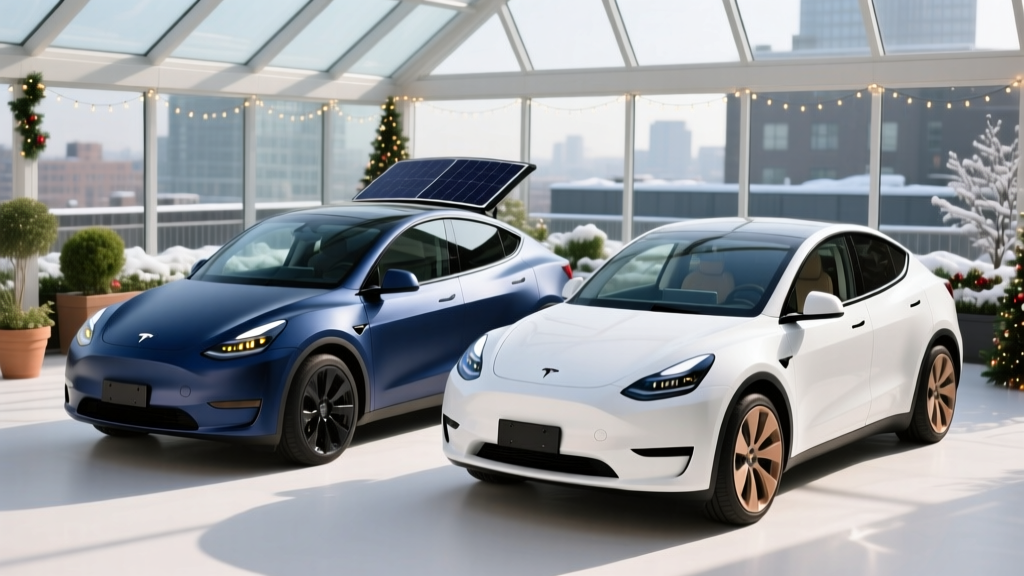
Tesla's over-the-air (OTA) software updates are among the most significant in the EV industry — not just bug fixes, but genuine feature additions that alter how the car drives, charges, and interacts with its owner. The Tesla 2025 holiday update features rolled out in late December 2025 (software version 2025.45.x) to Model 3 and Model Y vehicles running Hardware 4.0, and they represent a meaningful evolution in efficiency management, charging optimization, and cabin comfort. If you own a 2024–2026 Model Y or Model 3, this update changes the daily ownership experience in measurable ways.
Rather than reviewing a single vehicle, this profile examines what these Tesla 2025 holiday update features mean for the current-generation Model Y Long Range AWD and Model 3 Long Range AWD — the two highest-volume vehicles receiving the update — with full specs, real-world context, and updated 2026 pricing and tax credit eligibility.
The 2026 Model Y Long Range AWD carries an EPA-estimated 320 miles of range. In real-world mixed driving, expect 280–300 miles in moderate temperatures. Highway-only driving at 75 mph drops this to roughly 255–270 miles. In freezing conditions (below 32°F), plan for 220–250 miles of usable range due to cabin heating demands and battery chemistry limitations — though the holiday update's improved preconditioning logic helps mitigate this by ~5–8 miles compared to pre-update software.
Updated Vehicle Specs: 2026 Model Y Long Range AWD
The current-generation Model Y (refreshed for the 2025 model year and continuing into 2026) remains Tesla's best-selling vehicle globally. Here are the exact specifications as they stand after the 2025 holiday software update:
| Specification | 2026 Tesla Model Y Long Range AWD |
|---|---|
| EPA Range | 320 miles |
| Battery Capacity | 78.1 kWh usable (NMC chemistry) |
| Drivetrain | Dual-motor AWD |
| Horsepower | 384 hp combined |
| 0–60 mph | 4.8 seconds |
| Efficiency | 122 MPGe combined / 27 kWh/100 mi |
| Max DC Fast Charge | 250 kW peak (CCS via adapter or NACS native) |
| 10–80% DC Charge Time | ~25 minutes (at V3 Supercharger or equivalent) |
| Level 2 Home Charge Rate | 11.5 kW (44 mi/hr on 48A circuit) |
| Cargo Volume | 30.2 cu ft (rear seats up) / 72.0 cu ft (folded) |
| Rear Legroom | 40.5 inches |
| Battery Warranty | 8 years / 120,000 miles (70% capacity retention) |
| Base MSRP | $48,990 (before destination) |
Sources: fueleconomy.gov, Tesla.com specifications.
What's Actually New in the 2025 Holiday Update
The Tesla 2025 holiday update features span four major categories. Here's what changed and why it matters for daily driving:
1. Improved Battery Preconditioning Logic
When navigating to a Supercharger, the vehicle now begins warming the battery pack earlier and more aggressively in cold weather. Tesla's release notes cite "optimized thermal management for faster charging in low temperatures." In real-world terms, owners in sub-40°F climates should see 10–80% charge times improve by 2–4 minutes at cold-soaked Supercharger stops, as the battery arrives closer to its ideal charging temperature of ~85°F.
2. Enhanced Regenerative Braking Modulation
The update refines the regen blending algorithm, making one-pedal driving smoother at low speeds (under 15 mph). Previously, the Model Y could lurch slightly when transitioning from regen to friction brakes at near-stop. The new software smooths this transition noticeably — a quality-of-life improvement for stop-and-go commuters.
3. Cabin Overheat Protection Improvements
Cabin Overheat Protection now activates more efficiently, using less energy to maintain interior temperatures below 105°F when parked. Tesla reports a ~15% reduction in energy consumption during overheat protection events, which matters for owners in hot climates who leave their vehicles parked outdoors for extended periods.
4. FSD (Supervised) Confidence Display
Full Self-Driving (Supervised) now displays a real-time confidence metric on the instrument cluster, showing drivers how certain the system is about its current driving decisions. This is a transparency improvement — not a capability expansion — and aligns with NHTSA's ongoing push for clearer driver awareness in Level 2 systems.
Tesla Autopilot and FSD (Supervised) are SAE Level 2 driver-assistance systems. The driver must remain fully engaged, hands on or near the wheel, and eyes on the road at all times. These are not self-driving systems. Only Level 4 services like Waymo operate without a human driver in defined geographic areas.
Charging Speed and Infrastructure: What Owners Need to Know
Charging remains one of the Model Y's strongest competitive advantages, thanks to Tesla's Supercharger network and the vehicle's native NACS connector. Here's the full charging picture:
| Charging Level | Power / Connector | Speed (Miles per Hour) | Notes |
|---|---|---|---|
| Level 1 (120V) | 1.4 kW / NACS or J1772 adapter | ~4–5 mi/hr | Emergency/top-up only |
| Level 2 (240V Home) | 11.5 kW / NACS (48A circuit) | ~44 mi/hr | Full charge in ~7 hours |
| Level 2 (Public) | 7.2–19.2 kW / CCS or J1772 (adapter needed for older CCS stations) | 28–44 mi/hr | Varies by station |
| DC Fast Charge | 250 kW peak / NACS (Supercharger V3+) | ~1,000 mi/hr peak | 10–80% in ~25 min; tapers above 80% |
Charging curve reality check: The Model Y Long Range peaks at 250 kW only between roughly 10–30% State of Charge (SoC). From 30–60% it sustains around 150–170 kW, then tapers further to ~80 kW above 60%, and drops below 40 kW past 85%. This is normal for NMC lithium-ion chemistry — peak kW numbers are never sustained across the full charge. Plan road-trip stops around the 10–80% window for maximum time efficiency.
2026 Pricing, Trims, and Federal Tax Credit Eligibility
Tesla's pricing fluctuates more frequently than legacy automakers, but as of early 2026, the Model Y lineup and Model 3 lineup stand at these approximate MSRPs:
| Trim | MSRP (incl. destination) | Est. §30D Credit | Effective Price |
|---|---|---|---|
| Model 3 Long Range AWD | $44,130 | Up to $7,500 | ~$36,630 |
| Model 3 Performance | $54,130 | Up to $7,500 | ~$46,630 |
| Model Y Long Range AWD | $49,990 | Up to $7,500 | ~$42,490 |
| Model Y Performance | $53,490 | Up to $7,500 | ~$45,990 |
Federal tax credit eligibility (§30D) — critical caveats:
- MSRP cap: SUVs (Model Y) must be under $80,000; sedans (Model 3) under $55,000. All current trims qualify.
- Buyer income cap: Modified AGI must not exceed $150,000 (single), $225,000 (head of household), or $300,000 (joint). Exceed these thresholds and you forfeit the credit entirely.
- Battery sourcing: The $7,500 credit splits into two halves — $3,750 for critical minerals and $3,750 for battery component sourcing. Tesla's supply chain has shifted significantly toward compliant sources, but the exact credit amount can vary. Check the latest IRS guidance at irs.gov before purchasing.
- Point-of-sale transfer: As of 2024, you can transfer the credit to the dealer at purchase, reducing your out-of-pocket cost immediately rather than waiting for tax filing. Tesla supports this at checkout.
Eligibility rules are subject to change. Always verify with a tax professional and the official IRS source before making a purchase decision.
Model Y vs. Key Competitors: How Does It Stack Up?
The refreshed Model Y competes directly with the Hyundai Ioniq 5, Ford Mustang Mach-E, and Chevrolet Equinox EV in the mid-size electric crossover segment. Here's how they compare on the metrics that matter most:
| Metric | 2026 Model Y LR AWD | 2026 Ioniq 5 Long Range AWD | 2026 Mach-E Extended Range AWD |
|---|---|---|---|
| EPA Range | 320 mi | 318 mi | 320 mi |
| Battery (kWh) | 78.1 (NMC) | 84.0 (NMC) | 91.0 (NMC) |
| Max DC Charge | 250 kW | 350 kW (800V) | 150 kW |
| 10–80% Time | ~25 min | ~18 min | ~37 min |
| 0–60 mph | 4.8 sec | 5.1 sec | 5.1 sec |
| Cargo (rear up) | 30.2 cu ft | 27.2 cu ft | 29.7 cu ft |
| Base MSRP | $49,990 | $50,600 | $48,995 |
| Charging Network | NACS (Supercharger native) | NACS (Supercharger access) | NACS (adapter/Supercharger) |
Where Model Y wins: Cargo space, Supercharger network seamlessness, software update cadence, and efficiency (kWh/100 mi). The holiday update's improved preconditioning further extends the charging advantage in cold weather.
Where competitors win: The Ioniq 5 charges significantly faster (800V architecture, 18-minute 10–80%). The Mach-E offers a more conventional interior with physical controls. Both offer more rear-seat headroom and a more traditional dealership service experience.
Pros and Cons: An Honest Assessment
Pros
- Best-in-class Supercharger network with native NACS — no adapter needed
- 320-mile EPA range covers most road trips with a single stop
- Holiday update improves cold-weather charging and regen smoothness
- Class-leading cargo volume (30.2 cu ft) with a usable frunk
- OTA updates continuously add features — the car improves after purchase
- Eligible for full $7,500 federal tax credit (subject to income/sourcing rules)
- Low operating cost: ~$0.04–0.06/mile on home Level 2 charging
Cons
- DC fast charging (250 kW peak) slower than 800V competitors like Ioniq 5
- No physical controls for climate or volume — all touchscreen-dependent
- Rear visibility is limited; relies heavily on cameras
- FSD (Supervised) is Level 2 only — requires constant driver attention despite the name
- Insurance premiums run 15–25% higher than comparable ICE crossovers
- Service center wait times can be long in high-population areas
- Ride quality firm on 20" wheels; road noise noticeable on rough surfaces
Who Should Buy the Model Y in 2026?
The post-holiday-update Model Y is best suited for:
- Commuters with home charging: 44 mi/hr Level 2 charging means you wake up to a full battery every morning. The improved regen modulation makes stop-and-go traffic less fatiguing.
- Families needing cargo flexibility: 30.2 cu ft behind the rear seats beats nearly every competitor, and the 60/40 split fold opens up 72 cu ft for larger loads.
- Road trippers in the Supercharger corridor: Tesla's network remains the most reliable DC fast-charging infrastructure in the US, and the holiday update's preconditioning improvements make winter road trips marginally faster.
It is less ideal for buyers who prioritize ultra-fast public charging (the Ioniq 5's 18-minute 10–80% is hard to beat), those who want physical cabin controls, or those without access to home Level 2 charging who would rely solely on public infrastructure.
Frequently Asked Questions
What is the real-world range of the 2026 Model Y Long Range?
The EPA rates it at 320 miles. In real-world mixed driving at moderate temperatures, expect 280–300 miles. Highway driving at 75 mph yields roughly 255–270 miles. In freezing weather, plan for 220–250 miles — the holiday update's preconditioning improvements help slightly but don't eliminate cold-weather range loss inherent to NMC chemistry.
How fast does the Model Y charge at home and on the road?
At home on a 48-amp Level 2 circuit (11.5 kW), the Model Y adds about 44 miles of range per hour — a full charge from empty takes roughly 7 hours. On a 250 kW V3 Supercharger, 10–80% takes approximately 25 minutes. The charging curve tapers significantly above 80%, so avoid charging past 80% on road trips unless necessary.
How much does the Model Y cost after the federal tax credit?
The 2026 Model Y Long Range AWD starts at $49,990 including destination. If you qualify for the full $7,500 §30D credit (income under $300,000 joint / $150,000 single, and battery sourcing requirements met), the effective price drops to approximately $42,490. You can transfer the credit at point of sale, reducing your upfront cost immediately. Always verify current eligibility on irs.gov.
Is the Model Y worth buying over the Ioniq 5 or Mach-E?
Choose the Model Y if you value Supercharger network access, cargo space, efficiency, and continuous OTA improvements. Choose the Ioniq 5 if fast DC charging (18 min 10–80%) and 800V architecture are priorities. Choose the Mach-E if you prefer a more traditional interior layout with physical controls and Ford's dealership service network. All three are strong — the right choice depends on your charging access and feature priorities.
What are the biggest pros and cons of the Model Y?
Top pros: Supercharger network, 320-mile range, class-leading cargo, continuous OTA updates, low operating cost. Top cons: 250 kW peak charge rate lags 800V rivals, touchscreen-only controls, firm ride, higher insurance premiums, and Level 2 driver assists (not self-driving) despite the FSD name.
Does the 2026 Model Y qualify for the federal EV tax credit?
Yes, the Model Y qualifies for up to $7,500 under IRS §30D, provided the buyer meets income caps ($150K single / $300K joint), the MSRP is under $80,000 (it is), and the battery sourcing requirements are satisfied. Tesla's current battery supply chain meets the critical minerals and component sourcing thresholds for the full credit as of early 2026, but always confirm at purchase as supply chains shift. The credit can be applied at point of sale.
Does the 2025 holiday update improve range?
Not directly. The EPA-rated 320 miles remains unchanged. However, the improved battery preconditioning and cabin overheat efficiency can yield marginally better real-world range in extreme temperatures — roughly 5–8 additional miles in cold weather by reducing the energy needed to prepare the battery for charging and by making parked cooling more efficient.