The Tesla 2025.26.4 Grok update is one of the most talked-about over-the-air software drops in recent memory. Rather than introducing a new vehicle, this software version integrates xAI's Grok conversational AI directly into the Tesla infotainment system, fundamentally changing how drivers interact with navigation, vehicle settings, and trip planning. In this review, we examine what the update delivers, then ground it in the hard specs — range, charging, pricing, and ownership realities — of the Tesla vehicles that receive it.
What the Tesla 2025.26.4 Grok Update Actually Does
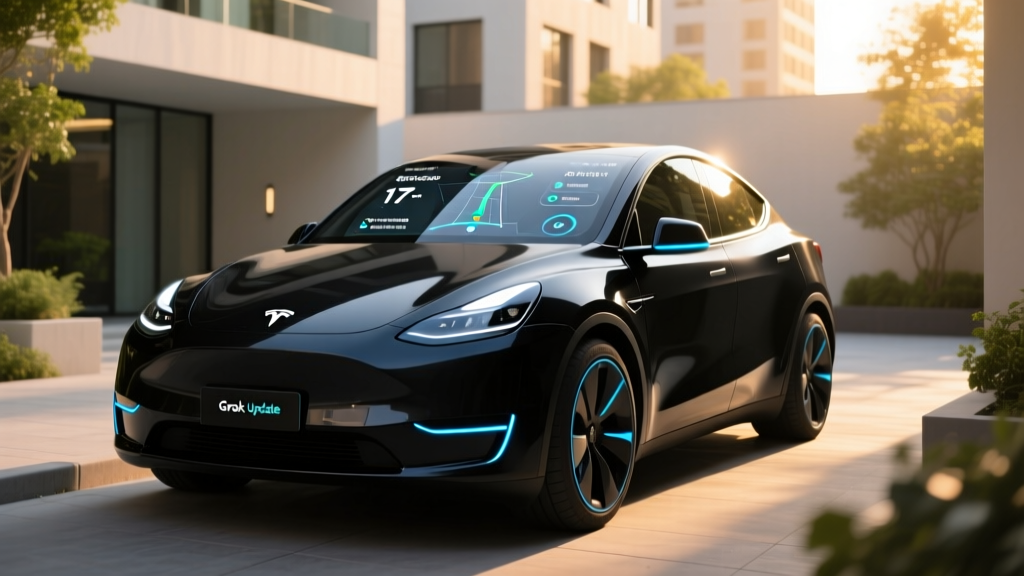
Software version 2025.26.4 brings Grok — xAI's large language model — into the Tesla touchscreen interface as a voice-activated and text-input assistant. Unlike the legacy voice commands that handled basic navigation entries and media requests, Grok enables multi-turn conversational queries. You can ask it to find charging stations along a route filtered by amenities, compare energy costs for a planned road trip, explain a warning light, or adjust climate and suspension settings through natural language.
The integration runs locally where possible for latency-sensitive commands (climate, media, basic navigation) and connects to xAI's cloud infrastructure for complex queries. Tesla has stated that Grok does not control driving functions — it is strictly an infotainment and convenience layer. Autopilot and FSD (Supervised) remain separate systems with their own validation pipelines.
Eligible vehicles include the current-generation Model 3 (Highland refresh and later), Model Y (Juniper refresh and later), Model S, and Model X running Hardware 4.0 or later. Owners of older Hardware 3.0 vehicles will not receive the full Grok integration due to compute constraints.
Platform Specs: Range, Battery, and Efficiency
Since the 2025.26.4 Grok update rolls out primarily to the refreshed Model Y (the highest-volume recipient), we'll anchor our spec analysis to the 2026 Tesla Model Y Long Range AWD — the most popular configuration.
| Spec | Value |
|---|---|
| EPA Range | 320 miles |
| Battery Capacity (usable) | ~78 kWh, NMC (nickel manganese cobalt) |
| Efficiency | 122 MPGe combined / 28 kWh/100 mi |
| Drivetrain | Dual-motor AWD |
| Horsepower | 384 hp (combined) |
| 0–60 mph | 4.8 seconds |
| Cargo Volume | 30.2 cu ft (rear seats up), 72.1 cu ft (folded) |
| Rear Legroom | 41.6 in |
| Battery/Drive Unit Warranty | 8 years / 120,000 miles |
| Base MSRP | $46,630 |
Charging Speed: DC Fast Charge and Home Level 2
Charging infrastructure access is where Tesla owners retain a significant advantage in 2026, thanks to the fully opened Supercharger network and NACS connector adoption across the industry. Here's what the current Model Y Long Range delivers:
| Charging Level | Power | Speed / Notes |
|---|---|---|
| Level 1 (120V household) | ~1.4 kW | ~4–5 miles per hour |
| Level 2 (240V home, 48A) | 11.5 kW | ~37 miles per hour; full charge in ~8 hours |
| DC Fast Charge (Supercharger V4) | Peak 250 kW | 10–80% in ~25 minutes |
The Model Y's peak 250 kW DC fast-charge rate is sustained only between approximately 10–30% SoC. Above 50%, the charge curve tapers significantly — you'll see roughly 100 kW by 60% and under 50 kW above 80%. This is standard behavior for NMC chemistry with active thermal management, but it means that 10–80% time is the more useful metric than peak kW alone.
At home, a Tesla Wall Connector on a 60-amp circuit delivers the full 11.5 kW (48 amps continuous), adding roughly 37 miles of range per hour of charging. Most daily commuters will recover a full day's driving in 1–2 hours of overnight plug-in. Installation costs for a 240V/60A circuit typically run $800–$2,000 depending on panel proximity and local permitting, according to Tesla's home charging guide.
Tech Deep Dive: Grok Integration and Driver Assistance
The Grok assistant in 2025.26.4 is the headline feature, but it sits within a broader tech ecosystem. The Model Y's 15.4-inch center touchscreen runs Tesla's latest UI with improved navigation rendering, trip energy graphs, and battery preconditioning prompts that warm the pack ahead of scheduled Supercharger stops.
Grok capabilities include:
- Natural-language destination entry with contextual filtering ("find a Supercharger near a grocery store in Denver")
- Trip energy estimation with elevation and weather factoring
- Voice-controlled vehicle settings (suspension height, regen mode, cabin overheat protection)
- Owner's manual Q&A ("What does the orange triangle warning mean?")
- General knowledge queries while parked (not available while driving for safety)
On the driver-assistance front, the Model Y ships with basic Autopilot (Traffic-Aware Cruise Control and Autosteer). FSD (Supervised) remains a $8,000 add-on or $99/month subscription. It is critical to understand that FSD is an SAE Level 2 system — it requires continuous driver supervision and does not make the vehicle autonomous. Tesla's own documentation states the driver must remain attentive and keep hands on the wheel. For context, only dedicated robotaxi services like Waymo operate at SAE Level 4.
Pricing, Tax Credit Eligibility, and Ownership Cost
The 2026 Tesla Model Y Long Range AWD starts at $46,630 before destination. With FSD added, the as-tested price climbs to approximately $55,630. The Performance trim starts at $51,630 with a 3.5-second 0–60 time and 21-inch wheels (which reduce EPA range to approximately 295 miles).
| Trim | Base MSRP | §30D Credit Eligible? | Effective Price (with credit) |
|---|---|---|---|
| Long Range RWD | $44,130 | Yes (if buyer qualifies) | ~$36,630 |
| Long Range AWD | $46,630 | Yes (if buyer qualifies) | ~$39,130 |
| Performance AWD | $51,630 | Yes (under $80K SUV cap) | ~$44,130 |
Federal tax credit rules (IRS §30D, current for 2026): The $7,500 credit is available as a point-of-sale reduction, but eligibility depends on multiple factors per IRS guidance:
- MSRP cap: SUVs must be under $80,000 — all Model Y trims qualify.
- Buyer income cap: Modified AGI must not exceed $150,000 (single), $225,000 (head of household), or $300,000 (joint).
- Battery sourcing: Critical minerals and battery components must meet phased percentage thresholds from FTA countries. Tesla's supply chain has largely complied, but verify current eligibility at fueleconomy.gov before purchasing, as sourcing rules tighten annually.
- Point-of-sale transfer: Buyers can transfer the credit to the dealer at purchase, reducing the purchase price directly rather than waiting for a tax refund.
Pros and Cons
- Access to the Supercharger network — the most reliable DC fast-charging infrastructure in the US
- Grok integration adds genuinely useful trip planning and voice control
- Class-leading cargo space (72.1 cu ft) for the compact electric SUV segment
- Strong efficiency at 122 MPGe combined
- OTA updates continuously improve the vehicle post-purchase
- 8-year/120,000-mile battery and drive unit warranty
- FSD (Supervised) remains a Level 2 system despite the $8,000 price tag
- No traditional instrument cluster — all info on center screen
- 250 kW peak DC charge rate trails Hyundai/Kia's 800V architecture (~350 kW)
- Ride quality on 21-inch Performance wheels is firm on rough pavement
- Grok requires internet connectivity for complex queries — dead zones limit functionality
- Insurance premiums run 15–25% higher than comparable non-EV SUVs
Who Should Buy the Model Y With Grok?
The 2026 Model Y with the 2025.26.4 Grok update is best suited for tech-forward commuters and families who value over-the-air improvements and seamless charging access. If you drive 30–80 miles daily, can install a Level 2 charger at home, and take 2–4 road trips per year, the Model Y's combination of range, Supercharger access, and cargo versatility is difficult to match.
It's less ideal for buyers who prioritize ride comfort over technology, those without home charging access, or anyone expecting full autonomous driving from FSD. If you need Level 4 autonomy today, robotaxi services like Waymo (available in select metro areas) are the only option.
Competitor Comparison: Model Y vs. the Field
The Model Y's primary competitors in 2026 include the Hyundai Ioniq 5, Ford Mustang Mach-E, and Chevrolet Equinox EV. The Ioniq 5 charges faster (10–80% in ~18 minutes on 800V architecture) but has less cargo space. The Mach-E offers a more traditional interior layout but trails in efficiency. The Equinox EV undercuts on price but delivers less range and slower DC charging.
The Grok integration gives Tesla a unique infotainment advantage that competitors haven't matched. Whether that justifies the premium depends on how much you value AI-assisted trip planning versus traditional interface simplicity.
Frequently Asked Questions
What is the real-world range of the 2026 Tesla Model Y?
The EPA rates the Long Range AWD at 320 miles. In real-world highway driving at 70–75 mph, expect 270–290 miles in warm weather and 250–270 miles in cold weather (below 40°F). City driving with regenerative braking can exceed the EPA estimate.
How fast does the Model Y charge at home and on the road?
On a home Level 2 charger (240V, 48A), the Model Y adds approximately 37 miles of range per hour, fully charging overnight. At a Supercharger V4, it peaks at 250 kW and charges from 10–80% in roughly 25 minutes, with significant tapering above 50% SoC.
Does the Model Y qualify for the $7,500 federal EV tax credit?
The Model Y qualifies under the MSRP cap (under $80,000 for SUVs). However, buyer income caps ($150K/$225K/$300K by filing status) and battery sourcing requirements apply. Verify current eligibility at fueleconomy.gov and consult a tax professional before relying on the credit.
Is the Grok update available on older Tesla vehicles?
The 2025.26.4 Grok update requires Hardware 4.0 or later. Vehicles with Hardware 3.0 (most pre-2023 Model 3/Y and pre-2021 Model S/X) will not receive full Grok integration due to onboard compute limitations.
Is FSD (Supervised) self-driving?
No. FSD (Supervised) is an SAE Level 2 driver-assistance system. The driver must remain fully attentive, keep hands on the wheel, and be prepared to take over at any moment. It does not make the vehicle autonomous.