If you're shopping for a Tesla or already own one, you've likely encountered the term Tesla 14-50 — shorthand for charging a Tesla electric vehicle using a NEMA 14-50 outlet. This 240-volt receptacle is the single most common home-charging solution for EV owners who want faster Level 2 speeds without the cost of a hardwired wall connector installation. But what does a 14-50 outlet actually deliver in real-world charging speed, and is it the right choice for your home and driving habits?
This guide breaks down exactly what you get when you plug a Tesla (or any EV with the right adapter) into a NEMA 14-50 outlet: the kW draw, miles of range added per hour, installation costs, safety considerations, and how it compares to hardwired Level 2 and DC fast charging. Whether you're setting up your first home charger or optimizing an existing one, these numbers will help you decide.
What Is a NEMA 14-50 Outlet and Why Do Tesla Owners Use It?
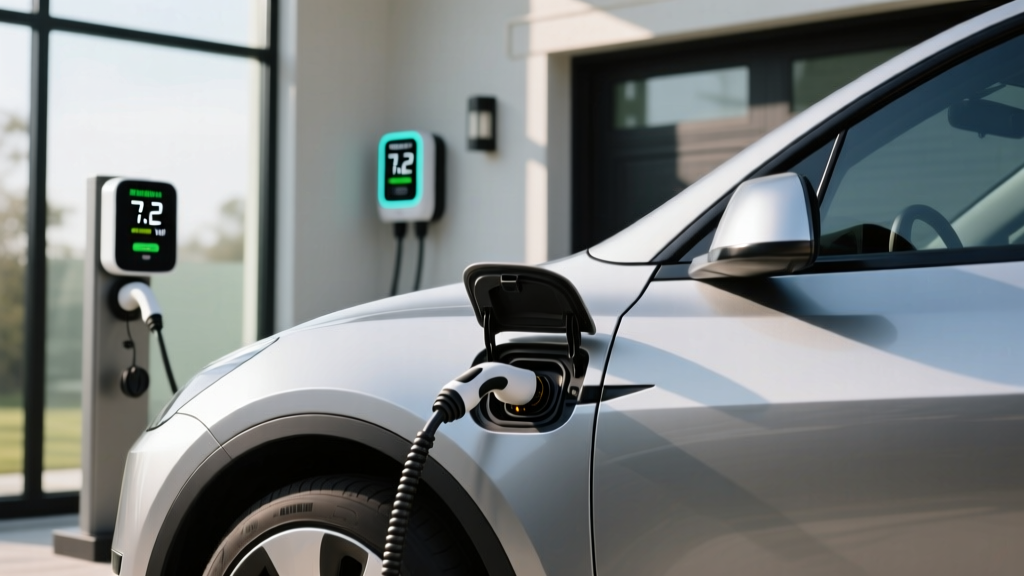
A NEMA 14-50 is a 240-volt, 50-amp electrical receptacle — the same type commonly used for electric ranges and RV hookups. For EV charging, it has become the default plug-in Level 2 solution because it offers a strong balance of charging speed and installation simplicity. You don't need to hardwire anything; a qualified electrician installs the outlet on a dedicated 50-amp circuit, and you simply plug in your Tesla Mobile Connector or a third-party Level 2 EVSE with a 14-50 plug.
Tesla's own Mobile Connector ships with a NEMA 14-50 adapter in the box (as of 2026 model-year deliveries), which is a major reason the term "Tesla 14-50" has become synonymous with home charging for Model 3, Model Y, Model S, and Model X owners. The outlet is also portable in the sense that if you move homes, the Mobile Connector comes with you — you just need another 14-50 outlet at the new location.
kW (kilowatts) measures the rate of charging — how fast energy flows into your battery. kWh (kilowatt-hours) measures the total energy capacity of your battery. A 14-50 outlet delivers up to ~9.6 kW of power; a Tesla Model Y Long Range battery holds ~75 kWh of usable energy. Think of kW as the width of the pipe and kWh as the size of the tank.
Tesla 14-50 Charging Speeds: Exact kW, Miles Per Hour, and Full-Charge Times
The NEMA 14-50 outlet is rated for 50 amps, but the National Electrical Code (NEC) requires that continuous loads (like EV charging, which runs for hours) be limited to 80% of the circuit rating. That means a 14-50 outlet delivers a maximum of 40 amps continuous at 240 volts, or approximately 9.6 kW.
Here's how that translates to real charging times for current Tesla models:
| Model | Battery (kWh usable) | Charge Rate (kW) | Miles of Range / Hr | 10–80% Time |
|---|---|---|---|---|
| Model 3 Long Range AWD | ~75 kWh | 9.6 kW | ~37 mi/hr | ~5 hr 20 min |
| Model Y Long Range AWD | ~75 kWh | 9.6 kW | ~33 mi/hr | ~5 hr 30 min |
| Model S Long Range | ~95 kWh | 9.6 kW | ~34 mi/hr | ~7 hr |
| Model X Long Range | ~95 kWh | 9.6 kW | ~30 mi/hr | ~7 hr 15 min |
| Cybertruck AWD | ~123 kWh | 9.6 kW | ~28 mi/hr | ~9 hr |
Real-world note: These figures assume a full 40A continuous draw. In practice, some older or marginal 14-50 installations may deliver slightly less due to voltage drop on long wire runs. Tesla's Mobile Connector will automatically negotiate the safe amperage with the outlet, so you won't overload the circuit — but you may see 32–36A on some installations instead of a full 40A.
At 9.6 kW, a 14-50 outlet adds roughly 30–37 miles of range per hour of charging. For most Tesla owners who drive 30–50 miles per day and plug in overnight, a 14-50 outlet fully replenishes daily driving in 1–2 hours. You'll wake up to a full battery every morning — the core advantage of home Level 2 charging.
NEMA 14-50 vs. Hardwired Tesla Wall Connector: Speed and Cost Compared
The main alternative to a 14-50 outlet is Tesla's Wall Connector, hardwired to a 60-amp circuit. Here's the direct comparison:
| Spec | NEMA 14-50 (Mobile Connector) | Hardwired Wall Connector (60A) |
|---|---|---|
| Max circuit amps | 50A | 60A |
| Continuous draw (80% rule) | 40A | 48A |
| Max kW (at 240V) | 9.6 kW | 11.5 kW |
| Model Y miles/hr | ~33 mi/hr | ~44 mi/hr |
| Equipment cost | $200 (Mobile Connector included) | $475 (Wall Connector) |
| Typical electrician install | $500–$1,500 | $800–$2,000 |
| Portability | Yes — take Mobile Connector with you | No — fixed to wall |
| Smart features | Basic (via Tesla app scheduling) | Wi-Fi updates, load sharing, access control |
The hardwired Wall Connector delivers about 20% more charging speed (48A vs 40A). For most daily drivers, the difference is negligible — both will fully recharge overnight. The 14-50 wins on cost and flexibility. The Wall Connector wins if you have a very high-mileage day (200+ miles), a large battery (Cybertruck or Model S/X), or need features like power sharing between two EVs on a single circuit.
Tesla 14-50 Installation Cost Breakdown
Here's what a NEMA 14-50 installation typically costs for EV charging, based on 2026 electrician rates across the U.S.:
| Component | Low End | High End | Notes |
|---|---|---|---|
| NEMA 14-50 receptacle + box | $30 | $80 | Industrial-grade (Hubbell/Bryant) recommended |
| 6 AWG copper wire (50 ft run) | $100 | $250 | Longer runs cost more; 4 AWG for runs over 75 ft |
| 50A double-pole breaker | $15 | $40 | Must match panel brand |
| Electrician labor | $300 | $1,200 | Depends on panel location, conduit, wall penetration |
| Permit + inspection | $50 | $200 | Required in most jurisdictions |
| Panel upgrade (if needed) | $1,500 | $3,500 | Only if existing panel lacks capacity (100A panels) |
| TOTAL (no panel upgrade) | $495 | $1,770 | Most homeowners pay $700–$1,200 |
Panel capacity check: Before scheduling an electrician, verify your electrical panel has at least 50 amps of spare capacity. Homes with 100-amp service may need a panel upgrade to 200 amps, which adds $1,500–$3,500 to the project. Homes with 200-amp service rarely need an upgrade for a single 14-50 outlet. Always defer final specifications to a licensed electrician who can assess your panel load calculation.
Safety Considerations: Why the 14-50 Outlet Brand Matters
Not all NEMA 14-50 receptacles are built the same. In 2021–2022, multiple EV owners reported melted or overheated 14-50 outlets during sustained 40A charging sessions. The issue was traced primarily to certain residential-grade receptacles (notably some Leviton models) that couldn't sustain high continuous current without excessive heat buildup.
The fix is straightforward: specify an industrial-grade 14-50 receptacle from brands like Hubbell (model 9450A) or Bryant (model 9450FR). These cost $40–$70 versus $10–$15 for residential-grade units, and they use heavier-duty internal contacts rated for continuous high-amperage loads. This is a non-negotiable specification for your electrician.
Additional safety best practices:
- Dedicated circuit only. The 14-50 must be on its own 50A breaker — never shared with an oven, dryer, or other appliance.
- Torque to spec. Your electrician should use a torque screwdriver to tighten terminal connections to the manufacturer's specification. Loose connections are the #1 cause of outlet overheating.
- GFCI breaker considerations. The 2020 NEC requires GFCI protection for 14-50 outlets in garages. Some EV owners report nuisance tripping with certain GFCI breakers. If this occurs, your electrician may recommend a hardwired Wall Connector instead (hardwired installations don't require GFCI under current code).
- Inspect periodically. Check the outlet face and plug for discoloration or warmth after your first few charging sessions. Any signs of heat damage mean stop charging and call an electrician immediately.
Cost to Charge a Tesla on a 14-50 at Home vs. Supercharging
Home charging on a 14-50 outlet is dramatically cheaper than DC fast charging. Here's the math for a Tesla Model Y Long Range (~75 kWh usable battery, EPA 320 miles):
| Method | Cost per kWh | Full Charge (0–100%) | Cost per Mile |
|---|---|---|---|
| Home 14-50 (U.S. avg $0.17/kWh) | $0.17 | $12.75 | $0.04 |
| Home 14-50 (off-peak TOU rate $0.09/kWh) | $0.09 | $6.75 | $0.021 |
| Tesla Supercharger (avg $0.35/kWh) | $0.35 | $26.25 | $0.082 |
| Gas equivalent (30 MPG, $3.40/gal) | — | $36.27 | $0.113 |
At national average electricity rates, home Level 2 charging on a 14-50 costs roughly $0.04 per mile — less than half the cost of Supercharging and about one-third the cost of gasoline. If your utility offers time-of-use (TOU) rates and you schedule charging for off-peak hours (typically 10 PM – 6 AM via the Tesla app), you can drop to $0.02 per mile.
For a driver covering 12,000 miles per year, home 14-50 charging at average rates costs approximately $480/year versus $1,360/year for gasoline at 30 MPG. That's nearly $900 in annual fuel savings — and the 14-50 installation pays for itself within the first year or two.
DC Fast Charging vs. Home 14-50: When You Need Each
A NEMA 14-50 outlet handles daily and overnight charging. For road trips, Tesla's Supercharger network provides DC fast charging at speeds far beyond what any home outlet can deliver. Here's the context for 2026 Tesla models:
| Level | Power (kW) | Model Y 10–80% | Best Use Case |
|---|---|---|---|
| Level 1 (120V standard outlet) | ~1.4 kW | ~36+ hours | Emergency / trickle only |
| Level 2 — NEMA 14-50 | 9.6 kW | ~5.5 hours | Daily home charging |
| Level 2 — Hardwired Wall Connector | 11.5 kW | ~4.5 hours | High-mileage / large battery |
| DC Fast — Tesla Supercharger V3 | Up to 250 kW | ~25 min | Road trips |
| DC Fast — Tesla Supercharger V4 | Up to 350 kW (Cable: CCS/NACS) | ~15–20 min | Road trips (newer stations) |
Charge curve reality check: DC fast charging peaks at the stated kW only in the lower state-of-charge range (roughly 10–40%). As the battery fills past 80%, the charge rate tapers significantly to protect battery health. A Supercharger session from 10–80% averages closer to 100–150 kW sustained, not the full 250 kW peak. At home on a 14-50, the 9.6 kW rate is sustained consistently across the entire charge — no tapering — because Level 2 rates are well within the battery's acceptance capability.
Is a Tesla 14-50 Setup Right for You? Decision Framework
Choose a NEMA 14-50 if:
- You drive under 150 miles per day (the vast majority of drivers)
- You can plug in overnight at home and wake up to a full charge
- You want to minimize installation cost ($500–$1,200 typical)
- You value portability — you can take the Mobile Connector when you move
- You may use the same outlet for an RV, welder, or other 240V equipment
- Your electrical panel has 50A of spare capacity without an upgrade
Choose a hardwired Wall Connector (60A) instead if:
- You regularly drive 200+ miles per day and need maximum overnight replenishment
- You own a Cybertruck or Model S/X with a larger battery and want faster top-ups
- You want smart features: Wi-Fi firmware updates, power sharing between two EVs, or access control for renters
- You plan to charge two Teslas simultaneously using Tesla's Power Sharing feature
- Your garage setup favors a fixed, clean wall-mounted installation
Tesla 14-50 and Federal Tax Credits: What Qualifies?
The NEMA 14-50 outlet itself does not qualify for the federal Residential Clean Energy Credit (IRS §25D), which covers solar, wind, and battery storage. However, the EV charger equipment and installation may qualify under the Alternative Fuel Vehicle Refueling Property Credit (IRS §30C) — a separate credit worth up to $1,000 for home charging equipment.
Key rules for the §30C home charging credit in 2026:
- Credit amount: 30% of equipment + installation cost, capped at $1,000 per year.
- Eligible property: The EVSE (Mobile Connector or Wall Connector) and the electrical work to install the dedicated circuit, including the 14-50 outlet.
- Location requirement: The charger must be installed at your primary residence in the United States.
- Census tract requirement: Starting in 2023, the property must be located in a qualifying census tract (non-urban or low-income community). Check the IRS eligible census tract tool to confirm.
- Income caps: Unlike the §30D vehicle credit, the §30C charger credit does not have buyer income limits.
For a typical 14-50 installation costing $1,000, the 30% credit would be $300 — a meaningful offset. Consult a tax professional to confirm your eligibility, as rules are subject to legislative change.
Regarding the §30D vehicle tax credit (up to $7,500 for a new Tesla): Tesla Model 3 Rear-Wheel Drive and Long Range AWD, as well as Model Y variants assembled in Fremont or Austin, have historically qualified for partial or full credit depending on battery sourcing and critical mineral requirements. Eligibility changes frequently based on supply chain sourcing. Always verify current eligibility on fueleconomy.gov before purchasing. MSRP caps apply ($55,000 for sedans, $80,000 for SUVs/trucks), and buyer income limits are $150,000 (single) / $300,000 (joint).
Frequently Asked Questions
Can I plug my Tesla into a dryer's 14-50 outlet?
Technically yes — if the dryer outlet is a NEMA 14-50 and in good condition. However, sharing an outlet with a dryer is not recommended for regular EV charging. You'd need to physically unplug the dryer each time, and older dryer outlets may have worn contacts not rated for continuous 40A EV loads. A dedicated 14-50 circuit for EV charging is the safe, code-compliant approach.
Does a Tesla 14-50 charge faster than a standard 120V outlet?
Dramatically faster. A standard 120V outlet (Level 1) delivers about 1.4 kW — roughly 3–5 miles of range per hour. A 14-50 outlet (Level 2) delivers 9.6 kW — about 30–37 miles per hour. That's a 7x to 10x speed increase. Level 1 is only practical for plug-in hybrids with small batteries or as an emergency backup.
Will a 14-50 outlet work with non-Tesla EVs?
Yes. Any EV with a J1772 inlet (which is virtually every non-Tesla EV sold in North America) can use a 14-50 outlet with a third-party Level 2 EVSE that has a 14-50 plug. Tesla's Mobile Connector also includes a J1772 adapter, so you can charge a non-Tesla from your Tesla Mobile Connector if needed. With the industry-wide shift to NACS (Tesla's connector standard), most new EVs from 2025 onward will natively use the Tesla-style plug.
How long can I safely charge on a 14-50 outlet every night?
Indefinitely. A properly installed 14-50 outlet on a dedicated 50A circuit with an industrial-grade receptacle is designed for continuous use. Tesla's onboard charger and Mobile Connector include thermal monitoring that will automatically reduce current or pause charging if temperatures rise. Thousands of EV owners charge nightly on 14-50 outlets for years without issue.
Do I need a permit for a 14-50 EV charger installation?
In most U.S. jurisdictions, yes. Any new dedicated circuit requires a permit and inspection. The permit cost is typically $50–$200 and ensures the work meets NEC safety standards. Skipping the permit may void your homeowner's insurance coverage if an electrical fire occurs. Your electrician should handle the permit process.
Can I install a 14-50 outlet myself?
While some homeowners with electrical experience do DIY 14-50 installations, it is strongly recommended to hire a licensed electrician. A 50A, 240V circuit carries significant fire risk if wired incorrectly — undersized wire, loose connections, or wrong breaker type can cause overheating. Professional installation also ensures code compliance and insurance coverage.