Tesla's October 7 "We, Robot" event generated more hype and speculation than almost any product reveal in the EV industry. Promised for years, delayed twice, and finally held at Warner Bros. Studios, the event showcased the Cybercab (a two-seat autonomous robotaxi), a larger Robovan, and an updated Optimus humanoid robot. But for actual car buyers and EV enthusiasts, the critical question remains: what did Tesla actually commit to delivering, and when?
This profile dissects the Tesla 10/7 announcement from a practical ownership and purchasing perspective — separating confirmed engineering details from forward-looking projections, and putting the Cybercab's claimed specs into context against the realities of autonomous vehicle deployment, regulatory approval, and consumer EV alternatives available today.
Cybercab: Announced Specs and Engineering Details
The Cybercab is a compact, two-passenger vehicle with no steering wheel, no pedals, and butterfly-style doors. It's designed exclusively for ride-hailing — Tesla envisions owners purchasing Cybercabs to add to a fleet that earns revenue autonomously. Here's what Tesla disclosed about the platform:
| Specification | Tesla Claim / Estimate |
|---|---|
| Vehicle Class | Two-seat autonomous robotaxi (no steering wheel/pedals) |
| Battery Capacity | ~50 kWh (estimated, not confirmed by Tesla) |
| Battery Chemistry | Likely LFP (lithium iron phosphate) for cost/longevity |
| EPA Range (projected) | ~250 miles (Tesla estimate, not EPA-certified) |
| Charging Method | Inductive (wireless) charging only — no plug port |
| Projected Price (pre-incentives) | Under $30,000 (Elon Musk claim, unverified) |
| Target Production Start | 2026–2027 (announced timeline, subject to delay) |
| Operating Cost (claimed) | ~$0.20/mile (Tesla estimate) |
| Autonomy Hardware | Tesla AI5 chip, camera-only vision system, no LiDAR |
Charging Infrastructure: The Wireless Wild Card
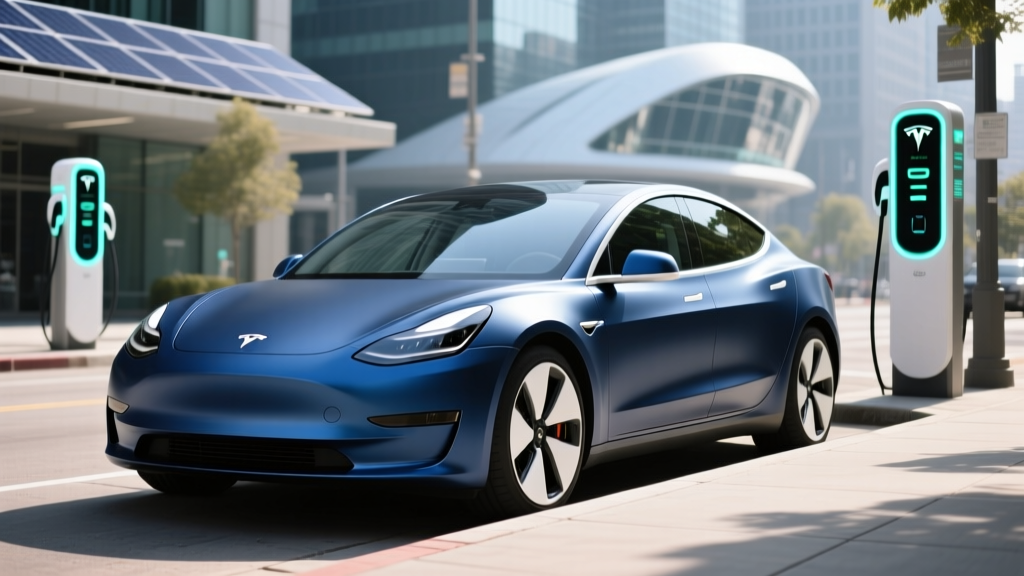
Perhaps the most consequential — and most uncertain — aspect of the Tesla 10/7 announcement is the Cybercab's charging strategy. The vehicle has no physical charging port. Instead, Tesla plans to use inductive (wireless) charging pads embedded in dedicated parking and depot locations.
This decision has major implications:
- No public charging compatibility: The Cybercab cannot use Tesla Superchargers, Electrify America, or any CCS/NACS public network. It is entirely dependent on Tesla-built wireless infrastructure.
- Charging speed unknown: Tesla has not disclosed the kW rate of its inductive system. Industry-standard wireless EV charging currently tops out around 11–22 kW for consumer systems. Even at 22 kW wireless, a 50 kWh battery would require roughly 2+ hours for a full charge — far slower than DC fast-charging at 150+ kW.
- Infrastructure buildout required: Every city where Cybercabs operate will need Tesla-installed wireless charging depots. This represents a massive capital expenditure and regulatory hurdle (permits, utility upgrades, land use).
| Charging Method | Power (kW) | 50 kWh Battery: 10–80% | Notes |
|---|---|---|---|
| Wireless Inductive (projected) | ~11–22 kW (est.) | ~2–3 hours | No official specs released; depends on pad design |
| Comparison: Tesla V4 Supercharger (wired) | up to 250 kW | ~15–20 min | Not compatible with Cybercab (no port) |
| Comparison: Level 2 Home (wired) | 7.7–11.5 kW | ~4–5 hours | Standard for consumer EVs |
For context, Tesla's own home charging installation guide recommends hardwired Level 2 Wall Connectors at 11.5 kW for consumer vehicles — a proven, code-compliant solution. The Cybercab's wireless-only approach means Tesla must build an entirely parallel charging ecosystem.
Robovan: The Larger Autonomous Platform
Briefly shown at the event, the Tesla Robovan is a larger autonomous vehicle designed to carry up to 20 passengers. Details remain extremely sparse:
- No specs on battery size, range, or charging method were provided
- The vehicle appeared to share the Cybercab's design language (no visible steering controls)
- Targeted at high-density urban transit and shuttle services
- No production timeline announced — likely 2027 at the earliest
The Robovan positions Tesla to compete with companies like NHTSA-regulated Level 4 shuttle operators, but it's further from reality than the Cybercab and faces steeper regulatory barriers for passenger-carrying autonomous vehicles.
Autonomy and FSD: Where Tesla Stands in 2026
The Cybercab's viability rests entirely on Tesla's Full Self-Driving (FSD) software achieving reliable, regulator-approved Level 4 autonomy. As of early 2026, here's where that stands:
Key autonomy milestones to watch:
- Regulatory approval: Each US state has its own autonomous vehicle deployment rules. California (via the DMV and CPUC) requires extensive testing permits, incident reporting, and gradual expansion. Tesla has not yet received a driverless deployment permit in California.
- Disengagement and incident data: Unlike Waymo, which publishes detailed disengagement reports to the California DMV, Tesla has not submitted comparable public data for unsupervised operation.
- Camera-only approach: Tesla removed ultrasonic sensors and radar from its vehicles, relying solely on cameras and neural networks. Competitors like Waymo use LiDAR, radar, and cameras in a redundant sensor suite. Whether camera-only can achieve Level 4 safety in all conditions (heavy rain, fog, direct sun glare) remains unproven at scale.
Pricing, Tax Credits, and Ownership Economics
Elon Musk stated the Cybercab would cost under $30,000 before incentives, with an operating cost of approximately $0.20 per mile. Let's put that in context:
| Cost Factor | Cybercab (Projected) | Tesla Model Y (2025, for comparison) |
|---|---|---|
| Base MSRP | Under $30,000 (claimed) | $44,990 (Long Range RWD) |
| Federal Tax Credit (§30D) | Unknown — must meet MSRP cap ($55K), income limits, and battery sourcing rules | Up to $7,500 (check current IRS §30D eligibility) |
| Effective Price (best case) | ~$22,500 (if credit applies) | ~$37,490 |
| Cost Per Mile (energy) | ~$0.04–$0.06 (est., at $0.13/kWh) | ~$0.04–$0.05 |
| Insurance (est.) | Unknown — autonomous fleet insurance unpriced | $1,800–$2,500/yr |
Competitive Landscape: Who's Already Doing This
The Cybercab enters a robotaxi market where competitors have years of real-world operational data:
- Waymo (Alphabet): Operating Level 4 robotaxis commercially in Phoenix, San Francisco, Los Angeles, and Austin. Over 10 million paid rider trips completed by late 2025. Uses a redundant sensor suite (LiDAR + radar + cameras). NHTSA-monitored safety record with detailed incident reporting.
- Zoox (Amazon): Purpose-built Level 4 vehicle (no steering wheel) undergoing testing in Las Vegas and Foster City, CA. Smaller fleet, but has received specific NHTSA exemptions for its steering-wheel-free design.
- Cruise (GM): Largely suspended operations after a serious 2023 incident in San Francisco. Attempting a phased restart with enhanced safety protocols.
Tesla's advantage is manufacturing scale and cost — if it can produce the Cybercab at $30,000, it would be dramatically cheaper than Waymo's modified Jaguar I-PACE vehicles (estimated $100,000+ per unit). But cost means nothing without regulatory approval for driverless operation.
Who Should Pay Attention (and Who Should Buy Something Else)
Watch the Cybercab if:
- You're interested in autonomous fleet ownership as an investment (pending regulatory clarity)
- You work in urban mobility planning or ride-hailing logistics
- You're tracking Tesla's AI and autonomy progress for stock/investment decisions
Buy a current EV instead if:
- You need a vehicle in 2026 — the Cybercab is not available for purchase and likely won't be until 2027 at the earliest
- You want proven Level 2 driver-assist with a steering wheel and full control
- You need more than two seats, cargo space, or highway road-trip capability
- You live outside a major metro area where robotaxi deployment is unlikely in the near term
Biggest Pros and Cons of the Tesla 10/7 Announcement
- Sub-$30K price target would disrupt robotaxi economics
- Tesla's manufacturing scale could deploy fleets faster than competitors
- ~$0.20/mile operating cost could undercut Uber/Lyft significantly
- LFP battery choice favors longevity and cycle life for fleet duty
- Camera-only autonomy, if solved, is cheaper to scale than LiDAR
- No production vehicle shown — prototypes only, no confirmed timeline
- Wireless-only charging requires massive unproven infrastructure buildout
- No regulatory approvals for driverless operation in any US state
- Camera-only autonomy unproven for Level 4 in adverse conditions
- Two seats, no cargo space — limited to a narrow use case
- Tesla has a history of missing announced timelines by years
- No EPA certification, crash testing, or insurance framework exists yet
Frequently Asked Questions
Can I buy the Tesla Cybercab right now?
No. The Cybercab is an announced concept/prototype as of the October 7 event. Tesla has not opened pre-orders, and production is not expected before 2026–2027 at the earliest. Tesla has a track record of significant delays — the Cybertruck was announced in 2019 and didn't reach customers until late 2023.
What is the real-world range of the Cybercab?
Tesla projects approximately 250 miles, but this is not EPA-certified. With a likely ~50 kWh LFP battery in a lightweight two-seater, 250 miles is optimistic. Real-world robotaxi duty cycles (constant HVAC, stop-and-go, cold weather) would likely reduce effective range to 180–210 miles in typical urban conditions, and potentially below 150 miles in freezing temperatures without robust thermal preconditioning.
How fast does the Cybercab charge?
Tesla has not disclosed the kW rate of its inductive charging system. Industry wireless charging currently maxes out around 11–22 kW for passenger vehicles. At that rate, expect 2–3 hours for a 10–80% charge on a ~50 kWh battery. This is dramatically slower than wired DC fast charging (150–250 kW, which can do 10–80% in 15–25 minutes). The Cybercab cannot use any existing public charging network because it has no physical charging port.
Does the Cybercab qualify for the federal EV tax credit?
It's too early to say. Under current IRS §30D rules, the vehicle must meet MSRP caps ($55,000 for sedans/compact vehicles), the buyer must fall within income limits ($150K single/$300K joint), and the battery must meet critical-mineral and component-sourcing thresholds that tighten each year. Additionally, if the Cybercab is classified as a fleet/commercial vehicle rather than a personal-use vehicle, different credit rules (§45W) may apply. No determination can be made until the vehicle enters production and is listed on fueleconomy.gov.
Is the Cybercab worth waiting for vs. buying a current EV?
For anyone who needs a vehicle in 2026, no — the Cybercab is not purchasable and won't be for at least 1–2 years. If you're looking for a personal EV with proven technology, current options like the Tesla Model Y, Hyundai Ioniq 5, or Chevrolet Equinox EV offer EPA-certified range, established charging networks, known tax-credit eligibility, and immediate availability. The Cybercab is a speculative future product aimed at fleet investors and autonomous-ride-hailing use cases, not personal transportation buyers.
How does Tesla's robotaxi compare to Waymo?
Waymo is already operating commercially with paying riders in multiple US cities using Level 4 vehicles with redundant sensor suites (LiDAR + radar + cameras). Tesla's Cybercab relies on camera-only vision and has zero miles of unsupervised public operation. Waymo's per-unit cost is far higher (~$100K+), but its safety record and regulatory approvals are established. Tesla would need to close a multi-year gap in both regulatory approval and real-world autonomous driving data before the Cybercab could operate commercially.