Tesla built its brand on straight-line speed. From the original Roadster to the Plaid tri-motor powertrains, the question buyers ask most is simple: how fast does a Tesla go from 0 to 60? The answer depends entirely on which model and trim you choose — and whether you care about the real-world factors that make those numbers usable (or not) on a daily basis.
This guide covers the full 2026 Tesla lineup with exact 0-60 mph times, EPA range, battery chemistry, charging speeds, pricing, and federal tax credit eligibility. We'll also separate marketing claims from what you'll actually experience on the street, at the charger, and in cold weather.
2026 Tesla 0-60 Times: Every Model at a Glance
Here's the quick answer to "how fast does a Tesla go from 0 to 60" across the current production lineup. These are manufacturer-claimed times with rollout subtracted where noted — real-world street launches typically add 0.1-0.3 seconds.
| Model / Trim | 0-60 mph | Top Speed | Horsepower | Drivetrain |
|---|---|---|---|---|
| Model 3 RWD | 5.8 sec | 125 mph | 271 hp | RWD (single motor) |
| Model 3 Long Range AWD | 4.2 sec | 125 mph | 346 hp | AWD (dual motor) |
| Model 3 Performance | 2.9 sec | 163 mph | 510 hp | AWD (dual motor) |
| Model Y Long Range AWD | 4.8 sec | 125 mph | 384 hp | AWD (dual motor) |
| Model Y Performance | 3.5 sec | 155 mph | 456 hp | AWD (dual motor) |
| Model S Long Range | 3.1 sec | 155 mph | 670 hp | AWD (dual motor) |
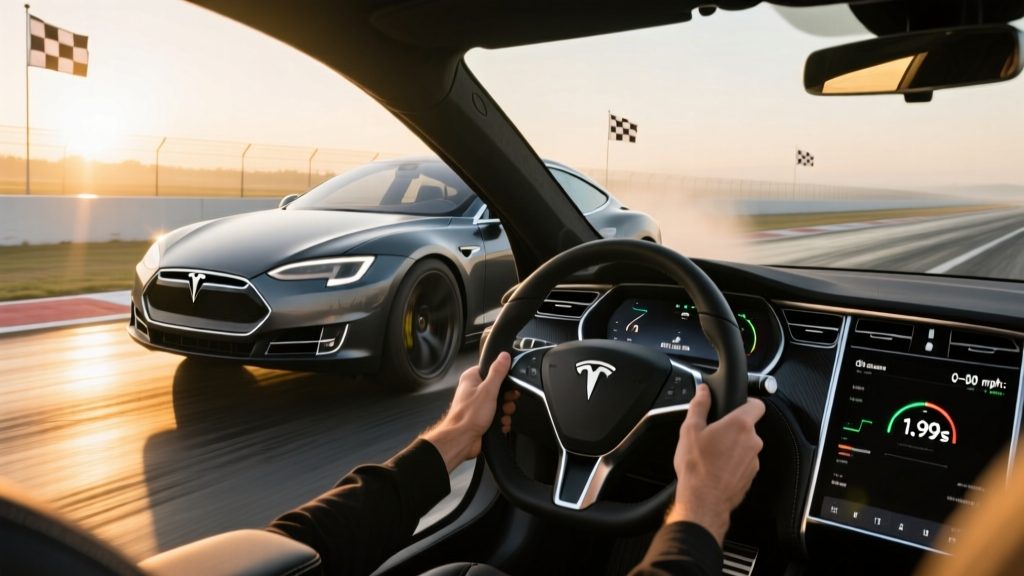
| Model S Plaid | 1.99 sec | 200 mph | 1,020 hp | AWD (tri-motor) |
| Model X Long Range | 3.8 sec | 155 mph | 670 hp | AWD (dual motor) |
| Model X Plaid | 2.5 sec | 163 mph | 1,020 hp | AWD (tri-motor) |
| Cybertruck AWD | 3.9 sec | 130 mph | 600 hp | AWD (dual motor) |
| Cybertruck Cyberbeast | 2.6 sec | 130 mph | 845 hp | AWD (tri-motor) |
Key takeaway: If raw acceleration is your priority, the Model S Plaid at 1.99 seconds remains one of the quickest production cars ever built. But for most buyers, the Model 3 Performance at 2.9 seconds — for roughly a third of the price — delivers supercar-level thrust in a practical sedan.
Range, Battery, and Efficiency: Beyond the 0-60 Number
Acceleration grabs headlines, but range and efficiency determine daily livability. Tesla uses two battery chemistries across its lineup: LFP (lithium iron phosphate) in the Model 3 RWD for longevity and daily 100% charging, and NMC/NCA (nickel-based) in Long Range and Performance trims for higher energy density.
EPA estimates assume mixed driving at moderate temperatures. Expect 10-15% range loss at sustained 75+ mph highway speeds, and 20-30% loss in sub-freezing temperatures. The Model 3 Long Range's EPA 363 miles translates to roughly 310 miles on a cold-weather highway road trip. Plan accordingly.
| Model / Trim | EPA Range | Battery (usable kWh) | Chemistry | Efficiency (kWh/100mi) | MPGe |
|---|---|---|---|---|---|
| Model 3 RWD | 272 mi | 57.5 kWh | LFP | 25 | 132 |
| Model 3 Long Range AWD | 363 mi | 75 kWh | NMC | 24 | 137 |
| Model 3 Performance | 315 mi | 75 kWh | NMC | 28 | 118 |
| Model Y Long Range AWD | 320 mi | 75 kWh | NMC | 27 | 122 |
| Model Y Performance | 277 mi | 75 kWh | NMC | 30 | 111 |
| Model S Long Range | 402 mi | 95 kWh | NMC | 26 | 124 |
| Model S Plaid | 359 mi | 95 kWh | NMC | 30 | 112 |
| Model X Long Range | 335 mi | 95 kWh | NMC | 30 | 109 |
| Model X Plaid | 311 mi | 95 kWh | NMC | 33 | 100 |
| Cybertruck AWD | 340 mi | 123 kWh | NMC | 42 | 79 |
| Cybertruck Cyberbeast | 320 mi | 123 kWh | NMC | 46 | 72 |
The Model 3 Long Range remains Tesla's efficiency champion — 363 EPA miles from a 75 kWh pack is exceptional. The Cybertruck's brick-like aerodynamics and 7,000-pound curb weight crush its efficiency to roughly 72-79 MPGe, closer to a body-on-frame gas truck than a sleek EV.
Charging Speed: DC Fast Charge and Home Level 2
How fast a Tesla charges matters more for road trips than how fast it accelerates. Tesla's Supercharger network remains its strongest competitive moat, with over 60,000 DC fast-charging stalls globally. Here's what each model pulls at the plug.
| Model / Trim | Max DC kW | 10-80% DC Time | Level 2 (kW / mi per hr) |
|---|---|---|---|
| Model 3 RWD | 170 kW | ~25 min | 11.5 kW / ~44 mi/hr |
| Model 3 Long Range AWD | 250 kW | ~22 min | 11.5 kW / ~44 mi/hr |
| Model 3 Performance | 250 kW | ~22 min | 11.5 kW / ~44 mi/hr |
| Model Y Long Range AWD | 250 kW | ~25 min | 11.5 kW / ~37 mi/hr |
| Model Y Performance | 250 kW | ~25 min | 11.5 kW / ~37 mi/hr |
| Model S / X Long Range | 250 kW | ~27 min | 11.5 kW / ~30 mi/hr |
| Model S / X Plaid | 250 kW | ~27 min | 11.5 kW / ~30 mi/hr |
| Cybertruck AWD / Cyberbeast | 250 kW | ~30 min | 11.5 kW / ~22 mi/hr |
Charging curve reality: Peak 250 kW is achieved only between roughly 10-30% state of charge. Above 50%, the rate tapers significantly — expect 100-150 kW through the 60% mark, and roughly 50-70 kW above 80%. This is why the 10-80% metric matters more than peak kW. For home Level 2 charging, Tesla's Wall Connector at 48 amps (11.5 kW) adds a full overnight charge in 6-10 hours depending on the model. Source: Tesla Home Charging.
Pricing, Trims, and Federal Tax Credit Eligibility
Tesla's pricing shifts frequently, but as of early 2026, here's where each model lands. Federal tax credit eligibility under IRS §30D depends on MSRP caps ($55,000 for sedans, $80,000 for SUVs/trucks), buyer income limits ($150K single / $300K joint), and battery component/critical mineral sourcing requirements that tighten annually.
| Model / Trim | Base MSRP | §30D Credit Eligible? | Effective Price (with credit) |
|---|---|---|---|
| Model 3 RWD | $38,990 | Yes (partial — $3,750-$7,500 depending on sourcing) | ~$31,490 - $35,240 |
| Model 3 Long Range AWD | $45,240 | Yes (partial) | ~$37,740 - $41,490 |
| Model 3 Performance | $52,990 | Yes (partial) | ~$45,490 - $49,240 |
| Model Y Long Range AWD | $44,990 | Yes ($7,500 — qualifies as SUV under $80K cap) | ~$37,490 |
| Model Y Performance | $48,990 | Yes ($7,500) | ~$41,490 |
| Model S Long Range | $79,990 | No — exceeds $55K sedan cap | $79,990 |
| Model S Plaid | $94,990 | No — exceeds cap | $94,990 |
| Model X Long Range | $79,990 | Yes — qualifies as SUV under $80K cap | ~$72,490 |
| Model X Plaid | $94,990 | No — exceeds cap | $94,990 |
| Cybertruck AWD | $79,990 | Yes — qualifies as truck under $80K cap | ~$72,490 |
| Cybertruck Cyberbeast | $99,990 | No — exceeds cap | $99,990 |
- MSRP cap: $55,000 for sedans (Model 3); $80,000 for SUVs/trucks (Model Y, X, Cybertruck)
- Income cap: Modified AGI ≤ $150K single, $225K head-of-household, $300K joint
- Battery sourcing: Increasingly strict critical mineral and component requirements — partial credits ($3,750) apply if only one requirement is met
- Point-of-sale transfer: Eligible buyers can apply the credit at purchase, reducing out-of-pocket cost immediately
Rules change annually. Verify current eligibility on IRS.gov or consult a tax professional before purchasing.
Interior, Cargo, and Daily Practicality
Speed doesn't matter if the car doesn't fit your life. Here's how Tesla's models compare on space — the metric that determines whether a car works for a family, a road trip, or a weekly Costco run.
| Model | Cargo (rear seats up) | Cargo (rear seats folded) | Frunk | Rear Legroom |
|---|---|---|---|---|
| Model 3 | 23 cu ft (trunk) | N/A (sedan) | 3.1 cu ft | 35.2 in |
| Model Y | 30.2 cu ft | 72.1 cu ft | 4.1 cu ft | 41.6 in |
| Model S | 28 cu ft (liftback + trunk) | ~65 cu ft | 5.3 cu ft | 35.4 in |
| Model X | 15.2 cu ft (behind 3rd row) | 81.5 cu ft (all folded) | 6.6 cu ft | 37.1 in (2nd row) |
| Cybertruck | 34.2 cu ft (bed, tonneau closed) | ~68 cu ft (bed + vault) | 7.1 cu ft | 38.4 in |
The Model Y's 72.1 cubic feet with seats folded rivals many midsize SUVs, and its hatchback design makes loading bulky items easier than the Model 3's traditional trunk. The Model X offers an optional third row (best suited for children), while the Cybertruck's 6-foot bed and lockable "vault" make it the most utility-focused Tesla — though the stainless-steel exoskeleton and polarizing design limit its appeal.
Tech, Autopilot, and Driver Assistance
Every 2026 Tesla ships with a 15.4-inch center touchscreen (17-inch in Model S/X), over-the-air updates, and Tesla's basic Autopilot suite — adaptive cruise control and lane-keeping assist. Full Self-Driving (Supervised) remains an $8,000 add-on (or $99/month subscription) and is classified as SAE Level 2 driver assistance.
Tesla's Autopilot and FSD (Supervised) require continuous driver attention. You must keep hands on the wheel (or demonstrate attentiveness via the cabin camera) and remain ready to take over instantly. Only Level 4 systems (like Waymo's robotaxi service) operate without a human driver. Never treat a Level 2 system as autonomous — NHTSA data shows crashes when drivers over-rely on driver-assist features.
Standout tech across the lineup includes Tesla's 360-degree camera-based vision system (no ultrasonic sensors since 2022), the Tesla app with remote preconditioning and Sentry Mode, and access to the proprietary Supercharger network — still the most reliable and dense DC fast-charging ecosystem in North America. The refreshed Model 3 "Highland" and Model Y "Juniper" interiors add ventilated front seats, ambient lighting, rear-seat touchscreens, and improved cabin insulation for reduced road noise.
Warranty and Long-Term Ownership
| Coverage Area | Term |
|---|---|
| Basic Vehicle | 4 years / 50,000 miles |
| Battery & Drive Unit (Model 3/Y RWD) | 8 years / 100,000 miles (≥70% retention) |
| Battery & Drive Unit (LR / Performance / S / X) | 8 years / 120,000 miles (≥70% retention) |
Tesla's battery warranty guarantees at least 70% capacity retention over the warranty period. Real-world degradation data from fleet operators and owner surveys suggests NMC packs lose roughly 5-8% capacity in the first 50,000 miles before leveling off. LFP packs (Model 3 RWD) degrade more slowly and can be charged to 100% daily without longevity concerns — a significant advantage for high-mileage commuters. Out-of-warranty battery replacement costs range from $12,000 to $20,000 depending on the pack, though full replacements remain rare within the first 150,000 miles.
Pros, Cons, and the Verdict
- Class-leading acceleration across every trim (1.99s to 5.8s 0-60)
- Supercharger network — 60,000+ stalls, highest reliability in the industry
- Over-the-air updates continuously add features post-purchase
- Strong efficiency (especially Model 3 LR at 137 MPGe / 363 mi EPA)
- Low maintenance — no oil changes, minimal brake wear with regen
- Competitive pricing after §30D tax credit (Model Y LR at ~$37,490 effective)
- Panel gaps and build-quality inconsistency still reported
- Vision-only Autopilot/FSD occasionally struggles in heavy rain, construction zones
- No physical controls for climate, mirrors, or glovebox — touchscreen-dependent
- Model S/X pricing above tax credit caps limits value proposition
- Cybertruck efficiency is poor (72-79 MPGe) and polarizing in design
- Insurance premiums run 15-30% higher than comparable non-Tesla EVs
Who Should Buy a Tesla in 2026?
Choose the Model 3 RWD if: You want the most affordable entry point, commute under 50 miles daily, and can charge at home. LFP battery longevity is ideal for high-cycle use.
Choose the Model 3 Long Range if: You road-trip regularly and want the best combination of range (363 mi), efficiency, and value. This is Tesla's sweet-spot sedan.
Choose the Model 3 Performance if: You want sub-3-second 0-60 times in a daily-drivable sedan without paying Model S Plaid money.
Choose the Model Y Long Range if: You need family cargo space, qualify for the full $7,500 tax credit, and want a crossover that handles road trips with 320 miles of range.
Choose the Model S/X if: Budget is flexible, you want premium luxury with hatchback/cargo versatility, and the $80K MSRP cap doesn't disqualify you from the credit (Model X qualifies; Model S does not).
Choose the Cybertruck if: You need a truck bed, value the stainless-steel durability and V2L/V2H capability, and accept the efficiency trade-off.
Frequently Asked Questions
How fast does a Tesla go from 0 to 60 in the quickest model?
The Model S Plaid achieves a manufacturer-claimed 0-60 mph in 1.99 seconds with rollout subtracted, making it one of the fastest production cars ever built. Real-world street launches typically clock 2.1-2.3 seconds depending on surface conditions and tire temperature.
What is the real-world range of a Tesla?
Expect 85-90% of EPA range in mixed driving at moderate temperatures. Highway driving at 75+ mph reduces range by 10-15%. Sub-freezing temperatures can cut range by 20-30% due to battery heating demands and reduced regenerative braking efficiency. The Model 3 Long Range (363 EPA) delivers roughly 310 highway miles in fair weather and 260-280 miles in winter.
Does Tesla qualify for the $7,500 federal EV tax credit?
It depends on the model and your income. The Model Y (all trims) and Model X Long Range qualify for the full $7,500 credit under the $80,000 SUV/truck MSRP cap. The Model 3 qualifies for a partial credit ($3,750-$7,500) depending on battery sourcing requirements. Model S, Model X Plaid, and Cybertruck Cyberbeast exceed MSRP caps. All require buyer income under $150K single / $300K joint. Verify current rules at IRS.gov.
How fast does a Tesla charge at a Supercharger?
Long Range, Performance, and Plaid models peak at 250 kW on V3/V4 Superchargers, achieving a 10-80% charge in roughly 22-30 minutes depending on battery size and preconditioning. The Model 3 RWD peaks at 170 kW. Always precondition your battery by navigating to a Supercharger in the Tesla app — this warms the pack and enables peak charge rates.
Is Tesla's Autopilot actually self-driving?
No. Autopilot and FSD (Supervised) are SAE Level 2 driver-assistance systems. The driver must remain fully engaged, monitor the road, and be prepared to take over at any moment. Tesla's cabin camera monitors attentiveness, and the system will issue warnings and eventually disengage if you look away. Only Level 4 services like Waymo operate without a human driver in the loop.
How does Tesla's 0-60 time compare to gas-powered competitors?
The Model 3 Performance (2.9 sec, ~$53K) matches or beats gas supercars like the Porsche 911 Carrera (3.5 sec, ~$115K) and Chevrolet Corvette Stingray (2.9 sec, ~$68K). The Model S Plaid (1.99 sec) outpaces virtually every production car, including the Bugatti Chiron and Ferrari SF90, at a fraction of the price. Electric motors deliver instant torque from 0 RPM — no turbo lag, no gear shifts, no power-band delay.
What's the best Tesla for a family?
The Model Y Long Range AWD offers the best balance: 320 miles of EPA range, 72.1 cu ft of cargo space with seats folded, 41.6 inches of rear legroom, eligibility for the full $7,500 federal tax credit, and a ~$37,490 effective price. It outsells every other Tesla for good reason.
Sources: EPA Fuel Economy, Tesla.com official specifications, IRS §30D Clean Vehicle Credits, NHTSA. All prices and specifications reflect 2026 model year data available at time of publication. Tax credit eligibility is subject to change — consult a tax professional before purchasing.